
Do you need a permit to cut down or remove a tree in Peoria, IL? If the tree is entirely on your private residential property, you generally do not need a permit. Standard residential tree removal typically costs between $500 and $2,500+. However, if the tree sits in the public right-of-way, a historic district, or commercial zoning, a permit or city approval is strictly required.
As the owner of Peoria Tree Removal Co. for the last 30 years, I’ve answered this question hundreds of times. Homeowners in the 61601, 61614, and surrounding zip codes often wake up after a severe Midwest ice storm to find a massive oak leaning dangerously toward their house. While panic sets in, the next logical fear is red tape: Will the city fine me if I cut this down right now?
Navigating municipal tree ordinances across Central Illinois can be confusing. The rules in Peoria aren’t exactly the same as the regulations in Washington or East Peoria. In this guide, I will break down exactly when you need permission, when you are free to clear your own land, and how to avoid costly fines while protecting your property.
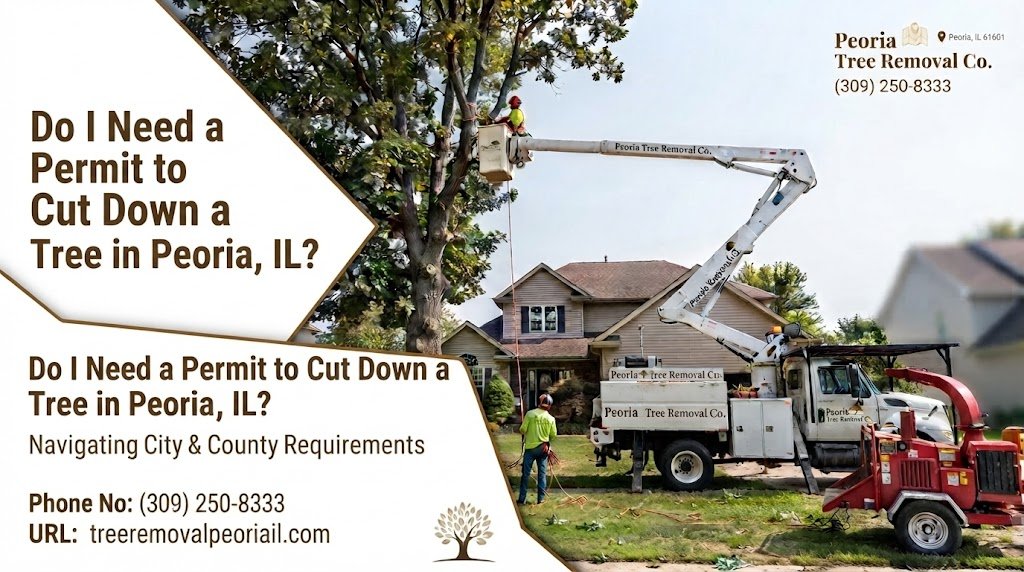
Understanding Peoria, IL Tree Removal Rules for Private Property
The State of Illinois does not have a statewide tree removal permit requirement for private residential property. Instead, the regulations are handled at the municipal level.
For the vast majority of homeowners in Peoria, if a tree is rooted solidly within your private lot lines (your front yard, backyard, or side yard), you are free to remove it without asking the city for a permit. The city views private landscaping as the homeowner’s responsibility.
When Permits Are NOT Required
You generally will not have to wait on the city to remove a tree if:
- The tree is dead, dying, or structurally hazardous.
- It is a standard shade tree, ornamental shrub, or fruit tree on your private lot.
- You are performing routine tree trimming or pruning on your own property.
- The tree was severely damaged by high winds and requires immediate emergency removal.
When Permits or City Approvals ARE Required
There are a few major exceptions where cutting down a tree in Peoria without permission will land you in hot water.
- Public Right-of-Way (Parkway Trees): The grassy strip between your sidewalk and the street curb is usually considered the public right-of-way. The trees located here belong to the City of Peoria. You cannot trim, prune, or cut down these trees yourself. The City of Peoria Public Works Forestry Division handles these. If a parkway tree is dead or dying, you must submit a request to the city to have their contractors remove it.
- Historic Districts: If you live in one of Peoria’s designated historic neighborhoods (like the Randolph-Roanoke Historic District), exterior modifications—including the removal of mature, heritage trees—may require approval from the Historic Preservation Commission.
- Commercial and Multi-Family Zoning: Commercial properties and large land developments are subject to strict landscaping ordinances (Chapter 16 of the Peoria Zoning Ordinance). Removing mature shade trees from commercial buffer yards or parking lots usually requires a permit and a mandatory replanting plan.
- HOA Covenants: While not a city law, many Homeowners Associations in North Peoria have strict covenants dictating what you can and cannot do with mature trees. Always check your HOA bylaws before firing up a chainsaw.
Tree Regulations in Surrounding Municipalities
What if you live outside the Peoria city limits? Tree care rules can shift quickly as you cross the Illinois River.
East Peoria and Morton Regulations
Similar to Peoria, private residential properties in East Peoria and Morton typically do not require permits for standard tree removal. However, both municipalities are highly protective of their public right-of-ways. If a tree borders a municipal sidewalk or a public easement, do not touch it without verifying property lines with a professional surveyor or the local public works department.
Washington, Pekin, and Chillicothe
In Washington (near Washington Square), Pekin, and Chillicothe, the approach remains largely the same. Private property gives you the right to manage your own canopy. However, if you are clearing a large wooded lot for new construction, you will likely trigger land development and erosion control permits, which encompass tree removal.
Whenever you are in doubt, a quick call to your local Development Services or Public Works office can confirm your status in a matter of minutes.
The True Cost of Tree Removal in the Peoria Area
Once you confirm you don’t need a permit, the next question is budget. How much does tree removal cost in Peoria, IL?
Pricing is entirely dependent on the physical dimensions, location, and risk factors associated with the tree. We generally break down the cost to remove a tree by size:
- Small Trees (Up to 30 Feet): $250 – $600. These are usually ornamental trees like crabapples or dogwoods that require minimal rigging.
- Medium Trees (30 to 60 Feet): $600 – $1,250. Standard shade trees that might require bucket truck access.
- Large and Extra-Large Trees (60+ Feet): $1,250 – $3,000+. Massive mature oaks or silver maples leaning over a house require heavy crane assistance, complex sectional rigging, and highly skilled climbers.
If a tree is dangerously close to power lines or leaning over your roof, the risk increases, which naturally increases the labor cost.
Dealing with Storm Damage: Emergency Removal
Central Illinois weather is notoriously brutal. When a severe summer microburst or a winter ice storm rips through the Illinois River valley, mature trees can fail catastrophically.
If a tree splits and lands on your house, you don’t have time to worry about municipal paperwork. You need emergency tree removal immediately to stabilize your roof and prevent massive water damage. But what is emergency tree removal, and who pays for it?
Emergency dispatch involves bringing heavy cranes, specialized rigging gear, and massive wood chippers to your property in the middle of the night or on a weekend. The priority is lifting the multi-ton wood off your structure safely. In these panic-inducing moments, many homeowners wonder, “Does homeowners insurance cover tree removal?“
Yes, if a healthy tree is blown over by a covered peril (like wind or ice) and damages an insured structure (like your home or garage), your homeowners insurance will generally cover the extraction. However, if the tree falls harmlessly into your empty backyard, you will likely be paying out of pocket. If you are ever unsure of your next steps during a storm crisis, check out our guide on what to do if a tree falls on your house in Peoria, IL.
Why Hiring an ISA Certified Arborist Matters
Removing a 10,000-pound oak tree is not a weekend DIY project. It requires an understanding of physics, wood tension, and advanced rigging mechanics. This is where an arborist service becomes invaluable.
An ISA (International Society of Arboriculture) Certified Arborist doesn’t just cut down trees; they understand tree biology. Before we recommend extraction, our arborists perform a structural hazard assessment. We look for root plate upheaval, internal trunk rot, and disease indicators like the Emerald Ash Borer. Often, we can save a beloved backyard tree through strategic pruning and dynamic cabling rather than resorting to the chainsaw.
Furthermore, a professional tree service company carries massive commercial general liability policies and workers’ compensation. If a “guy with a truck” drops a limb through your neighbor’s roof, you could be held personally liable for the damages. Always hire verified, insured professionals.
Stump Grinding and Site Restoration
After the canopy is dismantled and the logs are hauled away, you are left with an ugly, jagged stump sitting above grade. Left alone, decaying stumps become prime real estate for carpenter ants, termites, and fungal diseases.
Standard tree removal quotes rarely include the stump. To truly reclaim your yard, you will need professional stump grinding. We use high-torque grinders to pulverize the stump bowl and lateral roots 6 to 12 inches below the soil line. This allows you to lay down fresh topsoil and plant grass, leaving no trace that a tree was ever there.
Conclusion: Schedule Your Tree Assessment Today
To summarize: Do I need a permit to cut down or remove a tree in Peoria, IL or surrounding municipalities? Generally, no—as long as it is on your private, residential property and outside the public right-of-way.
However, dealing with declining timber is incredibly dangerous. Do not risk your property value or your physical safety by ignoring a leaning tree or attempting to cut it down yourself.
At Peoria Tree Removal Co., we have spent three decades safely dismantling some of the most dangerous trees in Central Illinois. Whether you need a dead ash tree removed in Bartonville, canopy thinning near Bradley University, or 24/7 storm response in Washington, we have the heavy equipment and the expertise to get it done right.
Contact us today at (309) 250-8333 to schedule your free, no-obligation site assessment.
Peoria Tree Removal Co.
(309) 250-8333
info@treeremovalpeoriail.com
https://treeremovalpeoriail.com/
114 W Forrest Hill Ave, Peoria, IL 61604, USA
Tree Service Company
3 Responses