
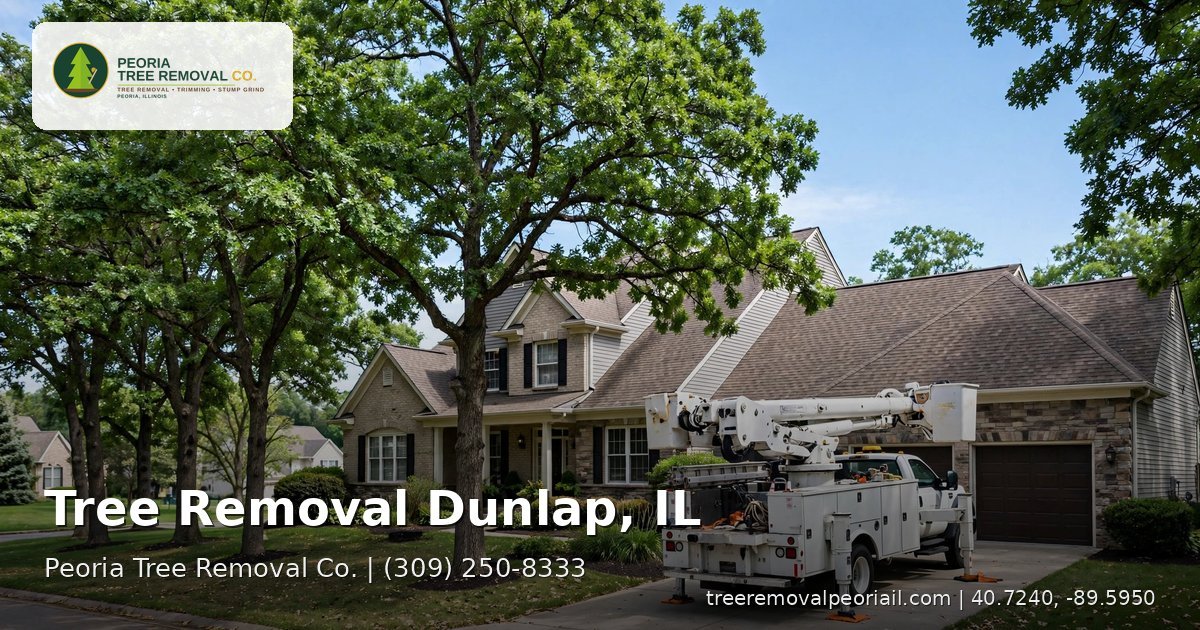
Tree Removal Dunlap, IL | Peoria Tree Removal Co.
Need tree removal in Dunlap, IL? Peoria Tree Removal Co. has served Dunlap (61525) for 17 years — removals, trimming, and stump grinding, from SummerRidge subdivisions to mature oaks (Quercus spp.) along the Kickapoo Creek corridor. Our arborists are certified by the International Society of Arboriculture (ISA); we’re licensed and insured. Call (309) 250-8333 for a free estimate.
What Tree Services Do We Offer in Dunlap, IL?
Dunlap’s housing stock tells two stories: well-kept 2000s-built homes on deep subdivision lots with young, fast-growing trees, and older farmstead properties with big mature hardwoods near Kickapoo Creek. Both need the right care at the right time. Sitting about 15 to 20 minutes north of downtown Peoria, Dunlap gives families top-rated District 323 schools and some of the most desirable subdivisions in Illinois — and homeowners here tend to hold their properties to a high standard, landscaping included. Whether your concern is a builder-planted pear splitting down the middle or a creek-bottom oak dropping limbs on the Rock Island Trail side of your lot, our crews work across the entire 61525 ZIP every week. Here is what we do:
- Tree removal in Dunlap — safe, controlled takedowns of dead, diseased, storm-damaged, or unwanted trees, including large oaks and maples on deep lots. See our tree service page for the full range of residential work.
- Emergency tree removal — 24/7 response when creek-valley storms drop limbs or whole trees on homes, fences, and driveways. Details on our emergency tree removal page.
- Tree trimming and pruning — structural pruning for young subdivision trees and crown work for mature canopy, keeping limbs clear of roofs and siding. Learn more about tree trimming and pruning.
- Stump grinding and removal — grinding stumps below grade so you can replant or reclaim the lawn. Read about stump grinding and removal.
- Arborist consultations — ISA Certified Arborist health assessments, disease diagnosis, and preservation plans for specimen trees. Book an arborist consultation in Dunlap.
- Storm cleanup and lot clearing — debris removal and selective clearing for Dunlap properties, including trail-adjacent parcels near the Rock Island Trail. We cover the whole region on our service areas page.
What Are the Most Common Tree Problems in Dunlap, Illinois?
After nearly two decades working around Peoria County, we see the same handful of issues in Dunlap again and again. Here are the ones that matter most for local homeowners:
Weak structure in young subdivision trees
Many Dunlap subdivisions — SummerRidge, Northtrail Meadows, Trail Crossing, Dover Pointe — were planted in the 2000s with fast growers like silver maple (Acer saccharinum), Bradford pear (Pyrus calleryana ‘Bradford’), and honey locust (Gleditsia triacanthos). Without early structural pruning, these trees develop co-dominant stems and included bark that split apart in their teens and twenties. We’ve removed plenty of failed Bradford pears over the years — and corrected young maples before they turned into hazards over driveways and sidewalks.
Storm damage along the Kickapoo Creek corridor
The Kickapoo Creek valley funnels wind through parts of Dunlap, and the Rock Island Trail State Park corridor just north of town holds tall, mature timber. After heavy storms we get calls for broken tops, uprooted trees leaning on fences, and large limbs hung up in neighboring canopies along Cedar Hills Drive and the creek bottoms. Hung-up limbs are deceptively dangerous — they need a professional, not a ladder.
Construction damage and soil compaction
Dunlap’s building boom left a legacy of trees planted — or preserved — in heavily compacted subdivision soil. Compacted soil suffocates roots, and grade changes around new homes can bury root flares under inches of fill. The result is slow decline: thinning canopies, early fall color, and dieback that shows up five to ten years after move-in. An arborist assessment catches it while the tree can still be saved.
How Does Our Tree Removal Process Work in Dunlap?
Every Dunlap job follows the same disciplined process, whether it’s a single dead maple behind a SummerRidge home or a multi-tree takedown on an acreage near the creek:
- Free on-site estimate. We walk the property with you, assess the tree’s condition and the drop zone, and give you a written price on the spot. No pressure, no obligation.
- Safety and protection plan. Before a saw starts, we map out rigging points, protect lawns, landscaping, and hardscaping with mats, and confirm clearances to the house, fences, and neighboring properties. When a stump sits near buried lines, we call JULIE 811 to mark utilities before grinding — it’s free, and Illinois law requires it before you dig.
- Controlled removal. Our climbers or bucket crew section the tree down piece by piece where space is tight — which is most Dunlap backyards — lowering wood by rope so nothing free-falls near your home.
- Cleanup and optional stump grinding. We chip brush on-site, cut logs to firewood length if you want them, and rake the area clean. Most Dunlap homeowners add stump grinding the same day so the yard is fully usable again.
- Final walkthrough. We walk the site with you to confirm you’re happy before we leave. That is how we’ve stayed in business for 17 years.
How Much Does Tree Removal Cost in Dunlap, IL?
Dunlap tree removal pricing follows the same ranges we see across the Peoria area, and we quote every job in writing before we start:
| Job type | Typical cost in Dunlap |
|---|---|
| Small trees (under 25 feet) | $300–$600 |
| Medium trees (25–60 feet) | $600–$1,200 |
| Large trees (60+ feet, mature oaks and maples) | $1,200–$2,500 |
| Emergency or storm-damage removal | $1,500–$5,000+, depending on complexity and access |
| Stump grinding | typically $150–$400 per stump, often discounted when bundled with the removal |
What moves a Dunlap job up or down in that range? Access is the big one — a tree in an open side yard costs less than the same tree wedged between two houses with no equipment access. Proximity to the home, power lines, fences, and the creek’s soft banks also matter, as does whether the tree is dead (brittle, unpredictable) or alive. Because Dunlap lots tend to be deeper than in-town Peoria lots, we can often work a crane or bucket truck in and keep the price reasonable. Timing matters too: once the first frost lands (usually October 11–20 here in USDA zone 6a) and trees go dormant, scheduling a removal in late fall or winter can mean faster booking and a smoother job. Call (309) 250-8333 and we’ll give you an exact number, free — and if the tree can be saved with pruning instead of removal, we’ll tell you that before we quote a takedown.
What Should Dunlap Homeowners Know About Construction Damage to Trees?
More Dunlap tree problems trace back to the building process than most homeowners realize. When subdivisions like SummerRidge and Northtrail Meadows went in, heavy equipment compacted the soil across entire lots — and compacted soil starves roots of oxygen and water for decades. Grade changes are another silent killer: even a few inches of fill piled against a trunk buries the root flare and invites decay, while cutting grade on one side severs half the root system outright.
The frustrating part is the delay. A tree damaged during construction often looks fine for five to ten years, then declines rapidly — thinning canopy, dieback from the top down, early fall color. By the time most homeowners notice, the tree is past saving. If your Dunlap home is 10 to 20 years old and your builder-planted trees are struggling, an ISA Certified Arborist can tell you which ones are worth treating with decompaction, proper mulching, and corrective pruning — the Morton Arboretum has clear, practical guidance on getting mulch rings right — and which ones should come out before they become hazards. For new construction nearby, we also advise builders and buyers on tree protection zones — simple fencing and root-zone protection during the build saves thousands in removals later.
Why Do Dunlap Homeowners Choose Peoria Tree Removal Co.?
Dunlap consistently ranks as one of the best suburbs in Illinois to buy a home, and homeowners here protect that investment. Here’s why Dunlap homeowners call our tree service:
- 17 years in business — we’ve been climbing Peoria County trees since before most Dunlap subdivisions were built. We know the soil, the species, and the storm patterns.
- ISA Certified Arborists — not just cutters. When a tree might be saved with pruning, cabling, or treatment, we’ll tell you honestly instead of selling you a removal.
- Licensed and insured — full liability coverage and workers’ comp on every crew member, on every job. Ask us for proof; we’re happy to provide it.
- Subdivision-friendly crews — we protect turf with ground mats, keep noise and mess contained, and leave HOA-conscious neighborhoods cleaner than we found them.
- Local and accountable — our shop is at 114 W Forrest Hill Ave in Peoria, about 15 minutes from Dunlap. When you call, you reach people who work these streets every week.
Proudly Serving Dunlap & Nearby Communities
Free on-site estimates across the Dunlap area
Nearby service areas: We also help homeowners in Chillicothe and Morton.
Tree Removal FAQs for Dunlap, IL
Do I need a permit to remove a tree in Dunlap, IL?
For most residential trees on private property in Dunlap, no village permit is required. Exceptions can apply for trees in easements, near the Rock Island Trail corridor, or in newer subdivisions with HOA covenants protecting street trees. If your HOA requires approval, we can provide a written arborist assessment to support your request.
How long does a typical tree removal take in Dunlap?
Most single-tree removals in Dunlap take two to four hours from arrival to final rake-up, including stump grinding. Large mature oaks or jobs with tight access between homes can take a full day. Multi-tree projects on acreage properties are scheduled across one to two days. We’ll give you a realistic timeframe with your free estimate.
Can you remove a tree that’s close to my house?
Yes — close-quarters removals are our specialty. Dunlap’s deep lots often put big trees near patios, additions, and garages. Our climbers dismantle the tree in small sections and lower each piece by rope, so nothing swings into your home. In many cases we can also bring in a crane when the lot allows, which speeds the job and reduces risk.
What happens to the wood and debris after removal?
Everything is chipped or hauled unless you want to keep it. Brush goes through our chipper on-site; trunk wood can be cut to firewood length and stacked where you like, or hauled away entirely. We rake the work area clean before we leave, and lawn-protection mats keep ruts out of your turf.
My young maple’s trunk is splitting — can it be saved?
Sometimes. Co-dominant stems with included bark — the classic problem in fast-growing subdivision maples and pears — can often be corrected with structural pruning or a cable-and-brace system if caught early. If the split has already torn deep into the trunk or decay has set in, removal is the safer call. An ISA Certified Arborist assessment will give you a straight answer.
Do you offer emergency tree service in Dunlap after storms?
Yes — we respond to storm emergencies in Dunlap around the clock. The Kickapoo Creek corridor and trail-adjacent properties take the brunt of valley winds, and we’ve pulled storm-split limbs off roofs along Cedar Hills Drive in the middle of the night. If a tree is on your house, blocking your driveway, or tangled in power lines, call (309) 250-8333 right away — and don’t touch a tree that’s contacting a power line yourself.
Ready to Get That Tree Handled in Dunlap?
Whether it’s a dead oak leaning toward the house, a storm-split pear in the front yard, or a stump you’ve been mowing around for years, one call gets it sorted. Reach out today for a free, no-pressure estimate anywhere in Dunlap, IL 61525.
Call or text: (309) 250-8333
Email: info@treeremovalpeoriail.com
Peoria Tree Removal Co.
114 W Forrest Hill Ave, Peoria, IL 61604, USA
(309) 250-8333
https://treeremovalpeoriail.com/