
Tree Roots vs Foundations, Sidewalks & Sewer Lines: A Peoria Homeowner’s Guide
Can tree roots damage your foundation? In Peoria, yes. Roots spread two to three times wider than the canopy — that maple 20 feet away has roots under your basement, and the silver maple (Acer saccharinum) by the curb has roots in your sewer lateral. Our clay soil swells and shrinks, letting roots crack foundations, heave sidewalks, and invade sewer lines.
After 17 years dealing with root damage across Peoria County, we’ve seen every version of this story: the cracked basement wall, the heaved sidewalk the city cites you for, the sewer backup on Thanksgiving. Most of it was preventable. Here is how roots actually behave, the warning signs to watch for, and how to decide between root pruning, barriers, and removal.
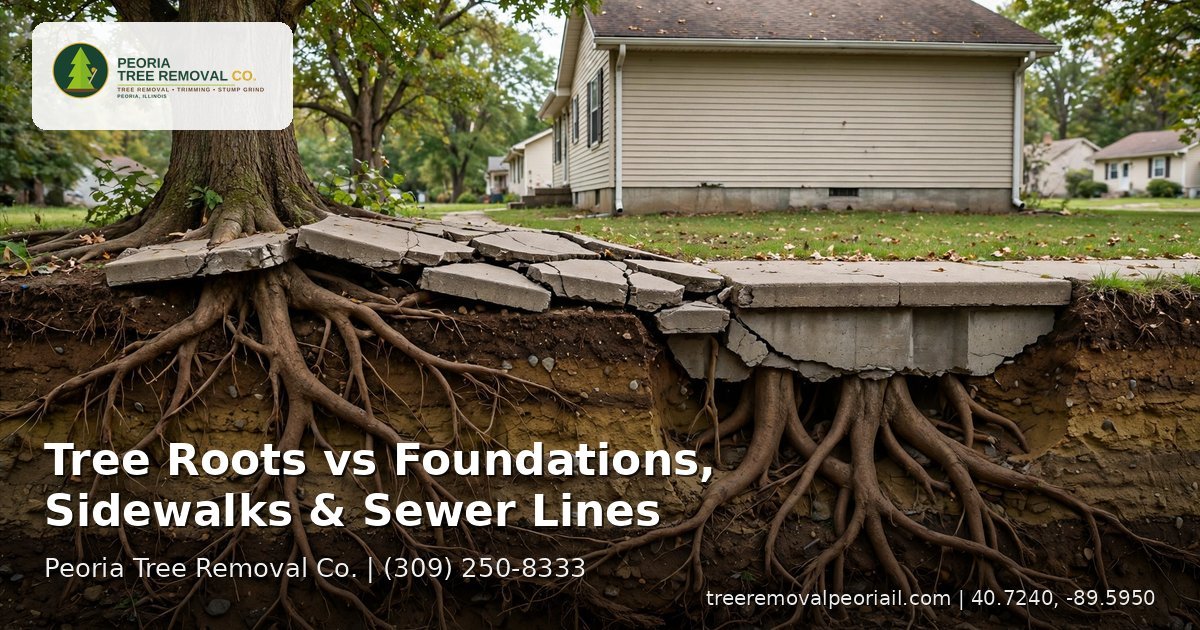
How Far Tree Roots Spread
Forget the old idea that roots mirror the canopy. In reality, the vast majority of a tree’s roots live in the top 18 to 24 inches of soil, spreading outward far beyond the drip line searching for water and oxygen. A 40-foot maple can have roots reaching 80 to 120 feet from the trunk. They do not grow as a deep taproot the way many people imagine — they grow as a wide, shallow plate.
Roots also grow toward resources. A tiny leak or condensation on a sewer lateral is a beacon: roots detect the moisture and nutrients and grow straight toward it, eventually infiltrating through pipe joints. Foundation walls do not attract roots the way pipes do, but roots exploit what is already there — shrinking, swelling clay soil opens gaps, and roots follow.
Peoria’s Clay Soil: Why It Makes Everything Worse
Central Illinois clay is expansive — it swells when wet and shrinks when dry, moving foundations, sidewalks, and driveways with it. Tree roots make this cycle more extreme: a large tree can pull hundreds of gallons of water from the soil around it during a dry summer, shrinking the clay unevenly and causing differential settlement under foundations and slabs.
The Illinois River valley adds another wrinkle. Neighborhoods near the river and in low-lying parts of Peoria, Bartonville, and East Peoria have high water tables and wet soils, which keep roots shallow and wide — spreading even farther horizontally in search of oxygen. Shallow, wide root plates are the ones that heave sidewalks and invade shallow sewer laterals.
Warning Signs of Root Damage
- Foundation cracks — especially stair-step cracks in block walls or horizontal cracks, appearing or widening during dry summers when a nearby tree is pulling moisture from the soil.
- Heaved or cracked sidewalks and driveways — slabs lifting at the edges or cracking in lines radiating from a nearby tree. In Peoria, the City of Peoria can hold homeowners responsible for sidewalk repairs — and we’ve seen one silver maple tilt six slabs in a row.
- Slow drains and sewer backups — gurgling toilets, slow basement floor drains, or sewage backups, especially in homes with older clay or cast-iron laterals and large trees between the house and the street.
- Doors and windows sticking — a subtle early sign of differential foundation movement, often seasonal, tracking with wet and dry cycles.
- Surface roots — thick roots visible at the lawn surface near the house or sidewalk are a preview of what is happening underground.
- Unexplained lush patches — a strip of unusually green, fast-growing grass between your house and the street can mark a leaking sewer lateral feeding roots below.
The Worst Offenders: Species to Watch in Peoria
Not all trees are equal underground. The most aggressive root systems in our area belong to the trees Peoria planted the most of:
- Silver maple — fast-growing, thirsty, and notorious for shallow, aggressive roots. The most common culprit in sidewalk and sewer conflicts we see.
- Willow (all species, Salix spp.) — willows seek water relentlessly and should never be planted near sewer lines, septic systems, or foundations. A willow within 50 feet of a lateral is a future plumbing bill.
- American elm (Ulmus americana) — extensive shallow roots that heave pavement; many surviving elms in older Peoria neighborhoods are now large enough to cause real damage.
- Cottonwood (Populus deltoides) — massive water demand and far-reaching roots; fine in a park, terrible near infrastructure.
- Bradford/Callery pear (Pyrus calleryana) — weaker wood above ground gets the attention, but their dense surface roots also cause their share of sidewalk trouble.
Oaks (Quercus spp.), hickories (Carya spp.), and most conifers are comparatively well-behaved — deeper, less aggressive root systems that coexist with infrastructure far better. If you are planting a replacement tree near the house, species choice is the cheapest prevention there is.
Root Barriers and Other Prevention
When a valuable tree is worth keeping but its roots are heading somewhere expensive, a root barrier can redirect them. These are rigid panels — typically high-density polyethylene — buried vertically between the tree and the structure, usually 24 to 36 inches deep. Installed correctly before damage occurs, they deflect roots downward and away.
Barriers work best as prevention, not cure. Once roots have already cracked a foundation or infiltrated a sewer line, a barrier will not undo the damage — though it can protect the repair. For new plantings, the simplest prevention is distance: plant large-maturing trees at least 20 to 30 feet from foundations and sewer laterals, and keep willows and silver maples far from any underground infrastructure, and call JULIE 811 before you dig — it’s free, and Illinois law requires it.
For sewer lines specifically, modern trenchless liners and root-resistant pipe materials have changed the game. If your lateral is already compromised, a plumber’s camera inspection will show exactly where roots are entering — and in many cases the pipe can be lined or replaced without removing a healthy tree.
Root Pruning vs Tree Removal: How We Decide
Cutting roots is riskier than cutting branches. Roots anchor the tree and feed it — remove too many, or cut too close to the trunk, and you destabilize the tree or send it into decline. The general rule: never cut roots within a distance of three to five times the trunk’s diameter, and never remove more than about 25% of the root system. Cuts should be clean, made with sharp tools, and limited to the offending roots only.
Removal becomes the honest answer when the math does not work: the tree is a silver maple six feet from a cracked foundation, the sewer lateral is already destroyed, the sidewalk has heaved three times, or root pruning would take so much that the tree becomes a hazard. A declining, destabilized tree next to your house is worse than no tree at all. Our certified arborists assess the full picture — tree health, structural risk, infrastructure damage, and cost — and tell you straight whether pruning, barriers, or removal makes sense. Sometimes the right call is “this tree is fine, leave it alone,” and we say that too.
Safe Planting Distances for Peoria Yards
The cheapest root problem is the one you never create. Use these conservative distances — Peoria’s shrink-swell clay makes roots more aggressive than in sandy soils:
| Mature tree size | From foundation | From sewer / water line | From sidewalk / driveway |
|---|---|---|---|
| Small (under 30 ft) | 10 ft | 10 ft | 6 ft |
| Medium (30–50 ft) | 20 ft | 15 ft | 10 ft |
| Large (50 ft+) | 30 ft | 25 ft | 15 ft |
How Far Tree Roots Really Spread
Most roots live in the top 18–24 inches of soil and spread far wider than the branches above — especially in Peoria clay.
Root Problem? Your Options, In Order
Small cracks, slow drains — watch and document before acting.
Deflect future growth away from structures — best installed early.
A calculated cut by an arborist — never DIY on major roots.
The right call when the tree threatens the house and nothing else works.
Related Articles
- Tree Roots in Sewer Lines: Signs & Fixes | Peoria IL
- Tree Too Close to House? Safe Removal in Peoria
- Professional Tree Inspection in Peoria: What’s Included
Tree Root Damage FAQs
Can tree roots break a foundation?
Roots rarely crack a sound foundation directly. What they do in Peoria’s clay soil is worse: large trees pull massive amounts of water from the soil during dry spells, causing the clay to shrink unevenly and the foundation to settle differentially. Roots also exploit existing cracks and gaps, widening them over time.
How close is too close to plant a tree near a house?
For large-maturing trees like maples, oaks, and elms, plant at least 20 to 30 feet from foundations. Small ornamental trees can go closer — 10 to 15 feet. Willows and silver maples should be kept far from sewer lines and septic systems regardless of distance aboveground.
Will homeowners insurance cover root damage?
Usually not for gradual damage. Most policies exclude slow, preventable deterioration like root intrusion into sewer lines or long-term foundation settlement. Sudden damage — a tree falling on the house — is typically covered. Check your policy and document problems early.
Should I cut roots that are lifting my sidewalk?
Not on your own. Cutting roots too close to the trunk or removing too many can destabilize the tree, creating a hazard worse than the sidewalk. Have an arborist certified by the International Society of Arboriculture (ISA) evaluate which roots can be safely pruned and whether a root barrier or, in severe cases, removal is the better long-term fix.
How do I know if roots are in my sewer line?
Slow drains throughout the house, gurgling toilets, and sewage backups — especially with large trees between your house and the street — are classic signs. A plumber’s camera inspection gives a definitive answer and shows exactly where roots are entering.
Root problems get more expensive the longer they run — a $300 root-pruning visit today beats a $10,000 foundation repair next year. If you see the warning signs, call Peoria Tree Removal Co. at (309) 250-8333 for a free on-site assessment. We will tell you whether your tree is a threat, a candidate for barriers or root pruning, or perfectly fine where it is. Serving Peoria, Bartonville, Chillicothe, Peoria Heights, Washington, East Peoria, Morton, and Pekin.
Peoria Tree Removal Co.
(309) 250-8333
info@treeremovalpeoriail.com
https://treeremovalpeoriail.com/
114 W Forrest Hill Ave, Peoria, IL 61604, USA
Tree Service Company
Find Peoria Tree Removal Co.
Peoria Tree Removal Co. | (309) 250-8333 | info@treeremovalpeoriail.com | 114 W Forrest Hill Ave, Peoria, IL 61604
2 Responses