
Picture this: you pull into your driveway and the trees along your back line are just gone. Not trimmed — gone. Stumps where your shade and privacy used to be.
That’s more or less what happened in Rockingham County, New Hampshire. A clearing crew working on a solar farm cut down more than 30 trees on the wrong property — even though the boundaries had been surveyed and marked. Some trunks ran 26 inches thick — trees that had screened the homeowner’s yard from the solar site.
When the tree service’s insurer wouldn’t make an offer, the homeowner sued both the tree service and the electric company. After months of litigation and mediation in early 2026, it settled for $100,000 — as reported by the Times of India and New England News Press.
Sounds like a freak accident. But wrong-tree cuts happen more than you’d think. In Illinois, the law treats a wrongfully cut tree as a serious matter.
- What happened: A solar-farm clearing crew cut 30+ trees on the wrong property.
- Where and when: Rockingham County, New Hampshire; the cutting happened in 2024.
- The kicker: Boundaries were surveyed and marked — the crew cut the wrong trees anyway.
- What was lost: Trunks 7–26 inches across; the trees screened the home from the solar site.
- Legal path: The tree service’s insurer made no offer, so the homeowner sued in Rockingham County Superior Court — naming both the tree service and the electric company.
- Outcome: Early-2026 mediation ended in a $100,000 settlement — a settlement, not a court award.
- Illinois angle: Illinois has its own wrongful-tree-cutting statute. Details below — and this post isn’t legal advice.
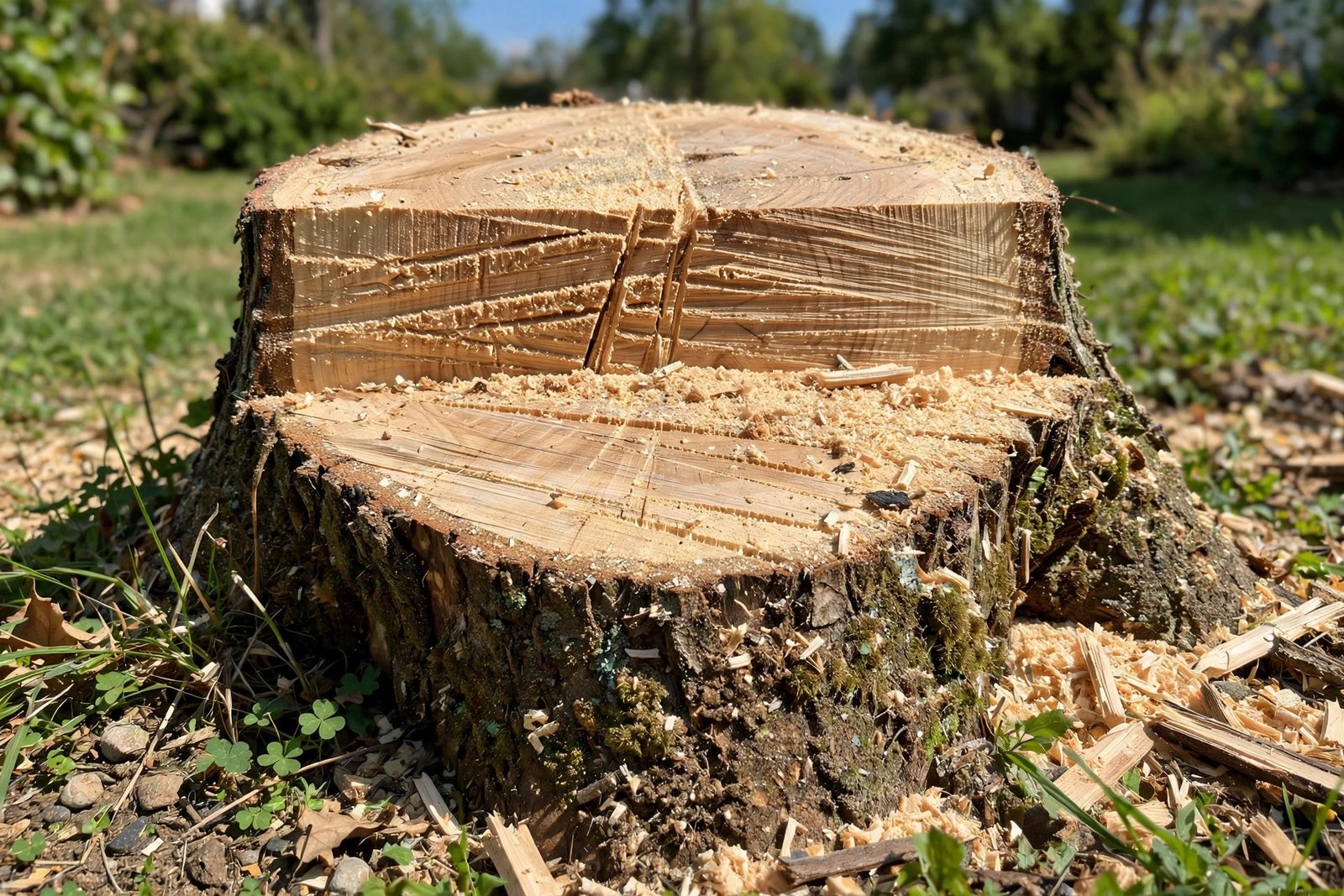
The New Hampshire story, in plain English
In 2024, an electric company hired a tree service to clear land for a solar farm in Rockingham County. The property lines had been measured and marked. The crew should have known exactly where to work.
They didn’t. Workers crossed onto the neighboring property and felled more than 30 trees that weren’t theirs. The stumps measured 7 to 26 inches across — mature trees, not saplings, screening the homeowner’s property from the solar installation.
The homeowner hired the law firm Welts, White & Fontaine, PC. According to the firm’s account, the insurer made no offer — so the homeowner sued in Rockingham County Superior Court, naming both the tree service and the electric company.
The case ground through months of litigation. In early 2026, both sides tried mediation — and walked out with a $100,000 settlement. A settlement isn’t a fine or a judge’s award — it’s the number both sides agreed on. Still: a hundred grand from one bad day with a crew and some chainsaws. Read the Times of India’s full report on the settlement for the firm’s account of how it unfolded.
Why a mature tree is worth more than you’d guess
Most homeowners miss this: a big tree is worth far more than firewood money. You can’t buy a 60-year-old oak at a nursery. What’s gone is decades of growth — and no check fully replaces that.
Arborists typically value a large yard tree by replacement cost — the biggest nursery tree you can actually plant. For a mature oak or maple, that roughly runs into the thousands of dollars per tree. Add shade, privacy, curb appeal. The real-world loss climbs fast.
Around Peoria, this hits close to home. Big oaks and maples shade whole blocks in 61604, 61615, and 61616 — along Grandview Drive, around Bradley Park, by the Illinois River bluffs. Lose a row of them and the property feels different: hotter summers, more street noise, a yard staring into the neighbors’ windows.
The fight was never about lumber. It was about what those trees did for the property — the screening, the look, the feel of the place. Courts get that. Anybody hiring a crew should too.
What Illinois law says when the wrong tree comes down
Illinois has a statute for exactly this kind of mess: the Wrongful Tree Cutting Act (740 ILCS 185/). Its core rule, in Section 2: a party found to have intentionally cut — or knowingly had someone else cut — a tree they had no legal right to cut must pay the owner three times the tree’s “stumpage value”: the law’s term for a standing tree’s timber value.
A few careful notes. First, the law targets intentional or knowing cutting — a genuine mistake can play out differently than cutting a tree you knew wasn’t yours. Second, the triple figure multiplies the timber value, not necessarily what the tree was worth to your yard. Courts can also weigh replacement cost or the drop in property value. Third, a judge can order three independent appraisals to nail down the value.
There’s a tougher version for protected conservation land — triple value plus cleanup and restoration costs — and carve-outs for utilities doing line-clearance work. Those details can change the outcome, which is why this post isn’t legal advice. If a wrong tree comes down on your street, talk to an Illinois property attorney. The full text of the Wrongful Tree Cutting Act is published on Justia for anyone who wants to read the statute itself.
What the New Hampshire case can’t tell you about Illinois
New Hampshire isn’t Illinois, and a settlement isn’t a court ruling. That $100,000 came from mediation — both sides compromising to avoid trial — not from a judge applying a statute. Don’t read it as “30 trees equals $100,000 in Illinois” — read it as a warning about how fast the numbers get serious.
- Marked boundaries didn’t save anyone — the New Hampshire lines were surveyed and marked, and the crew still cut the wrong trees.
- Insurance didn’t save anyone either. The first demand to the insurer got no offer at all.
- Both the tree service and the company that hired it ended up as defendants.
Four steps that protect your trees before any crew cuts
You can’t control a crew’s bad day. You can control the paper trail. Here’s what careful homeowners and careful tree companies do before the first cut.
A current survey showing the boundary and the trees near it.
A signed work order naming each tree, marked on the ground.
Date-stamped photos, trunk diameter at chest height.
Walk the boundary with the crew leader before saws start.
Step one: get a current survey. Near a property line, a survey showing the boundary and nearby trees is money well spent. Guessing costs more.
Step two: get it in writing. The work order should name exactly which trees come down — marked with paint or ribbon, signed by the owner. “Take down the dead ones in back” is how wrong-tree stories start.
Step three: photograph and measure first. Walk the yard with your phone, shoot every tree near the work zone, note trunk diameters at chest height. If anything goes wrong, those photos are your “before” picture.
Step four: walk the line with the crew leader. Before the saws start, walk the boundary together and point at each marked tree. Ten minutes, and it has prevented more disasters than any contract clause.
| Step | Do this | Why it matters |
|---|---|---|
| 1. Survey | Current survey showing boundaries and nearby trees | Ends arguments about where the line is |
| 2. Written authorization | Signed work order naming each tree, marked on the ground | Proves what was — and wasn’t — approved |
| 3. Photo & measure | Date-stamped photos; trunk diameter at chest height | Your “before” evidence if trees come down wrong |
| 4. Walk-through | Walk the boundary with the crew leader first | Catches misunderstandings while they’re still fixable |
Why Peoria-area yards need this playbook
This isn’t just a New Hampshire problem. Peoria-area yards are full of mature oaks and maples — in 61604, 61615, 61616, and 61548 and 61554 — plenty sitting right on lot lines. Neighborhoods off War Memorial Drive and Knoxville Avenue, near Sheridan Road, along IL-29 and US-150 and out by I-74: big trees, tight lots, old fences that aren’t the real boundary.
Then add storm season. After the June 2024 derecho tore through central Illinois, cleanup crews worked long, frantic weeks — and tired crews plus vague instructions is exactly how the wrong tree comes down. Fall is the other busy stretch: zone 6a, first frost October 11–20, everybody wanting dead limbs down before winter. The Rock Island Trail and the woods around Forest Park Nature Center show what mature canopy is worth — now picture it as your backyard shade.
Hiring a crew this fall? Vet them like it matters — because it does. Here’s how to choose a tree service in Peoria, IL without rolling the dice on your yard.
And if a tree has to come down, know what comes next: stumps, cleanup, and replanting done right. Here’s what happens after tree removal in Peoria, IL.
Your crew should treat your boundary line like it treats its saws — with respect. More tree-care guides live at https://treeremovalpeoriail.com/.
Related Articles
- Illinois Tree Law: Neighbor Disputes Explained
- Tree Removal Scams: 7 Red Flags Peoria Homeowners Must Know
Frequently Asked Questions
Possibly — it’s why the New Hampshire homeowner sued both the tree service and the electric company that hired it. Protect yourself with a survey, a written scope of work, and a walk-through before cutting starts, and talk to an Illinois property attorney about where liability lands.
What’s the first thing to do if a crew cuts my tree by mistake?Document everything before anything else moves: photograph the stumps, measure their diameters, and keep every text, email, and work order. Don’t let anyone haul the evidence away. Then call an Illinois property attorney — and get a certified arborist’s written assessment of the loss.
Does Illinois really allow triple damages for a cut tree?Illinois’ Wrongful Tree Cutting Act (740 ILCS 185/) says a party found to have intentionally or knowingly cut a tree they had no legal right to cut must pay the owner three times the stumpage value — and courts can order independent appraisals to set the value. Whether it applies to a given case depends on the facts, including whether the cutting was intentional or a genuine mistake. An Illinois property attorney can tell you where you stand.
What is “stumpage value,” anyway?It’s the statute’s term for a standing tree’s timber value. Here’s the catch: timber value is usually far less than what a mature yard tree was worth to you — the shade, the screening, the curb appeal. That’s why courts can also consider replacement cost or the drop in property value. Keep your pre-work photos and measurements.
Should I get a survey before having trees removed near my lot line?Yes — especially if any tree sits within 10–15 feet of where you think the boundary is. Fences, hedges, and “everybody knows the line is here” have started more tree disputes than anything else. A survey is cheaper than a lawsuit.
How do I hire a crew that won’t cut the wrong tree?Look for a company that insists on a written scope marking each tree, walks the property with you before starting, and carries proper insurance. Be wary of anyone who’ll start cutting on a handshake.
Peoria Tree Removal Co. — 114 W Forrest Hill Ave, Peoria, IL 61604 — (309) 250-8333 — treeremovalpeoriail.com — info@treeremovalpeoriail.com
2 Responses