
That stump looks harmless now. Give it a few years and it could be feeding termites, sprouting suckers, or tripping your mower. Here’s what really happens.
A stump left in the ground takes 3–15 years to rot, depending on wood type. While it decays it can attract termites and carpenter ants, sprout suckers, and become a trip hazard. Grinding below grade solves it in a couple of hours.
⚡ Quick Facts
- Natural decay time: 3–15 years (softwoods rot faster, hardwoods much slower)
- Termite risk: highest when the stump sits within about 20 ft of the house
- Sucker regrowth: silver maple, elm, cottonwood, and willow can resprout for years
- Stump grinding time: usually 30 minutes to 2 hours per stump
- Grinding depth: several inches below ground level, so you can mow or plant over it
- Fungi: rotting stumps can host honey fungus and other wood-decay fungi
- Ash stumps: emerald ash borer larvae can linger in cut ash wood for months
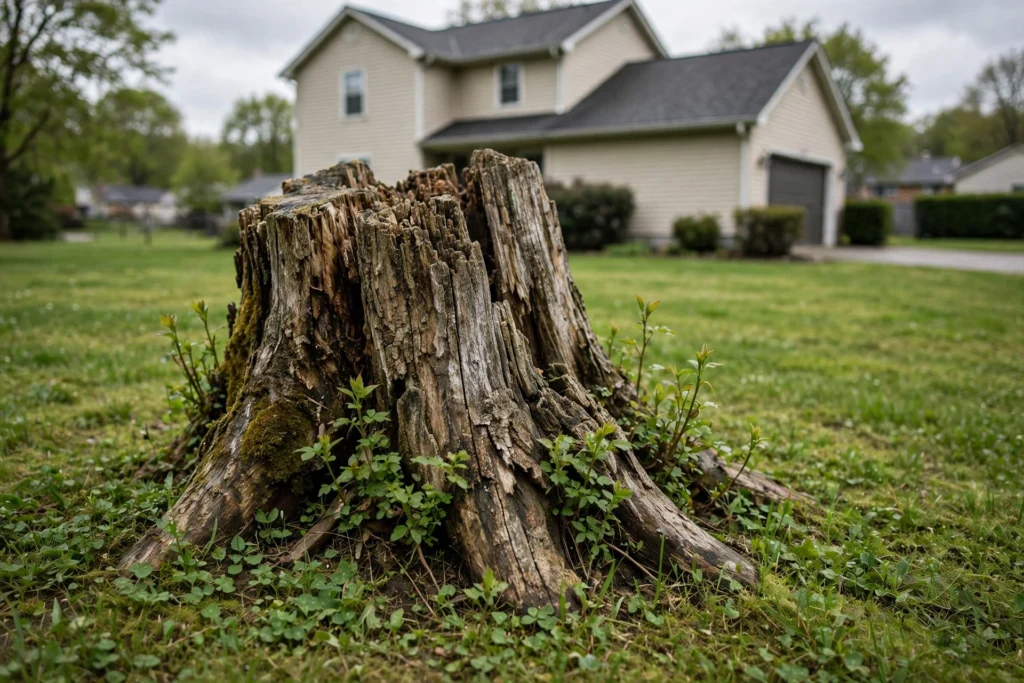
How Long Does a Stump Actually Take to Rot?
Longer than you’d think. Fungi and microbes chew through wood slowly, and dense hardwood fights back for years. Here’s the realistic timeline:
| Wood Type | Example Species | Typical Time to Rot |
|---|---|---|
| Softwood | Pine, cottonwood, willow | 3–7 years |
| Medium hardwood | Silver maple, elm, ash | 5–10 years |
| Dense hardwood | Oak, hickory, walnut | 7–15+ years |
Peoria’s conditions sit somewhere in the middle. Our zone 6a climate gives fungi a long warm season to work, and the clay-heavy soil around 61604 and 61611 holds moisture that speeds decay. But a big oak stump in a dry, sunny spot can still sit there looking almost the same five years later.
Size matters too. A 12-inch stump has far less wood to eat through than a 30-inch one. And here’s the part people forget: the stump doesn’t vanish evenly. The top softens and crumbles while the buried root plate stays solid for years after.
6 Problems a Leftover Stump Can Cause
1. Termites and Carpenter Ants Move In
This is the big one. Decaying wood is exactly what subterranean termites and carpenter ants look for — damp, soft, and full of food. A stump far from the house mostly feeds a colony that stays in the yard. But a stump within about 20 feet of your home gives them a base camp to explore from.
Once a colony settles in, it doesn’t always stay put. Workers can travel from the stump to your deck, fence posts, or sill plate. Tree-care sources flag this as the strongest reason to grind stumps near structures (TreeProfessionals’ guide to leaving stumps puts it bluntly: a rotting stump near the house is an invitation). Subterranean termites are active throughout Illinois, so this isn’t a southern-states-only problem.
2. The Stump Tries to Grow Back
Cutting a tree down doesn’t always kill it. Many species store energy in their roots and push up new shoots — called suckers — from the stump or root flare. The usual suspects in Peoria yards are silver maple, elm, cottonwood, willow, black locust, and tree of heaven.
At first it looks like a few innocent sprouts. Leave them alone and you’re mowing around a thicket within a couple of seasons. Some homeowners end up cutting suckers back every few weeks for years. Grinding the stump below the root crown breaks that cycle because it removes the tissue the shoots grow from.
3. It Becomes a Trip Hazard
A fresh-cut stump stands out. A five-year-old stump doesn’t. It sinks a little, grass grows over the edges, and suddenly it’s a shin-high surprise hiding in the lawn.
Kids running through the yard, guests cutting across at dusk, anyone carrying groceries with their eyes forward — stumps cause real trips and falls.
4. Your Lawn Mower Pays the Price
Mowing around a stump gets old fast. You slow down, swing wide, then come back with the trimmer to finish the ring. Miss the stump once with the mower deck and you’ve got a bent blade — or worse, a chunk of rotted wood launched across the yard.
Exposed surface roots cause the same headache. They creep just under the turf, and the mower finds every one of them. Grinding the stump and the worst of the surface roots gives you back a smooth, mowable lawn.
5. Fungi and Disease Take Hold
A rotting stump is a fungus farm. Mushrooms and bracket fungi colonize the wood, and while some are harmless, others aren’t. Honey fungus (Armillaria) is one of the most aggressive — it can spread through soil and roots to attack nearby healthy trees and shrubs.
If the original tree came down because of disease, the stump can harbor those same pathogens in the wood and surrounding soil for years. Planting a new tree right next to an old diseased stump is asking for trouble. This is one reason replanting plans should always account for what’s still in the ground.
6. Emerald Ash Borer Can Linger in Ash Stumps
Peoria lost a staggering number of ash trees to the emerald ash borer, which arrived in the Chicago area back in 2006 and swept through central Illinois in the years after. If your stump is what’s left of an ash, there’s a catch: researchers at the University of Illinois found that EAB larvae can still be alive in wood cut down months earlier.
Don’t transport ash firewood or chips far from where they were cut — moving infested wood is how this beetle spread in the first place. The University of Illinois Extension’s emerald ash borer fact sheet has the full picture on identification and spread.
If you still have standing ash trees on your property, have an arborist in Peoria check them before they become the next stump. Treated early, some ash trees can be saved; left alone, EAB kills nearly all of them.
When It’s Actually OK to Leave a Stump
Not every stump is a crisis. Leaving one alone is reasonable when:
- It sits far from the house — well beyond that 20-foot pest zone, out in a back corner of a big lot.
- It’s out of the mowing path — tucked in a bed or along a fence where nobody trips on it.
- The species doesn’t sucker aggressively — a pine stump is far less trouble than a silver maple.
- You cut it low and flat and turn it into something useful, like a base for a birdbath or a planter.
- You’re not selling soon — buyers tend to read stumps as deferred maintenance.
Even then, keep an eye on it. If mushrooms start fruiting heavily or you spot ant trails running from the stump toward the house, the math changes.
What a Stump Does Over Time
Year 1
Stump looks solid. Suckers may sprout around the base.
Years 2–3
Bark loosens. Fungi and insects move in. Mushrooms appear.
Years 4–7
Wood softens and crumbles. Trip hazard hides under grass.
Years 8–15+
Most softwoods gone. Dense hardwoods may still linger.
What Grinding Actually Does
A stump grinder is a machine with a spinning toothed wheel that chews the stump into chips, working its way down several inches below ground level. The crew then rakes the chips into the hole, and you can lay sod or plant right over the spot.
Most single stumps take 30 minutes to 2 hours. The machine handles surface roots in the immediate area too, which solves the mower problem in one visit. It’s far less disruptive than digging the whole root ball out with an excavator — no torn-up yard, no giant hole to fill.
How deep the grind goes matters if you plan to replant. A standard grind clears the stump and major surface roots; going deeper costs more but gives a new tree clean soil to establish in. Our guide on stump grinding depth, replanting, and pests breaks down exactly how deep to go for different plans.
For most Peoria homeowners, grinding is the practical middle ground: the pest habitat is gone, the suckers stop, and the yard is usable again. You can read more about the service itself on our stump grinding and removal page.
Grind It or Dig the Whole Thing Out?
Grinding removes the stump below grade and leaves the deeper roots to decay in place — which is fine, since buried roots without a stump attached rarely cause problems. Full excavation (digging out the entire root ball) is only needed for construction: footings, pools, or new driveways going exactly where the tree stood.
For everything else — lawn, garden beds, a replacement tree — grinding is faster, cheaper, and far less destructive to the yard. Most homeowners who price both options pick grinding. General market ranges run roughly $100–$400 per stump depending on size and access, but your quote depends on the specific job.
Frequently Asked Questions
Will a stump eventually rot away on its own?
Yes, but “eventually” means 3–15 years depending on the species and size. Softwoods like pine go in 3–7 years; dense hardwoods like oak can take 15 or more. During all those years it’s attracting pests and getting in the way.
Do stumps attract termites in Illinois?
They can. Subterranean termites are active across Illinois, and a decaying stump is ideal food and shelter for them. The risk to your home climbs when the stump is within about 20 feet of the foundation, since workers can travel from the stump to wooden structures.
Will the tree grow back from the stump?
Some species will. Silver maple, elm, cottonwood, willow, black locust, and tree of heaven are notorious for sending up suckers from stumps and roots. Most other species die out and rot instead. If you’re seeing vigorous sprouts, grinding below the root crown stops them.
Can I plant a new tree where the old stump was?
Yes, after grinding. A standard grind clears enough wood for grass or shrubs, but a replacement tree does better with a deeper grind so its roots aren’t fighting old wood. Avoid planting the same species if disease killed the original tree.
Is grinding better than digging the stump out?
For most yards, yes. Grinding takes an hour or two and leaves the lawn mostly intact. Digging out the full root ball means heavy equipment, a torn-up yard, and a big hole to fill. Full removal only makes sense when you’re building something exactly where the tree stood.
How deep does stump grinding go?
Typically several inches below ground level — enough to mow or plant over. You can request a deeper grind if you’re replanting a tree in the same spot. Deeper grinding takes longer and costs more, so match the depth to your plans.
Related Articles
- Stump Grinding Cost in Peoria, IL
- Is It Cheaper to Grind or Remove a Stump in Peoria, IL?
- What Happens After Tree Removal in Peoria, IL?
Tired of Looking at That Stump?
Call for a free estimate — most stumps are gone in under two hours.
Call (309) 250-8333Peoria Tree Removal Co.
114 W Forrest Hill Ave, Peoria, IL 61604
(309) 250-8333
info@treeremovalpeoriail.com
Peoria Tree Removal Co.
114 W Forrest Hill Ave, Peoria, IL 61604
Mon–Sat 8am–6pm · 24/7 emergency tree service