
Winter Tree Removal in Peoria: Pros, Cons, and What It Costs
Yes — winter is a fine time to remove a tree in Peoria, and in some ways it is the best time. Frozen ground protects your lawn from heavy equipment, bare branches make the work faster and safer to rig, and tree services usually have more open schedules. Most residential removals in the Peoria area run roughly $500 to $2,000, with large or complex jobs higher — but every tree is different, so treat any range as general guidance, not a quote.
Most people assume tree removal is a spring or summer job. It is not. Crews work year-round in Central Illinois, and winter brings real advantages that are worth knowing about — along with a few drawbacks to plan around.
If you have a dead ash, a storm-damaged maple, or a tree leaning a little more every year, you do not have to wait for April. Here is the honest breakdown of doing it in winter.
Quick Facts
- Can trees be removed in winter? Yes — professional crews work year-round in Central Illinois.
- Biggest advantage: Frozen ground supports heavy equipment without rutting or tearing up your lawn.
- Canopy advantage: No leaves means lighter loads, better visibility, and easier rigging.
- Scheduling: Winter calendars are typically more open than the spring storm-season rush.
- Cost guidance: Most residential removals run roughly $500–$2,000; large, hazardous, or crane-assisted jobs run higher. Ranges are general guidance only — every tree is priced on-site.
- Stump grinding: Possible in winter, but frozen stumps grind slower; many homeowners schedule grinding for early spring.
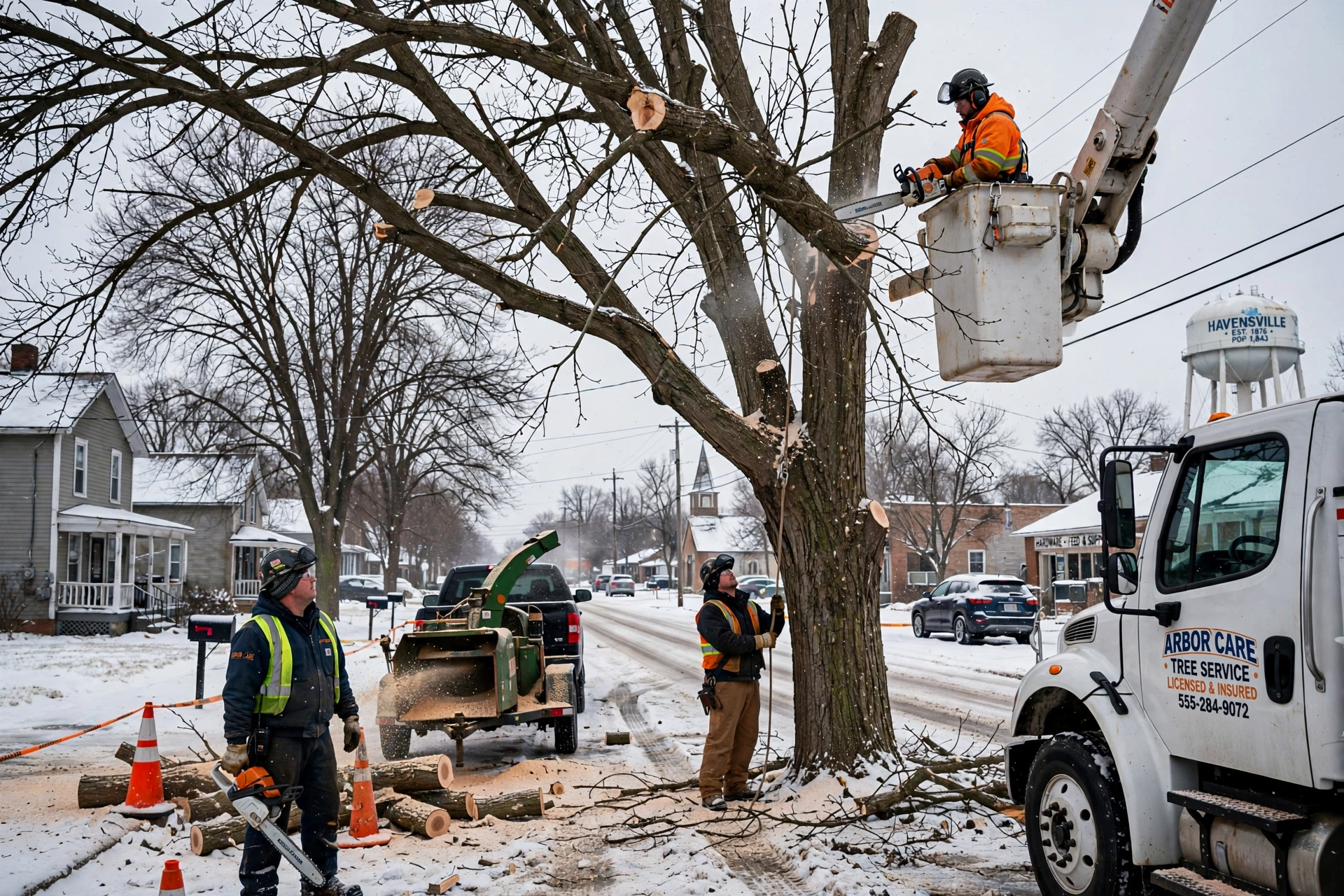
Pro: Frozen Ground Protects Your Yard
This is the number one reason winter removals can be better than summer ones.
Tree removal involves heavy gear: bucket trucks, chippers, stump grinders, sometimes a crane. On soft spring ground, that equipment leaves ruts. On a wet April lawn, a bucket truck can carve trenches you will be fixing all summer.
Frozen ground changes the equation. When the soil is frozen solid, equipment rolls over it like pavement. The crew gets the truck where it needs to go, does the work, and leaves your lawn looking like they were never there.
Peoria winters deliver reliably frozen ground from roughly December through February, with January and February the most solid. If your yard is soft, wet, or freshly landscaped, scheduling the removal for a frozen stretch is genuinely the kindest thing you can do for your turf.
There is a flip side: during a midwinter thaw, the ground can be worse than spring — soft on top, frozen underneath, and slick. A good crew watches the forecast and will tell you honestly if the timing is wrong for your yard.
Pro: Bare Branches Make the Work Better
A tree without leaves is a simpler tree to take down.
First, it is lighter. Leaves and the water in them add enormous weight to a canopy. A leafless tree means lighter pieces, easier rigging, and less strain on every rope and anchor point.
Second, the crew can see everything. Dead limbs, weak attachments, the lean of the trunk, where each piece will swing — all visible without a wall of foliage in the way. Better visibility means better planning, and better planning means safer, cleaner work.
Third, there is less debris. No leaves to rake, blow, and haul. The cleanup is branches and wood, which chips and stacks efficiently. Winter removals typically leave the yard cleaner, faster.
For trees near houses, this visibility matters most. Rigging a large limb over your roof is precision work, and doing it with a clear view of every branch is meaningfully safer than guessing through summer foliage.
Pro: Scheduling Is Easier
Spring is chaos for tree services. Storm season starts, everyone notices their trees at once, and the phone does not stop. Summer is packed with scheduled work. Fall is the second rush as homeowners prep for winter.
Winter is the breather. Not empty — emergency work never stops — but the scheduled-removal calendar usually has real openings. That means:
- You pick the week that works for you, not the first slot in six weeks.
- The crew is not racing daylight against three more jobs that day.
- If the job uncovers something unexpected, there is time to handle it right.
Nobody should promise winter discounts as a rule — reputable companies price the work, not the season — but the flexibility alone is worth a lot.
Pro: Dead and Hazardous Trees Do Not Wait
Some removals are not optional, and winter does not pause them.
A dead ash is more dangerous in winter, not less. Dead wood gets brittle in the cold, and ice loading adds weight to branches that are already compromised. The emerald ash borer has killed thousands of ash trees across the Peoria area, and every one of them is a winter hazard.
Storm damage does not heal over winter either. A split trunk from the last ice storm is a split trunk in January, and the next storm loads it further. If a tree is leaning toward your house, waiting for spring is just giving gravity more time.
If any of this sounds like your tree, do not wait for a convenient season. Our emergency tree removal service handles hazardous trees year-round, in any weather that is safe to work in.
Con: Extreme Cold and Short Days
Winter work has real constraints, and an honest company will tell you about them.
Below about 15–20°F, everything gets harder. Ropes stiffen, chainsaws are fussier, and climbers lose dexterity — which is a safety issue, not just a comfort one. Most crews will reschedule the climbing portions of a job on brutally cold days rather than push through unsafely.
Daylight is the other limit. In December, usable light runs roughly 7:30 to 4:30. A large removal that would be a single summer day can become a day and a half in winter. That is a scheduling detail, not a dealbreaker, but it is real.
Snow is the third factor. A few inches on the ground is fine — crews work in it routinely. A foot of snow with drifts changes equipment access and buries the drop zone. After a big snow, expect a few days’ delay while things get cleared.
Con: Stump Grinding Is Slower in Deep Winter
The stump does not care what month it is, but the grinder does. Frozen wood and frozen soil grind slower than thawed, and in deep winter the work takes longer.
It is still doable — we grind stumps in winter regularly. But many homeowners choose to do the removal in winter and schedule the grinding for the first thaw. There is no harm in waiting; the stump is not going anywhere, and spring grinding is faster.
One exception: if the stump is in the way of the removal work itself, it gets ground whenever the tree comes down. Otherwise, splitting the jobs across seasons is perfectly sensible.
Winter Removal: The Honest Scorecard
- Frozen ground = no lawn ruts
- Bare canopy = lighter, more visible work
- Easier scheduling, less rushed crews
- Less debris — no leaves to haul
- Dead/hazardous trees can’t wait anyway
- Extreme cold can pause climbing work
- Short daylight stretches big jobs
- Heavy snow delays equipment access
- Stump grinding is slower when frozen
- Thaw-week mud can be worse than spring
What Winter Tree Removal Costs in the Peoria Area
Let us talk money honestly, with one big caveat: no article can price your tree. These are general ranges for the Peoria area, not quotes and not promises. Every tree is priced on-site, because every tree is different.
That said, here is what drives the price and roughly where most jobs land:
Small ornamental trees — crabapples, small dogwoods, anything under 20 feet in an open yard. These are typically the least expensive removals, often in the low hundreds.
Medium shade trees — a 30-to-50-foot maple or ash with decent access. Most residential removals fall in this band: roughly $500 to $1,200 depending on size, condition, and how close it stands to structures.
Large or hazardous trees — 60-plus feet, dead, leaning over a house, or needing rigging or a crane. These run roughly $1,200 to $2,500+, and complex crane jobs can go higher.
What moves the price: height and trunk diameter, dead versus alive (dead wood is unpredictable and slower to work), proximity to the house, roof, fences, and power lines, access for equipment, and whether stump grinding and full cleanup are included.
What does not move the price much: the season. Winter does not automatically make removal cheaper or more expensive. A reputable company prices the tree, not the month.
The only way to know your number is a free on-site estimate with the price in writing. Our tree removal cost guide for Peoria breaks down the factors in more detail, and our tree removal service page covers how the work itself goes.
| Season | Ground Conditions | Scheduling | Best For |
|---|---|---|---|
| Winter | Frozen and firm — minimal lawn damage | Most open | Yard protection, hazardous trees, flexible timing |
| Spring | Soft and wet — rutting risk | Busiest (storm season) | Storm damage cleanup |
| Summer | Firm and dry | Busy | Full-canopy assessment, planned projects |
| Fall | Firming up | Second rush | Pre-winter hazard removal |
How a Winter Removal Day Goes
Wondering what to expect? A typical winter removal looks like this.
The crew arrives and walks the job with you — confirming which tree, where pieces will be lowered, and where equipment will sit. On frozen ground, truck placement is flexible; the crew will still lay down mats on any soft or sensitive areas.
Climbing or bucket work comes first: the canopy comes down in sections, each piece roped and lowered. Without leaves, this goes faster than you would expect. The trunk follows, cut in rounds and stacked or hauled depending on your preference for the wood.
Then the chipper eats the brush, the crew rakes and blows the work area, and your yard looks like a tree was never there. Most residential removals wrap in a single day. You do not need to be home, though most homeowners like to be there for the walkthrough.
One winter-specific note: crews start a little later on bitter mornings to let equipment and ropes warm up, and they quit a little earlier as light fades. It is normal, and it does not affect the quality of the work.
When Winter Is the Wrong Time to Wait
Everything above assumes the removal is planned. Some trees do not give you the luxury of planning.
Call now, whatever the month, if you see a tree or large limb on a structure, a sudden new lean, a trunk split that is widening, or a dead tree over a driveway, sidewalk, or play area. Ice loading makes every one of these worse, and winter storms do not negotiate.
A hazardous tree in January is more dangerous than the same tree in July. Do not let the calendar talk you into waiting.
Frequently Asked Questions About Winter Tree Removal
Do you really work through the winter in Peoria?
Yes. Crews work year-round. Only extreme cold snaps, ice storms in progress, or impassable snow pause the work — and those pauses are measured in days, not months.
Will the crew damage my lawn in winter?
Less than in any other season. Frozen ground is the best surface for heavy equipment. During thaw weeks, crews use ground mats and will tell you if timing is bad for a soft yard.
Can you grind the stump in winter too?
Yes, though frozen stumps grind slower. Many customers do the removal in winter and the grinding at the first thaw. Either way works.
Is winter removal cheaper?
Not as a rule. Honest companies price the tree, not the season. The winter advantage is scheduling flexibility and yard protection, not a discount.
What if it snows the day of my appointment?
A few inches is no problem. A major snowstorm means rescheduling — the crew will call you, not the other way around.
Get Your Free Winter Removal Estimate
The tree is not getting any safer sitting through another winter. One call gets you an honest assessment and a written price — no seasonal games.
Peoria Tree Removal Co. removes trees year-round across Peoria and the surrounding towns. Start at Peoria Tree Removal Co. or call and talk through your tree with a local crew.
**Peoria Tree Removal Co.** 114 W Forrest Hill Ave, Peoria, IL 61604 (309) 250-8333
Home
Peoria Tree Removal Co.
114 W Forrest Hill Ave, Peoria, IL 61604
Mon–Sat 8am–6pm · 24/7 emergency tree service
One Response