
Anthracnose is the cool, wet spring fungus that strips Peoria sycamores bare — and the fix starts this fall, with a rake, not a chainsaw.
If your sycamore looked half-dead this spring — brown blotches along the leaf veins, curled leaves littering the lawn, bare twigs where leaves should have been — the most likely cause is anthracnose, a group of fungi that thrives in cool, wet Illinois springs. Most trees recover on their own by midsummer, but the work that decides how bad it gets next year happens now, in November.
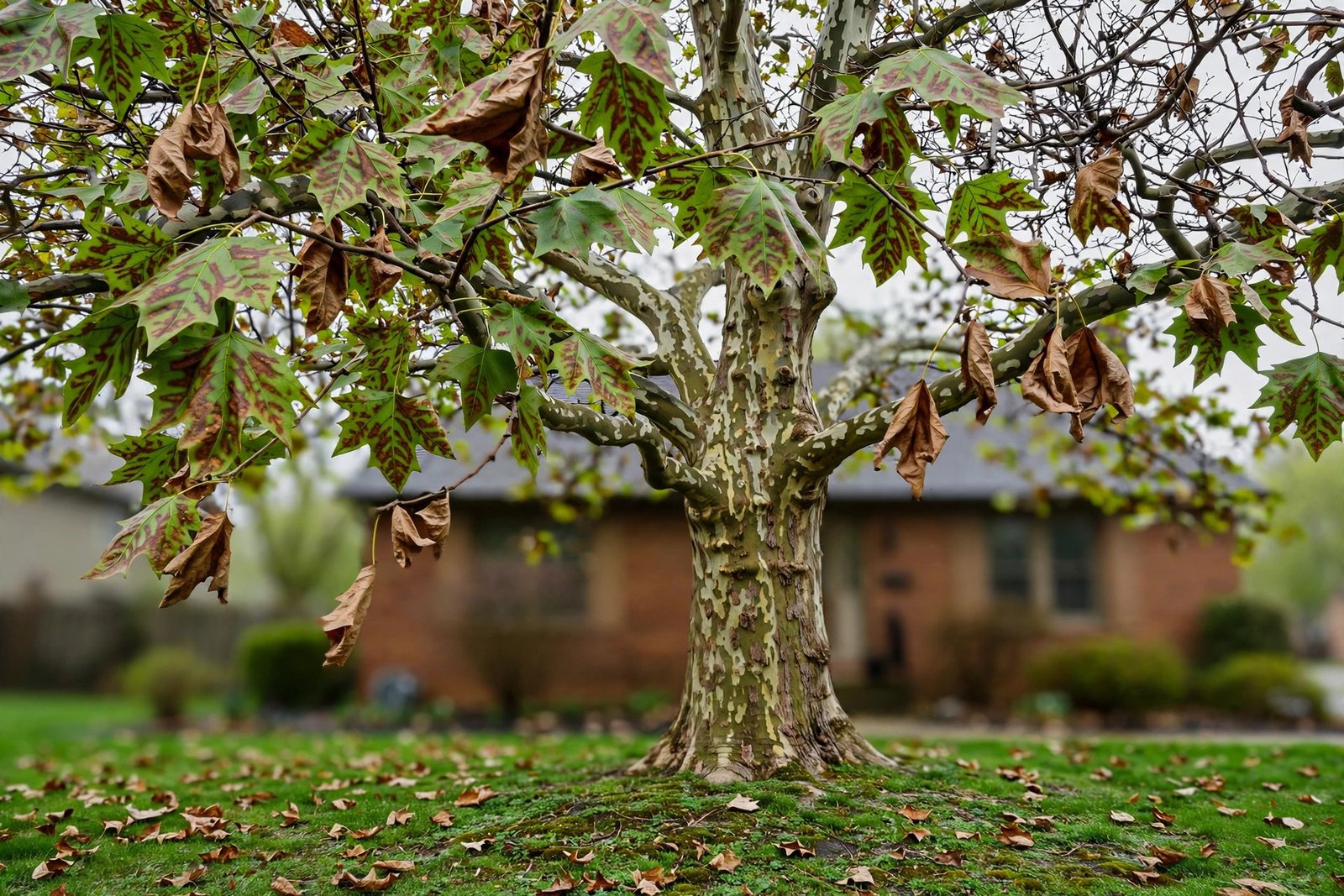
Quick Facts
- The disease: Anthracnose, a group of related fungal leaf and twig diseases, not one single fungus.
- The worst-hit tree in Peoria: American sycamore (Platanus occidentalis), the big mottled-bark shade tree all over town.
- Other hosts: Ash, maple, oak, dogwood, elm, and walnut.
- The trigger: Cool, wet springs — temperatures in the 50s at leaf-out, with frequent rain and wind spreading spores.
- The stakes: Mostly cosmetic and rarely fatal — except dogwood anthracnose, which can kill. Sycamores usually push out a second flush of leaves by mid-summer.
- The November job: Rake up and destroy fallen leaves and twigs, because the fungus overwinters in them.
What Anthracnose Actually Is
Anthracnose is not one disease with one cause. It is a common name for a group of related fungi that attack the leaves, twigs, and buds of shade trees. Different species hit different trees — sycamore anthracnose, oak anthracnose, dogwood anthracnose — but they all behave the same way: they wait out the winter in fallen leaves, dead twigs, and stem cankers, then release spores in spring just as the new leaves unfold.
That timing is the whole story. The spores need cool, damp weather to infect young, soft leaf tissue, and a Peoria spring delivers exactly that. When temperatures sit in the 50s during bud break and rain comes every few days, the infection runs. A dry, warm spring, and the same tree may show almost nothing. That is why anthracnose seems to come and go — a bare, alarming canopy one May, a perfectly normal tree the next.
The fungi do not travel far. Rain splash and wind carry spores onto new growth, usually within the same tree or the trees right next to it. That is also why the disease is worst on the lower, inner canopy first — the part that stays damp longest after rain — and why a tree in a low, shady spot off the Illinois River bluffs or near the Rock Island Trail often looks worse than the same species on a dry, sunny lot in Dunlap or Washington.
One thing anthracnose is not: it is not contagious to people or pets, it does not spread to your lawn or garden, and it will not jump from your sycamore to your spruce or pine. The fungi are picky about their hosts, and conifers are not on the list.
Why Sycamores Take the Worst of It in Peoria
Drive through Peoria in late May after a wet spring and the sycamores give themselves away. While the maples and oaks are fully leafed out, the big sycamores — the ones with the peeling, camouflage-pattern bark along Grandview Drive, around Bradley Park and Tower Park, and in front yards from the North Valley to Peoria Heights — can look nearly bare, their branches tipped with brown, curled leaves and dead twigs.
The American sycamore is native to every county in Illinois, and it is one of the most common large shade trees in the Peoria area. It is also, as University of Illinois Extension puts it, the poster child for anthracnose in our part of the state. The fungus hits sycamores harder than almost any other host because it attacks more than the leaves: it infects buds, shoots, and one-year-old twigs as well. In a bad year, spores kill the buds before leaves can even open, which is what leaves the tree looking dead from a distance.
The good news is worth saying plainly, because it saves a lot of needless worry and needless tree removal: sycamores have lived with this fungus for as long as anyone has been watching them. A sycamore that looks bare in May usually pushes out a second flush of leaves and carries a full canopy by mid-summer. The tree is not dying. It is having a bad spring.
That recovery is not guaranteed for every tree. A sycamore hammered year after year, especially one short on water in a dry summer or crowded by construction damage to its roots, can lose vigor over time. Repeated defoliation drains the energy the tree stored for growth, and dead twigs accumulate into the witches broom clusters that mark a tree in long-term decline. That slow slide is the real risk — not one bad spring, but five of them on a tree that is already stressed.
How Anthracnose Hits Trees in Illinois
The symptoms change with the tree, and knowing what to look for on your species keeps you from mistaking anthracnose for something worse — or missing something worse by blaming anthracnose.
| Tree | What you will see | How bad it gets |
|---|---|---|
| Sycamore | Brown to black blotches along leaf veins, curled leaves, young leaves dying and dropping, bare twigs, witches broom clusters | Worst of any host in a wet spring; usually releafs by mid-summer |
| White oak | Tan blotches following the veins, leaf distortion, early leaf drop | White oaks are more susceptible than black or pin oaks; rarely fatal |
| Maple | Small dark spots that grow into blotches, distorted leaves | Mostly cosmetic; young leaves may fall soon after infection |
| Ash | Spots and blotches on leaves, twig dieback in wet years | Leaf damage mostly; check separately for emerald ash borer |
| Dogwood | Large tan lesions with a purple border, shoot dieback, cankers, peeling bark | The exception — dogwood anthracnose can kill the tree |
| Walnut | Leaf spots and blotches, early defoliation | Mostly cosmetic on yard trees |
On sycamores, oaks, and maples, look for the vein pattern. Anthracnose damage follows the midrib and veins, spreading outward to the edge — that veinal necrosis is the signature. The blotches are tan to dark brown or black, and badly hit leaves curl up and drop, sometimes in piles that make a May lawn look like October.
On dogwood, the picture is different and more serious. The lesions are large, tan, with a purple border, and the fungus moves from leaves into shoots and twigs, where it forms cankers that girdle and kill branches. Bark may peel. A flowering dogwood in a shady, damp corner of a Peoria Heights or East Peoria yard can decline fast once dogwood anthracnose takes hold. If your dogwood shows these signs, do not wait for it to releaf on its own.
Anthracnose or Something Else?
Half the calls about spring leaf damage turn out to be something else, so it pays to check before you act. Anthracnose often looks like frost injury — and the two can hit in the same weeks, since a late frost and a cool, wet spring go together in zone 6a, where Peoria’s first frost usually lands between October 11 and 20.
Frost damage tends to hit the outer, most exposed leaves evenly, worst on the side facing the open sky. Anthracnose follows the veins and shows up worst on the lower, inner canopy where leaves stay wet. Frost damage also stops when the weather warms; anthracnose keeps spreading while the spring stays cool and rainy.
Oak wilt is the one you do not want to miss. It kills oaks fast, and it does not releaf. If your oak’s leaves are browning from the edges inward in mid-summer, dropping in large numbers, and the tree is not pushing new growth, that is not anthracnose — that is a tree in real trouble. Our oak wilt guide walks through the difference in detail.
If you are not sure what you are looking at, that uncertainty is itself a good reason to have someone experienced look at the tree in person. A wrong guess can mean spraying for a disease you do not have, or ignoring one you do.
What To Do About It This November
November is the most useful month in the anthracnose calendar, and the work is unglamorous: cleaning up. The fungus spends the winter in fallen leaves and dead twigs on the ground and in cankers on the stems. Every infected leaf you leave on the lawn is a spore source for next spring.
Rake up the fallen leaves under your sycamore, oak, maple, or dogwood and get them off the property — bag them for yard waste pickup, or burn them only if your town allows it and you follow local rules. Do not compost infected leaves unless you actively manage a hot pile that stays above 140 degrees, because a cold pile will not kill the fungus. Pick up dead twigs too, and destroy them rather than stacking them under the tree.
While you are out there, look up into the canopy. Dead twigs and small cankered branches can be pruned out now, while the tree is going dormant and the structure is easy to see. Cut back to healthy wood, and take the cuttings away with the leaves. On a sycamore, this is also the moment to spot the witches broom clusters — the tight, twiggy bunches at branch tips where repeated dieback has forced a flush of weak shoots. A few can be pruned out; a canopy full of them is a sign the tree has been losing the fight for years.
Then help the tree build energy for next year. A two-to-four-inch layer of mulch over the root zone — kept off the trunk itself — holds moisture through the dry spells that follow a wet spring. Water during dry periods, an inch or two a week, applied slowly and deeply. Hold off on heavy pruning this fall if the tree was badly hit; a tree that spent its energy growing a second set of leaves needs a quiet winter, not more wounds to heal.
If the tree is a dogwood, the rules tighten. Dogwood anthracnose needs infected wood removed as soon as you see it, and fungicide is part of the answer rather than an afterthought. That is a job for a professional assessment, not a do-it-yourself spray, because the timing — at bud break, then again at 10-to-14-day intervals — has to be right.
When Removal Is the Right Call
For most anthracnose cases, removal is the wrong answer. The disease rarely kills the tree, and cutting down a sycamore because it looked bare in May is the kind of decision homeowners regret by July, when the tree would have been in full leaf again.
Removal earns its place in a short list of situations. A dogwood that has lost most of its canopy to cankers and is not pushing new growth is usually past saving. A sycamore with a canopy full of witches broom clusters, dead major limbs, and no real recovery after two or three seasons is in long-term decline, and keeping it becomes a safety question — dead limbs over a driveway on Sheridan Road or a roof off Knoxville Avenue do not get safer with time. A tree that is leaning, has a cracked trunk, or lost a major limb in a storm like the June 2024 derecho is a hazard first and a disease case second.
If you are weighing it, get a free estimate and an honest assessment before you decide. A good assessment will tell you whether the tree is likely to recover, whether pruning can buy it years, or whether removal really is the safest call. Removal costs in Peoria vary a lot with size, condition, and access — most homeowners pay roughly $800 to $1,800 for a typical removal, with small ornamentals lower and large hardwoods over a house or power lines higher — but those are estimates, not quotes, and the only number that matters is the one for your tree.
One more thing to weigh: if your sycamore comes down, think about what goes back in its place. A London planetree looks much like an American sycamore but is notably less susceptible to anthracnose, and black and pin oaks hold up better than white oaks. Planting a resistant species is the cheapest anthracnose control there is — a decision you make once instead of every spring.
Stopping It Next Spring
You cannot spray your way out of anthracnose after the damage shows. Fungicides are preventive: they protect new leaves during the short spring infection window, and spots already on the leaves will not clear up. On most yard trees, the Extension guidance is blunt — the cost of spraying a mature tree, with multiple applications timed to bud break, usually cannot be justified by the limited control you get, because the disease is seldom fatal.
There are exceptions. A high-value specimen sycamore, or a dogwood where anthracnose is confirmed, can be worth treating — and for large trees, a preventive injection is sometimes an option. But that is a decision to make with someone who has seen the tree, not a bottle off a shelf. If you do go the spray route, the applications have to start just before bud break, before any damage appears, and the product label is the authority on how to use it. Spraying in June, after the leaves are already blotched, is money spent for nothing.
What actually moves the needle for next spring is the boring stuff. Clean up this fall. Prune for air circulation so leaves dry faster after rain — a dense, shaded canopy stays wet longer, and wet leaves are where the spores germinate. Water in dry spells so the tree is not fighting drought and disease at the same time. And when you plant, choose resistant varieties.
The anthracnose year at a glance
Fall (now, November): Rake and destroy fallen leaves and twigs. Prune out dead wood and cankers while the tree is dormant. Mulch the root zone 2–4 inches, off the trunk.
Winter: The fungus waits in leaf litter and stem cankers. Nothing to spray; the work is done.
Spring (bud break, 50s and rain): Spores infect new leaves. Watch for blotches along the veins. Fungicide, if used at all, must start just before bud break.
Early summer: A healthy sycamore pushes a second flush of leaves. Water in dry spells so it can.
Late summer: The canopy fills in. Note which trees were hit hardest — that is your planting and pruning plan for fall.
Frequently Asked Questions
Will anthracnose kill my sycamore?
Almost certainly not. Anthracnose is rarely fatal on sycamore, oak, maple, ash, or walnut. A badly hit sycamore can look dead in May and carry a full canopy by mid-summer. The exception is dogwood anthracnose, which can kill a flowering dogwood — that one needs prompt action.
My sycamore lost all its leaves in May. Should I cut it down?
No — not on that evidence alone. Wait for the second flush of leaves in early summer. If the tree releafs well, it is fine. If it stays bare into July, or if it has been bare for two or three springs running with dead limbs and witches broom clusters, have it assessed before you decide.
Can I just spray the tree and be done with it?
Spraying only works as prevention, before the damage appears, and it takes multiple applications timed to bud break. For most mature yard trees the cost is hard to justify, because the disease is seldom fatal and the control is partial. Fall cleanup and good tree care do more, for less.
Is anthracnose the same as oak wilt?
No, and the difference matters. Anthracnose is a leaf and twig fungus that trees usually recover from. Oak wilt is a vascular disease that kills oaks fast and does not releaf. Browning from the leaf edges inward in mid-summer, heavy leaf drop, and no new growth point to oak wilt, not anthracnose — and that tree needs a professional look right away.
What should I do with the leaves I rake up?
Get them off the property. Bag them for yard waste pickup, or dispose of them away from your trees. Do not compost them unless you run a hot pile that stays above 140 degrees, and do not leave them piled under the tree — the fungus overwinters in them and will be back in spring.
Peoria Tree Removal Co. serves Peoria, East Peoria, Peoria Heights, Morton, Washington, Bartonville, Pekin, and Dunlap. If a sycamore or dogwood needs a professional look, or a declining tree needs a safe removal, call (309) 250-8333 for a free estimate.
Peoria Tree Removal Co.
114 W Forrest Hill Ave, Peoria, IL 61604
Mon–Sat 8am–6pm · 24/7 emergency tree service