
Fire blight blackens the shoot tips of crabapples, apples, and pears — and November is the month to cut it out, while the tree is dormant.
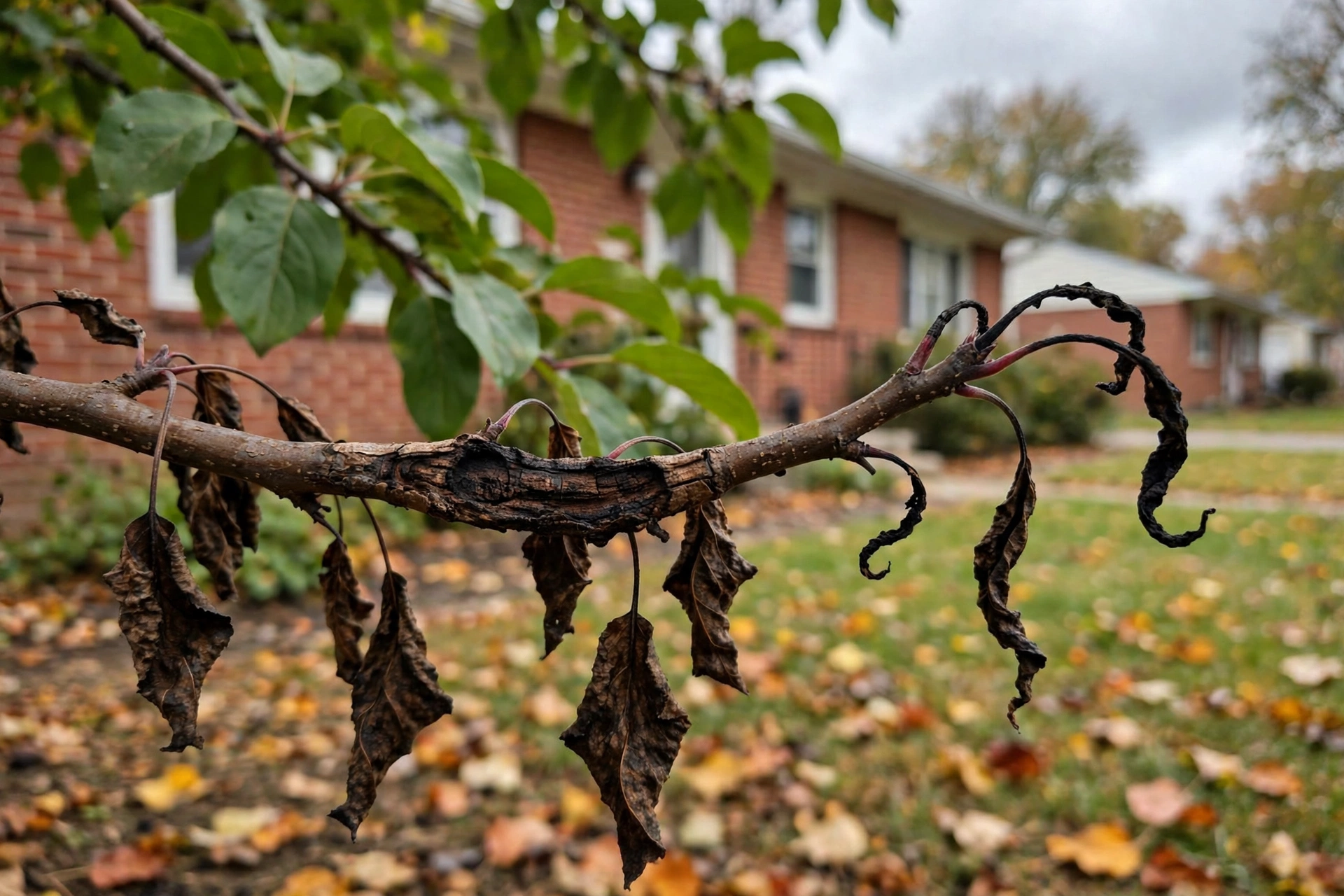
If the branch tips on your crabapple or pear look scorched black, curl over like a shepherd’s crook, and hold dead leaves long after fall, that is fire blight — a bacterial disease, not sun or frost damage. It spreads fast in warm, wet spring weather, and the fix is dormant-season pruning, done now.
Quick Facts
- The disease: Fire blight, caused by the bacterium Erwinia amylovora. It attacks only plants in the rose family.
- The hosts in Peoria yards: Apple, crabapple, pear (including ornamental Callery pear), hawthorn, mountain ash, cotoneaster, and serviceberry.
- The tell-tale sign: Shoot tips that wilt, turn black or dark brown, and curl into a shepherd’s crook, with dead leaves staying attached.
- How fast it moves: Shoot blight can travel down a branch at one to twelve inches a day in warm weather.
- The November job: Prune out cankered wood while the tree is dormant, cutting 6 to 12 inches below the last visible sign of the canker.
- What does not work: Spraying a tree that is already blighted. No spray cures infected wood — it has to be cut out.
- When to worry most: A canker on the trunk, a young tree blighted through, or the same tree struck year after year — that is when removal enters the conversation.
What Fire Blight Actually Is
Fire blight is a bacterial disease, and the bacterium behind it, Erwinia amylovora, only attacks plants in the rose family. In the Midwest, the trees that suffer most are apple, crabapple, and pear, along with mountain ash and cotoneaster — a list that covers a lot of Peoria, where flowering crabapples fill front yards from the North Valley to Dunlap, Peoria Heights, Morton, and Washington, pears line driveways and parkways, and Callery pear, the Bradford pear planted by the thousand across central Illinois, is a willing host too.
The name comes from how it looks: a blighted branch looks torched — blossoms wilt and brown, new shoots blacken, and dead leaves hang on all summer like scorched paper. It is bacteria, moving through the soft, fast-growing tissue of a tree in spring.
The disease works in three acts. First comes blossom blight: infected flowers turn water-soaked, then droop and brown, and within four or five days the fruiting spur behind them may collapse, dark brown to black. Then shoot blight: the infection runs down the new shoots from the tip, one to twelve inches a day, and the tip curls back on itself into the shepherd’s crook that gives the disease away. Finally, canker: where the dead shoot meets living wood, a sunken, cracked patch of bark forms — and that canker is where the bacteria spend the winter, waiting for spring.
In spring, when temperatures climb above 65 degrees and the weather turns wet, the bacteria in those cankers multiply and ooze out — and at 70 degrees, they can double every 20 minutes. That is why a tree that looked fine in May can look half-dead by June.
The Shepherd’s Crook: How to Spot Fire Blight in Your Yard
Go out this month, once the leaves have mostly dropped, and look at your crabapple, apple, or pear. Fire blight leaves four signatures, and any one is worth a closer look.
First, the shoot tips. A blighted shoot wilts, darkens, and bends over at the tip, forming a hook or crook. On pear the dead tissue is black; on apple and crabapple it is brown to chocolate brown. The color difference is a useful clue: if the blackened tips are on your pear and the brown ones on your crabapple, you may be looking at the same disease on two trees, not two different problems.
Second, the leaves. Blighted leaves wilt, die, and turn dark brown or black — and they stay attached to the branch through the summer and into fall, instead of dropping cleanly. A branch holding a cluster of dead, curled leaves in November, when the rest of the tree is bare, is a branch to inspect.
Third, the blossoms. You will not see this in November, but remember it for spring: the first symptom is usually a blossom that looks water-soaked, then droops and browns. If your pear’s spring bloom went brown in patches instead of fading white, fire blight was likely already at work, and the shoot blight that followed was its second act.
Fourth, the cankers. Run your eyes along the branch below a dead tip and look for a sunken, slightly cracked or discolored patch of bark — often darker than the bark around it, sometimes with a sharp edge where dead wood meets living wood. Cankers form at the base of the dead areas, and they are the part of the disease that survives winter. Finding them is the whole point of a November inspection, because a canker you find now is one you can cut out before spring.
Do not diagnose from a single brown leaf — fire blight is a pattern: blackened tips, curled hooks, dead leaves that refuse to drop, and cankers below them, all on a rose-family tree.
Fire Blight or Something Else? The Look-Alikes
Blackened branch tips worry homeowners, but fire blight is not the only thing that blackens them. Rule out the look-alikes first — each one calls for a different response.
| What you see | Most likely cause | How to tell it apart |
|---|---|---|
| Shoot tips blackened and curled into a hook, dead leaves still attached | Fire blight | Cankers below the dead wood; pattern repeats on several shoots; only on rose-family trees |
| New growth wilted and brown after a cold snap, tips straight not hooked | Late spring frost | Whole branch tips damaged at once, right after a freeze; no cankers; damage stops at the frost line |
| Leaves scorched brown at the edges in a hot, dry summer | Heat and drought stress | Browning starts at leaf edges and works inward; no curled shoot tips; the whole tree looks thirsty, not just the tips |
| Orange spots on crabapple leaves, brown balls on a nearby cedar | Cedar-apple rust | Leaf spots are yellow-orange and swollen; galls sit on juniper, not on the crabapple's wood |
| Sudden wilting of a whole branch on an oak in summer | Oak wilt or another vascular disease | Oak, not a rose-family tree; leaves wilt from the top down without the shepherd's crook |
Frost is the one most often confused with fire blight in Peoria, because both can hit in spring. The difference is the pattern: frost damages a whole flush of new growth at once, on the night of the freeze, and it does not leave cankers. Fire blight follows the bloom, moves down one shoot at a time, and leaves cankers behind. If you are not sure, look for the canker — it is the fingerprint. And if you are still not sure, the tree disease decision guide walks through the treat-it, prune-it, or remove-it question for any sick tree, and the University of Illinois Plant Clinic can confirm a diagnosis from a sample.
How It Spreads So Fast
The reason fire blight can take a tree in a single season is the way it travels. The bacteria spend winter alive in the living tissue at the edges of old cankers, and in buds. When spring turns warm — above 65 degrees — and wet, they multiply and ooze out of the cankers in a sticky, amber-colored bacterial ooze. Rain splashes that ooze onto open blossoms. Pollinating insects carry it from flower to flower as they work. And the infection, once it takes hold in a blossom, races down the shoot at up to a foot a day.
That speed is why timing matters so much. The bulk of new infections happen during flowering, when temperatures are warm and conditions are wet. A wet, warm May in central Illinois — the kind of spring Peoria gets most years — is prime fire blight weather. A dry, cool spring is not. You cannot control the weather, but you can control how much inoculum is sitting in your yard when bloom arrives, and that is exactly what dormant-season pruning does: it removes the cankers before they can ooze.
People spread it too. Pruning tools carry the bacteria from a cut branch to a healthy one, especially in the growing season. Heavy pruning and heavy nitrogen fertilizer also make it worse: both push a flush of young, succulent growth, which is exactly what the bacterium infects most easily. Do not over-fertilize, and do not prune hard during the growing season.
The bacterium also moves inside the tree, down through the wood ahead of the visible damage — which is why the pruning cut is made well below what you can see, not at the edge of the blackened wood.
Why November Is the Month to Act
Fire blight has a season, and November sits at the useful end of it. The tree is going dormant. The bacteria are quiet inside the cankers. The leaves are down, so you can actually see the branch structure, the dead tips, and the sunken canker patches that were hidden by foliage all summer. And every canker you remove now is a canker that cannot ooze bacteria onto next spring’s blossoms.
This is also the safest time to cut. In the dormant season, there is no fresh sap flow to carry bacteria, no bloom to infect, and no insects moving between flowers. The Extension guidance is explicit: pruners do not need to be disinfected between cuts when the tree is dormant. Compare that with growing-season pruning, when every cut should be made in hot, dry conditions, with tools disinfected between cuts — and even then, the cut has to go further below the damage. Dormant pruning is simply the lower-risk job, and November through March is the window for it in central Illinois.
Pair the inspection with your late-fall yard work: walk each rose-family tree once, look for the four signatures, and mark what you find with ribbon or flagging tape. If the tree needs more than a few cuts, or the cankers are high up, that is a job for a crew with the right equipment — the same judgment that applies to any dormant-season pruning work, with the added rule that blighted wood must be cut further back and disposed of properly.
Do not wait for spring to see whether it gets better on its own. A canker that survives winter becomes next spring’s source of infection, and a shoot blighted this year will not leaf out next year. Cutting the canker out is what stops it.
How to Prune Out Fire Blight
If the disease is limited to a few shoots, you can handle it — but the cut matters more than the effort. Cut wrong, and you leave the bacteria in the tree. Cut right, and you have done the single most effective thing there is against fire blight.
Start by finding the canker. Follow each dead shoot down until you reach the sunken, discolored patch of bark at its base. Then measure your cut: at least 6 to 12 inches below the last visible sign of the canker, into healthy wood. Extension sources give the range as 6 to 8 inches in one guide and 6 to 12 in another — use the full 12 inches when you can, because the bacteria travel ahead of the visible damage inside the wood. Do not leave a stub. Take the affected branch all the way back to the trunk or to the nearest side branch that is at least 6 inches below the canker, so the wound can close cleanly.
In the dormant season, you do not need to disinfect your tools between cuts. If you are forced to prune during the growing season — because a shoot is actively dying and you cannot wait — the rules change: prune only in hot, dry weather, cut 6 to 12 inches below the visible symptoms, and sanitize your pruners between every cut with a 10 percent household bleach solution or a similar disinfectant. Growing-season pruning is a rescue, not a routine, and it carries a real risk of spreading the disease to the next branch you cut.
Disposal matters as much as the cut: blighted wood is still infectious. Bag it or burn it where allowed — do not compost it, and do not leave cut branches under the tree, where spring rain will splash bacteria back onto it. Clean up the same day you prune.
And stop feeding the problem: skip heavy nitrogen fertilizer on a blighted tree, and skip hard spring pruning that forces a flush of soft new growth. A steadily growing tree is a harder target than one pushed into tender shoots. If you fertilize at all, do it only if a soil test says the tree needs it — and that is a question for your local Extension office, not a guess from a bag label.
When Pruning Is Not Enough: The Removal Decision
Most fire blight can be pruned out. But there are four situations where cutting branches is no longer the answer, and removal is the honest call.
First, a canker on the trunk. A branch canker is a pruning job; a trunk canker is a structural wound on the tree’s main stem. If it wraps much of the trunk, the wood above it starves, and the tree declines no matter how many branches you save. Second, a young tree blighted through. A newly planted apple or pear with infection running down the central leader has little healthy wood left to rebuild from — and the bacterium will likely be back next spring from the cankers it left behind. Third, the same tree struck year after year. One bad spring is bad luck; three in a row on the same tree means the tree is a reservoir of infection for every other rose-family tree in the yard and the neighborhood. Fourth, a tree whose blight has reached the root flare or the graft union. At that point there is no clean cut left to make.
If you are weighing that decision, the tree disease decision guide lays out the same framework — pest type, location, extent, and risk to nearby trees — and the cost guide explains what goes into a removal estimate in Peoria, so you can plan rather than guess. Costs vary by tree size, location, and access, and any figure should come from a free on-site estimate, never from a blog post.
One special case deserves its own note: Callery pear. If your infected tree is a Bradford or other Callery pear, the Extension guidance is unusually direct — cut it at ground level and replace it with a more desirable species. The tree is already on its way out of Illinois landscapes: it was added to the Illinois Exotic Weed Act in October 2025, with a ban on sale, planting, and distribution taking effect January 1, 2028, and existing trees are not required to be removed. Fire blight is simply one more reason not to invest in saving one. Our invasive trees guide covers the law and the replacement question in full.
What to Plant Instead
If a tree has to come out, or if you are planting a new apple or pear, choose a variety that fights back. The Extension lists apple cultivars with some fire blight resistance — Gold Rush, Empire, Enterprise, Liberty, and Winecrisp — and pear varieties Magness, Maxine, Moonglow, and Summercrisp. Resistance is not immunity — a resistant tree can still be infected in a bad spring, but is far less likely to be killed. Skip the Bartlett pear: Bartletts are extremely susceptible and are not recommended for planting in Illinois. For ornamental crabapples, ask the nursery for varieties with documented disease resistance, and give the new tree room — air circulation and morning sun dry foliage faster after rain.
What Sprays Can and Cannot Do
Sprays have a narrow role, and it is worth being straight about the limits. Copper sprayed in the dormant season and at green tip can reduce bacteria on the tree’s surface; commercial growers spray streptomycin every four to five days through bloom. Both are prevention, timed to bloom, and hard for a homeowner to time well. Neither cures infected wood — once bacteria are inside a shoot, no spray reaches them; only the saw does. If anyone offers a spray to cure a blighted tree, that is a promise the chemistry cannot keep. Prune first, then ask your Extension office whether a preventive spray makes sense for the trees that remain.
Frequently Asked Questions
Can fire blight kill my crabapple?
It can kill branches, and a young or badly infected tree, but a mature crabapple usually survives with pruning. The real risk is a trunk canker, a young tree blighted through, or repeated strikes year after year — if the trunk is cankered, have the tree assessed rather than waiting.
Is fire blight contagious to people, pets, or other trees?
No to people and pets — the bacterium only infects rose-family plants. It will not jump to your maple, oak, or spruce. But it will spread to other apples, crabapples, pears, hawthorns, and Callery pears nearby, carried by rain, insects, and pruning tools. That is why disposing of blighted prunings matters.
I pruned the blackened tips off in June. Why did it come back?
Usually the cut did not go far enough below the canker — the bacteria travel inside the wood ahead of the visible damage. Or growing-season pruning without disinfecting tools carried them to the next branch. Dormant-season pruning, 6 to 12 inches below the canker, is the reliable fix.
Should I fertilize my blighted tree to help it recover?
No — not with nitrogen. Heavy nitrogen and hard pruning push a flush of young, succulent growth, and that is exactly the tissue fire blight infects most easily. Hold off on fertilizer unless a soil test says the tree needs it, and let the tree grow at a steady, moderate pace.
My neighbor’s pear is blighted. Is my crabapple at risk?
Yes, if it is close — most infections happen within several hundred feet of a source, carried by rain and pollinating insects during bloom. Inspect your tree this November, prune out any cankers, and clean up fallen blighted wood.
Peoria Tree Removal Co. — 114 W Forrest Hill Ave, Peoria, IL 61604 — (309) 250-8333 — treeremovalpeoriail.com — Mon–Sat 8am–6pm, 24/7 emergency tree service.
Peoria Tree Removal Co.
114 W Forrest Hill Ave, Peoria, IL 61604
Mon–Sat 8am–6pm · 24/7 emergency tree service