
Plant for the tree you will have in twenty years, not the sapling in the pot. In Peoria, that usually means twenty feet or more from the house for a shade tree, and farther for the biggest species.
How far from the house should you plant a tree in Peoria? For a large shade tree, start at twenty feet from the foundation and go farther for the biggest species — and let the tree’s mature spread, not the size of the sapling, set the distance. A small ornamental tree can sit much closer. The expensive mistake is planting a future sixty-foot oak ten feet from the house because it looked small in the pot, then paying to remove it twenty years later. This guide gives you the spacing rules, the exceptions, and the checks to make before you dig.
Quick Facts
- The core rule: Plant a tree about as far from the house as half its mature canopy spread — and farther for large or aggressive-rooted species.
- Illinois Extension’s starting point: Shade trees about 20 feet apart and 20 feet from the foundation; smaller ornamental trees can be planted closer.
- Spacing by mature size: Small trees (10–30 feet tall) need about a 20-foot diameter of room; medium trees (30–50 feet) about 30 feet; large trees (over 50 feet) about 40 feet.
- Tree-to-tree spacing: Large shade trees about 50 feet apart, medium trees about 35 feet, small trees 15–20 feet apart.
- Before you dig: Call 811 for a utility locate. In Peoria that one call covers the lines under your yard, and it is free.
- Best season here: Fall is an excellent time to plant in central Illinois, according to Illinois Extension — and November planting still counts, before the ground freezes.
- This post is the planting decision: If the tree is already in the ground and too close, that is a different question, covered by the removal-side guidance linked later in this post.
Plant for the Mature Tree, Not the Sapling
Every planting mistake starts the same way. A homeowner stands in the yard with a five-foot sapling in a pot, holds it up against the house, and thinks, “That looks fine there.” It does look fine. The sapling is five feet tall and two feet wide. The problem is that the sapling is not the tree. The tree is what it becomes in twenty years: a red oak forty feet across, a silver maple with surface roots lifting the sidewalk, a honey locust dropping pods over the driveway.
University of Illinois Extension horticulture educator Kelly Allsup has named this exact mistake. Homeowners plant a small sapling close to the house, Allsup says, only to cut it down later or over-prune it, never letting it take its natural shape. The tree did not misbehave. It grew. The spot was chosen for the first summer, not for the fiftieth.
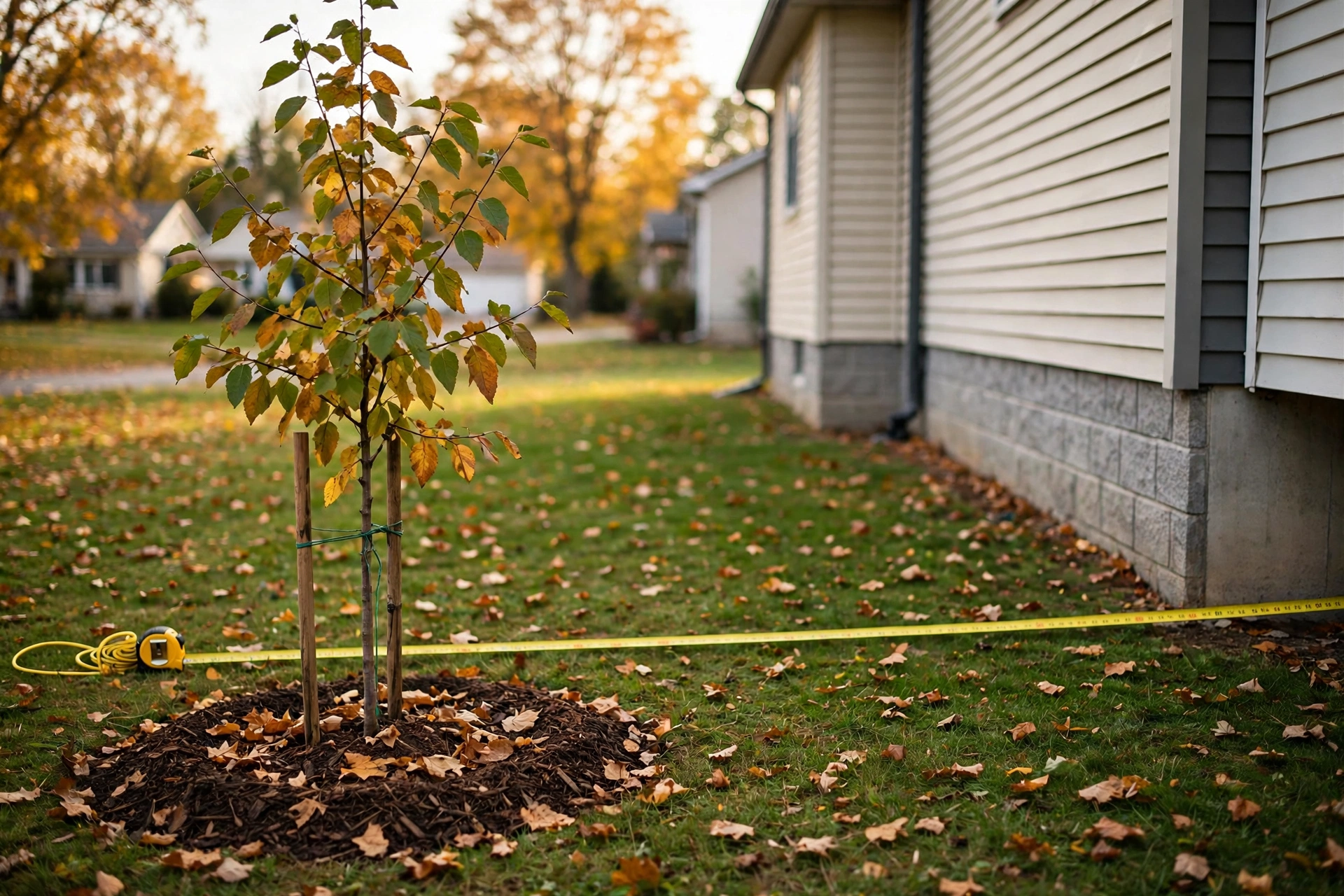
The fix costs nothing: plant for the mature tree. Before you buy, find the tree’s mature height and spread — on the nursery tag, in the catalog, or in Extension publications. Then measure from where the trunk will stand to the house, the driveway, the sidewalk, and the next tree, using the spread as your ruler. A tree that matures forty feet across reaches about twenty feet out from its trunk in every direction. Plant its trunk twenty feet from the foundation and its branches will just clear the roof at maturity. Plant it ten feet away and you have bought twenty years of pruning, gutter cleaning, and eventually a removal conversation.
The most useful rule is the simplest. The International Society of Arboriculture’s spacing guidance puts it this way: placement from the house is about one-half the ultimate spread — or, for two different plants, one-half of the total spread of both. A forty-foot-spread tree goes twenty feet from the house; two forty-foot trees go forty feet apart, trunk to trunk. The rule works because a tree’s root system roughly matches its canopy. Give the canopy its room, and you have usually given the roots theirs. Illinois Extension’s fall-planting guidance, written for Fulton, Mason, Peoria, and Tazewell counties, gives the same advice in round numbers: shade trees twenty feet apart and twenty feet from the foundation, smaller ornamentals closer. That twenty-foot figure is a starting point for a shade tree, not a ceiling — a large oak or a soft maple needs more.
Spacing by Size: Small, Medium, and Large Trees
The table below turns the rules above into numbers you can take into the yard with a tape measure. These are general guidance ranges from Extension and ISA sources, not guarantees for any individual tree. Soil, water, and the specific cultivar all move the real mature size.
| Size class at maturity | Height | Room needed (diameter) | Minimum from the house | Tree-to-tree spacing |
|---|---|---|---|---|
| Small ornamental | 10–30 ft | About 20 ft | 8–10 ft for accent plantings; 15–20 ft is safer | 15–20 ft apart |
| Medium shade | 30–50 ft | About 30 ft | 15–20 ft; 20 ft is the Extension shade-tree starting point | About 35 ft apart |
| Large shade | Over 50 ft | About 40 ft | 20 ft minimum; 30–50 ft for the biggest species | About 50 ft apart |
| Aggressive roots (willow, poplar, silver maple) | Varies | As large class, or more | 50 ft from structures is the common rule of thumb | Give them the most room you have |
Small trees are the right answer for a lot of Peoria lots. A redbud, dogwood, hawthorn, or crabapple matures at fifteen to twenty-five feet and can sit eight feet from the house as an accent planting without threatening the roof or foundation. On a tight lot off Grandview Drive or in the older neighborhoods near Bradley University, where the yard is measured in feet rather than acres, a small tree is often the difference between having a tree and having a problem. Pick the small tree on purpose, and you get spring flowers, fall color, and shade for a porch without a removal bill in twenty years.
Medium trees are the workhorses: red maple, river birch, and their kin, maturing at thirty to fifty feet. Twenty feet from the house is a sound minimum, and thirty-five feet apart keeps two medium trees from fighting for light, water, and root room. A medium tree twenty feet from the foundation will still reach the roofline with its outer branches at maturity — that is normal, and manageable with periodic pruning. What the twenty feet buys you is time: time before the branches touch the roof, and room to prune without butchering the tree’s shape.
Large trees are a different commitment. Oaks and other strong-wooded shade trees should be planted no closer than twenty feet from the house, and the biggest species deserve thirty to fifty feet. The ISA guidance is blunt about soft-wooded trees such as soft maple: plant them at an even greater distance than oaks. Large trees need about fifty feet from each other, and their forty-foot diameter of room is not negotiable if you want the tree to reach its natural shape. On a small city lot, a large tree may simply not fit — and that is useful information. A large tree in a small yard is a removal waiting for a storm. A medium or small tree in the same spot is a tree your grandchildren will sit under.
The aggressive-root row deserves its own warning. Willows, poplars, cottonwoods, and silver maple have fast-growing, shallow, fibrous root systems that seek water aggressively. The common rule of thumb is fifty feet from any structure, including the house, and the same caution applies to sewer lines and water lines. Silver maple is the one Peoria homeowners meet most often: fast-growing, weak-wooded, and famous for surface roots that lift sidewalks and driveways. If you love a silver maple, plant it far out in the yard, where it has room to be what it is. If the only spot you have is fifteen feet from the house, choose something else.
Foundations, Lines, Neighbors, and the Rest of the Yard
The house is not the only thing a tree needs distance from. Foundations, driveways, sidewalks, utility lines, and property lines each have their own logic, and a spot that clears the house can still fail on one of the others.
Foundations first, because they worry people most. The honest news is reassuring: tree roots do not, as a rule, punch through a sound foundation. Roots follow water and oxygen, and the soil hard against a foundation is compacted and dry, so roots tend to grow away from it. What roots will do is exploit a foundation that already has cracks, and draw moisture from nearby clay soils, which can contribute to settling. The half-spread rule protects you here too: it keeps most of the root mass out of the foundation zone. If your foundation already has cracks, fix the foundation first and plant second — no spacing rule compensates for a cracked wall.
Driveways and sidewalks fail from underneath. Surface roots, especially from maples, lift concrete a fraction of an inch a year until the sidewalk heaves and the driveway cracks. Keep large and aggressive-rooted trees well away from concrete, and choose deeper-rooted species near walks and drives. If a walkway already heaves, do not just cut the roots — root pruning near a mature tree can destabilize it, and that work needs an on-site assessment rather than a shovel and a guess.
Overhead lines are the check with safety consequences. A tree planted under a power line will grow into it. The choice is between a small tree that matures below the line, a spot well clear of the line, or a lifetime of line-clearance pruning. Ameren handles trimming near its lines, and no homeowner or crew should cut near a live line. The same logic applies to the service drop to your own house: it is the line a growing crown finds first. Underground, the check is a phone call. Call 811 before you dig — in Illinois it is free, and locators will mark the gas, electric, water, sewer, and communications lines under your yard. Planting on top of a sewer lateral is a slow-motion problem: roots find the joints, the joints leak, and the backup arrives on the worst possible day.
The property line deserves the same half-spread treatment as the house. If the tree will spread forty feet, its trunk belongs twenty feet from the line, so that at maturity roughly half the canopy sits on your side. On a narrow lot that is not always available, and then the honest options are a smaller tree, a different spot, or a conversation with the neighbor before you plant. A neighbor who knows a redbud is going in eight feet from the line is a neighbor. A neighbor who discovers a silver maple two feet from the fence, five years later, is a dispute. The property-line guidance on this site walks through shared trees and boundary lines, and it is worth reading before you plant near a line, not after the branches cross it. Leave room to walk behind the tree and maintain the fence, too — that room saves a rebuild, or a conversation you do not want to have.
Fall Planting, and Picking the Tree for the Room You Have
If you are reading this in November, you have not missed the season. Illinois Extension is clear that fall is an excellent time to plant a tree in central Illinois. Fall-planted trees put their energy into root growth while the top is dormant, and they wake up in spring already established. The window runs until the ground freezes — in zone 6a, with first frost usually arriving between October 11 and 20, that still leaves planting days in November in most years, as long as you can still dig the hole. If you have the spot measured, the species chosen, and the 811 marks in place, November is a good month to plant. If you have not measured yet, use November to measure, and plant in spring with the numbers settled. A winter of planning beats a spring of guessing.
Planting technique matters as much as spacing. Plant at the correct depth, with the root flare visible at or just above the soil line — a tree planted too deep looks like a telephone pole, and its roots suffocate. Make the hole two to three times as wide as the root ball and no deeper, rough up the sides so roots spread, and correct girdling roots before the tree goes in. Water it in well, mulch two to four inches deep, and keep the mulch off the trunk. Before you plant, run the numbers through a second check: the Tree Planting Spacing Planner on this site takes your tree’s mature size and available space and works out the spacing. Use it as the arithmetic check on the rules in this post, not as a substitute for them.
Start your choice from the room, not from the catalog photo. Measure the distance from the trunk spot to the house, driveway, sidewalk, property line, and nearest existing tree. Write the smallest number down. That number is your budget. Shop for a tree whose half-spread fits inside it, with room to spare. For a tight spot — under fifteen feet from the house — stay small. For twenty to thirty feet of clear room, a red maple or river birch earns its keep. For forty feet or more in every direction, an oak is a gift to the next owner of the house. Think about what else the tree will do in that spot, too: a tree west of the house shades the afternoon sun and cuts summer cooling demand, while a tree south of the house shades the roof in winter as well, when you want the sun. A tree near a patio drops leaves or fruit on it, and the species decides whether that is pleasant or a weekly chore.
If the tree you want does not fit the room you have, that is not a failure — it is the spacing rules doing their job. The tree planting service page sets out what professional planting covers, and a free estimate visit is a good place to test your measurements against someone who plants trees every week. And if the tree is already there — already too close, already over the roof, already lifting the walk — do not reach for the saw first. The tree too close to the house guide walks through when pruning can keep a close tree safely, and when removal is the honest answer. Planting distance and removal distance are the same question asked at different times. Ask it early, and you rarely have to ask it late.
Frequently Asked Questions
How far should a tree be from a house?
Plant the trunk about as far from the house as half the tree’s mature canopy spread, at minimum. For a shade tree that means about twenty feet from the foundation as a starting point, and thirty to fifty feet for the largest species. Small ornamentals can sit as close as eight feet.
What happens if a tree is planted too close to a house?
Branches reach the roof and gutters, roots crowd the foundation edge, and the tree needs constant pruning to keep its shape. Over time it usually has to be removed or heavily cut back — the expensive outcome the spacing rules exist to prevent.
How far apart should trees be planted?
About fifty feet for large shade trees, thirty-five feet for medium trees, and fifteen to twenty feet for small trees, trunk to trunk. Give each tree its full mature diameter of room.
What small trees are safe near a house?
Redbud, dogwood, hawthorn, and crabapple are good small choices for tight Peoria lots. They mature at fifteen to twenty-five feet and will not threaten the roof at maturity.
Should I plant a silver maple near my house?
Only with a great deal of room — fifty feet from structures is the common rule of thumb for silver maple, willow, and poplar. In a small yard, choose a different species.
Do I need to call 811 before planting a tree?
Yes. Call 811 before you dig, and let the locators mark the underground lines. It is free, and it keeps you from planting on top of a gas, electric, water, or sewer line.
Is November too late to plant a tree in Peoria?
No. Fall is an excellent planting season in central Illinois, and planting can continue until the ground freezes. A fall-planted tree establishes roots over winter and wakes up ready for spring.
If you are choosing a tree for a Peoria yard and want a second opinion on the spacing before you dig, call Peoria Tree Removal Co. at (309) 250-8333 for a free estimate. Measure the distances, check the mature spread, and plant once, in the right spot. Start with the Peoria Tree Removal Co. homepage for the full picture of the services behind the advice in this post, and read the best time to plant a tree guide if you want the seasonal timing in more detail.
Peoria Tree Removal Co. — 114 W Forrest Hill Ave, Peoria, IL 61604 — (309) 250-8333 — https://treeremovalpeoriail.com/
Peoria Tree Removal Co.
114 W Forrest Hill Ave, Peoria, IL 61604
Mon–Sat 8am–6pm · 24/7 emergency tree service