
Tree roots and septic systems are a slow, expensive collision — roots chase the moisture and nutrients in a drain field, and the damage usually shows up years after the tree was planted. Distance and species choice are the whole prevention.
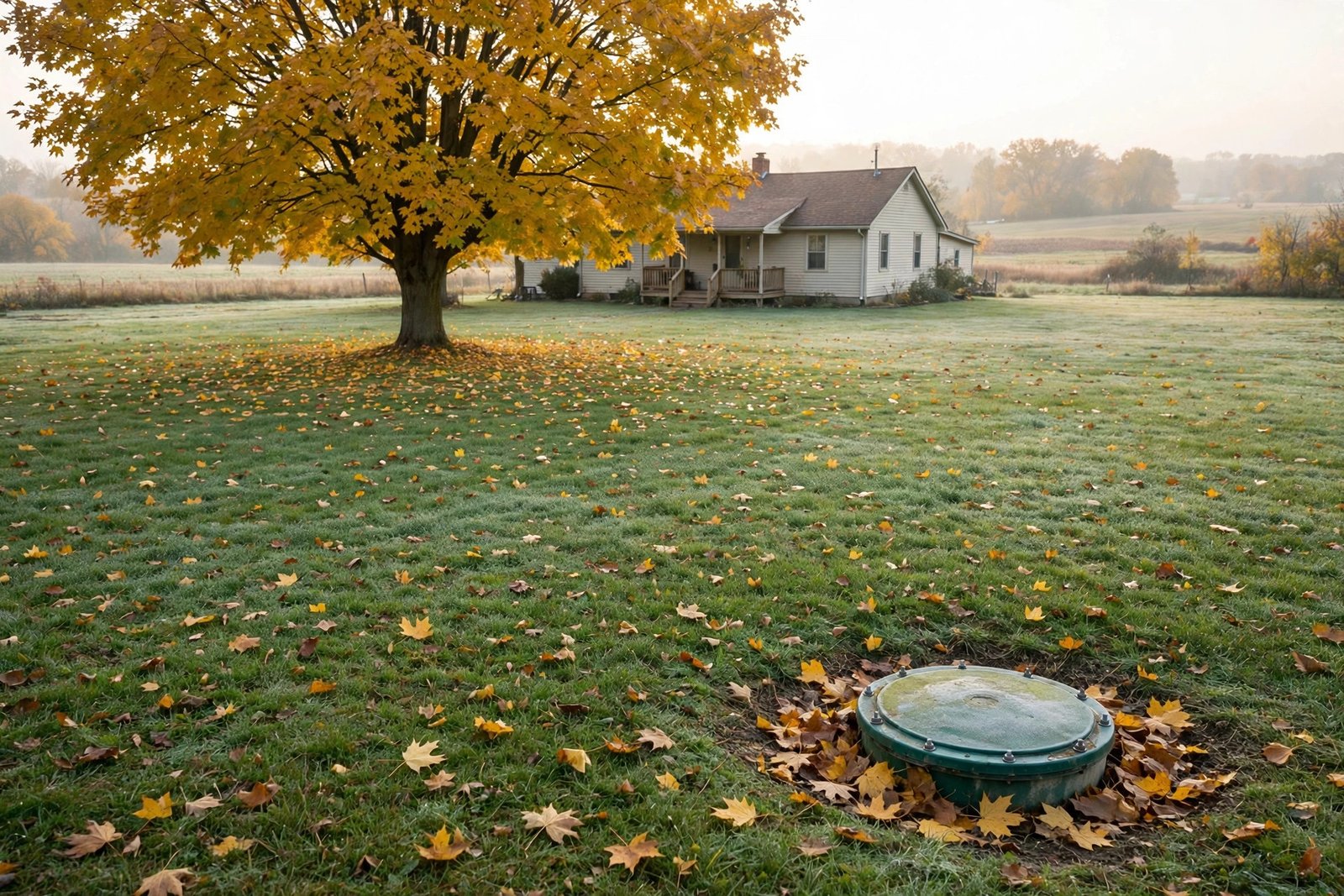
Plenty of Peoria County homes sit beyond the city sewer lines — out toward Dunlap, Edelstein, Chillicothe, and the rural edges of Bartonville and Washington — and those homes run on septic systems. A septic system is a quiet neighbor until something goes wrong, and one of the most common things to go wrong is a tree. Roots do not attack a drain field out of malice. They grow toward water and nutrients, and a drain field is the wettest, richest soil on the property. A maple planted twenty feet from the field as a sapling can send roots into the pipes fifteen years later, and the first sign is usually a slow drain or a soggy patch of lawn — by which time the fix is already expensive. This post explains how a septic system works, why roots love it, how far trees should stand from it, which species are the worst offenders, the warning signs to watch for, and what to do when a tree is already too close.
Quick Facts
- Most feeder roots live in the top 12–24 inches of soil — exactly the depth where drain field pipes run.
- Keep trees at least 20 feet from a drain field (University of Minnesota Extension guidance); water-seeking species need at least 50 feet.
- Never plant trees or shrubs on the drain field itself — grass and shallow-rooted plants only.
- The worst species near septic are willow, silver maple, poplar, elm, red maple, and river birch.
- Warning signs: slow drains, gurgling toilets, sewage odors, wet or unusually green patches over the field, and sewage backing up into the house.
- Call 811 (JULIE in Illinois) before you dig anywhere near a septic system — and find your field’s location first.
How a Septic System Works
A home septic system has two parts, and roots threaten each one differently. The septic tank is the buried concrete or plastic box near the house that holds wastewater long enough for solids to settle and scum to float. The clarified liquid — effluent — then flows out to the drain field, a network of perforated pipes buried in shallow trenches under the lawn, where it seeps into the soil and is treated by soil microbes. A mound system, common where the soil is shallow or the water table is high, raises that drain field above ground level in a built-up sand mound.
Two features of the drain field matter for trees. First, the pipes are shallow — most feeder roots live in the top 12 to 24 inches of soil, which is exactly where the pipes sit. Second, the field is wet and rich. Effluent carries water and nutrients year-round, even in a dry August when the rest of the lawn is brown. Roots grow in response to moisture, so they grow toward the field and keep growing once they arrive. A root does not need to break a pipe to cause trouble: fine feeder roots slip through tiny cracks, deteriorated pipe joints, and the perforations in the leach lines themselves, then grow into a mat that slows or blocks the flow.
The tank has its own risks. Roots can enter through hairline cracks in a concrete tank wall or a deteriorated seal, and a large tree close to the tank can shift or crack the structure as its roots thicken. Tank lids matter too: a heavy tree over a shallow tank lid is a weight and access problem when the tank needs pumping. None of this happens fast. That is the trap. A tree planted at a safe-looking distance as a sapling can become a problem tree at maturity, when its root system is two to three times as wide as its canopy.
Safe Distances: How Far Is Far Enough
There is no single magic number, because the right distance depends on the tree’s mature size and how thirsty its species is. University of Minnesota Extension gives the clearest rule: plant trees at least 20 feet from the edge of a septic mound or drain field, and plant water-seeking species — poplar, maple, willow, and elm — at least 50 feet away. A second Extension answer puts the same 20-foot minimum on small trees such as crabapple or cherry. The working rule many arborists use is simpler still: keep a tree at least as far from the field as its mature height. A tree that will grow 50 feet tall should stand at least 50 feet from the nearest drain field pipe.
| Septic component | Small trees (mature height under 30 ft) | Large trees (mature height over 30 ft) |
|---|---|---|
| Septic tank | At least 10–20 ft | At least 20–30 ft |
| Drain field / leach lines | At least 20 ft | At least 50 ft |
| Drain field, water-seeking species (willow, poplar, silver maple, elm) | At least 50 ft | At least 50–100 ft |
| Mound system | At least 20 ft from the mound edge | At least 50 ft from the mound edge |
Two cautions belong with this table. First, distance is measured from the nearest pipe or mound edge, not from the tank lid you can see. If you do not know where your field is, find out before you plant — the Peoria County Health Department keeps septic records for many properties, and a septic company can locate the field if the records are thin. Second, a drain field also needs sunlight. Clemson and Washington State University Extension both note that drain fields depend on evaporation and transpiration to shed moisture. A tree that shades the field all day reduces that drying, and a saturated field can look like a failing field even when the pipes are intact. Distance helps. Shade is a second reason to keep big trees well clear.
The Worst Trees Near Septic — and the Safer Ones
Species matters as much as distance. A willow at 60 feet will still send roots toward a drain field. A small, well-behaved tree at 25 feet may never touch it. The species to keep far away are the fast-growing, water-loving ones with aggressive root systems:
- Weeping willow — the worst offender. Its roots can travel more than 100 feet from the trunk, and it will find a drain field from across a yard.
- Silver maple — common in Peoria yards, fast-growing, with aggressive surface roots that also lift sidewalks and damage foundations.
- Poplar and cottonwood — fast, wide-rooted, and specifically fond of damp ground.
- American elm, red maple, river birch, sweetgum, and box elder — all vigorous rooters that do well in wet soil, which is exactly why they are dangerous near a field.
The safer choices are small trees with compact, fibrous root systems and modest water demand: Japanese maple, dogwood, and eastern redbud are the usual recommendations, planted at least 20 feet from the field. Even these are not “plant anywhere” trees — 20 feet is still the floor, not a suggestion. And nothing woody belongs on the field itself. Over a drain field, the rule is lawn or shallow-rooted herbaceous plants only. If you want screening near the field, use large shrubs set outside the clearance ring, or a fence, rather than a tree that will outgrow its welcome.
Warning Signs That Roots Have Found Your Septic System
Root intrusion rarely announces itself early. Most homeowners get their first warning when the problem is already well advanced. Watch for these signs, and take more than one of them seriously:
- Slow drains throughout the house. One slow sink is a clog. Every drain running slow at once points to the system, not a single fixture.
- Gurgling sounds in toilets and drains. Air trapped by a partial blockage bubbles back through the plumbing.
- Sewage odors inside or outside the house. A smell near the drain field, or a smell indoors with no obvious source, can mean effluent is not dispersing.
- Wet or unusually green patches over the drain field during dry weather. A lush, soggy strip above the field while the rest of the lawn is dry is effluent reaching the surface.
- Sewage backing up into the house. This is the late sign, and it means the blockage is severe. Do not wait for this one.
If you see these signs, the next step is a diagnosis, not a guess. A septic company can run a camera through the lines and show you whether roots are the problem, and where. That inspection matters, because the same symptoms can come from a full tank, a crushed pipe, or a saturated field — and each has a different fix. Do not pour root-killing chemicals into the system on a guess: copper sulfate and similar products can kill the soil microbes the field depends on, and they do not remove the root mass already in the pipes.
What to Do When Roots Are Already In
Once roots are in the pipes, the tree and the system are in conflict, and the fix has to deal with both sides. The septic side comes first: a septic professional clears the lines, usually by cutting the roots out mechanically, and assesses whether the pipes are damaged or just blocked. A camera inspection after clearing shows whether the pipes can be saved or need a section replaced. If the field itself is damaged — collapsed laterals, or soil so saturated it no longer treats effluent — the repair is bigger, and it may need a permit and a design change. That is septic-company and county-health-department territory, not a tree-crew decision.
The tree side is the harder call. Cutting the roots back buys time, but roots grow back, and they grow back toward the same water source. Root barriers — vertical plastic or metal sheets buried between the tree and the field — can slow the return, but they are not a permanent wall, and installing one means digging near the very pipes you are trying to protect. Call 811 (JULIE in Illinois) before any digging near a septic system, and have the field marked before a shovel goes in.
In many cases the honest answer is removal. A large willow or silver maple 15 feet from a drain field will keep sending roots into it for as long as it stands, and each clearing buys less time than the last. Removal ends the cycle: the tree comes down, the stump is ground, and the field gets a chance to recover. That is a real cost, and it is worth weighing against the cost of repeated septic repairs — but it is a decision to make with the septic company’s findings in hand, not on the basis of a hunch. Our guide to tree roots and sewer lines covers the related problem of roots in municipal sewer pipes, which follows the same logic with a different system.
A Tree Already Too Close: Remove It or Manage It?
Not every close tree has to come down tomorrow. The decision turns on three questions. First, what species is it? A small dogwood 20 feet from the field is a different risk from a willow 20 feet from the field. Second, is there any evidence of intrusion — slow drains, wet patches, or a camera finding? A healthy system with no symptoms buys you time to plan. Third, how much is the tree worth to the property? A specimen oak that shades the whole house may justify root pruning, barriers, and monitoring. A volunteer silver maple that seeded itself by the fence probably does not.
If you decide to keep the tree, manage it deliberately: have the system inspected on a schedule, keep the tank pumped on time, and do not plant anything else near the field. A professional tree inspection can assess the tree’s structure and root zone so the keep-or-remove call is based on the tree’s condition, not just its distance from the field. If you decide to remove it, do it before the roots cause a failure, not after — a planned removal in the dormant season is cheaper and calmer than an emergency septic repair in July. Either way, the decision should be written down with dates, so the next owner knows what was decided and why. Septic problems are one of the things that surface in a home inspection, and a documented history helps at sale time.
Planting New Trees on a Septic Property
The cheapest septic-root problem is the one that never gets planted. Before a new tree goes in, mark the tank, the field, and the lines — on paper and on the ground — and choose the planting spot from that map, not from the view out the window. Pick a species from the safer list, plant it at least 20 feet from the nearest field component (50 feet for anything large or thirsty), and keep the field itself in grass or shallow-rooted perennials. If you are replacing a tree that had to come out, our guide to the best replacement trees for Peoria can help you pick something that fits the yard without repeating the same mistake. If the yard is small and the field takes up most of it, the honest answer may be no new trees in that part of the yard at all, and a planting bed on the far side of the house instead.
When the tree goes in matters too. Fall planting works well in Peoria — the roots establish before winter — but the planting hole must stay clear of the field and the lines. And the same rule that applies to the field applies to the whole yard: call 811 before you dig, every time, even for a small tree. The lines you cannot see are the ones that cost the most to hit.
Frequently Asked Questions
How far should a tree be from a septic drain field?
At least 20 feet from the nearest pipe or mound edge for small trees, and at least 50 feet for large trees or water-seeking species such as willow, poplar, silver maple, and elm. The working rule is at least as far as the tree’s mature height. Measure from the nearest field component, not from the tank lid.
Can tree roots crack a septic tank?
Roots can enter through hairline cracks or deteriorated seals, and a large tree close to a tank can shift or crack the structure as its roots thicken. Tank lids also need to stay accessible for pumping — a heavy tree over a shallow lid is a problem when service is due.
What should I plant over a drain field?
Grass or shallow-rooted herbaceous plants only. No trees, no shrubs, and no vegetable garden on or immediately around the field — roots can invade the pipes, and the field needs sunlight to dry. Large shrubs and small trees belong outside the clearance ring.
Will cutting the roots fix a septic problem?
It buys time, not a cure. Roots grow back toward the same water source, and each clearing tends to buy less time than the last. If a large, thirsty tree stands close to the field, removal is often the lasting fix — decided with a camera inspection and the septic company’s findings, not on a guess.
Find the Field Before You Plant the Tree
Tree roots and septic systems fail slowly, quietly, and expensively — which is exactly why the prevention is so cheap by comparison. A tape measure, a species list, and a phone call to 811 before you dig will do more for your septic system than any product poured down a drain. If you already have a large tree close to a drain field, get the system checked before the symptoms start, and make the keep-or-remove decision with real information instead of hope.
If that decision is removal, Peoria Tree Removal Co. can take the tree down and grind the stump so the field has room to recover. Call (309) 250-8333 for a free estimate. Tell us where the tank and field are before the crew arrives, and we will plan the work around them — because the point of removing the tree is to save the system, not to damage it on the way out.
Peoria Tree Removal Co. — 114 W Forrest Hill Ave, Peoria, IL 61604 — (309) 250-8333 — https://treeremovalpeoriail.com/
Peoria Tree Removal Co.
114 W Forrest Hill Ave, Peoria, IL 61604
Mon–Sat 8am–6pm · 24/7 emergency tree service