
Clearing land in Peoria runs about $1,500 to $6,000 per acre — the spread comes down to what is growing there, how steep it is, and the stumps.
If you own a wooded lot in Peoria and want to know what clearing it will cost, the honest answer is a range, not a number: roughly $1,500 to $6,000 per acre for forestry mulching in Illinois, with a typical residential lot landing somewhere between $1,200 and $3,000. The rest of this post explains what pushes a job toward the low end or the high end, and what a quote should include before you sign it.
Quick Facts
- Typical Illinois range: About $1,500–$6,000 per acre for forestry mulching, depending on density and terrain.
- Typical residential lot: About $1,200–$3,000 for a quarter- to half-acre lot, per Illinois pricing guides.
- National picture: Angi’s 2026 data puts professional land clearing at $1,397–$6,173 per acre, with an Illinois average near $3,630.
- Biggest price drivers: Vegetation density, tree size, slope, access for equipment, and what happens to stumps and debris.
- Cheapest method: Forestry mulching is usually cheaper than conventional dozer-and-haul clearing, because nothing leaves the site.
- What is usually extra: Stump grinding or removal, grading, haul-off, and permits — ask whether each is in the quote.
- Before any digging: Call JULIE 811 so buried utilities are marked. It is free, and it is required before excavation.
What “Land Clearing” Actually Means in Peoria
Land clearing is not the same job as taking down one tree. A single-tree removal is a surgical job: one tree, one drop zone, one stump. Clearing is a site job. It means taking a piece of ground — a lot, a back acre, a fence line, a building footprint — from overgrown to usable in one pass.
Around Peoria, that usually means one of four situations. The first is a new build: a family buys a wooded lot in Dunlap, Washington, or out toward Mossville and needs the house pad, driveway, and septic area opened up. The second is a reclaim: a back acre that has gone to brush, honeysuckle, and volunteer saplings over ten years and needs to become lawn or pasture again. The third is a boundary job: a fence line or property edge choked with brush and small trees. And the fourth is a site-prep job for a garage, pole barn, or addition, where only part of the lot gets cleared and the rest stays wooded.
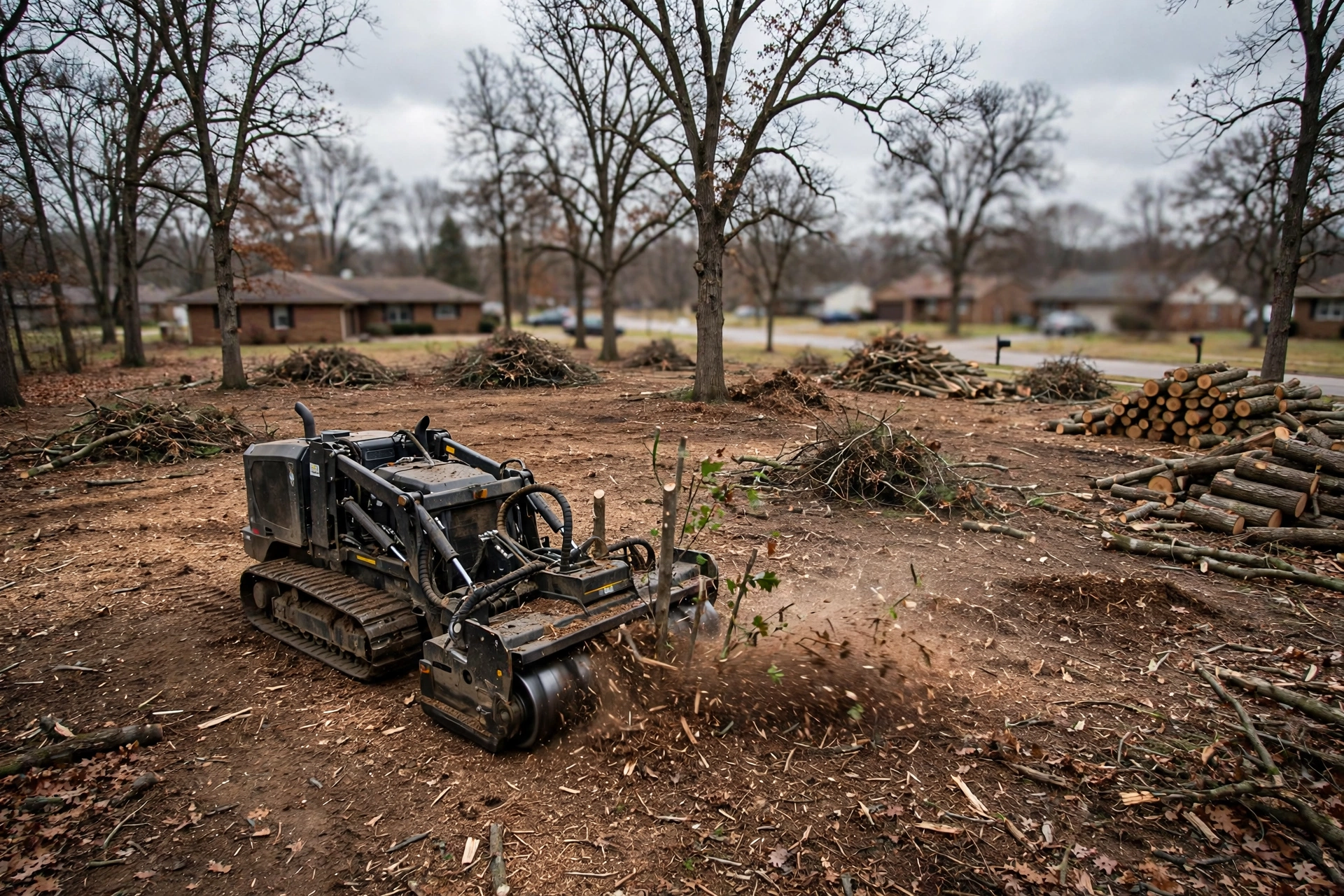
What the crew actually does depends on the method, and there are two. Forestry mulching runs a tracked machine with a rotary head through the brush and small trees, grinding everything standing into chips that stay on the ground as mulch. Conventional clearing uses excavators and dozers to push trees over, rip out roots, and pile or haul the debris away. Mulching is faster, cheaper, and leaves the topsoil in place; conventional clearing leaves bare dirt ready for a foundation, but costs more and disturbs more ground. A good quote names the method, because the method is half the price.
What Land Clearing Costs Per Acre in Central Illinois
Nobody can quote your lot from a blog post, and any post that pretends to is selling you something. What published pricing guides can do is show the range, so you can tell a fair quote from an outlier. Here is what the current Illinois pricing guides say, all framed as estimates that vary with the land.
| Job type | Typical range | Unit |
|---|---|---|
| Light brush, flat ground | $1,500–$2,500 | per acre |
| Medium brush and small trees | $2,500–$4,000 | per acre |
| Heavy forestry mulching, dense hardwood | $3,500–$6,000 | per acre |
| Residential lot clearing (0.25–0.5 acre) | $1,200–$3,000 | per lot |
| Fence line clearing | $500–$2,000 | per 1,000 feet |
| Complete site prep (clear + grade) | $4,000–$8,000 | per acre |
The national data tells the same story from the other direction. Angi’s 2026 figures, drawn from more than 2,400 verified projects, put professional land clearing at $1,397 to $6,173 per acre, with a national average of $3,778 and an Illinois average of about $3,630. The same data prices a half-acre at roughly $1,525 on average, and hourly rates for clearing crews at about $110 to $250 an hour.
A flat quarter-acre of light brush and a steep acre of mature oaks are both “land clearing,” and they can differ by a factor of four. That is not a pricing trick. It is the land itself, and the next section is the part that actually decides your number.
What Drives the Price Up or Down
Seven things move a clearing quote more than anything else. Walk your lot with this list in mind and you will understand any quote you receive.
1. Density and tree size. This is the biggest driver. Light brush and saplings under six inches go fast — a mulcher can chew through them in a steady pass. Mixed brush with trees up to a foot across slows the machine and wears the teeth. Mature hardwoods — a full oak or hickory — are a different job entirely: felling, bucking, and hauling, sometimes with a separate crew. A lot that is mostly open with a brushy edge costs a fraction of a lot that is wall-to-wall timber.
2. Slope and terrain. Flat ground is fast. A slope slows every machine, and a steep slope may need a different machine or hand work on the worst of it. The Illinois River bluffs around Grandview Drive and the ravines behind Peoria Heights are the local example: beautiful ground, expensive to clear. Wet ground is the other half of this — a low spot that holds water after rain can bog a machine down and add a day.
3. Access. A mulcher and a chip truck need to get in. A wide, dry driveway with a gate the machine fits through is cheap access. A narrow easement, a low bridge, a steep shared drive off War Memorial Drive, or a lot you can only reach through a neighbor’s yard all add time, and time is the price.
4. What is growing there. Not all brush is equal. Honeysuckle and buckthorn — the two invaders that take over Peoria woodlots — grow in dense, tangled thickets that fight the machine. Thorny brush like multiflora rose slows work and chews up tires. A dead ash is brittle and unpredictable, a big silver maple is heavy and wide-spreading, and a Callery pear stand is a thicket of weak-wooded stems.
5. Stumps. This is the line item that surprises people most. Grinding a tree down leaves a stump; clearing a lot leaves dozens of them. A mulching job can grind small stems to the ground, but larger stumps stay unless the quote includes grinding or removal. Ask directly: are stumps ground below grade, pulled, or left? Our stump grinding page explains what grinding does and does not do, and the live stump grinding cost post gives the usual ranges — but the point here is that stump work after clearing is a separate cost unless the quote says otherwise.
6. Debris and disposal. Mulching leaves the chips on site, which is why it is cheaper — nothing is hauled. Conventional clearing creates piles, and piles have to go somewhere: hauled to a dump site, chipped on site, or burned. Burning is the catch in Peoria: the City of Peoria Fire Department’s open-burning policy prohibits open burning of yard waste inside the city limits, so a “we’ll just burn it” plan is not a plan here. Haul-off costs real money — trucks, fuel, and dump fees — and it scales with volume.
7. Permits, utilities, and surprises. Most residential clearing in Peoria does not need a city permit, but a building footprint does — and a lot near a floodplain, a wetland edge, or the Illinois River bluffs can trigger extra review. Buried utilities are the other surprise: a gas line, a septic field, or an old wellhead hiding in the brush. That is why the JULIE 811 call comes before any machine starts.
Forestry Mulching vs. Conventional Clearing
If you only remember one comparison from this post, make it this one, because the method you choose sets the price band and the finished result.
Forestry mulching is the one-pass method. A tracked mulcher grinds brush, saplings, and small trees into chips and spreads them on the ground. It is fast — often an acre a day for light to medium growth — it leaves the topsoil and root mat in place, which controls erosion, and there is no haul-off bill. The trade-off is that it does not remove large stumps or roots, and it leaves a layer of chips that needs time to settle before you can seed or build on it. It is the right choice for reclaiming overgrown ground, clearing a fence line, opening a view, or prepping a lot where the building pad comes later.
Conventional clearing is the clean-slate method. Excavators push trees over, pull stumps, and load debris for haul-off or on-site chipping. It leaves bare, graded dirt that a builder can work on immediately. It also costs more — Illinois guides put full site prep at roughly $4,000 to $8,000 per acre — and it strips topsoil and invites erosion until the ground is seeded or built on. It is the right choice when a foundation, driveway, or septic system goes in right after clearing.
Per-Lot Pricing: What a Typical Peoria Lot Costs to Clear
Most homeowners do not buy clearing by the acre. They buy it by the lot, and the per-lot numbers are easier to picture. Illinois guides put a typical residential lot — a quarter to a half acre of mixed brush and small trees — at roughly $1,200 to $3,000. A small, mostly open city lot in the North Valley or East Peoria with a brushy back corner can come in at the low end. A half-acre wooded lot in Dunlap or Washington with mature trees, a slope, and no good machine access can run well past the top of that range.
Here is a practical way to think about your own lot. Count the mature trees first, not the brush. A dozen mature oaks is a tree-removal job with a clearing job attached; a hundred saplings and a honeysuckle thicket is a mulching job. Then look at the slope and the access. Then ask what happens to the stumps and the debris. Those four answers will put you in the right band before anyone quotes a number — and if a quote lands far outside the band those answers suggest, ask why.
What a Quote Usually Leaves Out
The cheapest quote is often the one with the most missing lines. Before you compare two numbers, check that both quotes cover the same work. These are the items most often left out:
- Stump grinding or removal. Ground below grade, pulled, or left standing — get it in writing.
- Grading and topsoil. Clearing leaves ruts and low spots. Grading is a separate pass, and topsoil replacement is a separate material.
- Haul-off and dump fees. If debris leaves the site, someone pays the trucks and the dump. Make sure it is in the number.
- Utility marking and protection. JULIE 811 marking is free, but protecting a septic field or a buried line inside the clearing area takes care and time.
- Cleanup of the edges. A good job includes the fence line and the driveway edge, not just the middle of the lot.
- Seeding or erosion control. Bare dirt after conventional clearing needs seed or straw, especially on a slope above a neighbor’s yard.
A quote that lists each of these as included, excluded, or priced separately is a quote you can trust. A quote that is one number with no breakdown is a quote you cannot compare to anything. Our lot and land clearing page describes the service itself; this post is the pricing companion to it.
Land Clearing vs. Selective Tree Removal: Which Do You Need?
Not every overgrown lot needs clearing. Sometimes the right job is smaller, cheaper, and better for the property.
Choose clearing when the goal is a usable site: a building pad, a lawn, a pasture, or a fence line that has to stay open. Clearing is also right when the growth is mostly brush, saplings, and invasive thicket rather than individual trees worth keeping.
Choose selective removal when the lot is mostly fine and the problem is specific: a dead ash over the driveway, a silver maple leaning toward the roof, a tree on the property line, or a handful of trees crowding the house. Selective removal keeps the good trees — the big oak that shades the patio, the maple the kids climb — and takes only the problem ones. Our tree removal service page covers that work, and the live tree removal cost post explains how per-tree pricing works, so you can compare the two approaches honestly.
The middle case is the common one in Peoria: a lot with five good trees and an acre of brush. The sensible job is selective removal of the problem trees plus mulching of the brush, keeping the trees that add value to the property. A crew that offers both can quote it as one job; a crew that only clears will clear the good trees too, because that is what they sell.
How to Get a Quote You Can Compare
A clearing quote is only useful if you can compare it with another one, and that takes a little homework on your side. Do these five things before anyone walks the lot.
First, mark the boundary. Flag the property lines and the exact area to clear, and the trees you want kept. A quote for “the back lot” and a quote for “the back lot except the oak row” are different jobs.
Second, take photos from all four corners, and one from the street showing access. A crew that has seen the slope and the gate before they arrive quotes tighter than one guessing from a phone description.
Third, ask for the method in writing: forestry mulching or conventional, and what happens to stumps and debris. If the quote does not say, it is not a complete quote.
Fourth, ask for the price broken into clearing, stump work, haul-off, and grading. Four lines beat one number every time, because you can see which crew is actually cheaper on the work you need.
Fifth, check the timing. Clearing in late fall and winter, when the ground is firm and the leaves are down, is often faster and cheaper than clearing in spring mud — and the crew can see the ground they are working on. That is also why November is a good month to get the quote, even if the work waits for a dry stretch.
One warning sign is worth naming: a quote given sight unseen, over the phone, for a wooded acre. No honest crew prices a wooded acre without walking it. Another is a price that is a fraction of every other quote with no explanation of what is left out. The explanation is usually in the missing lines — stumps, haul-off, grading — and those lines have a way of appearing later as extras.
Frequently Asked Questions
How much does it cost to clear a quarter-acre lot in Peoria?
Illinois pricing guides put a typical residential lot of a quarter to a half acre at roughly $1,200 to $3,000, depending on density, slope, and access. A mostly open lot with light brush lands at the low end; a wooded, sloped lot with mature trees and poor access can run higher. The only way to know your number is a free on-site estimate — the ranges in this post are for comparison, not quotes.
Is forestry mulching cheaper than traditional land clearing?
Usually, yes. Mulching runs roughly $1,500 to $6,000 per acre in Illinois, while full conventional clearing with grading runs roughly $4,000 to $8,000 per acre. Mulching is cheaper mainly because nothing is hauled away — the chips stay on site. It is the better choice when you want the ground reclaimed but not built on right away.
Do I need a permit to clear land on my property in Peoria?
Most residential clearing does not need a city permit, but clearing for a building footprint, driveway, or septic system is part of a building project that does. Lots near floodplains, wetland edges, or the Illinois River bluffs can face extra review. Check with the City of Peoria before the machines arrive, not after.
What happens to the stumps after land clearing?
It depends on the method and the quote. Forestry mulching grinds small stems to the ground but leaves larger stumps. Conventional clearing can pull stumps, or the quote can add stump grinding as a separate line. Always ask whether stumps are ground below grade, pulled, or left — and get the answer in writing.
Can I clear my own lot with a rented machine?
For light brush on flat, open ground, some homeowners do. For anything with mature trees, a slope, buried utilities, or a neighbor’s fence nearby, the risk runs ahead of the savings: a rental mulcher is a heavy machine, trees fall where physics says they will, and hitting a buried line is expensive. Get at least one professional quote before deciding — the comparison costs nothing.
If you are weighing a clearing job in Peoria, the next step is simple: walk the lot, flag what stays and what goes, and get a free on-site estimate that breaks the price into clearing, stump work, haul-off, and grading. The ranges in this post tell you whether a quote is in the right neighborhood. The walk tells you the rest. Call Peoria Tree Removal Co. at (309) 250-8333 for a free estimate.
Peoria Tree Removal Co. — 114 W Forrest Hill Ave, Peoria, IL 61604 — (309) 250-8333 — treeremovalpeoriail.com — Mon–Sat 8am–6pm, 24/7 emergency tree service.
Peoria Tree Removal Co.
114 W Forrest Hill Ave, Peoria, IL 61604
Mon–Sat 8am–6pm · 24/7 emergency tree service