
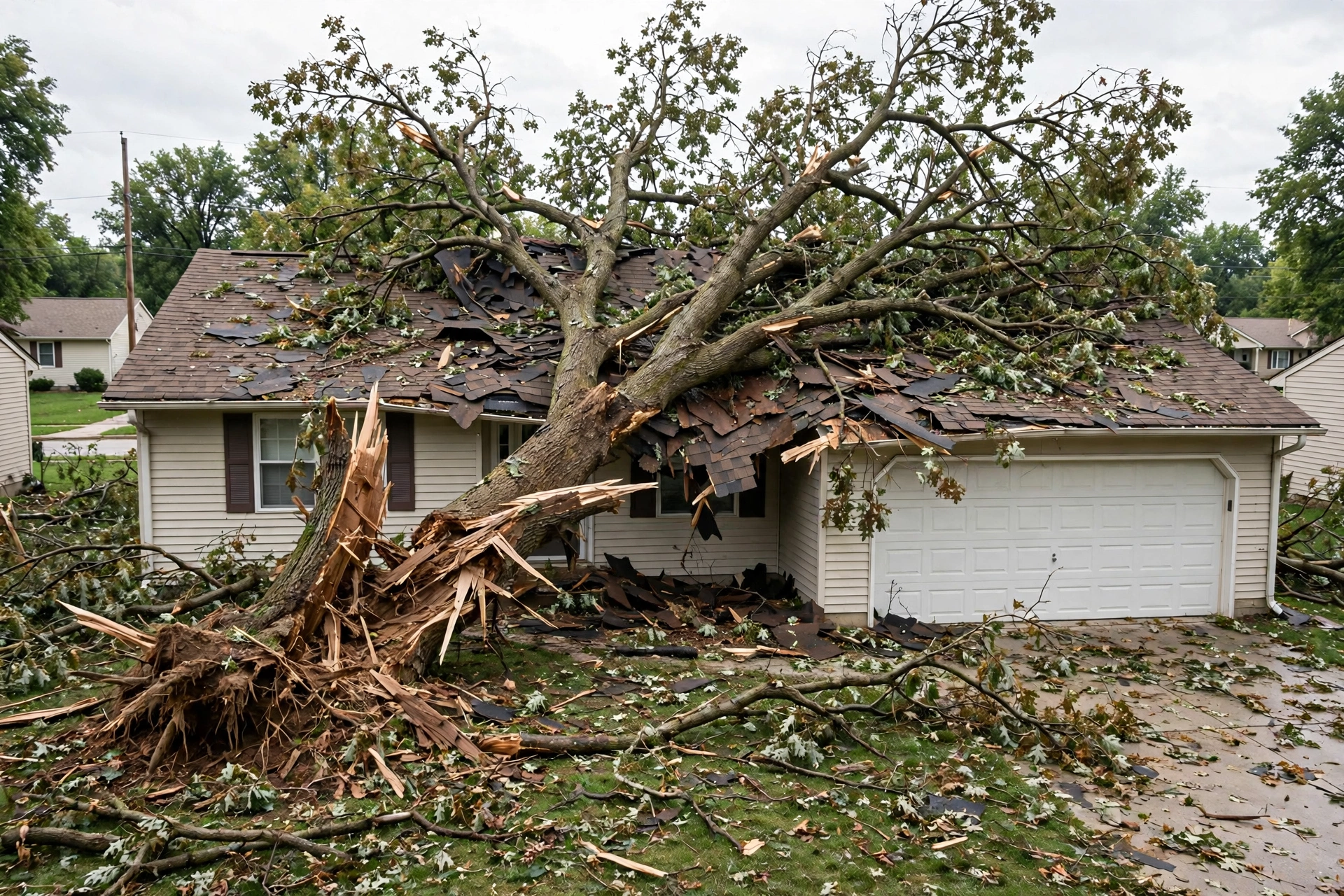
If you cut down a tree yourself and it hits your house, homeowners insurance usually covers the damage — if it was a genuine accident. But if the insurer decides you were reckless, they can deny the claim. Check your policy and talk to your agent.
That’s the short version. Here’s the longer one, from a crew that’s cleaned up DIY jobs all over Peoria.
Quick Facts: DIY Tree Damage & Insurance (Peoria, IL)
- Typical outcome: accidental DIY damage is usually covered; reckless or intentional acts usually are not
- Average roof repair after a tree strike: $5,000–$15,000 in the Peoria area
- Pro removal for comparison: $800–$2,500, most jobs done in one day
- Policy fact: intentional acts are excluded from virtually every homeowners policy
- Your first move: photograph everything before anything gets moved — then call your insurer
- Safety reality: DIY felling is among the most dangerous homeowner jobs
Last spring a homeowner off Sheridan Road notched a dead ash, tied a rope to his SUV, and watched it twist mid-fall through his garage roof. Ten minutes to fell; three weeks and $9,400 to fix. His DIY tree removal insurance claim dragged on four months — and nearly got denied.
He got lucky. Here’s when insurance covers DIY damage, when it doesn’t, and what to do in the first 24 hours.
Why DIY Tree Felling Goes Wrong So Often
A tree almost never falls exactly where the notch points. Lean, wind, an uneven crown, and hidden rot inside the trunk all get a vote — and rot votes last.
We’ve seen the aftermath in Glen Oak, Moss-Bradley, and the 61615 subdivisions: the “barber chair,” where the trunk splits vertically and kicks back at the cutter; the twist, where a lopsided crown spins the whole tree mid-fall; the hung-up limb under tension that snaps back like a whip. A 40-foot silver maple weighs tons — once it’s moving, you don’t steer it.
Peoria trees make it worse. Silver maples rot inside while looking solid. Ash killed by emerald ash borer turns brittle and snaps without warning. The June 2024 derecho left thousands of local trees with cracked limbs and loosened root plates in our clay soil — many still standing, waiting for the wrong cut.
Then there’s the ladder problem. Half our DIY cleanups started with a homeowner on a ladder, chainsaw overhead, cutting a loaded limb — the recipe for the emergency room. OSF and UnityPoint see these every storm season. Pros work from ropes and harnesses, never from a ladder with a running saw.
Will Your Homeowners Insurance Cover the Damage?
Usually, yes — with conditions. Most homeowners policies cover sudden, accidental damage to your dwelling, and a tree you accidentally dropped on your own roof generally counts. The roof repair, the smashed gutter, the hole in the garage — typically covered, minus your deductible.
But “usually” is doing a lot of work there. The catches:
- The tree removal itself often isn’t covered. Insurers fix the house, not the tree — unless it’s blocking access or on a covered structure. Preventative removal (cutting a healthy tree before a storm) is almost never covered either. Debris removal is often capped, so ask your adjuster.
- Your deductible comes off the top. A $6,000 repair with a $2,500 deductible pays $3,500, not $6,000.
- Rates might move. One claim won’t sink you, but insurers track frequency — ask your agent before filing a small one.
- Fences, sheds, and landscaping are capped. Detached structures and plantings carry much lower sub-limits than the dwelling.
The adjuster’s real question: accident or recklessness? An honest mistake reads very differently from a reckless setup. Next: what gets claims denied. Our homeowners insurance and tree removal guide digs deeper into typical Peoria coverage.
When a DIY Tree Removal Insurance Claim Gets Denied
Insurers deny DIY claims for repeat reasons that boil down to one word: negligence. If the adjuster decides you knew — or should have known — the tree would hit the house, your “accident” looks predictable.
| Scenario | Likely outcome |
|---|---|
| Misjudged the fall on a healthy tree despite a careful setup | Usually covered — honest accident |
| Cut a visibly dead, hollow tree leaning toward the house | Often denied — known hazard |
| Felled in high wind or an incoming storm | Often denied — reckless conditions |
| “Let it” hit the garage hoping insurance buys a new roof | Denied — intentional act, possible fraud |
| Lied to the adjuster about what happened | Denied — misrepresentation voids the claim |
| The tree hit the neighbor’s house instead of yours | Your liability coverage may apply — but expect a fight |
Three more denial triggers:
- Known hazards you ignored. If an arborist told you last year the tree was dangerous and you did nothing, the insurer will find that report.
- Exclusions you never read. Some policies exclude self-cut trees or require licensed pros. Read the exclusions — boring, and everything.
- Long-term neglect. A tree rotting for years can be framed as neglect, not a sudden accident.
The pattern: insurers cover bad luck, not bad judgment. Be honest with the adjuster — lying about a DIY job is fraud, worse than any denial. Our guide on who’s responsible when a tree falls on a house covers how Peoria liability gets sorted.
The First 24 Hours After It Hits Your House
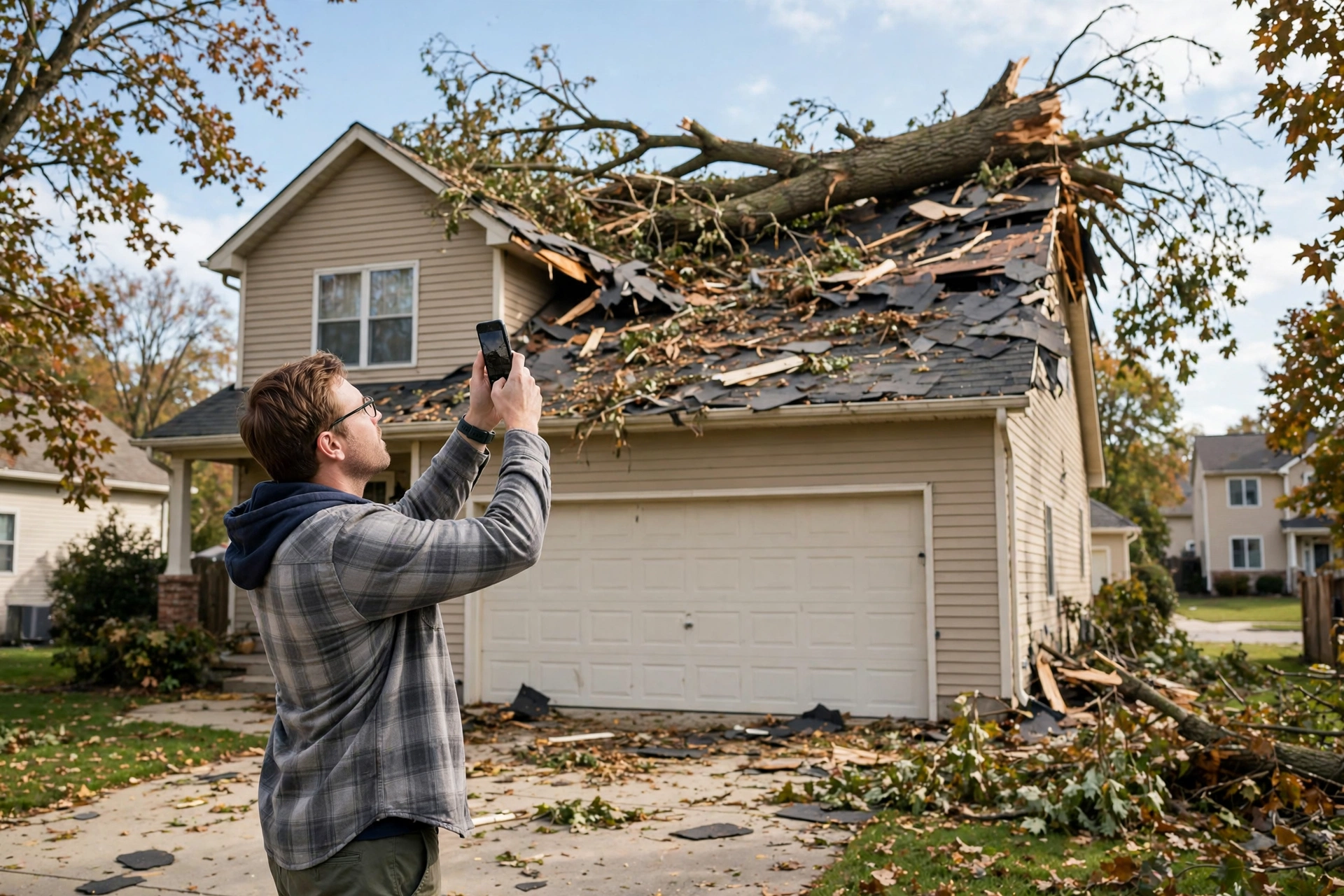
The tree is down, the roof has a skylight nobody wanted. What you do in the next 24 hours matters almost as much for your wallet as the chainsaw work did.
After a DIY Tree Hits Your House: 4 Steps
1
Document
Photos & video of everything before anything moves
2
Call Insurer
Start the claim now; get a claim number
3
Mitigate
Tarp the roof, stop water getting in
4
Call a Pro
Licensed crew removes the tree safely
Do these in order — especially step 1 before step 4.
1 — Document before you touch anything. Shoot the tree where it lies, the impact point, every cracked shingle, the stump and your cut. Timestamped evidence turns “he said” into “here’s proof.”
2 — Call your insurer the same day. Most policies require prompt notice. Tell the truth about cutting it yourself. Get a claim number and write down what they tell you.
3 — Stop the damage from spreading. Tarp the hole, move valuables from under the leak. Skip the tarp and overnight rain damage can be on you.
4 — Get a licensed crew to remove the tree. Don’t keep cutting. A pro crew lifts it off without grinding it deeper into the shingles — and their invoice joins your claim file. Our tree-fell-on-house checklist walks Peoria homeowners through each step.
The Paperwork That Wins (or Loses) Your Claim
Adjusters decide on files, not vibes. The homeowner with dated evidence gets paid faster and argued with less:
- Timestamped photos and video of the scene before cleanup — stump, equipment, all damage, attic included.
- A written timeline in your own words, dated and signed — written fresh, since memory only gets worse.
- Every receipt: tarp, crew invoice, hotel if you had to leave. Keep them all.
- An arborist’s written assessment of the tree and what went wrong. Independent opinions carry weight.
- A call log: who you spoke to, when, claim numbers, what they said.
- Keep the cut sections and rope setup until the adjuster releases them.
Stay off social media about it — “LOL dropped a tree on my garage” is discoverable and reads terribly in a claim file. Good documentation can make or break a DIY tree removal insurance claim. The Insurance Information Institute has plain-English guides on filing a claim.
What If a Hired Pro Drops the Tree on Your House?
Totally different story — and the strongest argument for hiring out. When a licensed, insured company damages your house, their general liability pays, not yours. Your claims history and deductible stay untouched.
That only works if the company actually carries insurance. Check before anyone touches your tree:
- Get a certificate of insurance (COI) before work day — not after. A real company emails it without blinking.
- Confirm it covers tree work specifically. A handyman’s policy sometimes excludes tree removal. Ask.
- Check that it’s current. Expired COIs are the oldest trick from the cheapest bidder.
- Get it in writing: scope, price, cleanup, and who’s responsible if something goes wrong.
The “$300 guy from Facebook” with a pickup and no paperwork is Peoria’s most expensive tree service. When he puts a limb through your roof and vanishes, there’s nobody to claim against — it lands on your policy, deductible and all. We’ve cleaned up that exact mess in Peoria Heights and West Peoria more times than we can count.
Our crew brings 17 years, ISA Certified Arborists, and full licensing and insurance — the COI goes out before the saws start. If a tree is close enough to make you nervous, hire it out. Our close-to-the-house removal guide shows how pros work tight Peoria lots without touching the roof.
DIY vs Pro: The Real Cost Math in Peoria
Let’s do the honest math, because “saving money” is why most people pick up the saw.
- DIY best case: a chainsaw ($250–$500), safety gear, your whole Saturday — and a clean miss.
- DIY worst case: a $5,000–$15,000 roof repair, a denied claim, and possibly an ER visit at OSF or UnityPoint. One bad afternoon costs more than ten pro removals.
- Pro: $800–$2,500 for most Peoria removals, done in a day, cleanup included — and their insurance absorbs the risk, not yours.
- The hidden DIY tax: disposal. That “free” removal leaves three tons of wood and brush. Chipper rental, dump fees, and a second weekend add up fast.
Then curb appeal. A botched job — torn lawn, rutted clay, a half-finished stump — drags down the place in neighborhoods like Glen Oak and along Grandview Drive, where buyers notice everything. A pro crew leaves the yard cleaner than they found it.
Rule of thumb: if the tree can hit anything you can’t afford to replace — house, garage, car, power lines, the neighbor’s fence — it’s a pro job. Full stop. Our Peoria tree removal cost guide breaks down pricing by size. And the ISA’s TreesAreGood.org explains what certified arborists do differently.
Related Articles
- Tree Removal Scams: 7 Red Flags Peoria Homeowners Must Know
- How to Choose a Tree Service in Peoria: 7 Questions to Ask
FAQs — Peoria Homeowners Ask About DIY Tree Damage and Insurance
Will insurance pay to remove a dangerous tree before it falls?
Rarely — insurers pay for damage after a covered event, not prevention. A leaning or dead tree counts as maintenance, your responsibility. If it already hit a structure, removing that tree is usually covered. Handle hazards before the storm does.
Does insurance cover cutting up and hauling away the tree?
Usually only partly. Policies focus on the structure; debris removal has a separate, much lower limit — and if the tree hit nothing covered, removal may not be covered at all.
Should I tell the insurer I cut the tree down myself?
Yes — always. Adjusters read it in the stump and the cut anyway, and lying is misrepresentation, far worse than a denial. Honesty about a genuine accident is your best shot.
What if the tree I cut hit my neighbor’s house instead?
Then it’s a liability question, and it gets messy. Your liability coverage may respond, but their insurer may come after you for negligence. Document everything, notify your insurer at once, and don’t put fault in writing before talking to your agent.
Can I be fined for cutting down a tree myself in Peoria?
On your own property, generally no — but street trees between the sidewalk and curb are the city’s, and cutting one without permission can mean a fine. When in doubt, call Peoria Public Works.
What should I avoid saying to my insurance company after a DIY tree accident?
Don’t speculate about fault, don’t guess at timelines, and never suggest it was intentional. Stick to the facts — what happened, when, and what was damaged — and let the adjuster ask the questions.
Get Your Free Estimate
If a tree is leaning toward your house anywhere in the Peoria area — Peoria, East Peoria, Peoria Heights, Bartonville, Washington, Morton, Pekin, Dunlap, Chillicothe — don’t gamble with a chainsaw. We’ll come look at it free and tell you straight whether it needs removal, pruning, or nothing at all. Seventeen years, ISA Certified Arborists, licensed and insured.
Call 309-250-8333 for 24/7 emergency service, or grab a free estimate online — we usually respond the same day.
Peoria Tree Removal Co.
https://treeremovalpeoriail.com/
114 W Forrest Hill Ave, Peoria, IL 61604, USA
Tree Service Company
One Response