
Plant Health Care in Peoria, IL
Plant health care (PHC) is a proactive, season-by-season program of inspections, tree fertilization, and pest and disease management that keeps trees healthy instead of rescuing them after they fail. In Peoria — where heavy clay soil, emerald ash borer (Agrilus planipennis), and oak wilt (Ceratocystis fagacearum) stress our trees — a care plan from our ISA Certified Arborists protects your landscape investment before problems turn expensive.
What Is Plant Health Care?
Most tree work is reactive. A limb breaks in a spring storm, a tree starts dropping dead branches over the driveway, and suddenly you are calling for an emergency removal. Plant health care flips that script. Instead of waiting for failure, PHC treats your trees the way a good doctor treats patients — with regular checkups, preventive care, and early intervention when something starts going wrong.
The philosophy behind a tree health care program is simple: healthy trees resist pests and disease far better than stressed ones. A tree growing in compacted clay with a volcano of mulch piled against its trunk is already fighting with one hand tied behind its back. A tree that gets inspected each spring, fed when soil tests show real deficiencies, and monitored for the first signs of emerald ash borer or oak wilt has every advantage nature allows.
That proactive approach matters more in Peoria than in a lot of places. Our region’s heavy glacial clay holds water in spring and turns brick-hard during a dry August. New construction around growing neighborhoods from Dunlap (61525) to Washington strips away topsoil and crushes root zones with heavy equipment. And two of the most destructive tree pests and pathogens in the Midwest — emerald ash borer and oak wilt — are both active in Peoria County. With 17 years of caring for trees across the Peoria area, we’ve learned that homeowners who spend a few hundred dollars a year on prevention almost always spend less than the ones who wait for a $1,500-plus emergency removal.
A plant health care program is not a single service or a one-time spray. It is an ongoing relationship between your trees and an arborist who knows them — their species, their soil, their history, and their vulnerabilities — season after season, year after year.
What’s Included in Our Tree Health Care Program?
Every tree health care program we build starts with what your property actually needs — not a canned package. After an initial walkthrough, your plan typically includes some combination of the following services, scheduled across the growing season:
- Annual inspections by International Society of Arboriculture (ISA) Certified Arborists. Every tree on your property gets a hands-on evaluation: canopy density and color, trunk and bark condition, root flare exposure, and soil conditions. We document what we find so we can track changes year over year — and catch problems when they are still cheap to fix.
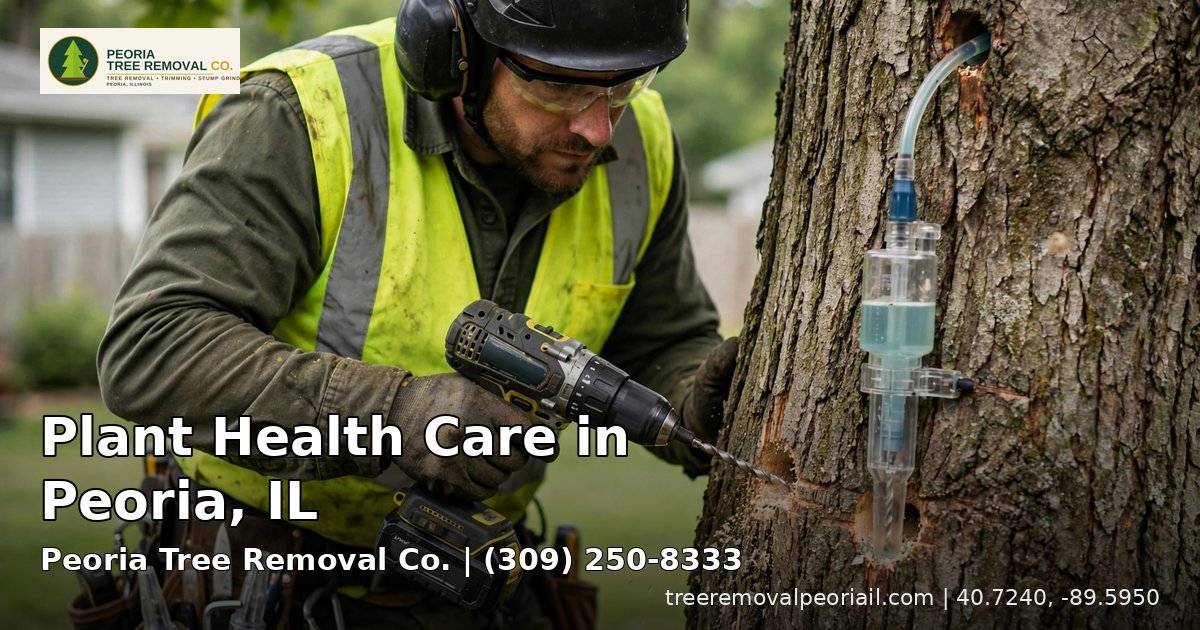
- Deep-root fertilization and feeding. When a soil test shows your trees are hungry, we inject slow-release nutrients directly into the root zone — deep root feeding, several inches below the surface, where feeder roots can actually absorb them. This bypasses compacted surface soil and competition from turf grass, a genuine advantage in Peoria’s dense clay.
- Season-long pest management and disease monitoring. From spring leaf-out through fall, we watch for the early signatures of trouble: borer holes, skeletonized leaves, cankers, fungal fruiting bodies, and the subtle canopy thinning that shows up long before a homeowner notices something is wrong.
- Soil care for Peoria clay soil. Laboratory soil testing, proper organic mulch rings, and decompaction treatments that improve drainage, aeration, and root growth. Healthy soil grows healthy trees — everything else in the program is just support for what happens underground.
- Targeted treatments only when warranted. Trunk injections for emerald ash borer, protective treatments for high-value oaks, and horticultural oils or biological controls for scale, mites, and aphids. We treat the specific problem we diagnosed — never a calendar spray of chemicals your trees do not need.
Emerald Ash Borer Treatment Plans in Peoria County
Emerald ash borer (EAB) has been confirmed in Peoria County by the Illinois Department of Agriculture, and it has been killing ash trees across central Illinois for years. Green ash (Fraxinus pennsylvanica) and white ash (Fraxinus americana) were planted by the thousands along Peoria streets and in suburban yards, which means many neighborhoods are watching their ash canopy disappear one tree at a time. The larvae feed beneath the bark, cutting off the tree’s ability to move water and nutrients, and an infested ash can go from looking fine to dead in two to four years.
The good news is that EAB is treatable — if you start before the damage is advanced. Our treatment plans use trunk injection of emamectin benzoate, the most effective product available for ash borer control. The insecticide is injected directly into the trunk, moves up through the tree’s own vascular system, and kills feeding larvae from the inside. Because the product stays inside the tree, there is no spray drift and nothing settling on your lawn. Treatments are typically applied in spring and repeated every two to three years for continued protection.
Not every ash is a treatment candidate, and an honest arborist will tell you so. Trees that still have at least half of their canopy intact, with no major structural defects like large splits or advanced decay, are generally good candidates — especially high-value trees that shade your home, frame your property, or hold sentimental value. Ash trees with heavy dieback, splitting trunks, or severe structural problems are usually better candidates for removal, because treatment cannot rebuild wood that is already dead.
Here is the hard truth about EAB in an infested county: doing nothing is also a decision, and it means losing the tree. Untreated ash in Peoria County will almost certainly die. If you have ash trees you want to keep, the time to start a treatment plan is while they still look healthy — waiting until the canopy thins is waiting too long. Call us for an evaluation and we will give you a straight answer on which of your ash trees are worth treating.
Oak Wilt Prevention for Central Illinois Oaks
Oak wilt is the other headline threat to Peoria-area trees, and it is especially brutal on red oaks — pin oak (Quercus palustris), northern red oak (Quercus rubra), and their relatives can die within a single growing season once infected. White oaks, including bur oak (Quercus macrocarpa) and swamp white oak (Quercus bicolor), decline more slowly and sometimes survive, but they can still suffer serious damage. The disease spreads two ways: sap-feeding beetles carry fungal spores from infected trees to fresh wounds, and the fungus travels underground through root grafts between neighboring oaks.
The single most important prevention rule is about timing: do not prune oaks from April through July. Those are the months when the beetles that spread oak wilt are most active, and a fresh pruning cut is an open invitation. Necessary tree trimming and pruning on oaks should be scheduled during the dormant season, roughly November through March, when beetle activity is minimal and the fungus is far less likely to spread.
Storm damage does not check the calendar, though. If an oak is wounded during the high-risk months — a broken limb in a June storm, for example — paint the wound immediately with latex paint or a commercial wound dressing. This is the one situation where arborists actually recommend wound paint: sealing the cut denies beetles access to the fresh wood and the sap they are after. Do not delay; the guidance is to treat wounds within minutes to hours, not days.
The underground route matters just as much. Oaks growing near each other often graft their roots together, and the fungus can pass from a sick tree to a healthy neighbor through those grafts. When we confirm oak wilt on a property, we evaluate the surrounding oaks and may recommend severing root connections by trenching between the infected tree and healthy ones — typically for oaks within about 50 feet. It is disruptive work, but it is often the only way to save the rest of a grove.
Know the warning signs. In red oaks, oak wilt shows up as leaves turning dull green, then bronze or brown starting at the margins, with wilting that begins at the top of the canopy and moves down. Defoliation can be shockingly fast — a tree can drop most of its leaves in a matter of weeks in midsummer. If you see this pattern, call an arborist immediately and do not prune the tree, since every cut risks spreading the disease further. We can arrange laboratory confirmation through the University of Illinois Extension plant clinic and lay out your disease treatment options, which depend on how far the infection has progressed.
How Often Should Your Trees Receive Professional Care?
Plant health care works best as a recurring seasonal program, not a one-time visit. Most of our Peoria clients are on plans with two to four visits per year, and each visit has a distinct job tied to what trees actually need in that season:
- Spring visit: full canopy and trunk inspection as trees leaf out, soil testing, deep-root fertilization where warranted, fresh mulch rings, and emerald ash borer treatments inside the spring application window.
- Summer visit: active pest and disease scouting during peak insect season, checking for borers, leaf diseases, and drought stress, plus watering guidance during dry stretches — critical in a year when Peoria clay bakes hard.
- Fall visit: root-zone care and soil amendments that trees absorb before dormancy, winter-prep assessment, and a check for storm damage after severe weather season.
Every visit ends with a written summary of what we found and what we did — no mystery, no upsell pressure. Over the years, those reports become a health history for each tree on your property, which makes future diagnoses faster and more accurate. Some clients with young, vigorous trees do fine with a single annual inspection; clients with mature oaks, ash under EAB treatment, or recently transplanted trees benefit from the full seasonal schedule. We will recommend the cadence that fits your landscape and your budget.
Warning Signs Your Trees Need Help Now
You do not need to wait for your next scheduled visit if a tree is telling you something is wrong. Call us promptly if you notice any of these symptoms:
- Dieback starting at the top of the canopy and working downward
- D-shaped exit holes in the bark of ash trees — the calling card of emerald ash borer
- Mushrooms or shelf-like conks growing at the base of the trunk or on major limbs
- Leaves dropping weeks earlier than normal, or browning at the edges in midsummer
- Heavy crops of water sprouts erupting along the trunk or main limbs
- Cracks, splits, or oozing cankers in the bark that were not there last season
- A new lean, or soil heaving and cracking on one side of the root zone
- Construction damage nearby: cut roots, changed grading, or heavy equipment parked under the canopy
Plant Health Care vs. Reactive Tree Care
The difference is timing — and it shows up in your wallet. The few-hundred-dollar visit that prevents the $1,500-plus emergency removal:
| Plant health care program | Reactive (wait and see) | |
|---|---|---|
| Inspection timing | Scheduled, 2–4 times per year | Only when something looks wrong |
| Pest & disease response | Caught early, treated affordably | Found late — often too late to save the tree |
| Typical yearly cost | A few hundred dollars per visit; annual programs $500–$1,500 | $0 until the emergency — then $1,500+ for removal |
| Tree lifespan | Full, healthy life | Shortened by repeated stress cycles |
| Storm resilience | Strong structure, pruned on schedule | Weak limbs waiting for the next derecho |
Your Peoria Tree Care Calendar
Tree care follows the seasons in Central Illinois. Here is what a program year looks like:
| Season | What we do | When in Peoria | Why it matters |
|---|---|---|---|
| Spring | Inspection + structural pruning | March–May | Catch winter damage; finish pruning before oak wilt beetles emerge |
| Summer | Pest monitoring: EAB, bagworms, Japanese beetles | June–August | EAB treatment window — infestations are treatable if caught early |
| Fall | Deep-root fertilization + mulch | September–October | Feed roots before dormancy; buffer against freeze-thaw |
| Winter | Structural check + dormant pruning | November–March | Only safe window for oak pruning; branch structure fully visible |
Treatment vs. a Care Plan: Which Do You Need?
A one-time treatment is the right call when a tree is already sick — an emerald ash borer injection for a valued ash, for example, or a targeted disease treatment. A care plan is prevention across the whole year: scheduled inspections, seasonal feeding, and pruning that keeps small problems from becoming removals. If you are not sure which fits, that is exactly what the first inspection answers.
Your Tree’s Year on a PHC Program
Four seasonal visits that keep Peoria trees healthy — and removals off your calendar
Post-winter health check, structural pruning before beetle season.
EAB and bagworm watch — treatable when caught early.
Deep-root fertilization and fresh mulch before the freeze.
Dormant pruning in the oak-safe window; storm-risk assessment.
Problems caught early cost a fraction of emergency work. Call (309) 250-8333 to start your program.
Plant Health Care FAQs
How much does a plant health care program cost in Peoria?
Most Peoria homeowners invest a few hundred dollars per care visit, with annual programs typically running $500 to $1,500 depending on tree count, size, and treatments included. A single inspection with a written report costs less. Either way, prevention is a fraction of a large removal.
Is fertilization really worth it in Peoria’s clay soil?
Often yes — but not automatically. Peoria’s clay is compacted, and construction frequently strips the topsoil trees feed on. We soil-test first and only feed trees with genuine deficiencies. Deep-root injection then places nutrients below the hard layer where roots can reach them.
Can a sick tree actually be saved?
Sometimes — and the odds depend on early detection. Emerald ash borer damage can be halted while the canopy is mostly intact; a red oak with advanced oak wilt almost never recovers. That is the case for regular inspections: early detection is the difference between a treatment plan and a removal quote.
How do I decide between EAB treatment and removal for my ash tree?
Treat ash trees that are still healthy — at least half the canopy intact, no major structural defects — and worth protecting, like shade trees cooling your home. Remove trees in advanced decline, because treatment cannot rebuild dead wood. Then compare repeat-treatment cost against removal.
Are PHC treatments safe for kids and pets?
Yes, when applied by licensed professionals. Most of our work uses trunk injections, which keep product sealed inside the tree — nothing sprayed on the lawn, nothing drifting through the air. For soil-applied products we follow label re-entry times exactly, and we share safety data sheets before starting.
How fast will I see results from a tree health care program?
It depends on the treatment. Insect problems often stop within weeks of application. Fertilization usually shows in the next full growing season — deeper green color, denser canopy, stronger growth. EAB treatment protects living wood but cannot regrow dead branches. Benefits compound year after year.
Get a Free Estimate
If your trees have not had a professional inspection in the last year — or you are worried about ash trees, oaks, or anything in your yard that just does not look right — start with a free estimate. Peoria Tree Removal Co. has spent 17 years keeping Peoria-area trees healthy. We are licensed and insured, and our arborists are certified by the International Society of Arboriculture (ISA).
Call (309) 250-8333 today and we will schedule a visit to walk your property, evaluate your trees, and build a plant health care plan that fits your landscape and your budget.
Peoria Tree Removal Co.
https://treeremovalpeoriail.com/
114 W Forrest Hill Ave, Peoria, IL 61604, USA