
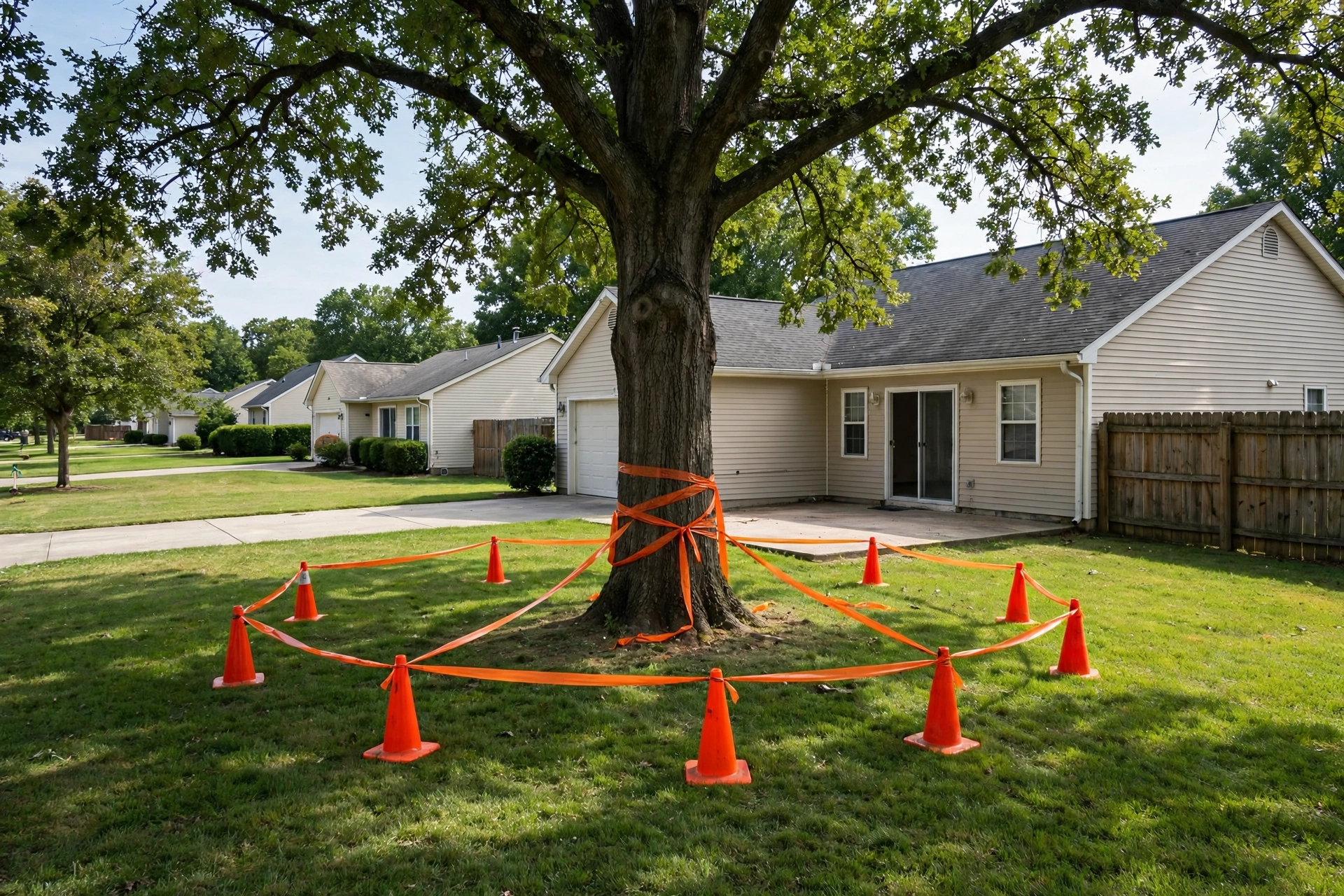
To prepare your yard for tree removal in Peoria, IL, move vehicles and furniture away from the drop zone, mark sprinklers and septic lines, unlock gates for crew access, and tell your neighbors. Call JULIE (811) for a free utility locate ahead.
We have pulled up to plenty of jobs where the homeowner did everything right — driveway clear, gates unlocked, dog inside, sprinklers flagged — and we were cutting within ten minutes. We have also spent the first forty minutes moving a trampoline, tracking down the dog, and waiting on someone to move the SUV. Guess which jobs finished faster and cost less in labor?
Preparing your yard is not complicated, and it protects the stuff you care about. This checklist covers exactly what to do before the crew arrives — plus what happens underground after the stump is ground, and how to get your lawn back to normal.
Clear the Work Zone: What to Move and How Far
Clear everything within about one and a half times the tree’s height in every direction — that is the drop zone, the area where limbs and trunk sections land. Move vehicles to the street, patio furniture and grills into the garage, and toys, potted plants, and anything breakable well out of range.
- Walk the drop zone first. Pace off roughly 1.5 times the tree’s height in every direction the crew might work. Anything in that circle you don’t want hit needs to move.
- Move vehicles to the street. Cars in the driveway are the number one thing we work around in the 61604 and 61614, where driveways run tight. Street parking for a day beats a dented hood.
- Clear the small stuff. Grills, patio furniture, toys, potted plants, garden art — if it’s not nailed down, move it. Sawdust gets everywhere, so tarp what can’t move.
- Flag what’s fragile. New paver patio, koi pond, prize rose beds — tell us upfront. We lay plywood over delicate turf and mat under heavy equipment.
Mark What’s Underground: JULIE, Sprinklers, and Septic
Call JULIE — Illinois’ free utility-locate service, reached by dialing 811 — at least two business days before the job so buried electric, gas, and telecom lines get marked. Mark your own private lines too: sprinklers, invisible fence, landscape lighting, and septic tank and field — JULIE does not cover those.
This matters more than you’d think. Grinding goes 6 to 12 inches deep, and in older Peoria neighborhoods utilities aren’t always where you’d guess — we’ve seen gas lines running diagonally across 61607 backyards and clay tile drains nobody knew existed.
Grab marking flags from the hardware store for a few dollars. Flag every sprinkler head. Homes toward Chillicothe (61523) and rural Tazewell County often have septic — flag the tank lids and field lines so our machines stay off them. Ten minutes with flags saves a very expensive repair.
Give the Crew Clear Access
Unlock every gate between the street and the tree, clear a path at least 4 feet wide for equipment, and keep dogs and kids inside during the job. Our trucks, chipper, and stump grinder need driveway or side-yard access — if we have to carry everything by hand, the job takes longer and costs more.
Think about the route like we do: the bucket truck needs overhead clearance, the chipper needs a straight shot to the truck, and the stump grinder — about the size of a large riding mower — needs a gate it fits through. Measure your narrowest gate; under 36 inches, tell us when you book so we bring the right machine.
And secure the pets. We love dogs, but a curious Lab under a falling limb is a nightmare. Inside the house or with a neighbor for the day — chainsaws, chippers, and open gates don’t mix with loose animals or kids.
Tell Your Neighbors Before the Saws Start
Tell your neighbors the day before — especially anyone sharing a fence line or with cars parked near the work zone. A heads-up about noise, truck traffic, and sawdust keeps the peace, and it is common courtesy if any limbs overhang their side.
Tree work is loud — there’s no quiet chipper. In close-in neighborhoods like Peoria Heights (61616) and older East Peoria (61611), where houses sit ten feet apart, a knock on the door the evening before prevents hard feelings. Mention our start time; we don’t fire up saws at dawn, but 8 a.m. is early for some.
If limbs hang over the neighbor’s yard, talk to them first. In Illinois you can generally trim to the property line, but a five-minute conversation beats a five-month grudge. We’re happy to explain the plan to a concerned neighbor — just introduce us.
What Happens to Tree Roots After Stump Grinding in Peoria, IL?
After stump grinding, the remaining roots decay naturally over 3 to 7 years, depending on species and soil moisture. Aggressive species like silver maple, elm, and cottonwood may send up suckers — fast-growing shoots from leftover roots — for a season or two; a quick follow-up treatment handles them.
Here’s what’s happening underground: the grinder chews the stump and root flare 6 to 12 inches below grade. Everything deeper — the structural roots spreading through Peoria’s clay — stays and rots in place. The soil settles as the wood volume disappears, which is why the spot dips over the first year. Normal, not a bad grind — just top it off with soil. For the full story, see our stump grinding guide for Peoria.
What to Do With the Hole After Stump Grinding
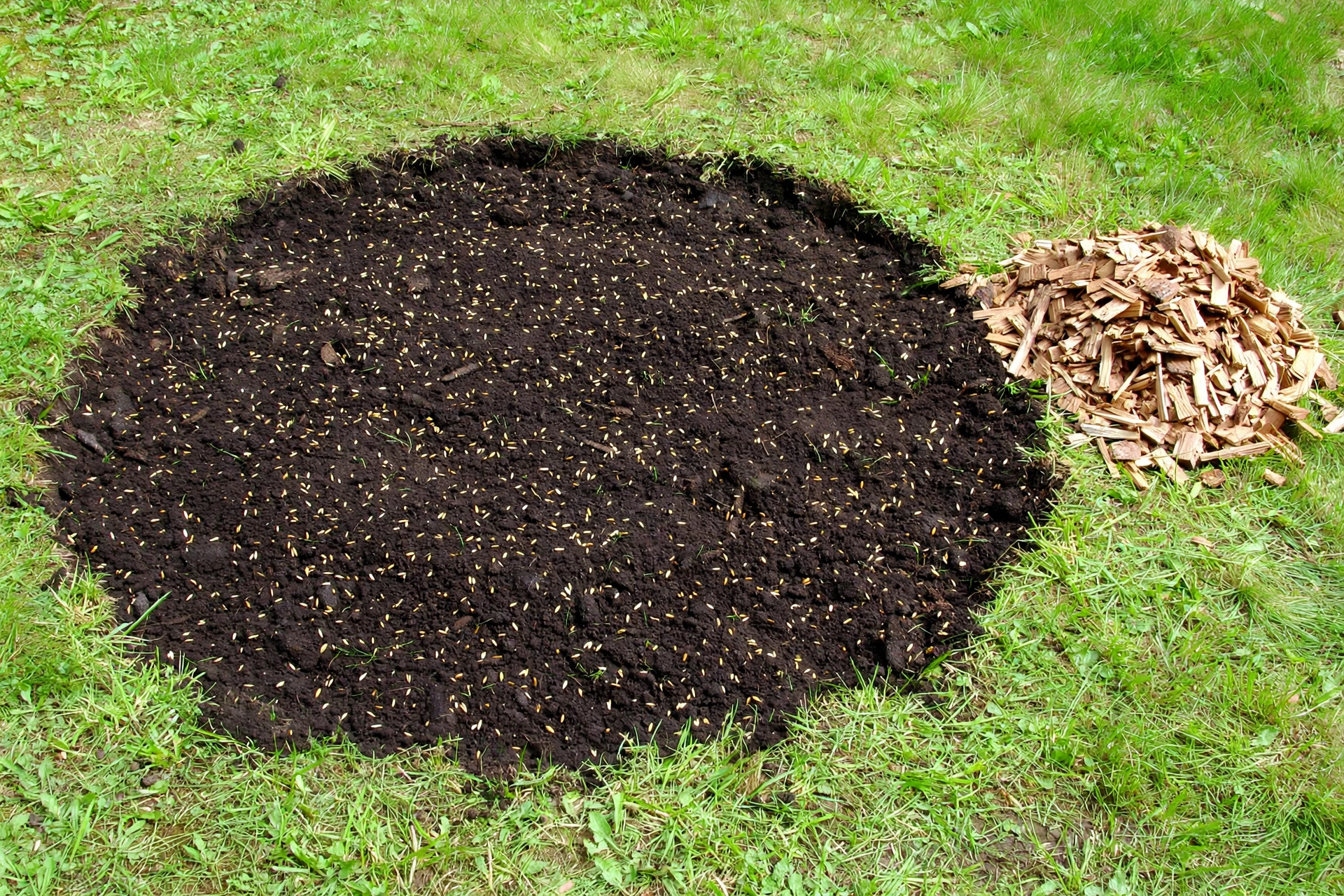
Backfill the hole with a mix of the wood grindings and topsoil, mound it slightly since it will settle, then seed or sod the top. In Peoria’s clay soil, expect the spot to settle for several weeks — top it off once and you will have a level lawn by next season.
- Rake the grindings level. Spread the chip pile evenly into the hole. Use it all as fill, or haul some off for mulch beds — aged a few months, it’s excellent mulch.
- Add topsoil. Cover grindings with 3 to 4 inches of good topsoil. Straight grindings make poor seedbed — grass needs real soil to root into.
- Mound slightly. Build fill a couple inches above grade. It settles with compaction and rain — a mound today is a level lawn in a month.
- Seed or sod, then water. A Central Illinois sun/shade mix takes well in spring or early fall. Keep it moist for two to three weeks, like any new seeding.
We offer backfill and topsoil as an add-on on every grinding job — most homeowners take it. Hauling topsoil yourself is nobody’s idea of a fun Saturday.
Can I Plant Grass or a New Tree Over It?
Yes to grass — once the hole is backfilled and settled, seed or sod takes well, usually within a few weeks. For a new tree, plant it 3 to 5 feet away from the old stump’s center rather than directly in the grindings, which temporarily rob nitrogen from the soil as they decompose.
That nitrogen tie-up is the key detail: fresh wood chips pull nitrogen from surrounding soil as they break down, starving young plants sitting right in the mix. Grass over a proper topsoil cap does fine, but a new tree planted directly into grindings will yellow and struggle. Offsetting a few feet — or waiting a season — solves it.
When you replant, match the species to the spot. If emerald ash borer took the old tree, don’t plant another ash. If a silver maple outgrew the space, choose something smaller-maturing. Morton Arboretum’s tree selector matches species to Central Illinois conditions — and we’re happy to talk options on site.
Related Articles
- What Happens to Your Tree After Removal? Firewood, Mulch & Hauling Options in Peoria
- When Should a Tree Be Removed in Peoria, IL? 7 Signs From a Local Arborist
- Tree Too Close to House? Safe Removal in Peoria
Prepare Yard for Tree Removal FAQs — Peoria Homeowners Ask
How should I prepare my yard for tree removal?
Move vehicles to the street, clear the drop zone (about 1.5 times the tree’s height), unlock gates, keep pets inside, flag sprinklers and septic, and call JULIE (811) two business days ahead.
What should I do with the hole after stump grinding?
Backfill with grindings plus topsoil, mound slightly for settling, then seed or sod. Top off the dip once after a few weeks.
Can I plant grass after stump grinding?
Yes — seed or sod takes well over a properly backfilled hole within weeks. Use a topsoil cap, not straight grindings, and water like any new seeding.
Can I plant a new tree where a stump was ground?
Plant 3 to 5 feet from the old stump’s center, not in the grindings — fresh chips temporarily rob nitrogen. Or wait a full growing season.
What happens to tree roots after stump grinding?
They decay naturally over 3 to 7 years. Elm, cottonwood, and silver maple may send up suckers for a season or two — a quick follow-up treatment handles them.
Ready for Tree Removal? We Make It Easy
Do the prep on this checklist and removal day goes smooth — and if you would rather not think about any of it, just call us and we will walk you through it on the estimate visit. That is what the free estimate is for: we look at the tree, the access, the underground stuff, and give you a firm price with no surprises.
Call 309-250-8333 for a free estimate anywhere in Peoria, Bartonville, Chillicothe, Peoria Heights, Washington, East Peoria, Morton, or Pekin. See what tree removal costs by size in Peoria, explore our full tree service, or learn more about tree removal in Peoria, IL — and visit our homepage to meet Peoria Tree Removal Co.
Listen to This Article
Prefer listening? Hear the full article narrated:
Peoria Tree Removal Co.
(309) 250-8333
info@treeremovalpeoriail.com
https://treeremovalpeoriail.com/
114 W Forrest Hill Ave, Peoria, IL 61604, USA
Tree Service Company
One Response