
Root Pruning & Root Barriers in Peoria, IL
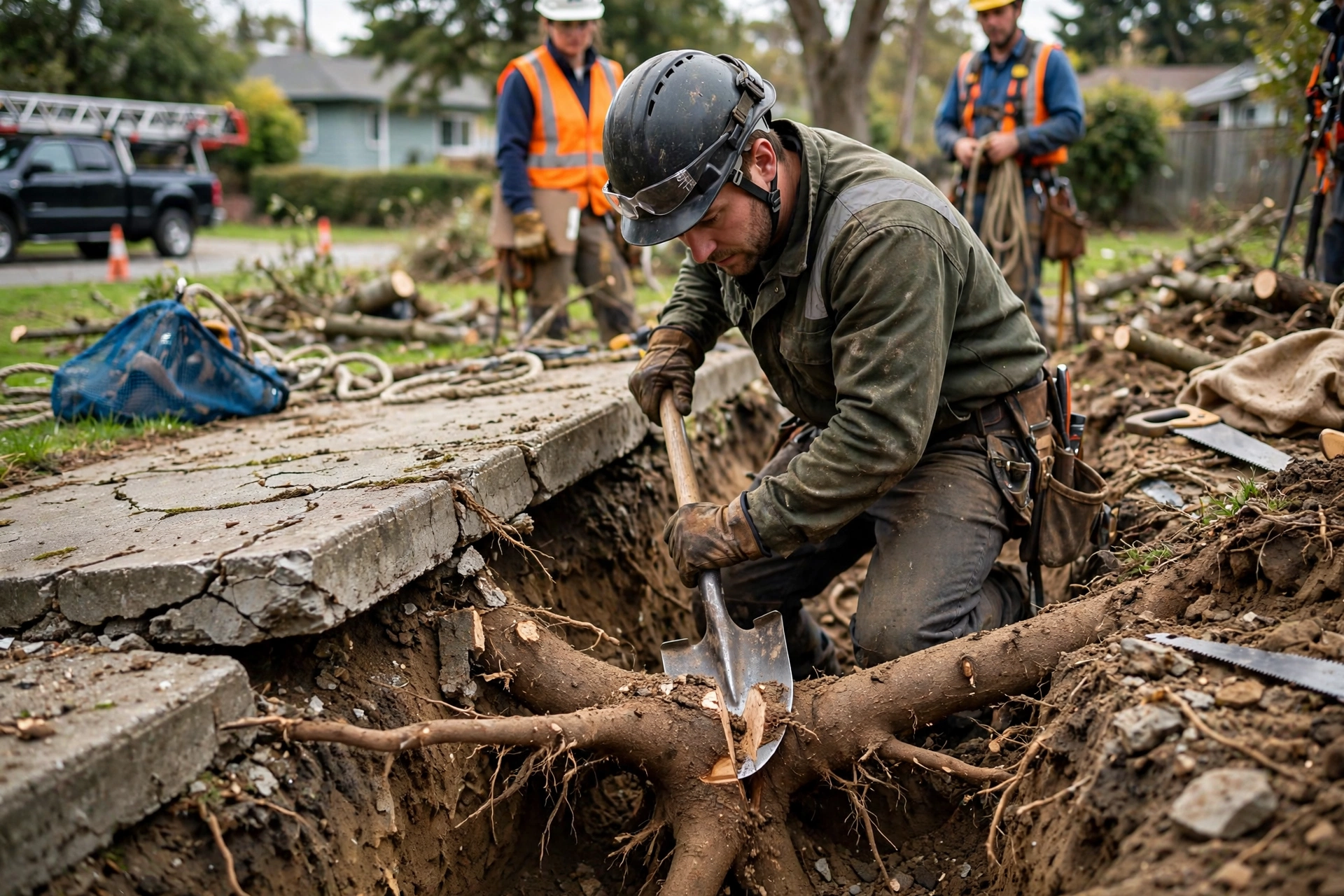
Root pruning is the cutting of roots to stop them damaging sidewalks, driveways, and foundations; root barriers are HDPE panels set underground to steer growth downward. You need them when roots heave concrete, crowd a new driveway, or run at your foundation.
Quick Facts: Root Pruning & Root Barriers (Peoria, IL)
- Trench depth: roots are typically cut at 18–24 inches, where most structural roots run in Peoria’s heavy clay.
- The safety rule: never sever more than 25–30% of a tree’s root zone in one job, and keep cuts at least 3–5 times the trunk diameter from the trunk.
- Barrier spec: HDPE panels installed 24–30 inches deep deflect roots downward instead of letting them run sideways into concrete.
- Best timing: late fall through winter dormancy — and never prune oak roots during oak wilt season.
- Zone & frost: Peoria is zone 6a with first frost around Oct 11–20, a good benchmark for scheduling fall root work.
- Realistic expectation: barriers redirect future growth; they don’t shrink or remove roots already in place.
Most people don’t think about roots until concrete starts moving — and cutting them back blindly can set the tree back so hard it drops limbs on your roof two summers later.
Last fall we were out in the Glendale area where a silver maple had jacked one end of a homeowner’s driveway nearly four inches off its base. Two contractors had quoted a full replacement; nobody had looked at the tree. We trenched along the edge, cut the offending roots cleanly, and set a barrier so they couldn’t come back. The driveway crew reset the slab for a fraction of full replacement, and the maple is leafing out fine this year.
The Peoria Root Problem: Heavy Clay and Shallow Roots
Peoria’s soil is the engine behind most of the root conflicts we see. The river valley and the bluffs around it sit on heavy clay, and clay does something that sand and loam don’t: it holds water near the surface and gets hard as brick below the top couple of feet. Tree roots take the path of least resistance, so instead of diving deep, they spread sideways — wide, shallow mats running right through the zone where sidewalks, driveways, and foundations live.
You can see the results on older Peoria streets everywhere: sidewalk panels lifted at the seams, driveway edges curling up, patio slabs tilting. It’s worst in neighborhoods planted with big shade trees decades ago, from the older blocks near 61604 out through 61614 and 61615. Newer builds around Dunlap and Edwards run into the other version: construction trenching for utilities and additions slices through established root zones, and the tree browns out a season or two later.
- Silver maples are the biggest offenders — fast-growing with aggressive surface roots that hunt moisture under slabs.
- Oaks grow slowly and their roots are sensitive — any root work on oaks has to respect oak wilt timing.
- New construction zones around Dunlap and Edwards produce most of our preventive calls: homeowners who want the tree saved before the excavator shows up.
- Sidewalk heave on older Peoria streets usually traces back to a handful of surface roots — a pruning and barrier combo often beats a full tree removal.
What Root Pruning Actually Does
We locate the roots causing the conflict, expose them by digging a narrow trench (usually 18–24 inches deep, where the trouble lives), and sever them with sharp tools. The key word is clean — a torn root can’t seal properly and invites decay back toward the trunk.
Timing matters more than most folks expect. We schedule root pruning during dormancy — late fall through winter — when the tree isn’t pushing new growth and wounds can seal before spring. In Peoria that window opens around first frost, typically Oct 11–20 in zone 6a.
Then there’s the math that keeps the tree alive. Two rules we don’t bend:
- The 25–30% rule: we never sever more than about a quarter to a third of a tree’s total root zone in a single job. Go past that and you’re starving the canopy.
- The distance rule: cuts stay at least 3–5 times the trunk diameter from the trunk. For a 20-inch-diameter maple, that means no closer than about five to eight feet from the trunk.
Bigger jobs sometimes split across two dormant seasons so the tree regrows feeder roots between rounds — slower, but it keeps a tree you care about standing.
Root Barriers: How They Work
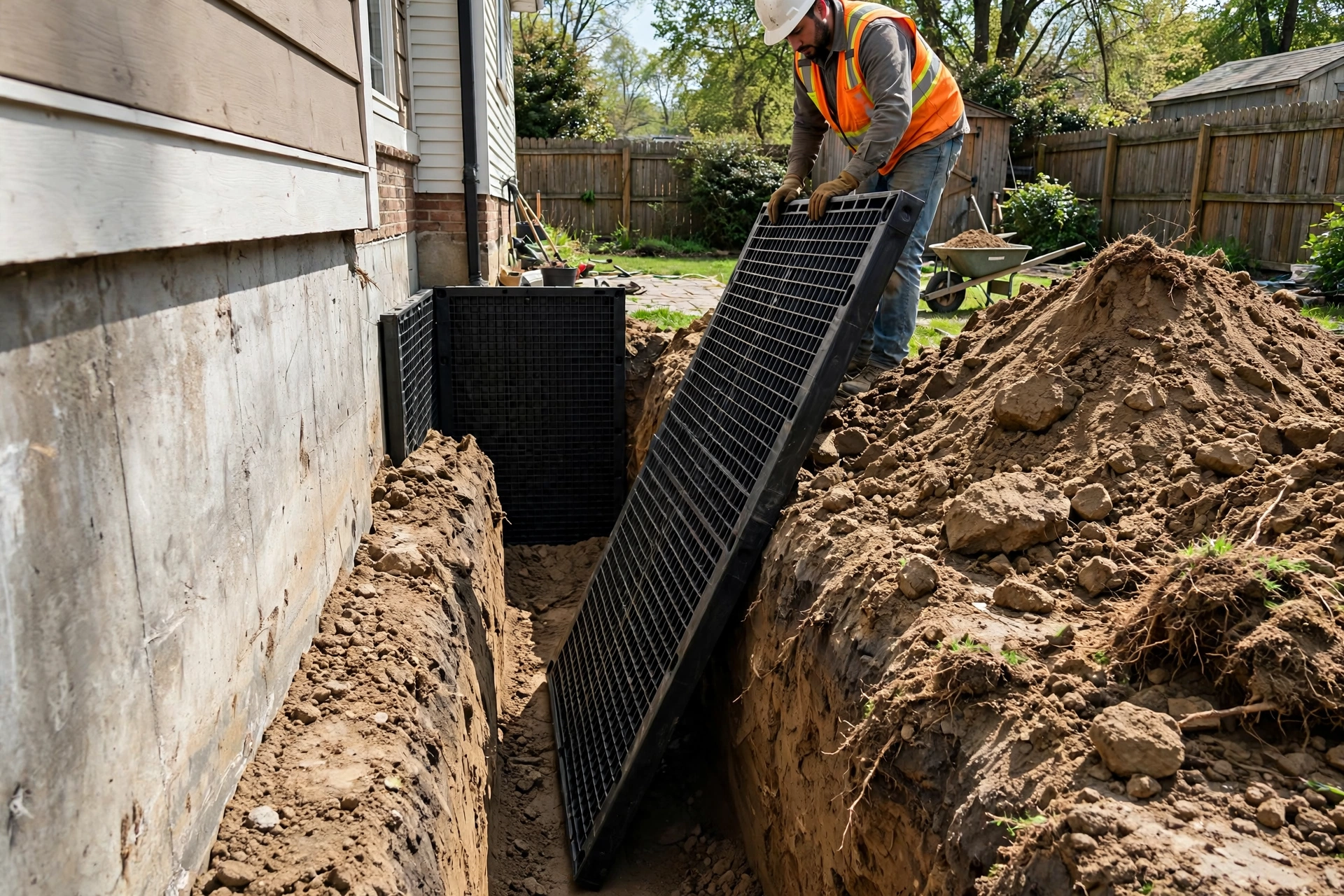
A root barrier is a wall in the ground: HDPE panels set vertically 24–30 inches deep along the line you want to protect. When a growing root hits the smooth face, it can’t grab hold, so it turns and heads downward instead.
Barriers don’t shrink or kill roots, and they don’t touch anything already growing on the house side — that still gets pruned first. The barrier is the follow-through: pruning solves today’s conflict, the barrier prevents the rematch. That’s why we usually install both on the same visit.
Root Barrier Installation: 4 Steps
1
Assess
Our arborist maps the roots and marks the protection line.
2
Trench & Prune
We dig an 18–24 inch trench and sever roots with clean, sharp cuts.
3
Set Panels
HDPE panels go in vertically, 24–30 inches deep, smooth side facing the tree.
4
Backfill
We backfill and compact, leaving the panel just below grade.
Done right, a barrier lasts decades — HDPE doesn’t rot or rust. It’s the standard answer for new sidewalks, driveway replacements, and pool installs.
Root Pruning & Barrier Costs in Peoria, IL
Every job prices on what’s underground, but here’s what most Peoria homeowners see.
| Service | Typical price | What drives the price |
|---|---|---|
| Root pruning | $8–$15 per linear foot | Trench depth, root size and density, access (fences, patios, tight lots) |
| Root barrier installation | $25–$45 per linear foot | Panel depth and length, clay soil conditions, proximity to utilities |
| Prune + barrier combo | quoted per job | Best value when one trench serves both jobs |
| Arborist root assessment | $0 with service | Included in every root pruning or barrier quote |
A root problem sometimes turns out to be a tree problem — a declining tree lifting a sidewalk isn’t worth saving, and we’ll tell you so. In that case, removal plus stump grinding usually costs less than years of fighting its roots.
When NOT to Cut Roots
Here’s the part most companies won’t put on their own website: sometimes the honest answer is don’t.
- Oaks during oak wilt season: in Illinois, oak roots are only pruned from late fall through winter — cutting any other time risks spreading oak wilt. No exceptions on our crews.
- Too close to the trunk: cutting inside the 3–5x trunk-diameter zone destabilizes the tree.
- Already-declining trees: if the canopy is thin, bark is falling off, or the tree is past its prime, losing even 20% of its roots can finish it. Put the money toward removal instead.
- Utility conflicts: roots tangled with gas, electric, or fiber lines get hand-dug and marked first — we never guess.
- The tree you don’t love: if you’re not attached to it, removal is cheaper than a lifetime of root management.
We’d rather talk you out of a job than sell you a tree-killer — that’s what our ISA arborist assessment is for.
What a Root Pruning Visit Looks Like
The arborist walks the property with you first — checks the heave, the species, and probes the soil to see where the roots are running.
On the work day, we dig a narrow trench along the protection line, sever the offending roots with clean cuts, and set the HDPE panels into the same trench on the tree side before backfilling. Most residential jobs take half a day.
Trees take a year or two to fully respond, so we recommend a check-in the following season. For the diagnosis side — what the roots were doing before we cut them — see our guide to root damage to foundations, sidewalks, and sewer lines.
Root Pruning & Barrier FAQs
Will root pruning kill my tree?
Not when it’s done right. We stay within the 25–30% limit, keep cuts well away from the trunk, and work during dormancy. Healthy trees seal the cuts and keep growing.
How deep do root barriers go?
Our HDPE panels install 24–30 inches deep — enough for sidewalks, driveways, and most foundations in Peoria’s clay.
Can you install a barrier before a new driveway gets poured?
That’s the ideal time to call. We set the barrier during site prep so roots never meet the slab — builders around Dunlap and Edwards bring us in for exactly this.
Why can’t I just cut the roots myself?
People cut too close to the trunk, and they tear instead of cutting cleanly. We’ve removed more than a few DIY casualties that cost far more than the pruning would have.
When is the best time of year for root work in Peoria?
Late fall through winter, once trees are dormant — first frost typically lands between Oct 11 and 20 in zone 6a, and oaks follow the stricter oak wilt calendar. The University of Illinois Extension is a solid resource for Central Illinois tree care.
Protect the Concrete, Keep the Tree
Roots and concrete don’t have to be enemies. With a clean pruning cut and a barrier in the right place, most conflicts end without losing a tree — or paying to pour the same driveway twice.
We serve Peoria, East Peoria, Peoria Heights, Bartonville, Dunlap, and the surrounding river-valley towns. Call 309-250-8333 for a free estimate — we’ll walk the property, map the roots, and tell you straight whether pruning, a barrier, or (honestly, sometimes) removal is the right call.
Peoria Tree Removal Co.
https://treeremovalpeoriail.com/
114 W Forrest Hill Ave, Peoria, IL 61604, USA
Tree Service Company