
Tree Cabling & Bracing in Peoria, IL
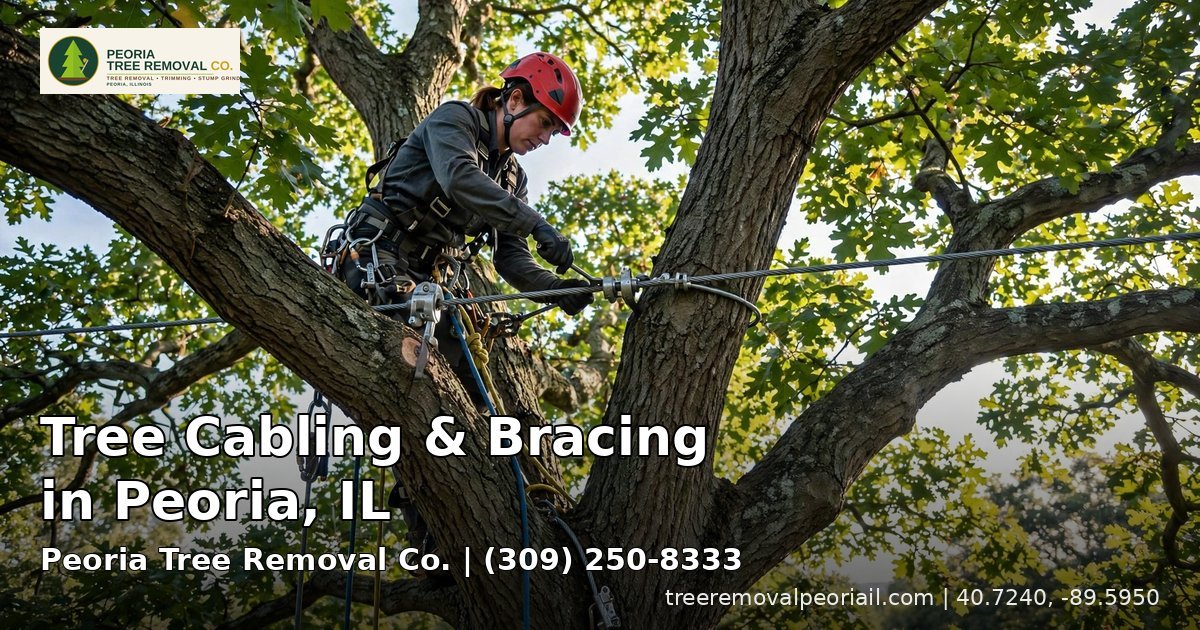
Tree cabling and bracing are supplemental support systems — structural support hardware — that keep structurally weak trees standing. Steel cables installed high in the canopy limit dangerous movement between branches, while threaded brace rods through a weak union add rigid, long-term support. Peoria homeowners need them when a mature maple (Acer spp.), oak (Quercus spp.), or pear (Pyrus spp.) develops a co-dominant stem, included bark, or a crack.
What Are Tree Cabling and Bracing?
Cabling and bracing are two techniques, often installed together, that reduce the risk of branch or trunk failure in a tree worth keeping. Neither one “fixes” a bad structure — they buy a valuable tree years of safe, useful life.
Cabling uses high-strength galvanized or stainless steel cable installed in the upper canopy between two or more limbs. It acts as a limiter: it allows normal sway but catches the limbs before a sudden gust can peel them apart. Most cables are installed about two-thirds of the way from the weak union to the top of the canopy, the sweet spot between the defect and the weight of the foliage.
Bracing uses threaded steel rods — brace rods — drilled directly through a weak crotch or cracked trunk. Each rod passes through both stems with large washers and nuts on either side, clamping the weak union together. Where cables work dynamically to limit movement, brace rods provide rigid, static support right at the defect.
Together, they are what arborists call “supplemental support systems.” That word — supplemental — matters. A support system extends the safe life of a tree that has a sound future. It does not cure advanced decay, hollow wood, or a tree that is already failing. Knowing the difference is the whole job, and it is why a proper assessment comes before any hardware goes in.
When Cabling Saves a Tree — and When Removal Is the Honest Answer
An arborist evaluates the defect, the tree’s health, and what it would hit if it failed. Here is how the call usually breaks down:
Good candidates for cabling and bracing:
- A healthy, vigorous tree with plenty of good canopy — the tree has decades of life ahead if the structural problem is managed.
- A valuable specimen: a mature shade tree cooling your home, a heritage oak, or a landscape centerpiece that would take 30 years to replace.
- A weak union that is still sound — included bark or a V-shaped crotch with solid wood on both sides and no decay.
- A crack that is limited and not actively spreading, especially one caught early after a storm or heavy snow.
- A multi-stem tree over a target — a driveway, patio, or play area — where reducing failure risk meaningfully protects people and property.
Poor candidates — where removal is the honest answer:
- Advanced decay or hollow wood at or near the defect — hardware needs solid wood to hold, and decayed wood cannot be trusted.
- A union that has already failed or is actively splitting — once a split runs deep, hardware cannot put the tree back together safely.
- A tree in serious decline — major dieback, root damage, or disease that means it will not live long enough to justify the investment.
- Conks, fungal fruiting bodies, or carpenter ant activity at the defect — all signs the interior wood is compromised.
We would rather tell you a tree should come down than sell you cables that cannot hold it. Tree cabling and bracing in Peoria, IL is about managing real, measurable risk — and an honest assessment protects your family, your home, and your wallet.
Co-Dominant Stems: The Most Common Reason Trees Need Cables
Walk through any Peoria neighborhood — the older streets off War Memorial Drive in the 61614, the established lots in Peoria Heights (61616), the big yards out toward Dunlap (61525) — and you will see them everywhere: large maples and oaks that fork into two or more trunks of nearly equal size, forming a tight V. Those are co-dominant stems, and they are the single most common reason a tree ends up needing cables.
The problem is what happens inside that V. When two stems of similar size grow against each other, bark gets trapped between them — a condition arborists call “included bark.” Bark has no structural strength. Instead of wood fibers weaving the stems together into one strong trunk, you get two stems pressed against each other with a seam of weak bark down the middle. It looks solid. Inside, it is a split waiting for a trigger.
Peoria sees a lot of this for a few local reasons:
- Silver maple (Acer saccharinum) and red maple (Acer rubrum) dominate older Peoria yards and are genetically prone to co-dominant leaders. Decades of fast growth built enormous V-forked maples, now 60–80 years old and carrying thousands of pounds of canopy on weak unions.
- Pin oak (Quercus palustris) and northern red oak (Quercus rubra) develop competing leaders when they were never structurally pruned as young trees. Many were planted as quick shade and left alone.
- Ornamental pears — the Bradford and Callery pears (Pyrus calleryana) lining so many Central Illinois streets — are notorious for included bark at tight V-crotches, and they are brittle wood. A dangerous combination.
- Central Illinois storms supply the trigger. Straight-line winds, summer microbursts, and winter ice loading pry at weak V-unions. One heavy wet snow or a 60 mph gust front can peel a co-dominant stem clean off a mature tree.
A co-dominant stem with included bark will not heal on its own. Left alone, the union gets more dangerous every year as the canopy — and wind leverage on that canopy — grows heavier. Cabling installed before the failure is preventive: it limits the movement that would eventually tear the union apart. Installed after a small split begins, cables and a brace rod can stabilize a defect that is still minor. Installed after a major failure, it is usually too late.
If you can see a tight V-fork on a large tree, especially one with bark pinched into the crotch or a visible seam running down it, have it assessed. That is the tree most likely to benefit from a support system — and the one most likely to end up across your garage after the next big storm if nothing is done.
How Cables and Brace Rods Are Installed to ISA Standards
Tree cabling is not a DIY project, and it is not a couple of chains from the hardware store. Proper installation follows the American National Standards Institute (ANSI) A300 standards, and it always starts with assessment — not hardware.
1. Assessment first. An ISA Certified Arborist inspects the tree’s structure, health, and the wood around the defect — checking for decay, cracks, cankers, and included bark, and evaluating whether the tree is vigorous enough to justify support. If the tree is a poor candidate, we say so before quoting anything.
2. The right hardware. Real tree support hardware is purpose-built: high-strength steel cable sized to the limb, lag-threaded eye bolts or through-bolts with thimbles, and threaded brace rods with large round washers that spread the load. Cheap substitutes — chain, rope, fence wire — cut bark, rust, and fail. We never use them.
3. Correct placement. Cables go in the upper canopy, roughly two-thirds of the way from the weak crotch to the top — too low and they do nothing useful, too high and they miss the leverage zone. In a three-limb system, cables form a triangle so no stem is loaded from only one direction. Brace rods go directly through the weak union, often two or more staggered for long crotches, snugged with washers and nuts so the stems clamp firmly together.
4. Pruning to match. Support hardware works best alongside corrective pruning: reducing weight and wind sail at limb ends takes leverage off the weak union, so the cables have less work to do. We often pair installation with a light crown reduction over the supported limbs.
5. Documentation and scheduling. Every system we install is documented: hardware type and size, placement, and installation date. That record starts the inspection clock, because a support system is only as reliable as its maintenance.
How Often Do Support Systems Need Inspection?
A cable or brace rod is not a “set it and forget it” fix. Trees grow — wood thickens, limbs gain weight, and hardware that fit perfectly today will be under different stresses in a few years. The ANSI A300 standard calls for support systems to be inspected at least annually.
During an annual inspection, a certified arborist checks that cables still have the right tension — too loose and they protect nothing, too tight and they restrict natural movement the tree needs. We look for bark growing over hardware, corrosion or broken strands, nuts that have worked loose as the tree added wood, and any new defects elsewhere in the canopy.
As the tree grows, hardware sometimes needs adjustment: cables may need re-tensioning, moving, or upsizing as limbs thicken. Brace rods are more permanent but still get checked for tightness and for wood growth around the washers.
How long does the hardware last? Galvanized steel cable in Central Illinois typically serves 10 to 20 years before corrosion or wear calls for replacement; the drier upper canopy often lasts longer. Stainless steel extends that further. Brace rods, embedded in wood and protected from the elements, can last decades. But “the hardware lasted” is not the same as “the tree is fine” — the tree itself gets re-evaluated every inspection, because a good candidate five years ago may have developed decay since.
Think of the support system as a subscription to that tree’s safety, not a one-time purchase. The annual inspection is the price of knowing the tree over your driveway is still sound — and most take less than half an hour.
Why Peoria Tree Removal Co. for Cabling and Bracing
Support hardware is only as good as the judgment behind it. Anybody can drill a rod through a trunk; knowing whether that rod will hold — or whether the tree should come down instead — takes training and experience. Peoria Tree Removal Co. has been caring for trees across the Peoria area for 17 years.
Our crew includes ISA Certified Arborists who install cabling and bracing systems to ANSI A300 standards. We are licensed & insured, so your property is protected while we work in your canopy.
What sets our assessments apart is local knowledge: which Peoria neighborhoods hold aging silver maples with co-dominant leaders, how clay-heavy Illinois soil stresses root systems, and what June microbursts do to Bradford pears on the west bluff. And because we also do full-service tree care and removals, we never push cabling on a tree that should come down — or removal when a support system would save a tree you love.
If a V-fork, crack, or lean on your property worries you, start with an assessment from an ISA Certified Arborist. We will tell you plainly whether cabling can keep your tree safe, what it will cost, and what the honest alternatives are.
Cabling vs. Bracing: Which Does Your Tree Need?
They solve different problems. Here is the practical difference:
| Cabling | Bracing | |
|---|---|---|
| What it is | Flexible steel or synthetic cable installed high in the canopy | Threaded steel rod through the trunk or limbs |
| Best for | V-shaped crotches, overextended limbs | Trunks already splitting, weak unions needing rigid support |
| Hardware | Extra-high-strength steel or dynamic synthetic cable | Galvanized threaded steel rod with washers |
| Typical cost per unit* | $250–$550 | $200–$400 |
| Lifespan | 20–40 years, inspected every 3–5 years | 20–40 years, inspected every 3–5 years |
What Does Tree Cabling Cost?
Nationally, a single cable installation typically runs $250–$550 and a bracing rod $200–$400, depending on tree size and access. Most residential systems use one to three cables. Compare that with $3,000-plus to remove a mature tree — plus the property value and shade you lose with it. When the tree is otherwise healthy, support hardware is almost always the better investment. We will give you both numbers in writing so you can decide with real math.
Cable It, Brace It, or Remove It? — A 60-Second Decision Guide
Removal is the honest answer. No hardware saves a dying tree.
Weak spot a V-crotch or long limb? Cable it.
Not sure which fits your tree? Call (309) 250-8333 — the assessment is free.
Tree Cabling & Bracing FAQs
How much does tree cabling and bracing cost in Peoria?
Most single-cable installations on a residential tree run a few hundred dollars, while a multi-cable system with brace rods on a large mature tree can reach the low thousands, depending on height, limb count, and hardware required. Cabling a valuable mature tree almost always costs far less than removing it and growing a replacement.
Does cabling hurt the tree?
Properly installed hardware causes only minor, localized wounding — small holes for eye bolts or brace rods that a healthy tree walls off with new wood, just as it does with pruning cuts. Poorly installed hardware is another story: rope or chain girdles bark, oversized bolts invite decay, and misplaced cables do nothing. That is why ISA-standard installation by a trained arborist matters more than the hardware itself.
How long do tree cables last?
Galvanized steel cables typically last 10 to 20 years in Central Illinois before corrosion or wear calls for replacement; stainless steel lasts longer. But hardware lifespan is only half the story. Cables need annual inspection and periodic re-tensioning as the tree grows, and the tree itself must be re-evaluated each time — a sound candidate today could develop decay tomorrow.
Can a split trunk be cabled back together?
It depends on how far the split has gone. A minor, early split in otherwise sound wood can sometimes be stabilized with brace rods clamping the stems together, plus cables above to limit movement. But a split that has run deep into the trunk, or one with decay along the crack, cannot be safely repaired — the wood will not rejoin, and hardware cannot restore lost strength. An arborist’s assessment tells you which side of that line your tree is on.
How do I decide between cabling, pruning, or removal?
Pruning is the right answer when removing weight or reshaping the crown fixes the risk — it is the least invasive option and often the first step. Cabling is right when the tree is healthy and worth keeping but has a structural weak point pruning alone cannot fix. Removal is right when the tree is decayed, declining, or failing beyond what hardware can hold. Often the best solution combines pruning with cabling, and a certified arborist weighs all three on every visit.
Will cabling cause problems with my insurance or city ordinances?
Cabling itself rarely triggers ordinance issues — Peoria does not prohibit supplemental support systems on private trees, and a professionally installed system is generally viewed favorably by insurers because it reduces failure risk. If your tree overhangs a sidewalk, street, or a neighbor’s property, local right-of-way rules may apply to the work, and your insurer may want to know about a known hazard tree regardless. We flag those situations during the assessment.
Get a Free Estimate
If a tree in your yard has a V-shaped fork, a crack, or a lean that worries you during storm season, do not wait for the next wind event to decide for you. Call Peoria Tree Removal Co. at (309) 250-8333 for a free, no-pressure estimate. An ISA Certified Arborist will assess your tree and give you the honest answer — even when the honest answer is removal.
Peoria Tree Removal Co.
https://treeremovalpeoriail.com/
114 W Forrest Hill Ave, Peoria, IL 61604, USA