
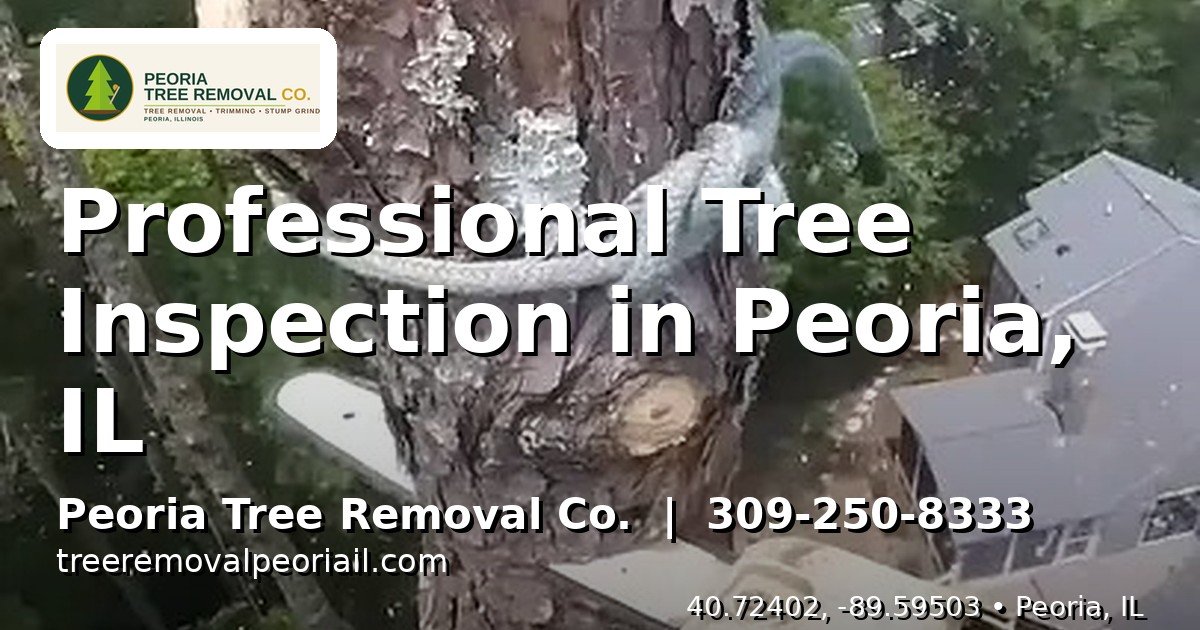
A professional tree inspection in Peoria costs $150–$300, takes 45–90 minutes for a typical property, and covers root flare, trunk, branches, canopy, and site conditions — ending with a written report rating each tree’s risk and recommending specific actions. One inspection can prevent a $3,000 emergency removal and a five-figure insurance claim.
Quick Facts: Tree Inspections (Peoria, IL)
- Cost: $150–$300 for a residential property; often credited toward work.
- Duration: 45–90 minutes for a typical yard; longer for estates.
- What’s checked: roots, trunk, branch structure, canopy health, site conditions.
- You get: written report with risk ratings and prioritized recommendations.
- When: spring leaf-out, after major storms, before buying a home, every 2–3 years.
- Our inspections: professional, documented, and honest — about a third end in “you’re fine.”
Here’s something most Peoria homeowners don’t know: trees almost always warn you before they fail. The lean gets a little more pronounced. A crack opens a little wider. The canopy thins on one side. Mushrooms appear at the base — the tree equivalent of a check-engine light. The problem isn’t that trees don’t communicate; it’s that most of us don’t speak tree.
That’s what a professional inspection buys you: a fluent translator, climbing boots optional, who reads your trees’ condition the way a mechanic reads an engine. And in a city with 100-year-old oaks over 60-year-old houses, that translation is worth every penny.
What an Inspection Actually Covers

A proper inspection works from the ground up, literally. Here’s the sequence:
- Root flare and base: the first thing we check, because root problems kill trees and topple them. Mushrooms or conks at the base, soil heaving, a trunk that flares less on one side — all red flags. Buried root flares (too much mulch or soil piled against the trunk) are the most common find.
- Trunk: cracks, cavities, seams, and included bark. We sound the trunk with a mallet — solid wood rings, decay thuds. A cavity isn’t automatically fatal, but its size relative to the trunk matters.
- Branch structure: weak V-shaped unions, crossing limbs, co-dominant stems. These are the failure points in the next big wind — the June 2024 derecho snapped thousands of them across Peoria County.
- Canopy: dieback patterns, leaf size and color, epicormic sprouts (those frantic little shoots along branches that scream “I’m stressed”). We compare against what’s normal for the species and season.
- Site conditions: grade changes, construction damage, drainage, mower wounds, utility conflicts. Trees don’t fail in a vacuum — the site tells half the story.
The Written Report: What You Walk Away With
An inspection without a written report is just a walk in the yard. Here’s what our report includes for every tree assessed:
| Report section | What it tells you |
|---|---|
| Tree inventory | Species, size (DBH), location, and condition rating for each tree |
| Risk rating | Low / moderate / high / extreme — with the reasoning spelled out |
| Photos | Documented defects — the evidence behind every recommendation |
| Recommendations | Prioritized: urgent (this month), short-term (this season), monitor (recheck yearly) |
| Pricing | Line-item estimates for recommended work — no surprises later |
That report is also your insurance documentation. After the June 2024 derecho, homeowners with recent inspection reports had measurably smoother claims — documented maintenance history is the difference between “act of God” and “responsible homeowner.”
When to Get an Inspection
5 Times You Need an Inspection
🌱
Spring leaf-out
Canopy tells the truth — dead branches show up fast.
⛈️
After major storms
Hidden damage today becomes failure next season.
🏠
Before buying
That mature oak is either an asset or a $4,000 liability.
🏗️
Before construction
Protect root zones before the excavator arrives.
📅
Every 2–3 years
Routine checkups catch slow decline early.
Inspection vs. Free Estimate: Know the Difference
These are different things, and companies sometimes blur the line. A free estimate answers one question: “what will this job cost?” An inspection answers a bigger one: “what’s the condition of my trees, and what should I do about it?” An estimate is sales; an inspection is diagnosis. We do both — and when an estimate customer needs diagnosis, we say so instead of quoting a removal they don’t need.
Rule of thumb: if you already know which tree and what you want done, ask for an estimate. If you’re not sure what’s wrong, what the risk is, or what your options are, get an inspection. About a third of our inspections end with “your trees are fine — here’s what to watch for.” That’s a good outcome, and it’s why inspections are worth paying for: the inspector has no incentive to sell you work you don’t need.
What Inspections Cost — and Why They’re Cheap Insurance

Residential inspections in Peoria run $150–$300 depending on property size and tree count. Compare that to what inspections prevent:
- Emergency removal after failure: $1,500–$4,500
- Roof repair from a limb strike: $3,000–$8,000
- Liability claim when your tree hits a neighbor: five figures, easily
We credit the inspection fee toward any work you book within 60 days — so if your trees do need attention, the inspection was effectively free. And if they don’t, you bought the cheapest peace of mind in homeownership.
Related Articles
- Early Signs Your Tree Is Dying or Diseased
- Is My Tree Dead or Dormant? How to Tell | Peoria IL
- How to Choose a Tree Service in Peoria: 7 Questions to Ask
Inspection FAQs
How often should my trees be inspected?
Every 2–3 years for mature trees, annually for trees over structures or with known issues, and after any major storm. New homeowners: get one in the first year — inherit the previous owner’s tree problems before they become yours.
Can I inspect my own trees?
You can do a basic visual check — look for dead branches, cracks, leaning, and mushrooms at the base — and you should, seasonally. But internal decay, root problems, and structural defects need trained eyes and sounding tools. DIY catches the obvious; pros catch the dangerous.
Will an inspection damage my trees?
No. It’s entirely visual plus non-invasive sounding (mallet taps). We don’t drill, core, or climb unnecessarily. If advanced diagnostics are warranted, we’ll explain why and get your approval first.
Do you inspect trees you’re not going to work on?
Yes — inspections are independent of our work pipeline. The report is yours whether you hire us for the follow-up or not. About a third need no work at all.
What if you find something urgent?
We tell you plainly, show you the evidence, and prioritize it in the report — “this one this month, those two this season.” For genuine emergencies (tree on structure, imminent failure), our 24/7 emergency service is available.
Is the inspection fee really credited toward work?
Yes — book recommended work within 60 days and the full inspection fee comes off the invoice.
Your Trees Are Talking. We’ll Translate.
That lean, that crack, those mushrooms — they’re your tree’s way of asking for help before the next storm asks the question for it. A 45-minute inspection and a written report turn guesswork into a plan. Call 309-250-8333 and let’s see what your trees are saying.
Peoria Tree Removal Co. — 114 W Forrest Hill Ave, Peoria, IL 61604. Mon–Sat 8am–6pm, 24/7 emergency tree service.
Peoria Tree Removal Co.
https://treeremovalpeoriail.com/
114 W Forrest Hill Ave, Peoria, IL 61604, USA
Tree Service Company
5 Responses