
Tree disease treatment in Peoria, IL can save a sick tree when the problem is caught early — issues like nutrient deficiencies, early emerald ash borer, and oak wilt prevention respond well to treatment. But advanced internal decay or major canopy loss usually means removal is the safer choice.
That’s the honest answer I give every homeowner who calls about a struggling tree. Some companies will happily sell treatments for a tree that’s already gone. A real diagnosis comes first, treatment second, removal only when the tree can’t be saved or made safe.
This guide covers how to spot internal rot, which Central Illinois tree problems are treatable, when removal is the responsible call, and what a risk assessment looks like. For the full warning-signs rundown, see our guide to the signs your tree is dying or diseased.
How to Tell If Your Tree Has Internal Rot
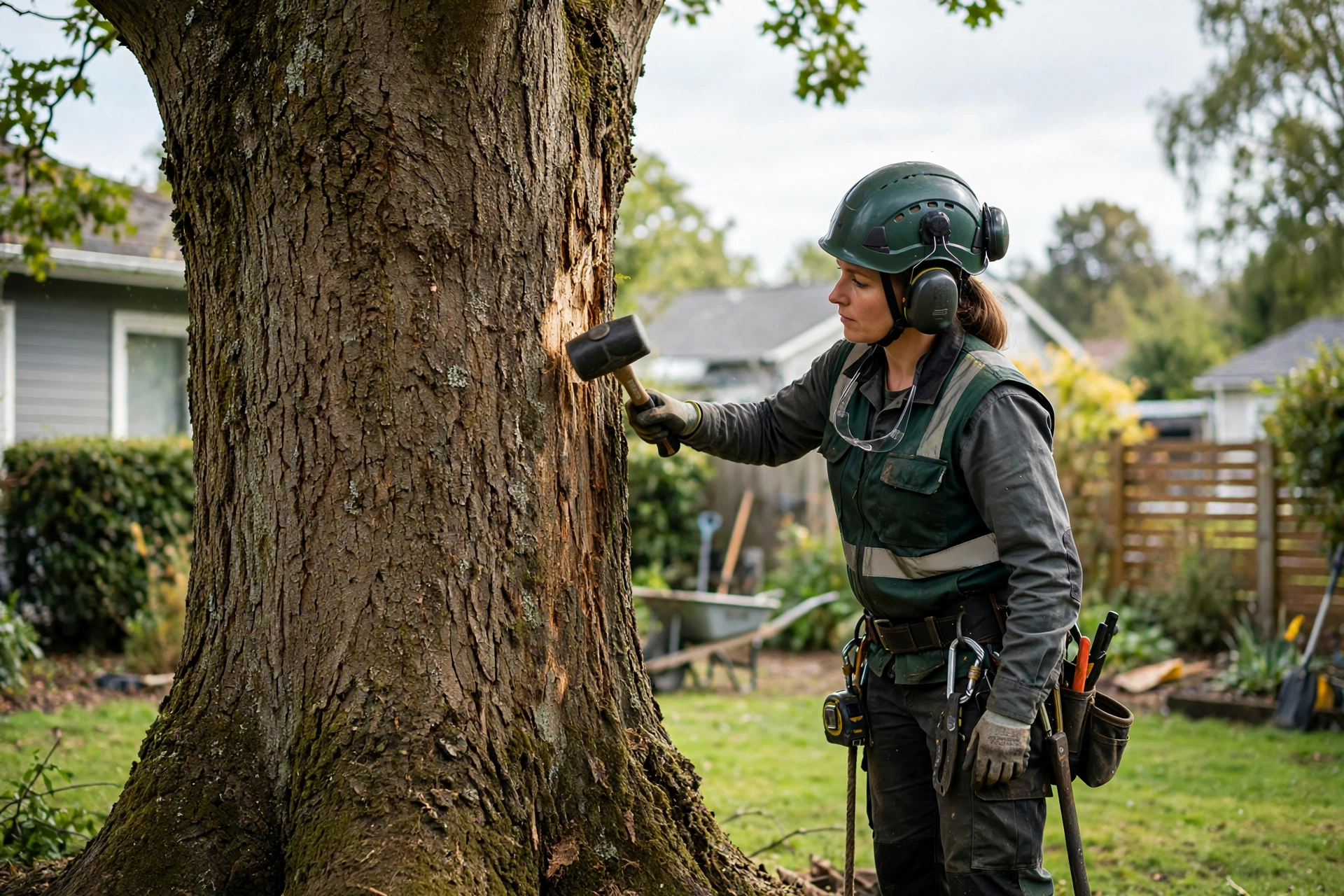
You can detect internal rot by tapping the trunk with a rubber mallet and listening for hollow, drum-like sounds instead of a solid thunk — arborists call this sounding. Visible proof includes shelf-like conks (mushrooms) on the trunk, open cavities, and carpenter ant activity around the base.
We find hidden decay every spring in Peoria — big silver maples on the older streets of the 61604 that looked fine in July and dropped a twenty-foot limb in August.
The Sounding Test
Tap the trunk and main limbs with a rubber mallet: a crisp thunk means healthy wood, a dull hollow drum means decay. It won’t diagnose by itself, but it tells you where to look closer.
Conks, Cavities, and Fungus
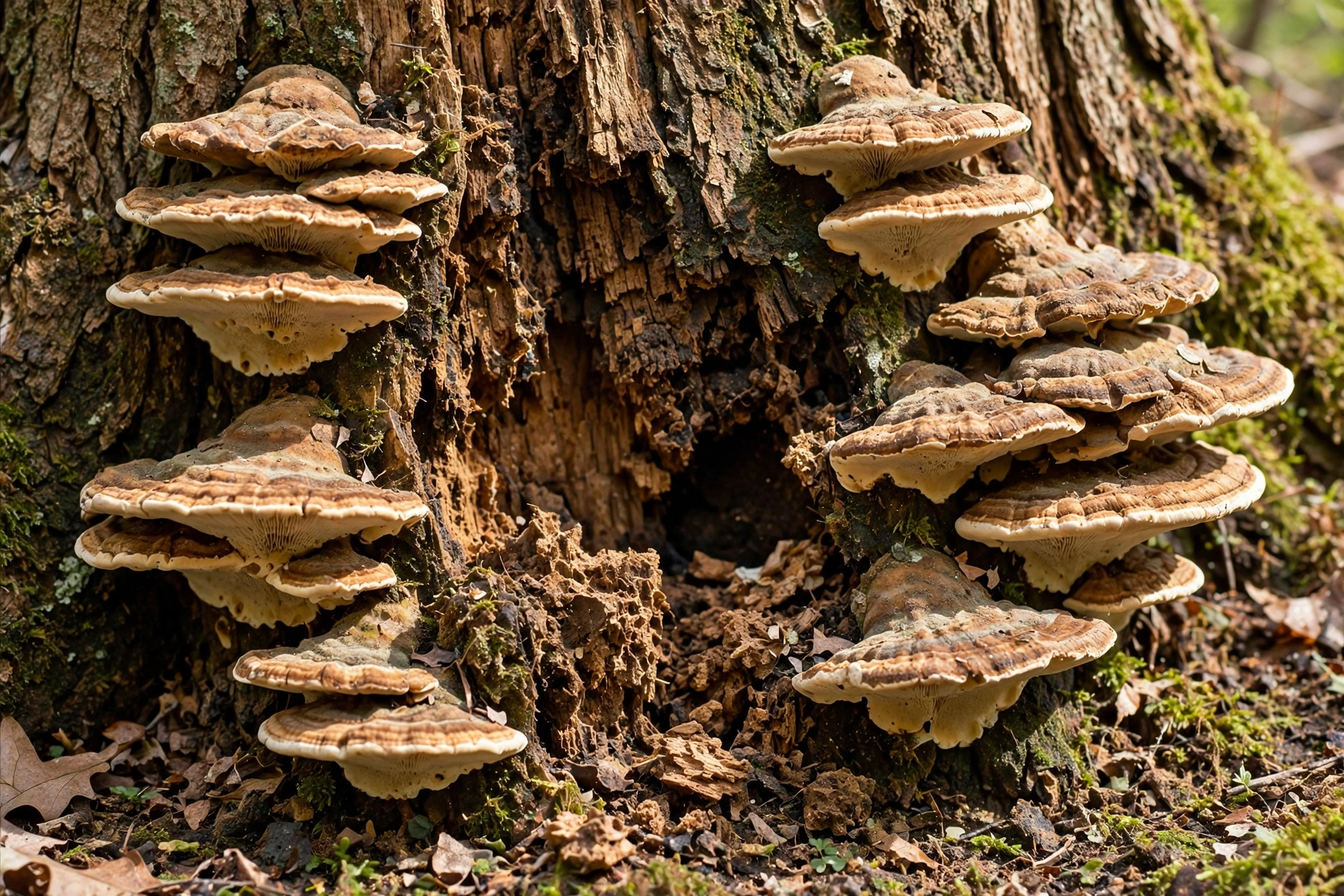
Shelf-like mushrooms (conks) on the trunk or root flare — where the trunk widens at the base — are fruiting bodies of decay fungi inside the wood. They mean rot is advanced, as do open cavities and carpenter ant activity.
The Resistograph
For hidden decay, we drill a pencil-width probe into the trunk with a resistograph — a micro-drill graphing wood density inch by inch. It’s a tree X-ray showing exactly how much solid wood remains.
When to Get a Professional Assessment
Conks, a fist-sized cavity, or hollow sounds across a wide trunk area? Stop guessing. Decay at the base of a large tree — over a Peoria Heights (61616) home or a downtown sidewalk — is a safety issue. Call an ISA Certified Arborist in Peoria.
Can a Diseased Tree Be Treated Instead of Removed?
A diseased tree can be treated instead of removed when the problem is caught early and the tree’s structure is still sound — the rule of thumb is less than 30 to 40 percent canopy loss. Advanced internal decay, a hollow trunk, or a lifted root plate mean removal is the safer choice, no matter what treatment is offered.
Second, structure beats health. A hollow trunk holding up a full crown over a bedroom is not a treatment candidate — it’s a removal candidate, no matter what the leaves look like.
Third, timing is everything. Emerald ash borer treatments work as prevention or at the earliest infestation signs; past about a third of canopy loss, injections won’t bring an ash back. Oak wilt prevention — mainly avoiding oak pruning wounds from April through July, when the beetles that spread it are active — is highly effective. Curing established oak wilt rarely works.
What Tree Problems Are Treatable in Central Illinois?
In Central Illinois, early emerald ash borer infestations respond to trunk injections ($50 to $150 per small tree every two years), iron chlorosis from our alkaline clay soils responds to soil treatments, and oak wilt is highly preventable by avoiding oak pruning from April through July. Leaf-spot fungi rarely threaten mature trees.
Emerald ash borer (early stage). Trunk injections every two years protect healthy ash remarkably well — far less than the $800 to $1,800 a large ash removal costs. The catch: the tree must still hold most of its canopy.
Nutrient deficiencies. Yellow leaves with green veins on pin oaks and maples — classic iron chlorosis from our alkaline clay soils — responds to soil treatments and trunk injections. Fall deep-root fertilization perks up declining trees within a season or two.
Fungal leaf diseases. Anthracnose and leaf spots look alarming but rarely threaten a mature tree. Raking fallen leaves and pruning for airflow usually does the job.
Oak wilt prevention. Don’t prune oaks April through July, and paint accidental wounds immediately. Prevention costs almost nothing. A cure for established oak wilt barely exists.
When Removal Is the Honest Answer
Removal is the honest answer when decay has hollowed the trunk or major limbs, more than 40 percent of the canopy is dead, or the root plate is lifting. I would rather talk you out of an unnecessary removal than sell you one — but a living tree with failed structure is still dangerous.
Cost-wise, removal around Peoria runs $300 for small trees up to $2,000–$2,500+ for large or complex ones near structures. Compare that to years of repeat treatments on a declining tree — plus the risk of it failing. Sometimes the chainsaw is the cheapest long-term option, and I’ll tell you when. Our tree removal guide for Peoria breaks down the pricing.
Quick Signs Recap: Is Your Tree Sick?
Watch for canopy dieback starting at the top, bark falling off in patches, conks or mushrooms on the trunk, D-shaped exit holes (the emerald ash borer calling card), and leaves yellowing or dropping out of season. One or two signs on a vigorous tree is treatable territory; several at once means call an arborist now.
One or two of these on an otherwise vigorous tree? Worth an assessment. Several at once, or any of them on a large tree near your home? Call sooner rather than later — trees don’t heal on their own, and every season you wait narrows the treatment window.
What Is a Tree Risk Assessment — and When Do You Need One?
A tree risk assessment is a formal, documented evaluation of how likely a tree is to fail and what it would hit if it did. You need one for any large or questionable tree near people or property — over a house, driveway, or sidewalk — and always after major storm damage.
A qualified arborist — ideally one with Tree Risk Assessment Qualification (TRAQ) — inspects roots, trunk, and crown, then rates risk low, moderate, high, or extreme. Get one for questionable trees near people or property, before buying a home with mature trees, and after major storms.
A written report runs $150 to $500 in the Peoria area and becomes your action plan: what’s urgent, what can wait, what needs nothing. It’s information you own — the opposite of a scare-tactic sales pitch.
Related Articles
- Emerald Ash Borer Signs in Peoria IL | Save Your Ash Tree
- Professional Tree Inspection in Peoria: What’s Included
Tree Disease Treatment FAQs — Peoria Homeowners Ask
How can I tell if my tree has internal rot?
Tap the trunk with a rubber mallet — hollow, drum-like sounds suggest decay. Look for conks (shelf mushrooms), open cavities, and carpenter ants. An arborist’s resistograph maps exactly how much solid wood remains.
Can a diseased tree be treated instead of removed?
Often, if caught early: early emerald ash borer, nutrient deficiencies, and oak wilt prevention all respond to treatment. Past 30–40 percent canopy loss or advanced structural decay, removal is usually safer.
When should I call an arborist to inspect my tree?
When you spot conks, cavities, significant dieback, a new lean, or anything here that worries you — especially on large trees near your home. Mature trees deserve a professional look every one to three years.
What is a tree risk assessment and when do I need one?
A formal documented evaluation of failure likelihood and consequences. Get one for any questionable large tree near people, structures, or high-traffic areas — and always after major storms.
How much does tree disease treatment cost in Peoria?
EAB injections run roughly $50 to $150 per small tree every two years. Deep-root fertilization is typically a few hundred dollars — early treatment almost always beats removal on cost.
Get an Honest Diagnosis for Your Tree
A sick tree deserves a diagnosis before a prescription — and you deserve straight answers about whether treatment can work or removal is the responsible choice. That is what our ISA Certified Arborists do on every visit: assess, explain, and give you a written plan with real numbers.
Call 309-250-8333 for a free estimate anywhere in Peoria, Bartonville, Chillicothe, Peoria Heights, Washington, East Peoria, Morton, or Pekin. Explore our full tree service in Peoria, IL, learn more about Peoria Tree Removal Co., or check Morton Arboretum’s excellent plant health resources for a second opinion you can trust.
Listen to This Article
Prefer listening? Hear the full article narrated:
Peoria Tree Removal Co.
(309) 250-8333
info@treeremovalpeoriail.com
https://treeremovalpeoriail.com/
114 W Forrest Hill Ave, Peoria, IL 61604, USA
Tree Service Company
4 Responses