
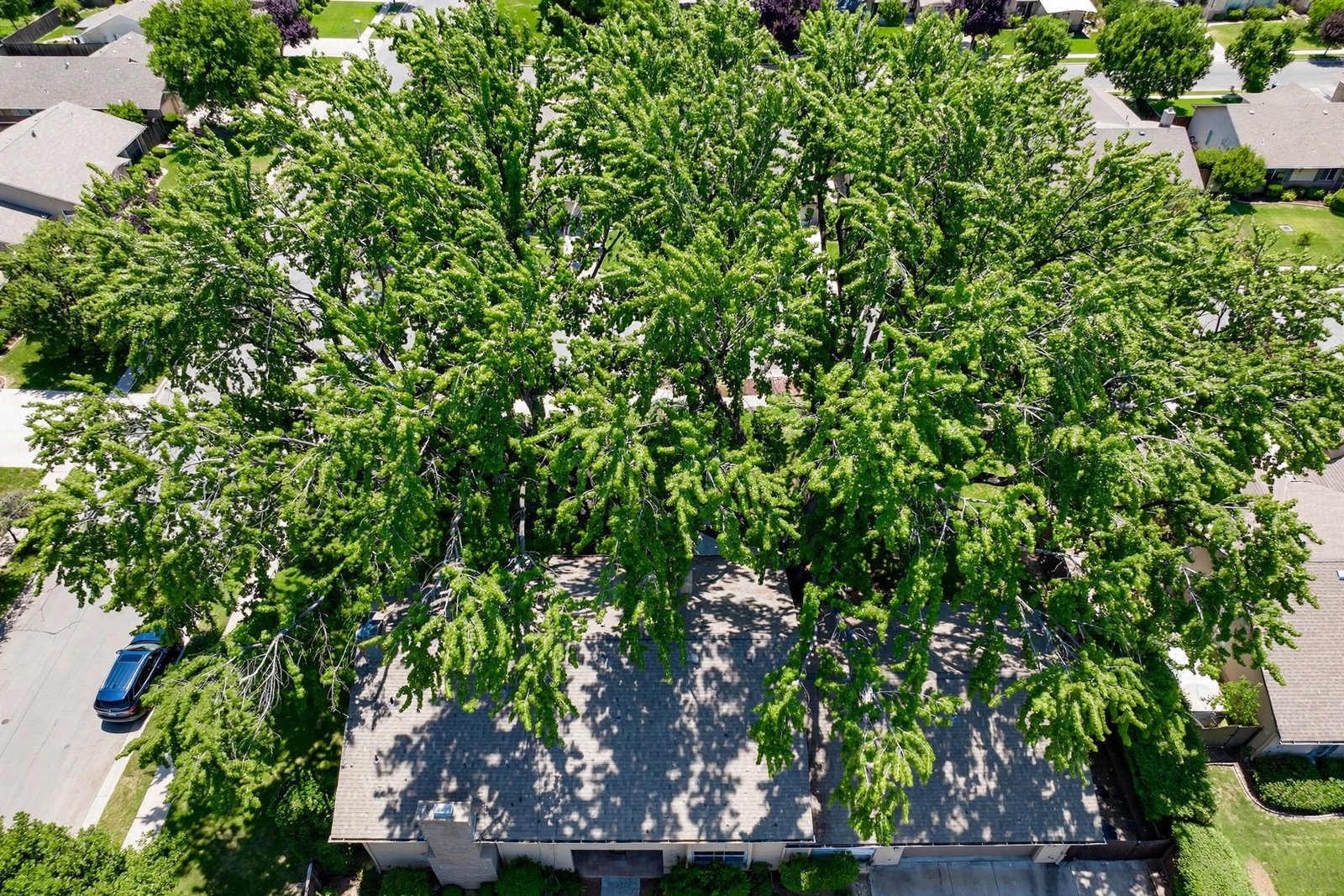
Nobody expects their insurance company to be watching their backyard — but that’s exactly what’s happening. Insurers across the country are pulling satellite and aerial images of homes to decide who keeps their coverage, and trees are one of the first things they check.
In August 2026, KUT News reported on an Austin homeowner with zero claims whose Travelers policy would not be renewed — aerial photos showed trees crowding her roof. She paid $3,000 in pruning to keep her coverage. The Times of India picked up the story, and it rattled anyone with a big old maple leaning toward the house.
If you live in Peoria, this isn’t somebody else’s problem. After the June 2024 derecho tore through Central Illinois, insurers paid out a mountain of storm-damage claims. Underwriting got stricter, and camera-based risk checks are now part of the new normal. A satellite doesn’t care how much you love your shade — it just sees limbs over a roof.
- The story: Austin homeowner, zero claims, faced non-renewal after aerial photos flagged trees near her roof; she paid $3,000 in pruning to keep coverage (KUT News via Times of India, ~Aug 2026).
- The risk: Insurers can refuse to renew — or deny a claim — under the “negligence trap”: if you knew or should have known a tree was hazardous, the damage may be called preventable.
- The fix: Clearance pruning over the roof, deadwood removal over structures and driveways, plus dated maintenance records — photos, dates, trimming invoices.
- The timing: Dormant season (late fall through early spring) is best in our zone 6a climate; our first frost usually lands Oct 11–20.
- Typical costs: Trimming one mature tree in the Peoria area typically runs roughly $200–$800 as an industry norm; urgent insurer-driven pruning can run into the thousands.
- Speed: Most routine trimming jobs finish in a day or less — but don’t wait for a 30-day renewal ultimatum.
What Happened in Austin — A Warning Shot for Peoria Homeowners
The Austin homeowner had never filed a claim. Not one. Then her insurer, Travelers, told her the policy wouldn’t be renewed. When she asked why, the answer pointed to aerial photographs of her property — trees growing close enough to the roof to raise a red flag.
She had two choices: pay for serious pruning, or shop for a new policy in a tough market. She chose the pruning, at a cost of $3,000. It kept her coverage in place.
Nobody’s home was wrecked. The insurer simply decided the risk looked too high from the sky — and put the bill for fixing it on the homeowner.
Why Insurers Are Photographing Homes From the Sky
Aerial and satellite imagery lets insurers check thousands of homes without sending a single inspector. It’s fast, it’s cheap, and it sees everything — including trees a homeowner might walk past every day without noticing.
Tree claims are expensive. A limb punching through a roof, a trunk landing on a parked car, roots cracking a foundation — carriers pay out on these every storm season. The June 2024 derecho that tore across Central Illinois was a wake-up call for the whole region, and Peoria felt it hard.
Now the math has flipped. Instead of waiting for a claim, insurers screen for risk in advance. If the overhead view shows branches draped across your roof, you’re getting flagged — or a non-renewal letter — long before the next storm rolls in.
What Aerial Underwriting Actually Flags
From above, your property tells a story. Underwriters — and the software that reviews their imagery — look for patterns that predict expensive claims. Here’s what tends to get flagged.
Branches touching or overhanging the roof
This is the big one. Limbs resting on shingles wear them down, dump debris into gutters, and give squirrels and raccoons a highway into your attic. From the sky, a canopy hugging the roofline is the clearest signal of deferred maintenance.
Neighborhoods in 61604 and 61615 around Grandview Drive and Bradley Park have gorgeous mature canopies — and plenty of roofs hiding under them. An aerial photo can’t tell a beloved heritage oak from a hazard. It just sees the overlap.
Deadwood hanging over the house, driveway, or sidewalk
Dead branches are the first to snap in a wind event, and leaf-off overhead shots can reveal bare, gray limbs that no longer leaf out. Hanging over a driveway or sidewalk, deadwood reads as a liability waiting to happen.
Trees leaning toward the house or in visible decline
A tree leaning toward the roof, a thinning crown, or bare patches show up from above as lopsided shapes and gaps — signs a tree could fail in the next big wind.
Out in the Morton and Washington subdivisions, 61548 and 61554, many maples were planted when the neighborhoods were built. Decades later they’re tall, heavy, and towering over the same roofs they once shaded as saplings.
Property that looks neglected from above
Sometimes it’s not one tree — it’s the overall picture. Overgrown lots, brush crowding structures, and several unkempt trees together paint a picture of a property where maintenance doesn’t happen. Insurers read that as claim risk.
The “Negligence Trap” — How a Photo Becomes a Denied Claim
2026 insurance guides describe something called the negligence trap. The idea is simple: if you knew — or should have known — a tree was hazardous, your insurer can argue the damage was preventable. And preventable damage is a reason to deny a claim.
Aerial photos are now the evidence. If satellite imagery shows a dead limb hanging over your garage roof for two years before it finally falls, the carrier has a dated record that you should have known. That’s a hard argument to beat.
The flip side is just as important. Dated maintenance records — photos of your trees, inspection reports, trimming invoices with dates — are your defense. They show you acted like a responsible homeowner, not a negligent one.
Check Your Own Roof From Above
You can run your own aerial audit right now. Open Google Maps, switch to satellite view, and zoom in on your roof. It’s the same perspective your insurer uses — and it’s free.
- Branches touching or hovering directly over the roof
- Canopy covering a big share of the roof surface
- Bare, gray limbs that didn’t leaf out this year
- A tree leaning noticeably toward the house
- Brush or saplings crowding the foundation
If two or more of those are true, you’re a candidate for a trimming visit — before your insurer notices first.
What Pruning Actually Satisfies an Insurer
There’s no single official rulebook — every carrier sets its own bar. But industry guidance consistently points in the same direction: keep branches clear of the structure, remove deadwood over anything valuable, and document everything you do.
| What the insurer sees | Recommended clearance* | Common fix | When to do it |
|---|---|---|---|
| Branches touching the roof | 6–10 ft between branch tips and roofline | Clearance pruning | Dormant season |
| Limbs over siding or windows | About 6 ft from walls | Crown raising / thinning | Late fall–early spring |
| Deadwood over the house | Zero deadwood over structures | Deadwood removal | Any time — treat as urgent |
| Branches over the driveway | 12–14 ft above pavement | Crown raising | Dormant season |
| Brush crowding the foundation | Clear about 10 ft around structures | Brush clearing | Any time |
*Typical industry guidance — not a carrier requirement. Confirm the numbers with your insurer in writing.
Build Your Proof-of-Maintenance Folder
1Photo your trees yearly
Date-stamped pictures show condition over time — and prove you were paying attention.
2Keep every invoice
Trimming receipts with dates are your paper trail if a claim is ever questioned.
3Get a written inspection
A professional report documents defects, risk, and the fixes you made.
4Prune before renewal
Address flagged issues before the deadline hits — not after the letter arrives.
Why Older Peoria Neighborhoods Get Flagged First
Peoria’s charm is its canopy — streets near Grandview Drive, the Illinois River bluffs, and the 61616 corridors were planted when those homes were built. Many of those trees are now 50 to 70 years old: a sapling from 1970 is a 60-foot giant dropping limbs on shingles today.
Along the river bluffs and near Forest Park Nature Center, wooded lots back right up to rooflines. And along War Memorial Dr, Knoxville Ave, Sheridan Rd, and out by the Rock Island Trail, neglected boundary trees nobody claims add to the picture. From above, it all reads the same: risk.
What to Do If Your Insurer Flags Your Trees
First, don’t panic — and don’t ignore the letter. A non-renewal or repair-request notice usually comes with a deadline, often 30 to 60 days. Start the clock.
Get the requirement in writing. Ask exactly what needs to change — which trees, how much clearance, by when. Vague letters make it hard to prove you complied.
Then get an independent read on your trees before you cut anything. A tree risk assessment documents each tree’s condition, its defects, and what work actually reduces the risk — so you’re pruning for safety, not just for the camera. For a deeper documented record, a professional tree inspection gives you a dated written report, which is exactly what an underwriter wants to see.
Timing matters in Peoria. Our first frost usually arrives between October 11 and 20, and dormant-season pruning is easier to schedule — with the leaves off, crews can see branch structure clearly.
Keep everything. Photograph each tree before and after the work, save every invoice, and file the inspection report with your policy documents. If a claim ever gets questioned, that folder is your defense.
One more thing: the problem tree isn’t always yours. If your neighbor’s dead ash leans over your fence, talk to
them early — and document that you did. Insurers can still ask questions about hazards on the adjacent lot.
Related Articles
- Does Homeowners Insurance Cover Tree Removal?
- 7 Benefits of Tree Pruning for Peoria Homeowners
- How to Choose a Tree Service in Peoria: 7 Questions to Ask
Frequently Asked Questions
Can my home insurance company really drop me because of my trees?
Yes. Insurers can choose not to renew a policy when aerial imagery shows risk factors like overhanging or neglected trees — that’s exactly what happened in the Austin case reported by KUT News. It’s easier for them to non-renew than to fight over a future claim.
Will trimming my trees lower my homeowners premium?
Not necessarily. Trimming mainly protects you from non-renewal or a denied claim — it rarely earns a discount. What it does buy you is a dated maintenance record, which is far more valuable if a storm hits.
How much clearance do insurers want between trees and the roof?
There’s no single carrier rule, but industry guidance often points to 6–10 feet between branch tips and the roofline, with no branches touching the roof. Ask your insurer for their specific requirement in writing.
Do I have to remove the tree, or is pruning enough?
Pruning is usually enough. Removal typically only comes up for dead, structurally failing, or badly placed trees. An assessment tells you which one you’re dealing with.
What records should I keep to prove maintenance?
Date-stamped photos of your trees, a written inspection report, and invoices showing when trimming was done. Keep them with your policy documents — they’re your defense against a negligence claim denial.
When is the best time to trim trees in Peoria?
Dormant season — late fall through early spring. In our zone 6a climate, once leaves drop after the first frost (usually Oct 11–20), branch structure is easy to see and scheduling beats the spring storm rush.
Peoria Tree Removal Co. — 114 W Forrest Hill Ave, Peoria, IL 61604 — (309) 250-8333 — treeremovalpeoriail.com — info@treeremovalpeoriail.com