
Next spring’s pest problem may already be hiding in your yard. Both the spotted lanternfly and the spongy moth lay egg masses in late summer and fall, tucking them onto bark, fences, and patio furniture where they sit quietly all winter.
The Illinois Department of Agriculture’s August 26, 2026 update confirms spotted lanternfly — first found here in 2023 — is still present, with more Cook County sightings this year. The public is asked to report sightings by email, with a photo and a location.
The spongy moth is an older enemy — in Illinois for decades, and it loves our oaks. Local coverage this fall has urged residents to destroy both insects’ egg masses before the cold sets in.
You don’t need chemicals, permits, or special gear — a putty knife, a jar of hand sanitizer or rubbing alcohol, and one walk around the property are enough. Here’s what to look for and where.
- Pests: Spotted lanternfly (in Illinois since 2023) and spongy moth (here for decades)
- Timing: Egg masses laid late summer through fall; they hatch in spring
- Stakes: One spongy moth egg mass can hold up to 1,000 eggs
- Method: Scrape masses into rubbing alcohol or hand sanitizer — no chemicals needed
- Reporting: Email lanternfly@illinois.edu with a photo and location for spotted lanternfly
- Cost: DIY removal costs nothing but your time; professional tree inspections typically run a few hundred dollars as an industry norm — our estimates are free
What’s Happening in Illinois This Fall
Spotted lanternfly arrived in Illinois in 2023 and hasn’t left. The state’s August 2026 update confirmed it’s still present, with more Cook County sightings as the insects swarm during mating season.
Fox Weather covered the August mating-season swarms that lead into fall egg-laying: gray, putty-like masses on bark, stones — and, annoyingly, houses, cars, and outdoor equipment.
Meanwhile the spongy moth keeps doing what it’s done here for decades: defoliating oaks and other hardwoods. Local news has urged residents to destroy both pests’ egg masses this fall — each mass removed is up to a thousand insects that never hatch.
Why Peoria Homeowners Should Care
Pests hitchhike on firewood, trailers, and nursery stock, and they travel green corridors like the Illinois River, the Rock Island Trail, and the woods around Forest Park Nature Center.
Peoria’s neighborhoods are full of exactly what these insects want. Mature oaks line streets off Grandview Drive and around Bradley Park. Maples shade yards from 61604 to 61615. And tree-of-heaven — the spotted lanternfly’s favorite host — pops up along I-74, US-150, and rail corridors all over town.
Our zone 6a climate helps them, unfortunately. Winters here are real but not reliably cold enough to wipe out egg masses. With first frost typically landing October 11–20, the window for a comfortable yard check is right now.
How to Spot a Spotted Lanternfly
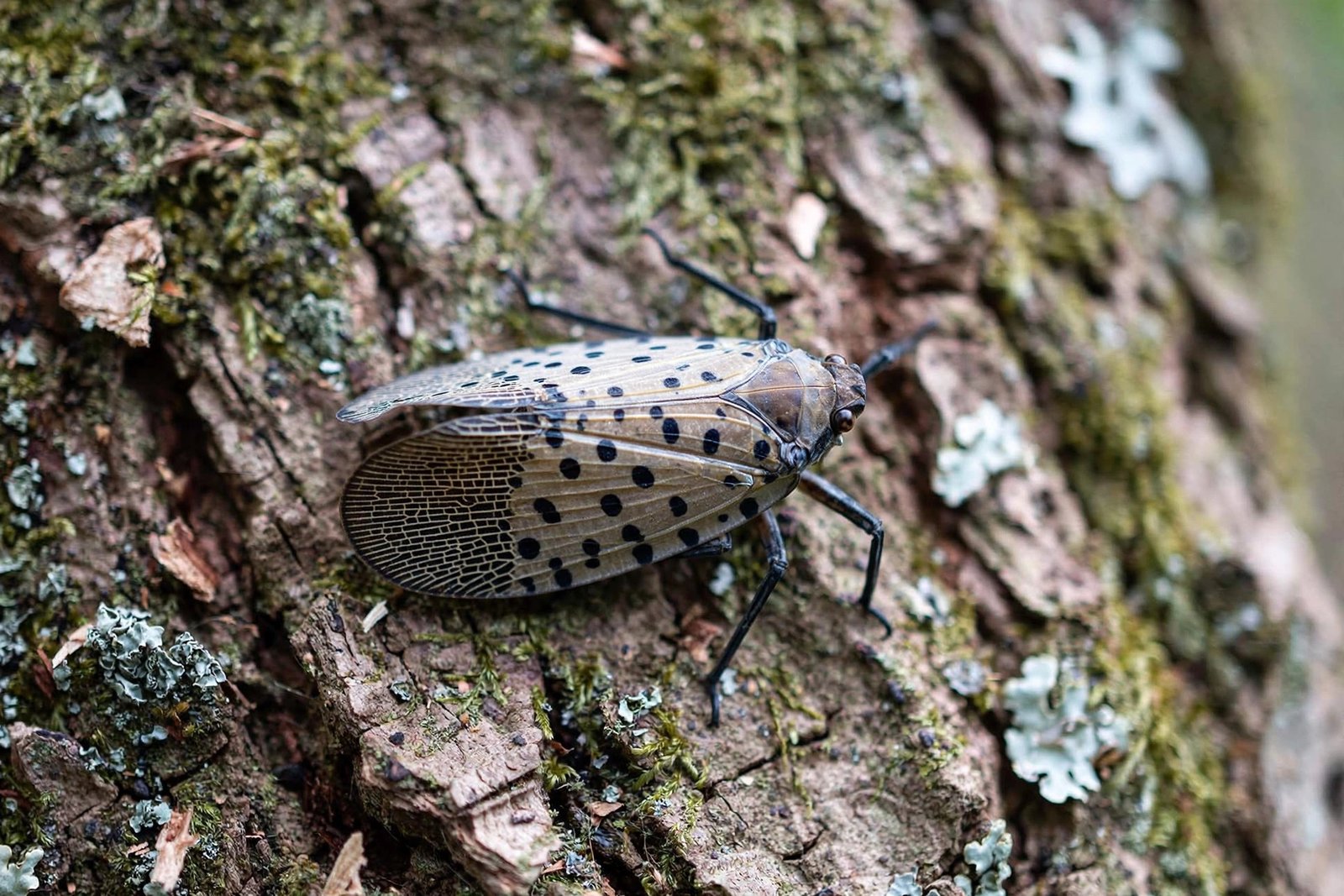
Adults are about an inch long — bigger than most people expect — with gray, black-spotted outer wings. When they open, you get a flash of bright red underwings. That red flash is the giveaway.
Younger ones look different. Early nymphs are black with white spots, like tiny beetles. Later nymphs turn red and black before growing wings. You’ll see them clustered on trunks and stems through summer.
- About 1 inch long as an adult, with spotted gray forewings
- Bright red underwings visible in flight or when the wings open
- Nymphs: black with white spots, then red-and-black in later stages
- Often found on tree-of-heaven, but also maples, walnuts, and grapevines
The real damage is quieter. Lanternflies feed on sap and excrete a sticky substance called honeydew. That honeydew grows sooty mold — a black coating on leaves, bark, and anything parked underneath, from patio furniture to cars.
Heavy feeding weakens trees over time. One season won’t kill a healthy oak, but years of sap loss plus moldy leaves add up — especially for trees already stressed by the June 2024 derecho.
How to Spot a Spongy Moth and Its Egg Masses
You may know it by its old name, the gypsy moth. It’s been in Illinois for decades, with a simple strategy: pack a huge number of eggs into one protected mass, then let spring do the rest.
The egg mass is the thing to look for: cream-colored to buff, with a spongy, felt-like texture — like a small patch of foam stuck to a surface. Each one can hold up to 1,000 eggs.
Females don’t fly far, so they lay masses close to where they fed. Check the bark of oaks and other hardwoods, but don’t stop at trees. These masses turn up on grills, patio furniture, fences, sheds, trailers, stacked lumber, and firewood.
In spring the caterpillars hatch and start eating, and oaks are a favorite — a bad year can strip a mature tree nearly bare. A healthy oak usually recovers from one defoliation, but repeated years, or defoliation on top of storm damage and drought, can kill branches or the whole tree.
New Masses vs. Old Ones
Fresh masses feel firm and full, with a velvety surface. Last year’s leftovers look weathered, flaky, and hollow — the caterpillars already left. When in doubt, scrape it anyway; you might catch a fresh one.
Egg-Mass ID at a Glance
Use this side-by-side comparison when you’re standing in the yard wondering what you’ve found.
| Feature | Spotted Lanternfly | Spongy Moth |
|---|---|---|
| Appearance | Gray, putty-like smear with rows of seed-like bumps under a waxy coating | Cream to buff patch with a spongy, felt-like texture |
| Size | Roughly 1 to 1.5 inches long | Roughly 1 to 2 inches across, sometimes larger |
| Where to look | Tree trunks, stones, house siding, vehicles, outdoor equipment | Bark, grills, patio furniture, fences, sheds, trailers, firewood |
| Eggs per mass | Around 30 to 50 | Up to 1,000 |
| Fall action | Scrape into alcohol; report with a photo to lanternfly@illinois.edu | Scrape into alcohol or hand sanitizer and discard |
Where to Check Around Your Property Before Winter
Do the check before the first hard freeze, while scraping is still pleasant work — in Peoria, that means before the October 11–20 first-frost window closes.
Walk the whole lot, not just the trees — egg masses hide on undersides and shaded sides. Bring a flashlight for sheds and the shady side of fences.
- Tree trunks and large limbs, especially oaks, maples, and tree-of-heaven
- Firewood piles and stacked lumber — check before you carry wood inside
- Grills, patio furniture, and planters
- Fences, sheds, and the eaves of garages
- Trailers, campers, and anything with wheels that sat all summer
- Children’s play equipment and decorative stones
Pay extra attention near the river corridor, the Rock Island Trail, or the woods around Forest Park Nature Center — green corridors and roads both move insects. Firewood bought along IL-29 or hauled in from out of town is a classic way egg masses travel.
Areas around 61548 and 61554, toward Metamora and Washington, sit close to orchards and nurseries where lanternflies like to feed. Got grapevines, fruit trees, or a big garden? Add them to the route.
Found an Egg Mass? Here’s Exactly What to Do
Scrape it off completely with a putty knife, an old credit card, or any stiff flat tool. Get the whole mass — eggs left behind can still hatch.
Drop the scrapings into a jar or bag with rubbing alcohol or hand sanitizer — that kills the eggs. Seal it and trash it. Don’t just knock masses to the ground; they’ll survive winter down there.
For spotted lanternfly — the insect or its eggs — take a photo and email it to lanternfly@illinois.edu with the location. The state tracks reports to watch the spread, and your photo helps.
Found masses high in a tree, on a limb you can’t reach safely, or on an already stressed tree — thinning canopy, dead branches, heavy soot? Bring in a pro. A professional tree inspection can tell you whether the tree needs pruning, treatment, or just monitoring.
Why Fall Checks Protect Peoria’s Oaks
Oaks are the backbone of Peoria’s older neighborhoods — the big shade trees along Sheridan Road, Knoxville Avenue, and War Memorial Drive, and the mature canopy around 61616. Spongy moth caterpillars consider them dinner.
One defoliation rarely kills a healthy oak, but our trees have had a rough few years. The June 2024 derecho snapped limbs and tore bark across the region — and stressed trees are exactly the ones pests finish off.
The fall check also pairs well with watching for other pests. Emerald ash borer gets most of the attention here — our emerald ash borer treatment page covers what to watch for on ash trees — but a yard full of oaks deserves the same vigilance.
The egg-mass check is the cheapest tree care you’ll do all year: ten minutes in October can save a dead limb — or a dead tree — by next summer.
Related Articles
- Buying Firewood This Fall? How Moving It Spreads Tree-Killing Pests in Illinois
- Early Signs Your Tree Is Dying or Diseased
- Tree Disease Treatment in Peoria, IL: Can a Sick Tree Be Saved?
Frequently Asked Questions
Start now and finish before winter. Both pests lay from late summer through fall, so an October check — before the typical October 11–20 first frost — catches fresh masses while they’re easy to scrape.
What do spotted lanternfly egg masses look like?A gray, putty-like smear about an inch to an inch and a half long, often with rows of small seed-like bumps under a waxy coating. You’ll find them on tree trunks, stones, siding, vehicles, and outdoor equipment.
What do spongy moth egg masses look like?Cream to buff patches with a spongy, felt-like texture, roughly 1–2 inches across, on bark, grills, patio furniture, fences, sheds, trailers, and firewood. One mass can hold up to 1,000 eggs.
How do I destroy egg masses safely?Scrape the entire mass into a container of rubbing alcohol or hand sanitizer, seal it, and throw it away. No pesticides needed. Don’t just knock masses to the ground — the eggs can survive winter there.
Should I report what I find?Yes, for spotted lanternfly — email a photo and location to lanternfly@illinois.edu so the state can track the spread. Spongy moth is already established in Illinois, so destroying the masses is the main action.
Can these pests kill my trees?Spongy moth caterpillars can defoliate oaks, and repeated defoliation — especially on trees stressed by the June 2024 derecho — can kill branches or the whole tree. Spotted lanternflies weaken trees through sap feeding and sooty mold. Fall egg-mass checks are the simplest prevention.
What if the egg masses are too high to reach?Don’t climb or set ladders on uneven ground around trees — call a professional instead. Our crew can handle high or hard-to-reach masses during a visit and check the tree’s health at the same time.
Peoria Tree Removal Co. — 114 W Forrest Hill Ave, Peoria, IL 61604 — (309) 250-8333 — treeremovalpeoriail.com — info@treeremovalpeoriail.com
One Response