
Why Winter Is the Best Time to Prune Most Trees in Peoria, IL
Yes – for most trees in Peoria, winter is the best time to prune. Trees are dormant, so cuts seal faster come spring, bare branches reveal the structure clearly, and insects and disease are at their lowest. Oaks especially should only be pruned from November through March, when oak wilt cannot spread through fresh cuts.
If you have been putting off tree work, winter is your window. The leaves are gone, the bugs are gone, and the tree is resting. That combination makes dormant-season pruning the safest, cleanest, and smartest time to shape up the trees in your yard.
Most homeowners think of tree care as a spring chore. But ask any arborist in Central Illinois when they would rather prune, and you will hear the same answer: winter. Here is why the cold months are prime time for your trees – and which trees you should leave alone until spring.
Quick Facts
- Best pruning window: Dormant season, roughly November through March, before buds swell in spring.
- Oaks: Prune only November through March. Never prune oaks April through June, when oak wilt spreads through fresh cuts.
- Why it works: The tree is dormant, so it stores energy in roots and seals wounds quickly once spring growth starts.
- Disease pressure: Lowest in winter – the insects and fungi that attack fresh cuts are inactive.
- Typical cost: Most Peoria homeowners pay roughly $300-$700 per tree for professional dormant-season pruning, depending on size and access.
- Sweet spot: Late February into March is ideal – cold enough for dormancy, close enough to spring for fast wound closure.
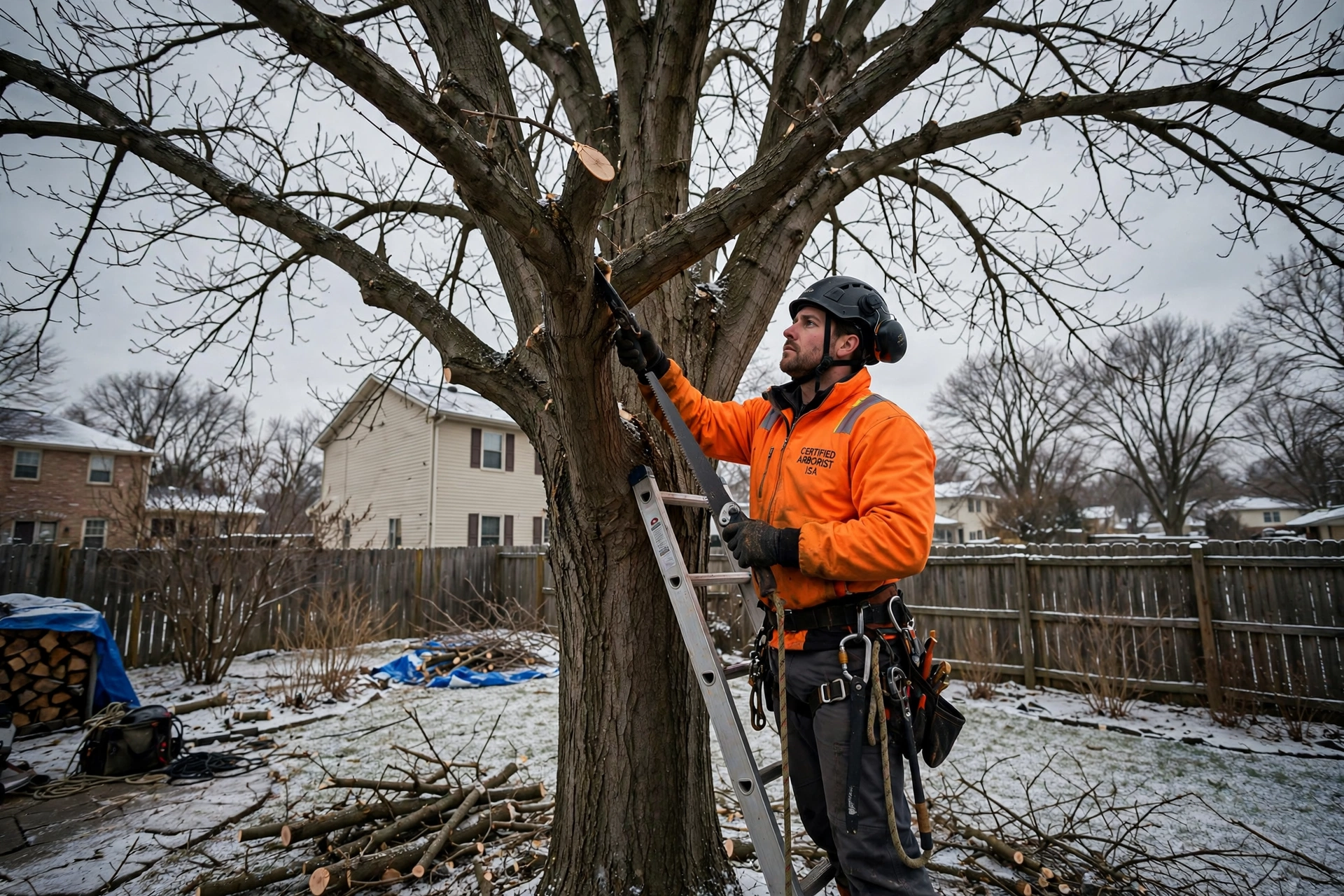
What “Dormant” Actually Means for Your Trees
A dormant tree is not dead. It is resting. Growth has stopped, leaves have dropped, and the tree has pulled its energy reserves down into the roots and trunk for the winter.
Think of it like the tree is asleep with its savings in the bank. When you prune during dormancy, you are working while the tree’s energy is safely stored away from the branches you are cutting. The tree barely notices.
Prune the same tree in late spring, and you are cutting off branches full of the energy the tree just spent weeks producing. It is the difference between trimming your nails and cutting into live tissue. One is painless. The other sets the tree back.
This is the core reason winter pruning works so well. You get the structural benefits of pruning with the smallest possible cost to the tree.
Wounds Seal Faster When Spring Arrives
Here is something most people get backwards: a winter pruning cut does not heal in winter. It waits.
The tree seals the wound when spring growth starts, laying down new wood around the cut in a process arborists call compartmentalization. A cut made in February gets sealed by the vigorous spring growth flush just weeks later. A cut made in October sits open through the entire fall — months of exposure to fungi and decay before the tree can respond.
That timing matters. An open wound is an invitation. In winter, almost nothing is around to accept it. Fungi are dormant. Bacteria are sluggish. The insects that carry disease from tree to tree are not flying.
So a February cut gets the best of both worlds: minimal exposure while open, then fast sealing when growth resumes. It is the cleanest healing cycle a pruning wound can get.
Bare Branches Show the Real Structure
Try finding a crossing branch in July. Good luck. The canopy is a wall of green, and every cut is a guess.
In winter, the tree is a skeleton. You can see everything: branches rubbing against each other, limbs growing inward toward the center, weak narrow-angled attachments that will split in the next ice storm, dead wood that has been hiding all summer.
This visibility is a bigger deal than most homeowners realize. Good pruning is about decisions — which branch stays, which goes — and you cannot make good decisions you cannot see. A winter prune lets the arborist read the tree like a blueprint and make cuts that shape its growth for years.
It also makes dead wood obvious. Dead branches do not drop their bark the same way, and without leaves they stand out. Winter is when we find the dead limbs homeowners never noticed, including the ones hanging over driveways and roofs.
What a Good Winter Prune Targets
A proper dormant prune is not a haircut. It is selective surgery. Here is what it usually includes:
- Dead and dying branches. These are hazards first and health problems second. They come off in any season, but winter makes them easy to spot.
- Crossing and rubbing limbs. Two branches grinding against each other create wounds that never heal right. One of them goes.
- Inward-growing branches. Limbs growing toward the center of the canopy crowd the tree and block airflow. Thinning them opens the crown.
- Weak attachments. Branches with narrow, V-shaped crotches are the ones that split in ice storms. Reducing or removing them prevents future failures.
- Suckers and water sprouts. Those fast vertical shoots around the base and along limbs drain energy and clutter the structure.
What it does not include: topping. Cutting the top off a tree is never correct, in any season. If a company suggests it, find another company.
Disease and Insects Take the Winter Off
Almost every serious tree disease in Illinois spreads through fresh wounds, and almost every vector — the insect or fungus doing the spreading — goes quiet in winter.
Oak wilt is the big one. It kills oaks fast, there is no cure, and it enters through fresh pruning cuts carried by sap-feeding beetles. Those beetles are not active in winter. That is why the rule is ironclad: prune oaks only when dormant, roughly November through March.
But oak wilt is not the only concern. Fire blight on ornamental pears and crabapples, Dutch elm disease on elms, and various canker fungi all spread more easily when pruning happens during the growing season. Winter pruning sidesteps nearly all of it.
This is also why we say: if a tree is already diseased, winter is the safest time to remove infected wood. You are far less likely to spread the problem to healthy trees nearby.
The Dormant Pruning Calendar for Peoria, IL
Safe for all dormant pruning. Oaks, maples, elms — the full window is open.
The sweet spot. Still dormant, and spring sealing is just weeks away.
Stop pruning oaks. Sap beetles are active and oak wilt risk peaks.
Only dead, damaged, or hazardous limbs. Save the rest for winter.
What NOT to Prune in Winter
Winter is the best time for most trees, but not all of them. Here are the exceptions worth knowing.
Spring-Flowering Trees and Shrubs
If it blooms in spring on old wood, do not prune it in winter — you will cut off this year’s flowers. This includes forsythia, lilac, flowering quince, and ornamental cherries grown for their spring show.
Prune these right after they finish blooming instead. You keep the flowers and still shape the plant.
Trees Pruned for Spring Sap (Mostly Cosmetic)
Maples and birches bleed heavily when pruned in late winter as sap starts rising. It looks alarming — sap dripping from every cut — but it is harmless. The tree loses a little sugar water and seals up fine.
If the dripping bothers you, prune maples and birches in late fall or early winter instead of late winter. The result is the same; the mess is smaller.
Newly Planted Trees
A tree planted last fall is still establishing roots. Light corrective pruning is fine, but skip any heavy shaping in its first winter. Let it settle in, then prune the following dormant season.
Anything During an Ice Storm
This is about the worker, not the tree. Do not prune when branches are coated in ice or when it is dangerously cold. Brittle frozen branches snap unpredictably, ladders slip, and no pruning job is worth an injury. Wait for a clear day above 20°F.
The Late-Winter Sweet Spot: February into March
If you want the single best time to prune in Peoria, circle late February and March.
The tree is still fully dormant, so all the disease and energy benefits apply. But spring is close — buds will swell within weeks, and the tree will start sealing wounds almost immediately after the work is done. It is the shortest possible time between cut and closure.
There is a practical bonus too. Tree services are typically less booked in late winter than during the spring rush. Scheduling is easier, and crews can spend the time the job actually needs instead of racing to the next one.
One caution: watch the forecast for oaks. If an unusually warm spell pushes buds to swell early, the dormant window is closing. When in doubt, earlier is safer than later.
| Pruning Task | Do It in Winter? | Why |
|---|---|---|
| Oak pruning | Yes — Nov to Mar only | Avoids oak wilt transmission through fresh cuts |
| Dead branch removal | Yes, ideal | Dead wood is easiest to spot on bare branches |
| Structural shaping | Yes, ideal | Full branch structure visible; cuts seal fast in spring |
| Spring-flowering shrubs (lilac, forsythia) | No — wait until after bloom | Winter pruning removes this year’s flower buds |
| Maple and birch pruning | Yes, but expect sap drip | Bleeding looks bad but is harmless; prune early winter to reduce it |
| Heavy pruning on new plantings | Wait one year | Let roots establish before major canopy work |
Winter Pruning and Storm Damage Go Together
Winter in Central Illinois means ice. Every year, freezing rain tests every weak branch in Peoria, and the ones that fail end up on roofs, cars, and driveways.
A dormant-season prune is preventive storm work. The weak attachments, the dead limbs, the overextended branches reaching toward the house — a winter prune removes the failures before the ice finds them. It is far cheaper than the roof repair after.
If ice has already done damage, winter is also the right time to clean it up properly. Torn limbs should be pruned back to the branch collar so the tree can seal the wound in spring. If you are dealing with fresh storm damage, our emergency tree service in Peoria handles hazardous limbs and fallen trees any time.
Should You Do It Yourself?
Light pruning — small branches you can reach from the ground with hand pruners or a pole saw — is fine for a careful homeowner. Cut just outside the branch collar, never flush to the trunk, and never leave a stub.
But most winter pruning worth doing is not light work. Anything involving a ladder, a chainsaw, or branches over your roof, driveway, or power lines belongs to a professional. A bad cut in winter is still a bad cut — it just gets sealed faster.
A professional tree trimming and pruning service also sees things you will not: the early decay, the structural flaw three years from failure, the limb that looks fine but is hollow. That trained eye is half the value of the visit.
Frequently Asked Questions About Winter Pruning in Peoria
Can you prune trees when there is snow on the ground?
Yes. Snow on the ground does not matter. What matters is the condition of the branches — skip the work during ice storms or extreme cold snaps, and pick a clear day.
Will pruning in winter make my tree bloom or leaf out early?
No. Dormant pruning does not wake the tree up. Bud break is driven by temperature and day length, not by pruning.
How late in spring can I still prune oaks safely?
Do not push it. Once buds start swelling, the dormant window is over for oaks. Our full oak trimming timing guide covers the oak wilt danger zone in detail.
Is it cheaper to prune in winter?
Not necessarily cheaper per tree, but scheduling is usually easier and crews are less rushed. The real savings come from preventing storm damage.
What about evergreens — can they be pruned in winter?
Light shaping is fine, but evergreens are best pruned in late spring after the new growth hardens off. Heavy winter pruning on evergreens can expose inner foliage to windburn.
Book Your Dormant-Season Prune Before Spring
The window is open now and it closes when buds swell. If your trees have dead limbs, crossing branches, or storm damage from last season, winter is the time to deal with it.
Peoria Tree Removal Co. serves Peoria and the surrounding area with professional pruning, trimming, and tree care. Learn more at Peoria Tree Removal Co. — or just call and talk to a real local crew about your trees.
**Peoria Tree Removal Co.** 114 W Forrest Hill Ave, Peoria, IL 61604 (309) 250-8333
Home
Peoria Tree Removal Co.
114 W Forrest Hill Ave, Peoria, IL 61604
Mon–Sat 8am–6pm · 24/7 emergency tree service
One Response