
Oak wilt can kill a red oak in one season — and November is the month to check your oaks, because the safe pruning window just opened.
Oak wilt is a fungal disease found throughout Illinois that plugs an oak’s water vessels. Red oaks can die in one season; white oaks decline over years. There is no cure, but timing — especially pruning only from November to April — keeps it from spreading.
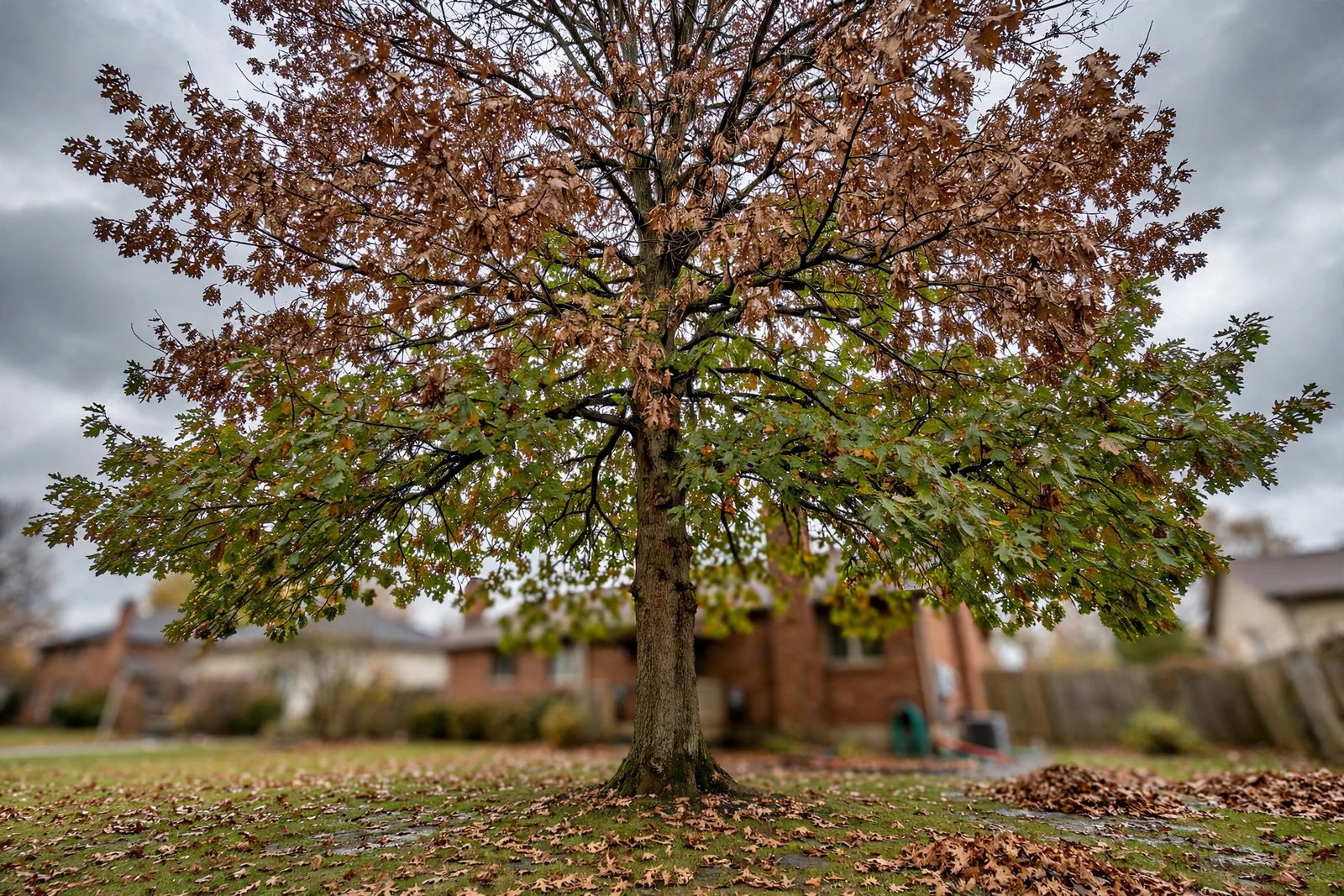
Quick Facts
- The disease: oak wilt, caused by the fungus Ceratocystis fagacearum (also named Bretziella fagacearum in newer references).
- Where it occurs: found throughout Illinois, according to the University of Illinois Extension.
- Red oaks die fast: trees in the red oak group usually die within weeks to months, often in a single growing season.
- White oaks decline slowly: symptoms stay on individual branches and progress over years, not weeks.
- How it spreads: underground through root grafts between nearby oaks, and above ground when sap beetles carry spores to fresh wounds.
- Highest-risk months in Illinois: April, May, and June, when beetle activity peaks.
- Safe pruning window: early November to very early April — which means right now.
- No complete cure exists: management is containment — confirmed diagnosis, removal of infected trees, root-graft barriers, and protection of high-value healthy trees.
What Oak Wilt Actually Is
Oak wilt is a vascular wilt disease. The fungus invades the water-conducting vessels in the sapwood and plugs them, so the tree cannot move water to its leaves even when the soil is wet. That is why the first signs look like drought: leaves wilt and discolor even though it rained last week. The fungus gets in two ways — through a fresh wound, carried by a sap beetle, or underground, through roots grafted to an infected neighbor.
Oaks are not all equally at risk. Illinois has twelve species in the red oak group, including northern red oak, pin oak, black oak, shingle oak, and cherrybark oak — all common in Peoria yards, along Grandview Drive, in Bradley Park, and through the older neighborhoods off War Memorial Drive and Knoxville Avenue. Red oaks have pointed leaf lobes, and they are the group that dies fast. The white oak group — white oak, bur oak, swamp white oak, chinkapin oak — has rounded leaf lobes and holds up longer. Knowing which group your tree belongs to matters, because it decides how fast you need to act. The University of Illinois Extension has the full disease profile, and it is the source for the facts in this post.
The fungus also produces spore mats under the bark of an infected red oak, usually in the spring or fall after the tree dies. The mats smell sweet and fruity, drawing sap beetles — also called picnic beetles — that feed on them, pick up spores, and carry them to the fresh sap of a pruning cut or storm wound on a healthy oak. A single pruning cut made in June can be enough.
Red Oak or White Oak: How the Signs Differ
The symptoms look different depending on the group, and misreading them wastes the one thing you cannot get back — time. In a red oak, the disease moves fast and shows itself plainly. In a white oak, it creeps, and it is easy to mistake for drought or old age for a season or two.
| Sign | Red oak group | White oak group |
|---|---|---|
| Speed | Dies within weeks to months, often one growing season | Declines branch by branch over several years |
| Where it starts | Top of the crown and tips of lateral branches, moving down and inward | Scattered individual branches, not the whole crown at once |
| Leaves | Turn dull green, then bronze or tan starting at the margins; curl, droop, roll lengthwise; fall while still partly green | Turn light brown or straw-colored from tip toward base on affected branches only |
| Leaf drop | Heavy, early — often most leaves gone by midsummer | Partial; the tree keeps most of its canopy for years |
| Under the bark | Brown or black streaking in the current-season sapwood; fungal mats with a fruity smell under cracking bark | Brown streaking in affected branches; mats less common |
| Shape over time | Whole tree collapses in one season | Stag-head look — isolated dead branches in the crown after two or more years |
The leaf pattern is the detail worth learning. On an infected red oak, a leaf dies from the tip or the outer margin inward, and the line between the green part and the brown part is almost straight. The leaf may droop and roll lengthwise before it falls. Green leaves sometimes fall too, which is not normal — healthy oaks do not drop green leaves in July. When several red or black oaks in one block start dying together, oak wilt is the first suspect, because the fungus travels through their grafted roots and takes the whole group.
White oaks are harder to read. A branch or two dies back, the leaves on those branches scorch from the tip, and the rest of the tree looks fine. Next year another branch goes. A white oak with less than a third of its crown affected can sometimes be helped with a fungicide injection given early — but only by a trained arborist, and only after a laboratory test confirms the diagnosis. Guessing wastes a season.
If the signs above sound familiar, compare them with the broader warning signs in the guide to signs a tree is dying or diseased — but do not stop there. Oak wilt needs its own confirmation, because the treatment for a drought-stressed oak and the treatment for an oak-wilt oak are opposites: one needs water, the other needs to be removed before it infects its neighbors.
How Oak Wilt Travels Through a Peoria Neighborhood
Oak wilt moves in two directions, and both matter in a Peoria yard. The underground route is silent. Oaks of the same or related species growing close together often fuse their roots where they cross, forming grafts. Once one tree is infected, the fungus travels through those grafts into the next tree without any wound or insect at all. A single infected red oak can take a whole row of oaks along a property line or a street in one growing season.
The overland route is the beetle. Sap beetles feed on the fungal mats under the bark of a dead or dying red oak, then carry the spores to fresh wounds — pruning cuts, storm tears, mower scrapes, construction damage. In Illinois the risk is highest in April, May, and June, when beetle activity peaks. The June 2024 derecho tore bark all over Peoria, and every one of those wounds was an open door through the highest-risk months. Pruning an oak in May is the same mistake on a smaller scale.
Firewood is the third way the disease moves, and the one homeowners control most directly. Wilt-killed red oak logs can still produce fungal mats and spores, so moving that wood moves the disease with it. The rule from the University of Illinois Extension is plain: do not store wilt-killed red oak firewood, and do not move logs without the bark removed. The same warning runs through the guide to how firewood spreads tree pests.
Why November Is the Month to Act
November is the best month of the year to deal with oaks in Peoria. Peoria’s first frost usually lands between October 11 and 20, in USDA zone 6a, and the Morton Arboretum calls early November to very early April the safest time to prune oaks. The beetles are inactive, the fungus is not producing spores, and a fresh cut is not an invitation. The University of Illinois Extension puts it the same way: prune oaks only when the leaves are off, or after the first hard frost.
November is also the month when the evidence is easiest to read. With the leaves down, you can see the crown structure — the dead branches, the stag-head shape on a white oak, the bare top on a red oak that wilted in summer. Walk your oaks now, before winter, and look at three things: dead branches in the upper crown, bark cracking with any unusual sweet smell, and whether the oaks next door are declining in the same pattern. If two or three oaks on the same block all went downhill this year, that cluster pattern is itself a clue.
This is also the window for the work itself: dead or infected red oaks should come out over the winter, before they produce spore mats in spring. The timing is covered in the guide to the best time to trim oak trees in Illinois and the dormant-season pruning guide — both point the same way.
What to Do If You Suspect Oak Wilt
Do not start by cutting. The first step is confirmation, because the symptoms overlap with drought stress, root damage, and other oak problems — and the response to oak wilt is the most disruptive one. A laboratory test is the only sure diagnosis. The University of Illinois Plant Clinic tests samples from suspect trees, and an arborist can collect the sample or tell you how to submit one. A branch section showing the brown streaking in the sapwood is the sample the clinic works from. Do not peel bark off the trunk to look for streaks yourself; that creates the kind of wound the disease uses.
Once a case is confirmed, the sequence is containment first, tree second. Map every oak within about fifty feet, especially oaks of the same group — those are the trees at risk through root grafts. Break the root grafts by trenching three to four feet deep, usually halfway between the infected tree and the healthy ones, or in a line around the dripline. Call JULIE at 800-892-0123 before any digging, so underground lines are marked first. Remove the infected red oak before spring, before it produces fungal mats. The decision framework is covered in the guide to when a tree should be removed.
Handle the wood correctly: do not move wilt-killed red oak logs to another property, and do not stack them for firewood with the bark on. Protect the healthy high-value oaks nearby — fungicide injections with propiconazole can protect healthy oaks near a confirmed infection, and can help an early-stage white oak with less than 30 percent of its crown affected — but only by a trained arborist, never as a homeowner spray. Sterilize tools between trees with rubbing alcohol left on for about a minute, or chlorine bleach. A dirty saw carries the fungus from one tree to the next.
A professional inspection is the practical way to run this sequence. It looks at the whole tree — canopy, trunk, flare, roots, lean, and what sits underneath — and weighs how much sound wood is left against what the tree could hit if it failed. That judgment turns a scary diagnosis into a plan. For what an inspection covers, see the guide to professional tree inspection. The broader treatment picture is in the tree disease treatment guide.
What Not to Do
Most of the damage from oak wilt is done by well-meaning mistakes in the first weeks after the symptoms appear. Do not prune an oak between mid-April and mid-October — that is the beetle season, and a fresh wound in May or June is an open door. If a branch is a genuine safety hazard in that window, paint the cut with a nontoxic wound dressing and sterilize tools between every cut, but the safe choice is to wait for November. Do not move oak firewood from a suspect tree: logs from a wilt-killed red oak can carry the fungus to a new yard, a campground, or a relative’s property.
Do not seal a wound and call the tree protected — dressing is a stopgap for an unavoidable cut in beetle season, not a cure. Do not water a wilting oak and assume it is drought: oak wilt blocks water movement inside the tree, so extra water does not reach the leaves — and while you wait a season, the fungus travels through the root grafts to the next oak. Do not replant an oak in the same spot right away, and do not ignore a cluster: three wilting red oaks on the same block is an outbreak, and it needs the trenching and removal sequence now, not a wait-and-see spring.
Oak Wilt or Something Else?
Oak wilt is not the only thing that makes an oak look sick, and the differences decide the response. Drought stress browns leaf edges too, but it affects the whole crown evenly, improves after rain, and does not produce brown streaking in the sapwood or fungal mats under the bark. Anthracnose spots and curls young leaves in wet spring weather, and the tree usually leafs out again — it does not kill a red oak in one season. Oak decline is a slow, multi-year weakening from age, drought, construction damage, and borers. And emerald ash borer attacks ash trees, not oaks.
The honest test is the pattern, not a single leaf. Top-down wilting in late spring and early summer, leaves browning from the margin inward with a straight green-brown line, heavy leaf drop by midsummer, brown streaks in the sapwood, and nearby oaks declining in the same pattern — that combination points at oak wilt, and it points at a laboratory test. One brown branch in August after a dry July points at drought. The two mistakes are equally costly: treating oak wilt like drought lets it spread, and treating drought like oak wilt removes a tree that would have recovered.
Frequently Asked Questions
Can oak wilt be cured?
No complete cure exists. Once the fungus is established in a tree, no treatment removes it. Management is containment: confirm the diagnosis, remove infected red oaks before they produce spore mats, break the root grafts to protect neighbors, and use propiconazole injections to protect healthy high-value oaks nearby.
How fast does oak wilt kill a red oak?
Fast. A red oak infected in spring can wilt from the top down over a few weeks and be bare by midsummer, dead within a single growing season. White oaks are different — they decline branch by branch over several years, which is why they are sometimes mistaken for drought-stressed or simply old trees.
Is it safe to prune my oak tree in November?
Yes — November through very early April is the safest window. The sap beetles that carry the fungus are inactive, the fungus is not producing spores, and fresh cuts are not at risk. The University of Illinois Extension’s rule is to prune oaks only when the leaves are off, or after the first hard frost. Peoria’s first frost usually falls between October 11 and 20, so by November the window is open.
Should I remove a tree if only one branch looks infected?
Not on one branch alone. On a white oak, a single dead branch can be pruned out in the safe window and the tree watched. On a red oak, branch symptoms usually mean the fungus is already moving through the whole tree. Get a laboratory confirmation first — the University of Illinois Plant Clinic tests samples — and then decide with an arborist whether removal, trenching, or protection is the right move.
Check Your Oaks This Month
Oak wilt rewards the homeowner who looks at the right time. November gives you bare branches to read, a safe window to prune, and months before the beetles return to plan any removal or trenching. Walk your oaks this week: look at the crown from the top down, check the bark for cracks and any sweet smell, and look at the oaks on either side of your property line — this disease does not respect fences.
If a red oak wilted this summer, or a white oak has been losing branches for two years running, do not wait for spring. A confirmed diagnosis in November leaves you the whole winter to act. The same diagnosis in June leaves you watching beetles do the work.
Peoria Tree Removal Co. — 114 W Forrest Hill Ave, Peoria, IL 61604 — (309) 250-8333 — https://treeremovalpeoriail.com/
Peoria Tree Removal Co.
114 W Forrest Hill Ave, Peoria, IL 61604
Mon–Sat 8am–6pm · 24/7 emergency tree service