
Most sick trees are not a coin flip between saving and removing. Four facts — what it is, where it is, how far it has gone, and what it threatens — usually settle the decision before anyone picks up a saw.
A tree pest or disease does not always mean removal, and it does not always mean a spray will save the tree. The honest answer depends on what is attacking the tree, where the damage sits, how much of the tree is already affected, and whether nearby trees are at risk. This post gives Peoria homeowners the framework an arborist uses to sort those questions, so you can tell a treatable problem from a spreading one, and know when removal is the act that protects the rest of your yard.
Quick Facts
- Identification comes first: The same symptom — thinning leaves, dead branches, bark damage — can come from a pest, a fungus, drought, or root trouble, and each points to a different answer.
- Location decides a lot: Damage confined to a few branches can often be pruned out; damage girdling the trunk usually cannot.
- Extent is the tipping point: A small, early problem has options. A widespread problem, especially in the trunk, often does not.
- Nearby trees change the call: A spreading pest or disease can make removal the protective choice, even for a tree you would rather keep.
- Pruning diseased wood needs care: Cut beyond the visible damage, clean tools between cuts, and do not prune when the bark is wet.
- No treatment is promised here: Sprays and injections work only for certain problems, at certain times, and only after identification. An assessment comes before a recommendation.
The Symptom Is Not the Diagnosis
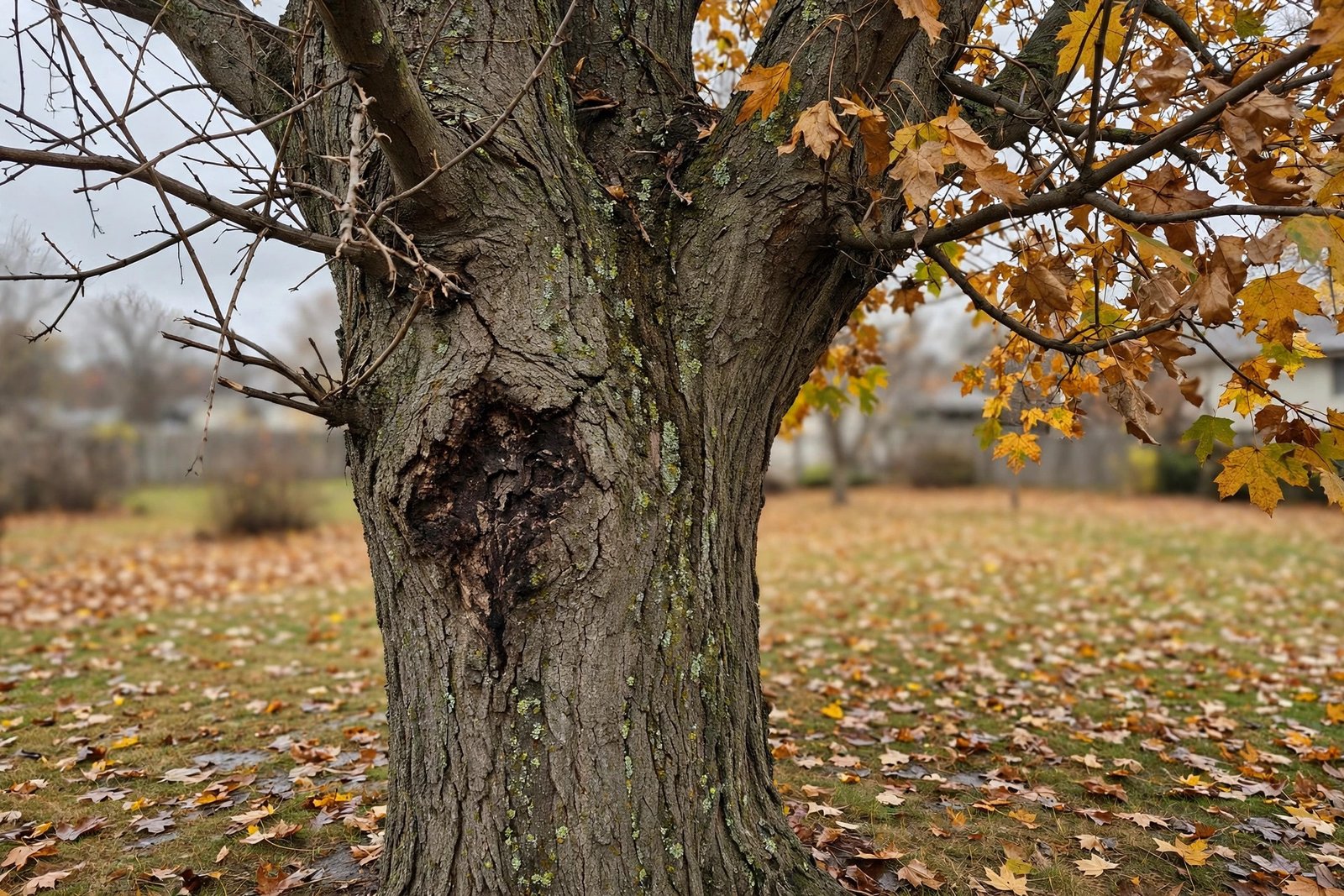
The call usually starts with something you notice from the kitchen window. The maple that used to leaf out full now looks thin at the top. The spruce drops needles from the lowest branches upward. The crabapple’s leaves curl and blacken at the tips. A dark, sunken patch appears on the bark, or sap weeps from a crack that was not there last year. Something is wrong, and the instinct is to ask for a single fix: spray it, prune it, or take it down.
That instinct skips the step that matters. Symptoms overlap, and they overlap a lot. Thinning canopy can mean root damage from construction, compacted soil, drought, a borer, or a vascular disease, and each of those needs a different response. Wilting can mean the tree is short of water, or it can mean something is blocking the water’s path inside the tree. Bark damage can be a canker, a frost crack, a mower wound that let a fungus in, or the entry point of a borer. A homeowner who treats the symptom without naming the cause can spend money on the wrong fix and lose the tree anyway, or remove a tree that would have recovered with water, mulch, and time.
An assessment is how the cause gets named. A good assessor looks at the whole tree, not just the bad branch: the roots and root flare, the trunk from the ground up, the branch structure, the canopy, and the ground around the tree. They ask about recent changes — construction, trenching, grade changes, a wet spring, a dry summer — because trees in Peoria’s zone 6a carry the history of their site in their growth. They look for the signs that separate one problem from another: the pattern of dieback, the shape of the bark lesion, the presence of fungal fruiting bodies, the sawdust-like frass that borers leave behind. You do not need to learn all of that yourself. You need to know that the decision should follow the diagnosis, and that anyone who recommends removal or a spray without looking at the whole tree has skipped the diagnosis.
Take a photo record before the visit, if you can. Photograph the whole tree, the worst branch, and a close view of the bark or leaves. Note when you first noticed the change, and whether it is spreading. That record helps the assessor, and it helps you later, if the problem turns out to be one that needs watching over a season rather than deciding in a day.
The Four Questions That Settle Most Decisions
An arborist’s decision is rarely a gut feeling. It is four questions, asked in order, and the answers narrow the options until one of them is clearly the right one. Homeowners can use the same four questions to understand a recommendation, and to spot a recommendation that has skipped a step.
The first question is: what is it? A named pest or disease behaves in a known way. A canker fungus that girdles branches behaves differently from a leaf-feeding insect that defoliates for one season, and both behave differently from a borer that tunnels under the bark. Some problems have effective treatments; some have none. University of Illinois Extension guidance is blunt on that point for some canker diseases: no chemical treatment has been shown to prevent or arrest Cytospora canker on spruce, and no chemicals are registered for Biscogniauxia canker on oaks. Knowing the name tells you whether treatment is even on the table. If nobody can name the problem, the honest next step is identification — sometimes through the Extension diagnostic service — not a spray chosen at random.
The second question is: where is it? Location is the most practical question in the framework, because it decides whether the damaged part can be separated from the healthy part. A canker on a branch can be pruned out. A canker that has girdled the trunk cannot be pruned out, because the trunk is the tree. A borer confined to a few branches is a different problem from a borer in the main stem. A fungus fruiting from the root flare points to root and butt decay, which is a structural question as much as a health question. Where the damage sits decides whether pruning is a cure, a delay, or a waste of effort.
The third question is: how far has it gone? Extent is where early and late problems part ways. A few infected branches on a vigorous tree, caught early, can often be removed with a real chance of stopping the spread. The same disease covering most of the canopy, or girdling half the trunk, has passed the point where pruning restores the tree. Extension guidance on severely cankered spruce says it plainly: severely cankered trees cannot be restored to good health and should be cut down and burned, because they remain a source of infection for other trees. Extent is not about how bad the tree looks on its worst day. It is about how much healthy, functioning tree is left to build on.
The fourth question is: what does it threaten? A diseased tree is not an island. Some pests and diseases spread to the same species nearby — a cankered oak to the oaks down the street, a borer from one ash to the next. A structurally weakened tree threatens the roof, the driveway, and the people under it. A tree near a power line, a sidewalk, or a play area carries a different risk from the same tree in the back corner of a large lot. Risk to nearby trees and risk to people and property are different kinds of threat, and both belong in the decision. A tree that could be watched for another year in an open field may need removing the same week when it overhangs a house in a Peoria neighborhood along War Memorial Drive or Knoxville Avenue.
| Question | What to look for | If the answer is small / contained | If the answer is large / spreading |
|---|---|---|---|
| What is it? | Named pest, fungus, or stress cause | A known, treatable problem with a known method | An untreatable problem, or an unnamed one needing identification |
| Where is it? | Branch, trunk, root flare, or whole canopy | Confined to branches that can be pruned out | Girdling the trunk, at the root flare, or through the canopy |
| How far has it gone? | Share of canopy, trunk circumference, or branches affected | Early, limited, tree otherwise vigorous | Most of the canopy, half the trunk or more, tree in decline |
| What does it threaten? | Nearby trees of the same species, people, property, lines | Little spread risk, low target risk | Same-species neighbors, or a target under a failing tree |
Treat It: When Treatment Earns Its Place
Treatment is the right answer when the problem is named, the treatment is known to work for that problem, the timing is right, and the tree has enough health left to respond. That is a narrower list than most homeowners expect, and it is narrower than most spray advertisements suggest. The narrowing is honest: a treatment applied to the wrong pest, at the wrong time, or to a tree too far gone does not help the tree, and it can harm the insects and fungi that were never the problem.
Leaf-feeding insects are the clearest example of a treatable, timing-dependent problem. Bagworms on evergreens, for instance, are best controlled when the caterpillars are small and actively feeding, a few weeks after hatching in June in central Illinois, and handpicking the bags through fall and winter removes the overwintering eggs. The bagworm post covers that timing in detail. The general principle carries across pests: the vulnerable life stage is the target, and the calendar matters more than the product name. A spray applied after the pest has sheltered inside a bag, a gall, or the wood itself is a spray applied too late, whatever the label promises.
Some diseases respond to treatment in the same conditional way. Fungicide sprays for certain pine tip blights are recommended in conjunction with removing affected twigs and reducing stress, timed to bud and needle emergence in spring. The spray is one part of a program, not a rescue on its own. And for some problems, the treatment is not a product at all. It is water during a dry spell, mulch kept off the trunk, soil decompaction, or removing the stress that let a canker fungus take hold in the first place. Extension guidance on canker diseases returns to that point again and again: canker fungi are stress pathogens, present in many trees without causing trouble until the tree is stressed. Fix the stress — water imbalance, root injury, compaction, grade change — and you fix the conditions that made the disease possible, even when no chemical is involved.
No spray guarantees a cure, and no schedule of treatments makes a girdled trunk whole again. If a recommendation cannot name the pest, the product’s target, and the timing, it is not yet a treatment plan. Ask for the three names.
Prune It: When Cutting Is the Cure, and When It Is Not
Pruning is the most misunderstood option in the framework, because it looks like doing something, and doing something feels better than waiting. Sometimes pruning is the cure. A branch with a canker, a knot, or a borer gallery can be removed, and the tree can go on without it. Sometimes pruning is the delay: it removes the visible damage, buys a season, and lets the homeowner watch whether the problem returns. And sometimes pruning is the harm: it removes healthy canopy the tree needs, opens fresh wounds for the fungus to enter, or spreads the very disease it was meant to stop.
The cases where pruning works share a pattern. The damage is confined to identifiable branches. The cuts can be made beyond the visible damage, into healthy wood, so the infection is actually removed rather than trimmed back to its edge. The tree has enough healthy canopy left after the cuts to recover. And the work is done at a time and in a way that does not invite reinfection. Illinois Extension pruning guidance makes the practical points: remove dead and diseased branches, since that helps defend against spread; when cutting diseased branches, clean tools when finished to prevent spread; and do not prune when the bark is wet, because wet conditions help spread canker fungi. The more detailed canker guidance adds the specifics: prune several inches behind any sign of disease, remove and destroy the affected parts rather than leaving them under the tree, and sterilise tools between cuts with 70 percent rubbing alcohol or a fresh bleach solution. These are small disciplines, and they are the difference between pruning that helps and pruning that spreads.
Timing matters in a second way. Late winter, around February and March, is the standard dormant pruning window for deciduous trees in Illinois, and pruning then helps avoid diseases such as oak wilt in oaks, stem cankers in honey locusts, Dutch elm disease in elms, and fire blight in fruit trees. Dead and diseased branches, Extension notes, can be removed at any point in the year — but “can” is not “should, without care.” A diseased branch removed in wet weather, with dirty tools, and dropped under the tree is a disease moved, not a disease removed. Ask the crew how they will handle the cut wood, and expect the answer to be removal and destruction, not a pile by the fence.
There is a limit to pruning that homeowners should know before they authorise it. Extension’s rule of thumb is not to remove more than 15 to 20 percent of the canopy in a pruning session, prioritising the cuts that matter most. A tree that needs half its canopy removed to get clear of disease does not have a pruning problem. It has a removal problem, and pruning it heavily only weakens what is left. If the estimate calls for removing a large share of the canopy, ask the crew to say plainly whether the tree is expected to recover, and what the tree will look like in two years. A lopsided, hollowed-out tree over a Peoria roof is not a saved tree. It is a removal postponed, at the cost of the canopy that made the tree worth keeping.
Remove It: When Removal Is the Protective Choice
Removal is the hardest recommendation to hear, and it is sometimes the most responsible one to make. It earns its place in a short list of situations, and each one follows from the four questions above rather than from a preference for taking trees down.
The first is structural failure in progress. A trunk girdled by a canker, a root flare with active decay and fungal fruiting bodies, a large dead section over a target, or a lean that has recently accelerated are not cosmetic problems. They are signs that the tree’s structure is failing, and structure does not heal. A tree in that condition over a house, a driveway, or a sidewalk in Peoria, Peoria Heights, or East Peoria is a risk that pruning cannot fix, because the failure is in the part of the tree that holds it up.
The second is a spreading problem with no effective treatment. Severely infected trees that remain a source of infection for nearby trees of the same species are the textbook case. Extension guidance on Biscogniauxia canker says severely infected oaks should be promptly removed and the infected wood destroyed immediately, to keep the disease from spreading. The same logic applies to other spreading problems: keeping one tree can cost the street its trees. The decision is not about the single tree’s feelings. It is about the row of oaks, pines, or ash along the block, and the homeowner who removes the source tree is protecting the neighbors’ trees as well as their own.
The third is the tree that has passed the point of recovery. A canopy mostly dead, a trunk mostly girdled, a root system mostly rotted — at some point the healthy remainder is too small to rebuild from, and the kindest and cheapest course is removal and replacement with a species suited to the spot. Replacement matters here. Removal without a replanting plan leaves a gap in the yard and in the shade, and a new tree planted at the right distance from the house, with room for its mature size, is part of the same job. The tree planting service page covers planting, and the tree spacing guide covers the distances that keep a new tree out of the trouble the old one was in.
A note on emerald ash borer, because Peoria homeowners will meet it. Ash trees have their own decision — treat or remove — governed by the borer’s timing, the tree’s condition, and the value of the individual tree. That decision is covered in the emerald ash borer post, and it is deliberately not repeated here. If your tree is an ash showing thinning, dieback, or the D-shaped exit holes borers leave, start with that dedicated guidance and an assessment, rather than applying this general framework to a pest with its own calendar.
What an Assessment Should Give You
You are entitled to leave an assessment with more than a price. A useful assessment names the problem, or says honestly that it cannot yet be named. It answers the four questions in plain language: what it is, where it is, how far it has gone, and what it threatens. It gives you the options in order — treat, prune, watch, remove — with the reasons for each, and it says what each option costs in money and in canopy. It tells you what happens to the cut wood if pruning or removal is the recommendation, because diseased wood left on site is a reservoir, not mulch. And it tells you what to watch for if the recommendation is to wait.
Ask for the assessment in writing when the decision is a big one, especially when removal is recommended. A written assessment protects you if a neighbor, an insurer, or a buyer later asks why the tree came down, and it protects the tree if the recommendation is to keep it and a second opinion later suggests otherwise. Ask, too, about the crew’s approach to the work itself: how the tree will be taken down if it is removed, how the canopy will be shaped if it is pruned, and how the site will be left. The tree disease treatment page covers treatment services in general terms, and the arborist service page describes what a professional assessment covers. The assessment visit is where those general services meet your specific tree.
One question deserves asking directly, because it sorts the careful companies from the hurried ones: “What would make you change this recommendation?” A company that can answer — “If the canker has moved past this branch by spring, we remove; if it holds, we prune again” — has thought in seasons, not in jobs. A company that cannot answer has given you a verdict, not a plan.
Frequently Asked Questions
Can a diseased tree be saved, or does it need removal?
It depends on the disease, its location, and its extent. Damage confined to a few branches, caught early, can often be pruned out. Damage girdling the trunk, or covering most of the canopy, usually cannot be reversed. Identification comes before the decision.
When is tree removal the only option for pests?
When the pest or disease is spreading to nearby trees and has no effective treatment, when the trunk or root system is structurally compromised, or when the tree has too little healthy canopy left to recover. In those cases removal protects other trees and the people under the failing one.
Can trimming infected branches stop a tree disease?
Sometimes, when the infection is confined to branches and the cuts go beyond the visible damage into healthy wood, with clean tools and the cut wood removed. It does not stop a disease that has reached the trunk or the roots, and heavy pruning can weaken the tree further.
What tree pests can be treated versus removed?
Leaf-feeding pests caught at the vulnerable life stage can often be treated, and some diseases respond to timed treatment combined with pruning and stress reduction. Borers in the main stem, trunk-girdling cankers, and extensive root decay usually cannot be treated back to health. Each pest and disease has its own answer, which is why identification matters.
How does an arborist decide whether to treat or remove a tree?
By naming the problem, locating the damage, measuring how far it has gone, and judging what it threatens — nearby trees, people, and property. The recommendation follows those four answers, not a preference for any single option.
Should I spray a sick tree myself?
Not until the problem is identified and the timing is right. A spray aimed at the wrong pest, or applied after the vulnerable stage has passed, wastes money and can harm beneficial insects. Get an assessment first, and ask what the spray targets and when it works.
If a tree in your Peoria yard is showing signs of pests or disease and you want the decision made on facts rather than fear, call Peoria Tree Removal Co. at (309) 250-8333 for a free estimate and assessment. Bring your photos, note when the change started, and ask the four questions in this post. Treat what can be treated, prune what pruning will cure, and remove what removal will protect — and plant the replacement where it has room to grow.
Peoria Tree Removal Co. — 114 W Forrest Hill Ave, Peoria, IL 61604 — (309) 250-8333 — https://treeremovalpeoriail.com/
Peoria Tree Removal Co.
114 W Forrest Hill Ave, Peoria, IL 61604
Mon–Sat 8am–6pm · 24/7 emergency tree service