
Clearing a lot for a new house is a sequence, not a single day with a saw. Get the survey and approvals first, clear only the approved footprint, and protect the trees you mean to keep before a machine ever rolls in.
Clearing trees for a new build in Peoria means working in the right order: survey and site plan first, approvals second, then clearing only the areas the plan allows, then stumps and grading. Clearing first and asking questions later is how homeowners lose a tree they wanted to keep, pay to fix a grade that was never meant to change, or find out too late that a tree they removed was never theirs to remove. This post walks through the sequence the way it should happen on a Peoria-area lot, from the first stakes in the ground to a graded pad that is ready for the builder.
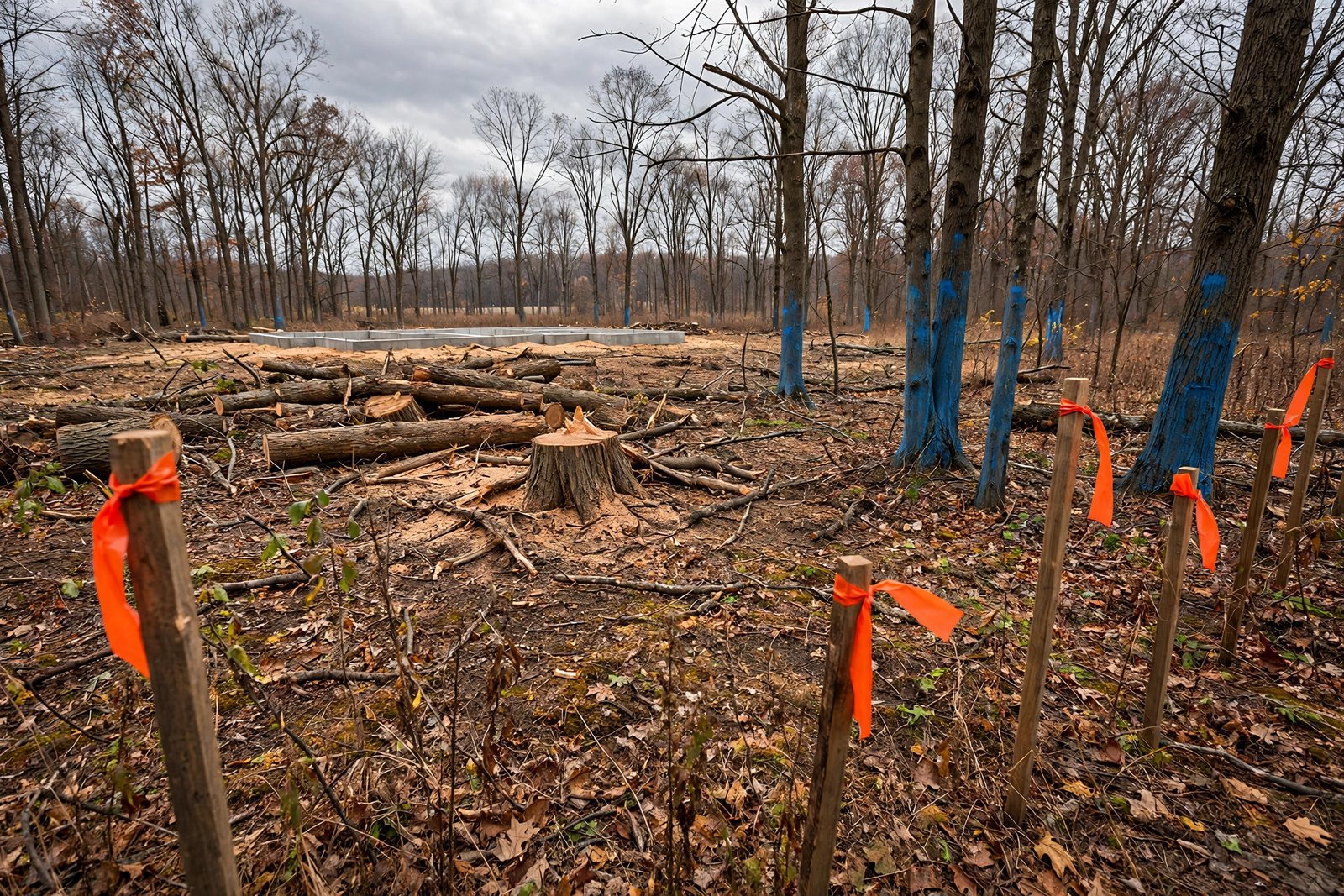
Quick Facts
- The order matters more than the equipment: Survey, site plan, and approvals come before any cutting.
- Clear only the approved footprint: The house, driveway, utilities, and septic or sewer work each need room, and each has its own boundary.
- Trees you keep need protection before work starts: Fencing, no storage, and no grade change inside the root zone.
- Stumps are a separate decision: Grinding, pulling, or mulching each leave a different site behind for the builder.
- Call 811 before you dig: Underground utilities must be marked before stumps, grading, or trenching begins.
- Costs are site-specific: Lot size, tree size and count, access, and stump work all move the figure, so treat any range as general guidance only, never as a quote for your lot.
Start With the Lot, Not the Chainsaw
Every new-build clearing story that goes wrong starts the same way: somebody walks a wooded lot in Peoria Heights or out toward Dunlap, falls in love with the setting, and starts picturing the house among the trees. Then the clearing starts, and the picture changes. The big oak that was supposed to shade the back patio is gone because it stood where the driveway needed to swing. The maple by the property line comes down because nobody marked the line. The ground where the house will sit is six inches lower than the plan assumed, because the topsoil went with the stumps.
The fix is unglamorous, and it happens before any tree work. Get the lot surveyed, and get the survey in your hands, not just in the builder’s file. A survey tells you where your land ends and your neighbor’s begins, where easements run, and where the setbacks sit. Setbacks are the distances the house must keep from the lot lines, and they decide, more than taste does, which trees can stay. A tree that looks like it is in the middle of nowhere can turn out to stand inside the building envelope, and a tree that looks doomed can turn out to be safely outside it. You cannot make the keep-or-clear call without the lines on paper.
Walk the lot with the survey and the builder at the same time, if you can. Stand where the front door will be. Stand where the driveway will enter from the street. Look up at the trees over the roofline, and look down at the ground where the foundation will go. The builder thinks in grades and access; the tree crew thinks in canopies and root zones; you think in the house you will live in. The walk is where those three views meet, and it is far cheaper than discovering the disagreement after the first tree is down.
While you are walking, note the trees that matter most to you, and say so out loud. Builders and crews are not mind-readers, and a tree that is not marked as a keeper is a tree that can be cleared as part of the footprint. Mark keepers with ribbon or paint that everyone on site recognises, and write the list down. The trees you want to keep are not an afterthought to the clearing plan. They are the reason the clearing plan has boundaries.
Approvals, the Site Plan, and the Paperwork Nobody Wants to Skip
A new house needs approvals, and the tree work sits inside them. The site plan shows the house footprint, the driveway, the utility runs, the septic field or sewer connection, and the grading. The clearing should follow that plan, not lead it. If the plan changes — and plans do change, when a soil test comes back or a utility route moves — the clearing plan should change with it, before more trees come down.
What approvals a lot needs depends on where it sits. A lot inside Peoria city limits, a lot in a surrounding town like Morton or Washington, and a lot in unincorporated county land can each answer to different offices, and the rules for trees, grading, drainage, and protected areas can differ from one to the next. This post does not quote a single fee, timeline, or ordinance for any of them, because a figure that is right for one lot can be wrong for the next street over. The practical step is the same everywhere: ask the builder which approvals the lot needs, confirm them with the city or county office that issues them, and get the answer in writing before cutting starts. If a tree stands in a protected area, a drainage way, or a utility easement, that fact belongs in the plan, not in a surprise halfway through the job.
Two paperwork checks save more trouble than any other. First, confirm who owns the trees on the boundary. A tree whose trunk straddles the lot line is not yours alone to remove, and the neighbor conversation should happen before the crew arrives, not after the trunk is on the ground. Second, confirm the utility picture. Call 811 before any digging, stump pulling, or trenching, so underground lines are marked. Overhead lines matter too: if a tree to be cleared leans toward a service drop or an overhead line, say so at the estimate visit, because Ameren may need to be involved before cutting starts. Never let anyone cut near a live line to keep a schedule.
Keep the paperwork with the clearing plan itself: the survey, the approved site plan, the list of keeper trees, and the written approvals. A crew that works from the plan clears the right trees. A crew that works from memory clears the trees somebody remembers.
Decide Which Trees Stay — and Mean It
The hardest clearing decision is rarely which trees to take down. It is which trees to keep, and what keeping them actually costs in care. A mature oak or maple that survives construction adds shade, privacy, and character that no new planting can replace for decades. It also has a root system that does not forgive being driven over, buried, or trenched through. Keeping a tree is a commitment to protect it through the build, not just a decision to leave it standing on clearing day.
Start with health and structure. A tree with a sound trunk, a balanced crown, and no major decay is a keeper worth protecting. A tree that is already dying, leaning hard, hollow, or dropping large limbs is a removal candidate even if it stands outside the footprint, because construction stress will finish what decline started, and a failing tree over a new roof is a problem you will pay for twice. A professional assessment before clearing day is the honest way to sort the two groups, especially for the big trees closest to the house. Ask the assessor to look at each keeper tree and say, plainly, whether it is likely to thrive after construction, and what protection it needs.
Then think about placement, not just beauty. A large tree a few feet from the foundation will drop leaves in the gutters, shade the roof, and send roots toward the foundation and the sewer line over time. A tree that shades the west wall in a Peoria summer is worth more than the same tree shading the north side. A tree in the path of the driveway, the septic field, or the utility trench is not a keeper, however handsome it is, because the work that serves the house will kill it slowly even if the saw never touches it. The tree preservation during construction guide covers protection in detail; the point here is the decision itself. Keep the trees that are healthy, well placed, and protectable. Let the rest go, and plant replacements where they will thrive, at a distance from the house that suits their mature size.
The Clearing Sequence, Step by Step
Once the plan is set and the keepers are marked, the work itself follows a sequence. Knowing the sequence helps you judge whether a job is on track, and it helps you ask useful questions at the estimate visit.
First comes the access. Equipment needs a way in that does not destroy the trees you are keeping. The access route should be marked, and it should avoid keeper root zones wherever the lot allows. On a tight Peoria lot, that may mean a single narrow track; on a larger county lot, it may mean a loop. Either way, the route is part of the plan, not something the operator improvises on the day.
Second comes the undergrowth and the small stuff. Brush, saplings, and invasive growth in the approved footprint are cleared first, so the crew can see the ground, the stumps, and the grade. This is also when the crew finds what the walk missed: an old fence line, a buried stump, a wet spot that never dries. Expect the plan to flex a little at this stage, and expect the crew to tell you when it does.
Third comes the trees themselves, in the approved footprint only. Trees are felled or taken down in sections depending on their size, their lean, and what stands nearby. On a building lot, sectional work is common, because a keeper tree, a neighbor’s fence, or a power line may stand within falling distance. The crew should be able to explain, tree by tree, why each one is coming down and what will happen to the wood: hauled away, chipped on site, or left as firewood if you have asked for it and the species suits it. If you want the wood, say so before the work starts, because chipping is a one-way decision.
Fourth comes the stumps, and fifth comes the grading. The two are linked, and the link is the part homeowners most often miss, which is why each gets its own section below.
Forestry Mulching or Conventional Clearing? The Honest Difference
Homeowners researching a new build will meet two very different descriptions of clearing, and both are real methods. Forestry mulching uses a machine with a mulching head to grind trees, brush, and smaller vegetation where they stand, leaving a layer of mulch on the ground. Conventional clearing uses saws, excavators, and haul trucks to cut trees, pull or grind stumps, and carry the debris away, leaving bare ground behind. The right choice depends on what the lot is for, and the difference is worth understanding before you hire either one.
Mulching is the gentler method on the ground itself. The mulch layer stays, the roots of cleared brush largely stay, and the soil is less disturbed, which helps with erosion and keeps topsoil in place. It suits lots where some trees and vegetation will remain, where the goal is to reclaim overgrown ground, open a view, or prepare an area without building on it immediately. It is not, on its own, a foundation-ready method: stumps ground to mulch level can still sit below grade, roots remain, and a building pad still needs excavation and grading by the builder’s earthwork crew. A mulched lot still needs the foundation work done properly, and the builder should confirm what that work involves on your soil.
Conventional clearing is the blank-slate method. Trees, stumps, and roots come out, debris is hauled away, and the ground is left open for grading, trenching, and the foundation. It disturbs the soil more, it can remove topsoil with the root balls, and it leaves bare ground that needs erosion control until grass or landscaping goes in. But for a house footprint, a driveway, and utility trenches, that blank slate is usually what the build actually needs. The builder’s grading plan assumes a cleared, workable pad, and conventional clearing is how that pad is produced.
| Method | What happens to the vegetation | What the ground looks like after | Best fit on a new-build lot |
|---|---|---|---|
| Forestry mulching | Ground into mulch where it stands, left on site | Mulch-covered, roots largely in place, soil less disturbed | Reclaiming overgrowth, areas around keeper trees, land not built on yet |
| Conventional clearing | Cut, pulled or ground, hauled away | Bare ground, open for grading and trenching | House footprint, driveway, utility runs, building pad |
| Selective clearing | Only marked trees removed, rest left standing | Cleared footprint plus intact keeper areas | Lots where keeper trees are the point of the setting |
| Stump grinding only | Stump ground below grade, roots left to decay | Surface clear, below-grade roots remain | Lawns and landscaping, not under a foundation |
| Stump pulling | Stump and main roots lifted out | Hole to backfill and compact | Under foundations, driveways, and septic fields |
Stumps: The Decision That Decides the Foundation
Stumps are where clearing budgets and building schedules collide, because a stump that is fine under a lawn is not fine under a foundation. Grinding a stump takes it below grade and leaves the roots to decay in place. That is usually enough for grass, planting beds, and landscaping, where a settling root system is a minor nuisance. Under a house, a driveway, or a septic field, it is not enough. Decaying roots leave voids, voids settle, and settling under a slab or a driveway shows up as cracks. In those zones, stumps and major roots generally need to come out entirely, the hole needs backfilling with suitable material, and the fill needs compacting so the builder is working on solid ground.
The rule to carry into the estimate visit is simple: tell the crew and the builder where the foundation, driveway, and septic or sewer work will sit, and ask, zone by zone, whether grinding or pulling is right. A crew that grinds every stump on the lot without asking where the house goes has not done the job the build needs. A crew that pulls every stump, including the ones in the back corner that will be lawn, has spent your money on work the lot did not need.
There is also the question of what happens to the grinding itself. Grindings left in a hole and covered with soil can settle and can tie up nitrogen as they decay, which matters if you plan to plant in that spot soon. On a building lot, the practical answer is usually to remove grindings from foundation and driveway zones and backfill properly, and to use grindings elsewhere only where the builder and the landscaper agree they belong. Ask where the grindings will go before the grinder starts, because moving a pile of grindings twice costs more than placing it right the first time.
Timing matters too. Stump work in frozen ground is slower and harder, and stump work in wet spring ground can rut the lot and compact the soil the builder needs loose. In zone 6a, the practical windows are the same ones that govern most outdoor work in central Illinois: firm, dry ground in late spring through fall, with winter work possible when the ground is solidly frozen and the crew can get equipment in without tearing the lot apart. If the builder’s schedule pushes clearing into a wet spell, say so, and let the crew and the builder agree on whether to wait or to work around it. A rutted, compacted lot is a problem that follows the house for years.
Grading, Drainage, and the Ground the House Will Sit On
Clearing changes how water moves across a lot, and grading is how you put that movement back under control. Trees intercept rain, roots hold soil, and leaf litter slows runoff. Take the trees away, and rain hits bare ground harder and runs faster. The builder’s grading plan — the slopes away from the foundation, the swales that carry water around the house, the driveway crown — is what replaces that natural control. Clearing without a grading plan leaves a lot that sheds water toward the foundation, the neighbor’s yard, or the street, and none of those is a place you want it.
The grading sequence follows the clearing sequence. Rough grading comes first, shaping the pad, the driveway, and the drainage paths while the lot is open and equipment is already there. Topsoil that was stripped during clearing should be stockpiled and put back where lawns and beds will go, because topsoil is the growing layer, and a lot graded with subsoil alone will struggle to grow grass. Final grading comes later, after the foundation is in and the utility trenches are backfilled, when the ground can be shaped to its finished levels. If the clearing crew and the builder are different outfits, the handoff between them should be explicit: who stockpiles the topsoil, where it goes, and who is responsible for erosion control in between. Bare ground in a Peoria downpour does not wait for the handoff meeting.
Water should move away from the foundation on every side and should not pond in a keeper tree’s root zone. If the lot drains toward a neighbor, that is a conversation to have before the foundation, not after the first storm.
Protecting the Trees You Keep Through the Build
A keeper tree that survives clearing day can still die during construction, slowly, from the things that happen around it. The most common killers are not dramatic. They are a delivery truck parked over the roots, a pile of fill buried against the trunk, a trench cut through the root zone for a utility line, and a grade change that buries the root flare under six inches of soil. Each one is preventable, and each one needs to be prevented before the work starts, because by the time the canopy shows the damage, the roots have been dying for months.
The standard protection is a fence around the root zone, at the dripline — the outer edge of the canopy — wherever the lot allows, put up before clearing starts and left up until the heavy work is done. Inside the fence, the rules are simple: no parking, no storage, no spoil piles, no grade change, and no trenching. If a utility trench must cross a root zone, the builder and the tree crew should agree on the route and the method before the trench is dug, because a trench cut with an excavator and a trench cut with care are very different injuries to the same tree. The protection conversation belongs in the same meeting as the clearing plan, with the same marked map, so everyone on site works from the same lines.
After the build, keeper trees need a season of watching. Water them deeply during dry spells in the first summer, keep mulch at two to four inches and off the trunk, and watch for the signs that stress has taken hold: thinning canopy, early fall color, dieback at the branch tips. A tree that struggles in the first year after construction is telling you something, and an assessment that year is cheaper than a removal the next. The arborist service page describes what a professional assessment covers, and the tree risk assessment page covers how risk is judged for trees near a house.
The Questions to Ask Before Anyone Cuts
A clearing estimate is a good test of a tree company, because it rewards the company that asks about the plan before it talks about the saw. Use these questions, and listen for specific answers about your lot, not general ones about clearing in general.
- Have you seen the survey and the site plan? If the crew has not seen them, the estimate is a guess about which trees come down.
- Which trees are keepers, and how will you protect them? The answer should name the trees and the fencing, not just promise care.
- Which method fits each zone — mulching, conventional, or selective? A single method for the whole lot is rarely the right answer.
- What happens to each stump, zone by zone? Foundation and driveway zones need a different answer from lawn zones.
- What happens to the wood, brush, chips, and grindings? Each stream needs a destination in the estimate.
- Who handles erosion control and topsoil between clearing and construction? The gap between phases is where lots get damaged.
- Are utilities marked, and is Ameren involved if lines are near the work? The answer should be a clear yes, with the marking confirmed before digging.
If the answers are specific, the lot is in good hands. If they are vague, get a second estimate. Clearing is the one phase of a build that cannot be undone, and the cost of a second opinion is nothing next to the cost of a keeper tree lost or a foundation pad graded wrong.
Frequently Asked Questions
Do I need a permit to clear trees for a new house in Peoria?
It depends on the lot’s jurisdiction and the site plan. Confirm the approvals with your builder and the city or county office for the lot, and get the answer in writing before cutting. Do not assume a neighboring lot’s approvals apply to yours.
Should I clear trees before or after the house is staked?
After the survey and site plan, and ideally after the house is staked, so the crew clears the footprint the plan actually shows. Clearing before staking risks removing trees the final plan would have kept.
What is the difference between forestry mulching and conventional land clearing?
Mulching grinds vegetation where it stands and leaves a mulch layer, with less soil disturbance. Conventional clearing cuts and hauls debris away and leaves bare ground ready for grading. On a new build, the footprint usually needs conventional clearing, while other zones may suit mulching.
Should I keep any trees when building a new house?
Yes, where they are healthy, well placed, and protectable. A mature keeper tree adds shade and character no new planting can replace quickly. Protect its root zone with fencing, and keep storage, parking, and grade changes out of it through the build.
What happens to stumps when clearing a building lot?
It depends on the zone. Stumps under foundations, driveways, and septic fields generally need pulling, backfilling, and compacting. Stumps in lawn and landscaping zones can usually be ground below grade. Ask zone by zone at the estimate visit.
Can clearing change drainage on my lot?
Yes. Removing trees changes how rain runs off the lot, which is why the builder’s grading plan matters. Water should move away from the foundation on every side and should not pond in a keeper tree’s root zone.
If you are planning a new build on a wooded Peoria-area lot and want the clearing done in the right order, call Peoria Tree Removal Co. at (309) 250-8333 for a free estimate. Bring the survey and the site plan to the walk, mark the trees you want to keep, and ask the zone-by-zone questions above. The lot will only be cleared once, and it is worth doing in the sequence the house deserves.
Peoria Tree Removal Co. — 114 W Forrest Hill Ave, Peoria, IL 61604 — (309) 250-8333 — https://treeremovalpeoriail.com/
Peoria Tree Removal Co.
114 W Forrest Hill Ave, Peoria, IL 61604
Mon–Sat 8am–6pm · 24/7 emergency tree service