
The cheapest pruning a tree ever gets is the pruning done while it is young. A few small, well-chosen cuts in the first years build a strong trunk and well-spaced branches — and spare you the big, expensive corrections a neglected tree needs later.
Walk through any older Peoria neighborhood and you can read the history of its trees in their shapes. The oaks with a straight trunk and branches spiraling evenly up the stem were almost certainly guided when they were young. The maples with two trunks splitting from the same spot, the limbs crossing through each other, the branch that grew straight into the roofline — those trees were mostly left alone until the problems were too big to fix with a hand pruner. The difference between those two futures is rarely money or luck. It is a handful of small cuts, made at the right time, in the first few years after planting.
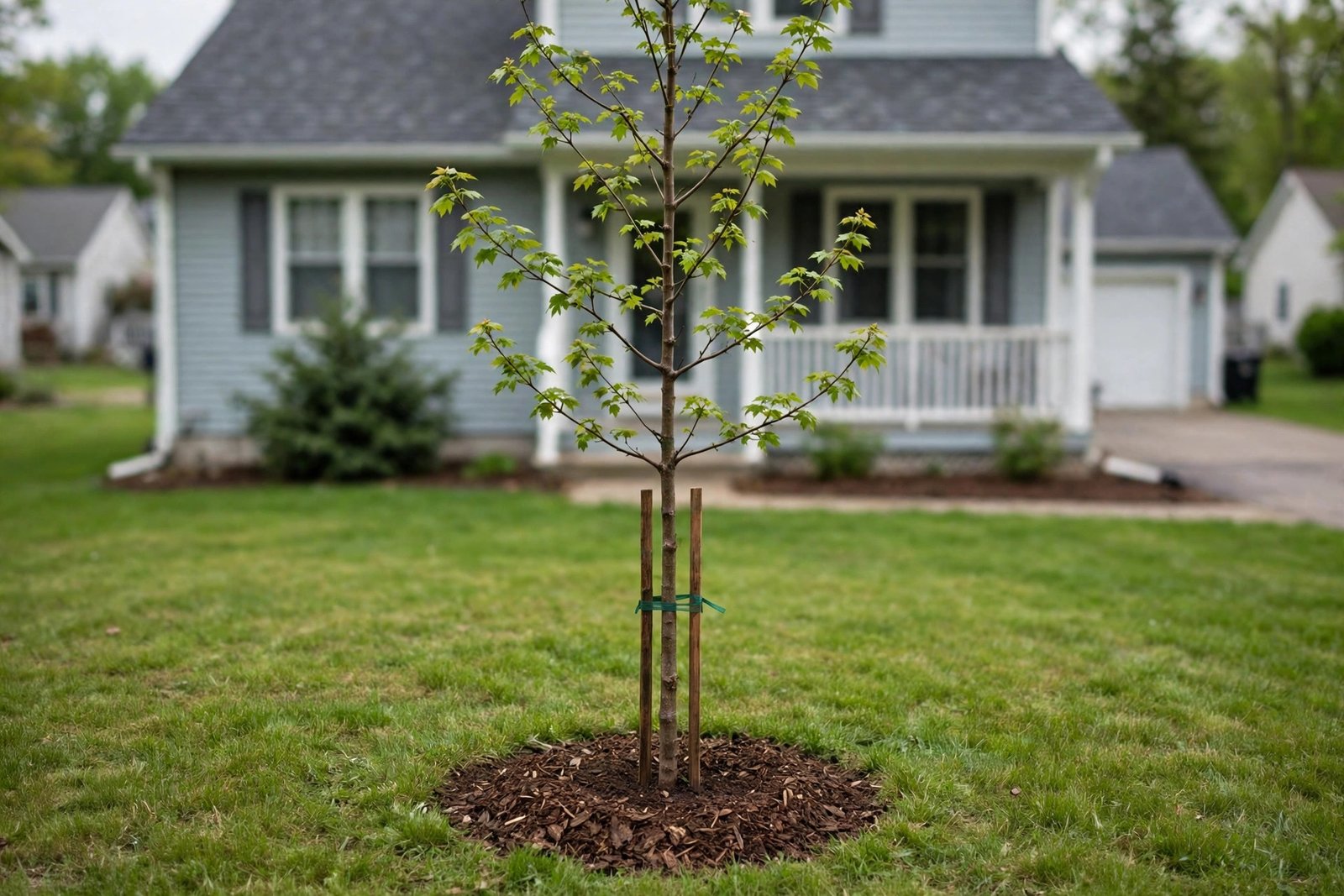
That is structural pruning: pruning a young tree not to make it smaller or prettier this season, but to train the shape it will carry for the next fifty years. It is the single highest-return job in tree care, because a cut on a young tree is small, heals fast, and changes the direction of the whole tree, while the same correction on a mature tree means removing a limb the size of your leg and leaving a wound the tree may never fully close. If you planted a tree in the last few years — or you are about to — this post is the schedule, the targets, and the mistakes to avoid.
Quick Facts
- Structure is set early: the trunk form and main branch layout a tree carries for life are mostly decided in its first years, while cuts are still small.
- One leader, well-spaced branches: for most shade trees, the goal is a single dominant central leader with scaffold branches spaced up the trunk, not a fork at the top or a cluster of branches from one point.
- Small cuts heal fast: a finger-thick branch removed from a young tree closes quickly; the same branch left to grow for a decade becomes a major wound when it finally has to come off.
- Dormant season is the training season: structural work is best done when the tree is leafless, so you can see the branch structure you are shaping — dead or damaged wood, by contrast, can come off any time.
- Less is more, every year: structural pruning is a light annual habit, not a heavy one-off haircut. A young tree that loses too much canopy in one visit grows back weakly and wildly.
- Do not force every tree into the same shape: some species naturally grow with several stems. Train the tree toward its own strong form, not toward a picture of a different species.
What Structural Pruning Is Training, Exactly
A mature tree’s strength comes from its skeleton, and the skeleton is built young. Three features matter most, and every structural cut serves one of them.
The first is a single dominant leader. For most shade trees — oaks, maples, elms, lindens, and the other single-trunk species planted across Peoria yards — the trunk should continue upward as one central stem, with side branches coming off it, rather than forking into two or more equal trunks near the top. A fork of two equal leaders is a weak point waiting for a storm: the two stems push apart as they grow, bark gets trapped in the joint, and ice or wind eventually splits them. University of Illinois Extension makes the same point for young trees in its pruning guidance: developing a single dominant leader early is one of the most important things you can do for a young tree. Where two leaders compete, structural pruning picks the straighter, better-placed one and removes or shortens the other while both are still small.
The second is scaffold branches: the permanent main limbs that will carry the crown for the life of the tree. A good scaffold set is spaced both vertically, up the trunk, and radially, around it, so branches are not stacked on top of each other or all growing to the same side. Branches that leave the trunk at a wide angle — roughly the angle of a hand held open, rather than a tight V — are stronger than narrow forks, because wide unions have room for wood to grow on both sides of the joint. Narrow, V-shaped forks with bark pinched inside them are the ones that fail, and they are far easier to remove as twigs than as limbs. Silver maples, a common Peoria yard tree, are a standing example: fast growth, weak wood, and tight forks combine into exactly the structure that splits in ice storms, which is why early training matters even more for them than for a slow-growing oak.
The third is clearance and balance for the tree’s future, not just its present. A branch that is fine at six feet will be a problem at sixteen feet if it grows toward the house, the driveway, or the service line. Structural pruning looks ahead: it removes or shortens the branch that is headed for trouble while it is still small, and keeps the branch that has open sky to grow into. It also keeps the crown balanced, so the tree does not grow lopsided toward the light and then lean under its own weight. None of this is about making the young tree look tidy this year. It is about making sure the mature tree is still standing, and still welcome, in thirty years.
The First-Years Schedule
Structural pruning works best as a short annual habit, not a project. Here is how the job changes as the tree grows, in a typical Peoria yard in zone 6a. These are training goals, not rigid rules — a slow-growing tree may need less, a fast grower may need a visit sooner, and a tree that arrived from the nursery already well-shaped may need almost nothing in year one.
In the planting year, do almost nothing. A newly planted tree is busy growing roots, and it needs every leaf it has to feed that work. The only cuts in year one are for damage: a branch broken in transport or planting, a dead tip, a rubbing branch that will wound its neighbor before next spring. The tree planting service page covers the planting side of this year — depth, mulch, and watering — and the planting year is the year to get those right, not the year to start shaping.
In years two and three, start training in earnest, while everything is still reachable from the ground. Walk around the tree in the dormant season, when the branches are bare and the structure is visible, and pick the leader: the straightest, most central stem going up. If a second stem competes with it, remove the competitor or shorten it well below the leader so the leader clearly wins. Then choose the first scaffold branches — the lowest permanent limbs, spaced up the trunk and around it, with wide angles — and remove the branches that compete directly with them: the tight forks, the crossing limbs, and the ones growing straight into each other. Leave the small, temporary lower branches alone for now if they are not causing trouble. They feed the trunk and help it thicken, and they can come off later, once the trunk is established. What you are building at this stage is not a finished tree. It is a trunk with a future.
In years three to five, the job shifts from choosing to refining. The leader should be clear and dominant by now; if a new competitor has appeared, deal with it while it is still small. The scaffold branches chosen earlier get checked for spacing as they thicken — a pair that looked well-spaced as twigs can crowd each other as limbs, and the weaker one should go before they start rubbing. Low temporary branches can start coming off gradually, lowest first, as the trunk gains girth and the permanent crown rises. And the branches headed for the house, the roofline, or the service line get shortened or removed while the correction is still a hand-pruner job, not a saw job. By the end of this stage, the tree should read clearly from the street: one trunk, a set of well-spaced main limbs, no forks at the top, no branches crossing through the middle.
After about year five, structural pruning tapers into ordinary mature-tree care. The skeleton is set, and the work becomes maintenance: deadwood removal, clearance, and the occasional correction, rather than training. That handover is the payoff for the early years. A tree trained well in its first five years rarely needs a major corrective prune later, and when it does need work, the work is smaller, cheaper, and less stressful for the tree. A tree never trained often needs exactly the opposite: a large, expensive correction in its teens or twenties, when removing the problem limb leaves a wound the size of a dinner plate.
Cuts That Help, and Cuts That Hurt
Young trees forgive a lot, but not everything, and the mistakes made on young trees are the ones that show up decades later. The most common ones are all avoidable once you know them.
The first mistake is topping a young tree to keep it small. Cutting the leader back to a stub does not make a small tree; it makes a tree that sends up a broom of weak, fast-growing shoots from the cut, each one more weakly attached than the branch it replaced. The topping post explains the damage in full — starvation, sunscald, decay at the stubs, and regrowth that fails sooner — and none of it is kinder because the tree is young. If a young tree is already too big for its spot, the answer is to move it while it is still small enough to transplant, or to choose a smaller species next time, not to cut its top off.
The second mistake is over-pruning in a single visit. A young tree that loses a large share of its canopy in one go responds with a flush of weak shoots, sunscald on bark that grew up shaded, and a season of poor growth while it rebuilds leaves instead of roots. The general trimming versus pruning guide sorts the kinds of pruning by purpose, and the through-line for young trees is restraint: a few well-chosen cuts a year, every year, beats a heavy cut every five years. If you find yourself removing armfuls from a young tree, step back and ask whether the tree was the wrong species for the spot, because no amount of pruning fixes a tree planted under a power line or six feet from a foundation.
The third mistake is bad cuts: flush cuts that slice off the branch collar, the swelling at the base of the branch that the tree uses to seal the wound, and stubs left long beyond the collar that die back and invite decay. The right cut is just outside the collar, angled so water runs off, leaving the collar itself intact. On a young tree, where branches are small, a clean cut with sharp bypass pruners — not an anvil pruner that crushes, and not a dull blade that tears — is most of the job. And skip the wound paint. Trees seal their own wounds, and dressings have not been shown to help; a clean cut in the right place needs nothing smeared on it.
The fourth mistake is pruning at the wrong time for the wrong reason. Structural work belongs in the dormant season, when you can see the skeleton and the tree is not spending energy on leaves. Dead or damaged wood is the exception — it can come off any time, and a broken branch should not wait for winter. The one seasonal caution that matters in central Illinois is disease timing: oaks, in particular, should not be pruned during the months when oak wilt spreads most actively, unless the work is urgent. If you are unsure whether your tree is one of the susceptible species, or whether the season is safe, that uncertainty is itself a reason to ask a professional before cutting rather than after.
Doing It Yourself, and Knowing When to Call
Most structural pruning on a young tree is genuinely homeowner-scale work, and that is part of its charm. The branches are small, the tree is short, and everything can be reached from the ground with a pair of bypass pruners and, for the thicker limbs, a sharp hand saw. Work in the dormant season, step back after every few cuts to look at the whole tree rather than the branch in your hand, and stop when the structure reads clearly. If you cannot decide which of two branches is the leader, or which fork is the weak one, take a photo and ask before cutting — a wrong cut on a young tree is cheap to avoid and expensive to undo.
Call a professional sooner than you think when the job leaves the ground. Anything that needs a ladder, anything near a service line, and anything on a tree that is already large enough that a falling limb could hurt someone or damage property is crew work, not homeowner work. Ameren handles service drops and line clearance — the scheduled disconnect number is 1-800-755-5000 — and no young-tree training goal is worth reaching toward a line. A professional visit every few years in the training stage is also a reasonable investment even for a confident homeowner: an arborist sees the structure the tree will have in twenty years, not just the structure it has today, and one visit can reset a training plan that has drifted.
One last caution about species. Not every tree wants a single leader, and structural pruning should train the tree toward its own strong form. A serviceberry or a redbud grown as a multi-stemmed specimen is not a failed single-leader tree; it is a different form, and forcing it into one trunk fights its nature. The goal is a strong version of what the tree is, with well-spaced stems and no weak forks — not a copy of the oak next door. When in doubt about what form your species should take, check before the first training cut, not after the fifth.
Frequently Asked Questions
When should I start structural pruning a young tree?
In its second or third year, after a quiet planting year spent on roots, water, and mulch. Start while branches are still small enough for hand pruners and the tree is still reachable from the ground.
What is a central leader, and why does it matter?
The single main stem that continues the trunk upward. For most shade trees, one dominant leader with side branches off it is far stronger than two equal trunks forking at the top, which tend to split under ice or wind as they grow.
What are scaffold branches?
The permanent main limbs that will carry the crown for the tree’s life. Good scaffolds are spaced up the trunk and around it, leave the trunk at wide angles, and have open sky to grow into.
How much can I prune a young tree at once?
Lightly, and often, rather than heavily and rarely. A few well-chosen cuts each dormant season train the tree without starving it of leaves. Removing a large share of the canopy in one visit triggers weak regrowth and sunscald.
Is it too late to structurally prune a tree that is ten years old?
Not too late, but the job changes. Corrections are bigger, wounds are larger, and some problems — like a fork that has already grown thick — may need managing rather than fixing. The earlier the training starts, the smaller the cuts and the better the result, which is why the first five years matter so much.
Should I prune my young tree in fall or winter?
Structural training is best in the dormant season, when the bare branches show the structure you are shaping. Dead or damaged branches can come off any time. For oaks and other disease-susceptible species, check the disease-spread season before cutting.
If you planted a tree in the last few years around Peoria and you are not sure whether its structure is on track, call Peoria Tree Removal Co. at (309) 250-8333 for a free estimate. Bring a photo of the whole tree, bare branches if you can get one in the dormant season, and ask which stem is the leader and which branches are the scaffolds. Five minutes of answers now can save a major correction later — and the tree you train today is the shade your yard enjoys for decades.
Peoria Tree Removal Co. — 114 W Forrest Hill Ave, Peoria, IL 61604 — (309) 250-8333 — https://treeremovalpeoriail.com/
Peoria Tree Removal Co.
114 W Forrest Hill Ave, Peoria, IL 61604
Mon–Sat 8am–6pm · 24/7 emergency tree service