
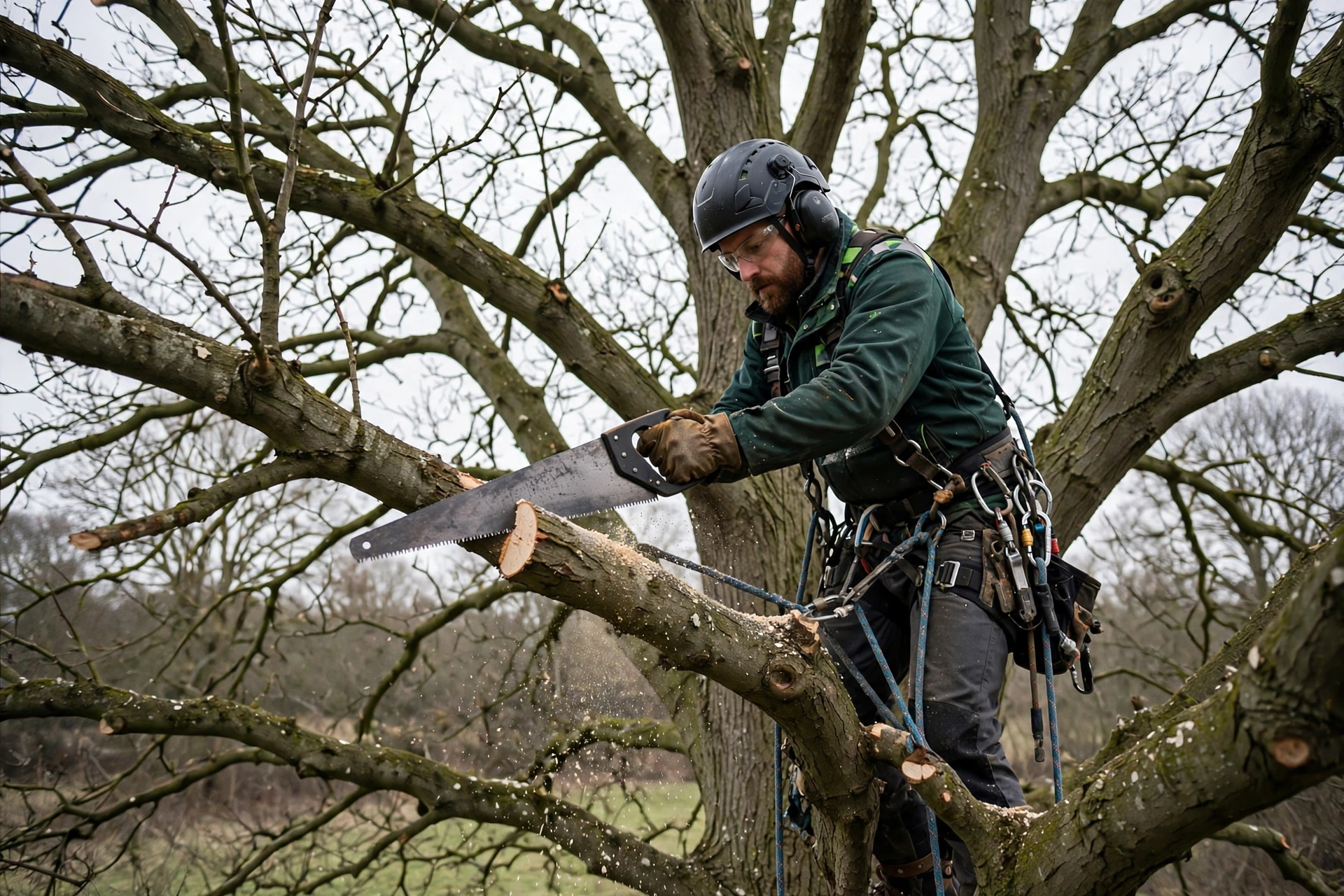
People use “trimming” and “pruning” like they mean the same thing. Around here, most folks say “trimming” for everything. But there’s a real difference, and knowing it helps you ask for the right work — and avoid paying for the wrong work.
This guide answers the questions Peoria homeowners ask us most: what’s the actual difference, when’s the best time to prune in Central Illinois, how often should you do it, whether pruning can really protect your home in a storm, and how often an arborist should check your trees.
What Is the Actual Difference Between Tree Trimming and Tree Pruning?
Trimming is about appearance and clearance. Cutting back branches that hang over your roof, clearing limbs away from power lines, shaping an overgrown tree so it looks tidy — that’s trimming. It’s the haircut.
Pruning is about health and structure. Removing dead, diseased, or crossing branches. Opening up the canopy so air and light get through. Training a young tree to grow with a strong central leader so it doesn’t split apart in twenty years. That’s pruning — it’s the surgery.
In practice, a good crew does both in one visit. When we prune your oak, we’re also going to clear the branch that’s scraping your gutters. The reason the distinction matters is that pruning requires knowing where to cut. A bad cut — too close to the trunk, or leaving a stub — invites disease. That’s why pruning should be done by someone who understands tree biology, not just someone with a pole saw.
When Is the Best Time of Year to Prune Mature Trees in Central Illinois?
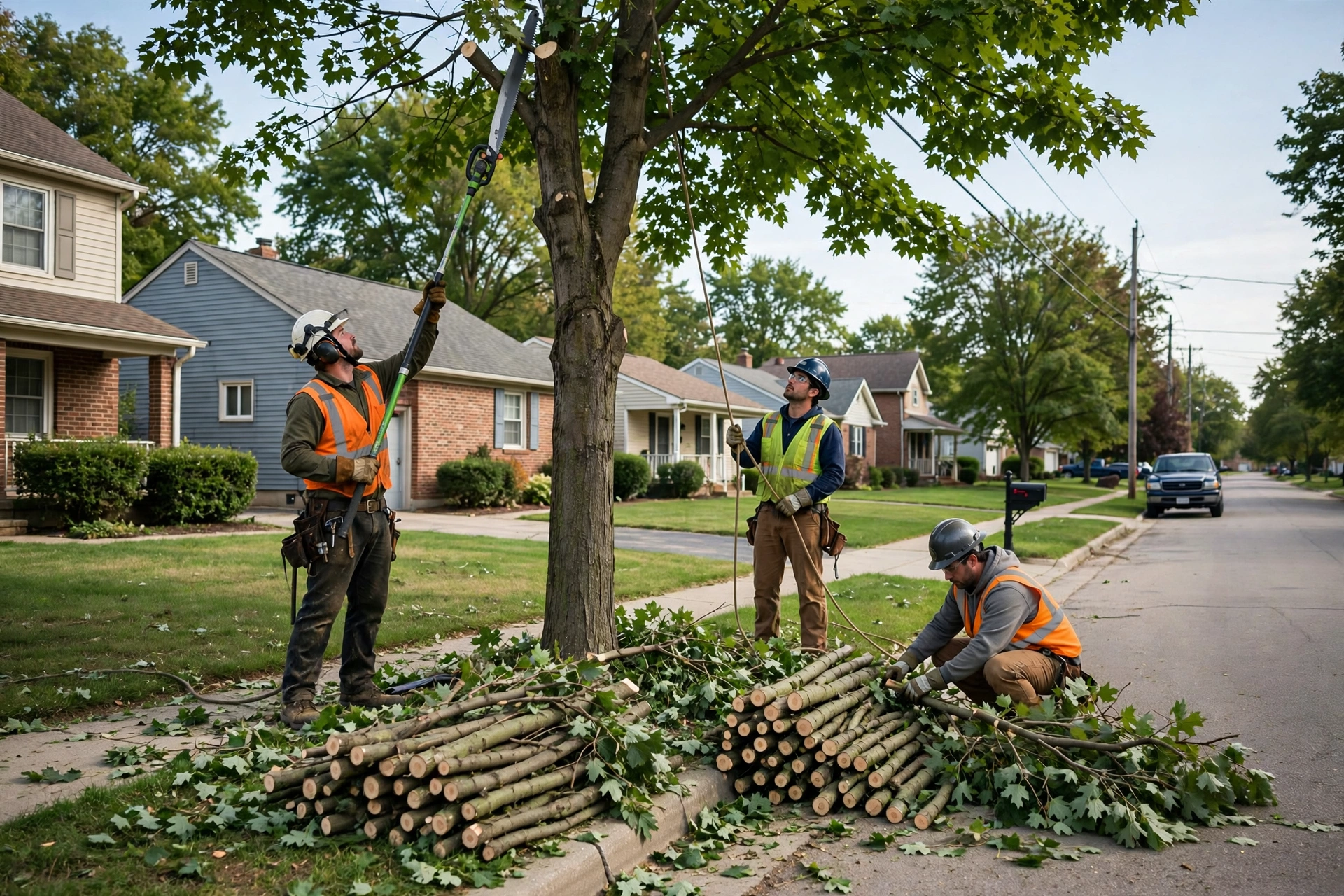
For most trees in the Peoria area, the sweet spot is late winter to early spring — roughly February through March — while the tree is still dormant. No leaves means we can see the branch structure clearly, the tree heals fast once spring growth starts, and disease-carrying insects aren’t active yet.
There’s one big exception: oak trees. Oak wilt is a real threat in Central Illinois, and the beetles that spread it are active from about April through July. Pruning an oak during those months opens wounds that attract the beetles. So we don’t prune oaks in spring and early summer — period. Late fall and winter only.
What about summer pruning? Light corrective work is fine, but heavy pruning in summer stresses the tree when it’s already dealing with heat. And fall pruning is the worst of both worlds — cuts heal slowly going into winter, and decay can set in. If a company offers you a “fall pruning special,” that’s a red flag.
The Worst Pruning Mistakes We See in Peoria
Topping. This is the big one — cutting the top off a tree to make it shorter. It doesn’t work. The tree responds by throwing up a broom of weak, fast-growing shoots that are more dangerous than the original crown. Topped trees are uglier, weaker, and shorter-lived. If a company suggests topping, send them away.
Flush cuts. Cutting a branch flush against the trunk removes the branch collar — the tree’s natural healing zone — and leaves a wound that can’t close properly. Decay moves straight into the trunk.
Lion-tailing. Stripping all the inner branches and leaving tufts at the ends looks tidy but starves the branch of its ability to flex. Lion-tailed limbs snap in windstorms — exactly the opposite of what pruning should achieve.
Over-pruning. Taking more than about a quarter of a tree’s live canopy in one year stresses it badly. Good pruning is gradual. If your tree looks dramatically smaller after a visit, too much came off.
How Often Should You Trim the Trees on Your Residential Property?
For mature shade trees — your big oaks, maples, and sycamores — every 3 to 5 years is the standard cycle. Younger trees benefit from structural pruning every 2 to 3 years while they’re still trainable. Fast-growing species like silver maple and willow may need attention more often because they put on weak growth quickly.
Here’s what we tell homeowners in Bartonville and across our area: put it on a schedule instead of waiting for a problem. Trees that get regular, light pruning stay healthier, look better, and cost less to maintain than trees that get hacked back every ten years after a storm tears them up.
What a Proper Pruning Visit Actually Includes
So you know what you’re paying for: a proper pruning visit starts with an assessment — the arborist walks your trees and identifies dead wood, structural problems, clearance issues, and disease. Then the work: dead and diseased limbs out first, then crossing and rubbing branches, then clearance pruning (roof, driveway, power lines), then light shaping for structure.
Every cut gets made at the right spot — just outside the branch collar — so the tree can seal the wound. Big cuts get kept to a minimum. And cleanup is complete: branches chipped or hauled, lawn raked, gutters checked for debris. When we leave, your trees should look like themselves — just healthier. If a tree looks butchered after pruning, it was.
Can Regular Tree Pruning Prevent Storm Damage to Your Peoria Home?
Honest answer: it helps a lot, but nothing makes a tree stormproof. Proper pruning removes the weak, dead, and crossing limbs that are the first to fail in high wind. It also thins the canopy, which reduces the “sail effect” — a dense crown catches wind like a sail, while a thinned one lets it pass through.
Around here, that matters. Central Illinois gets ice storms that load branches with hundreds of extra pounds, and derechos that hit like a freight train. A well-pruned tree bends and sheds wind; a neglected one with dead limbs and a top-heavy crown snaps.
But let’s be straight: a direct hit from an EF-scale tornado or a once-in-a-decade ice storm can damage any tree. Pruning shifts the odds strongly in your favor — it doesn’t eliminate risk. Anyone who promises otherwise is selling you something.
A Simple Pruning Calendar for Peoria Homeowners
February–March: Prime time. Most trees are dormant — this is when the bulk of pruning should happen, including oaks.
April–July: Hands off the oaks (oak wilt season). Light corrective pruning on other species is fine, but save the heavy work for winter.
August–September: Generally a quiet period. Dead wood can come out anytime, but hold off on major pruning — the tree is storing energy for winter.
October–November: Not ideal for fresh cuts, which heal slowly going into cold weather. Good time to schedule your winter pruning visit, though — our calendar fills up fast once the leaves drop.
December–January: Excellent pruning weather in Central Illinois. Dormant trees, frozen ground (less lawn damage from equipment), and full visibility of branch structure. Some of our best pruning work happens in January.
Anytime: Dead, broken, or hazardous limbs. Safety doesn’t follow a calendar — if a limb threatens your house or a power line, it comes down now.
How Often Should Mature Shade Trees Be Inspected by an ISA Certified Arborist?
For healthy mature shade trees, an inspection every 1 to 2 years is a good rhythm. For high-risk trees — big trees leaning toward your house, trees with a history of storm damage, or ash trees in EAB territory — go annual.
An inspection isn’t just someone glancing at your tree. A certified arborist checks the root zone, the trunk, the branch structure, and the canopy, and looks for the early warning signs most homeowners miss. Catching a problem at the inspection stage usually means a few hundred dollars of pruning instead of a few thousand dollars of emergency removal.
We offer free assessments across our service areas — if you’re not sure when your trees were last checked, that’s a good sign they’re overdue. And if an inspection reveals a tree that’s past saving, our guide on when a tree should be removed in Peoria, IL walks you through what comes next.
Related Articles
- 7 Benefits of Tree Pruning for Peoria Homeowners
- Tree Topping in Peoria, IL: Why It Ruins Trees & What to Do Instead
- How Many Branches Can You Prune Off a Tree at Once in Peoria?
Keep Your Trees Healthy — Schedule a Free Assessment
Seventeen years, licensed and insured, ISA Certified — and we prune trees the right way, in the right season, for the long health of your trees. Explore our tree services in Peoria or just call 309-250-8333 for a free estimate. We’ll tell you what your trees actually need — nothing more.
Want to learn more on your own? TreesAreGood.org and the Morton Arboretum both have great pruning guides for Midwest homeowners.
Listen to This Article
Prefer listening? Hear the full article narrated:
Peoria Tree Removal Co.
(309) 250-8333
info@treeremovalpeoriail.com
https://treeremovalpeoriail.com/
114 W Forrest Hill Ave, Peoria, IL 61604, USA
Tree Service Company
4 Responses