
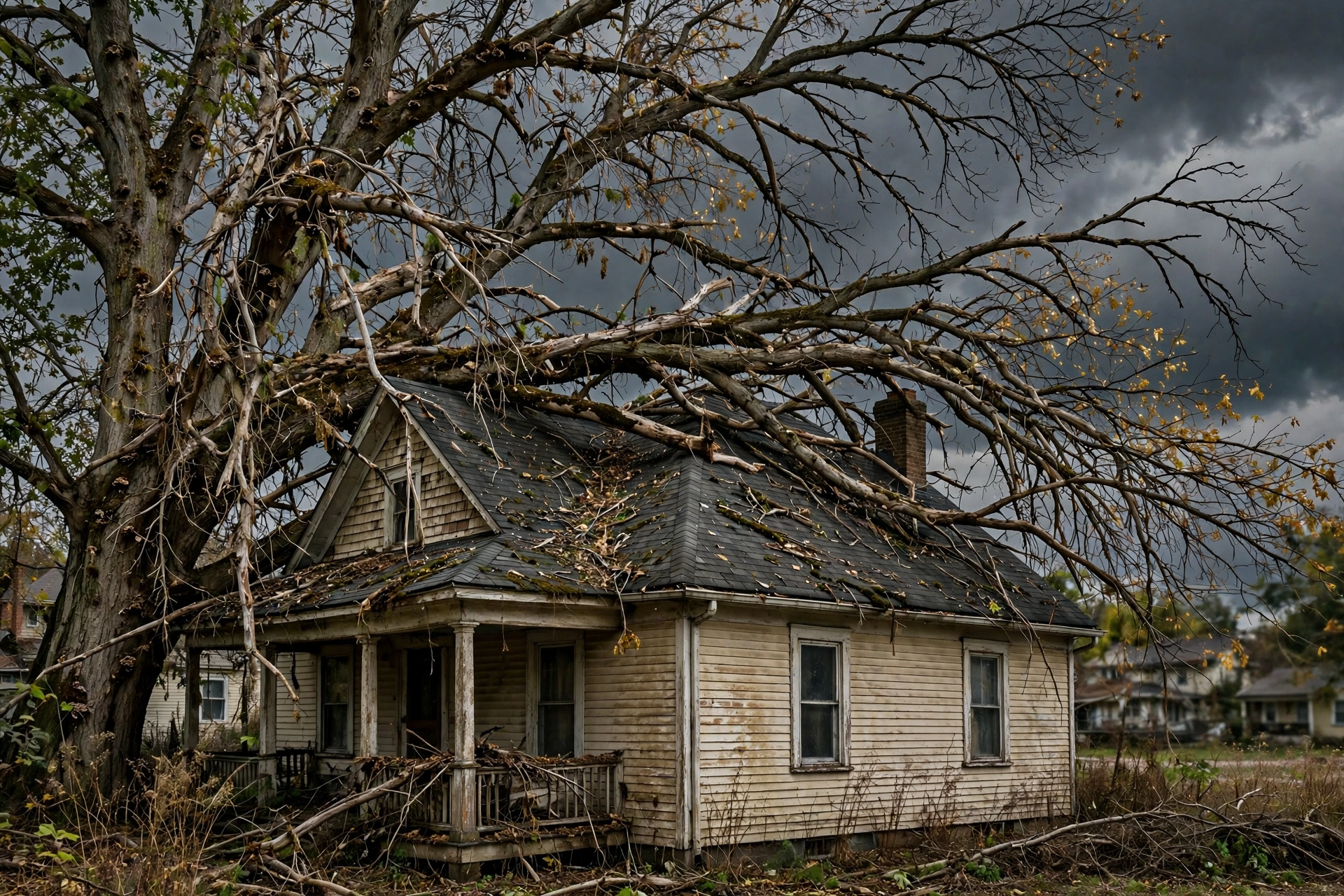
If you never prune a tree, dead limbs pile up in the crown, branches cross and rub wounds into each other, and weak unions get heavier every year. Within a decade the tree is weaker, uglier, and far more likely to drop a limb on your roof — or split apart in a storm.
Quick Facts: What Happens When You Never Prune a Tree (Peoria, IL)
- Pruning rhythm: most shade trees need attention every 3–5 years; typical cost $300–$500
- Deadwood timeline: weak limbs can start failing 2–3 years after regular care stops
- The 25% rule: never remove more than a quarter of a live crown in one season
- Storm risk: dense, neglected crowns catch far more wind — the June 2024 derecho proved it
- Neglect math: a skipped $400 pruning often becomes a $2,000+ removal
- Best window: late fall through early spring is prime pruning season in zone 6a
Here’s what most homeowners miss: a tree doesn’t need pruning to survive — it needs pruning to fail gracefully instead of catastrophically. In the woods a weak limb hits the forest floor. In the 61604, it hits your garage.
Seventeen years climbing Peoria trees has taught us the pattern: the trees that worry us most aren’t the sickly ones — they’re the big, vigorous ones nobody ever touched. All that growth, zero guidance.
Dead Branches Don’t Hang Forever — They Fall
Every tree sheds branches — it’s natural. Lower limbs get shaded out, die, and hang in the crown as deadwood. On a maintained tree, a climber removes them every few years. On a never-pruned tree, they just accumulate.
We see it every week — a maple in Glen Oak untouched for fifteen years, a dozen dead limbs hanging 30 feet over a driveway. “It’s been fine for years,” the homeowner says. Sure. Until the next wind.
- Dead limbs with no bark, gray and brittle
- Branches that don’t leaf out in spring while the rest of the tree does
- Fungus or mushrooms growing on a limb — that’s decay inside
- Limbs hanging lower than they used to, meaning the attachment is failing
More than a handful of dead limbs means that tree is overdue. Deadwood is the easiest pruning there is — just someone willing to climb up and cut it out.
Crossing Limbs Rub Each Other Into Wounds
Branches aren’t supposed to touch. When two limbs grow into each other, every breeze grinds bark off until the protective layer wears through — an open wound, and in Peoria’s humid summers, an open invitation for decay fungi.
Give it a few years and the wound rots inward, weakening the limb right where it meets its neighbor — usually over your fence or shed. We’ve pulled out limbs hollow as drainpipes. They’d been rubbing for a decade and nobody noticed.
This is one of the early signs your tree is dying or diseased that homeowners walk past every day. A five-minute look up into the crown once a year catches it. Nobody does the five-minute look.
- Two branches crossing and touching, bark worn smooth where they meet
- Dark, soft, or sunken spots at the contact points
- Sawdust-like frass or sap oozing from a rub wound
Early, it’s a small cut during routine pruning. Late, it’s rigging a rotted twelve-inch limb off your roof.
Two Leaders, One Weak Tree
Some trees grow one strong central trunk. Others — silver maples and Bradford pears are the worst — split into two or three equal trunks pushing against each other. That’s co-dominant stems: the most dangerous structural defect a tree can have.
Where the two stems meet, bark gets trapped between them instead of wood bonding to wood. Arborists call it included bark, and it’s basically a built-in crack running down the middle of your tree. Every year the stems get heavier, the crack gets longer, and the whole thing gets closer to peeling apart like a wishbone.
On a young tree it’s a twenty-minute fix — pick the stronger leader, subordinate the other. On a thirty-year-old neglected one it’s a crane job. Got a big maple with a tight V split? Read the hazardous tree warning signs — and don’t park under it in a windstorm.
Bradford pears are infamous for this — fast-growing, early-splitting, littering Peoria neighborhoods with broken trunks after every ice storm. Never been pruned? Start planning its retirement party.
A Neglected Crown Catches Wind Like a Sail
Pruning thins a crown so wind passes through. Skip it for a decade and the canopy turns into a dense, lopsided sail of leaves. Same wind, wildly different force on the trunk and roots.
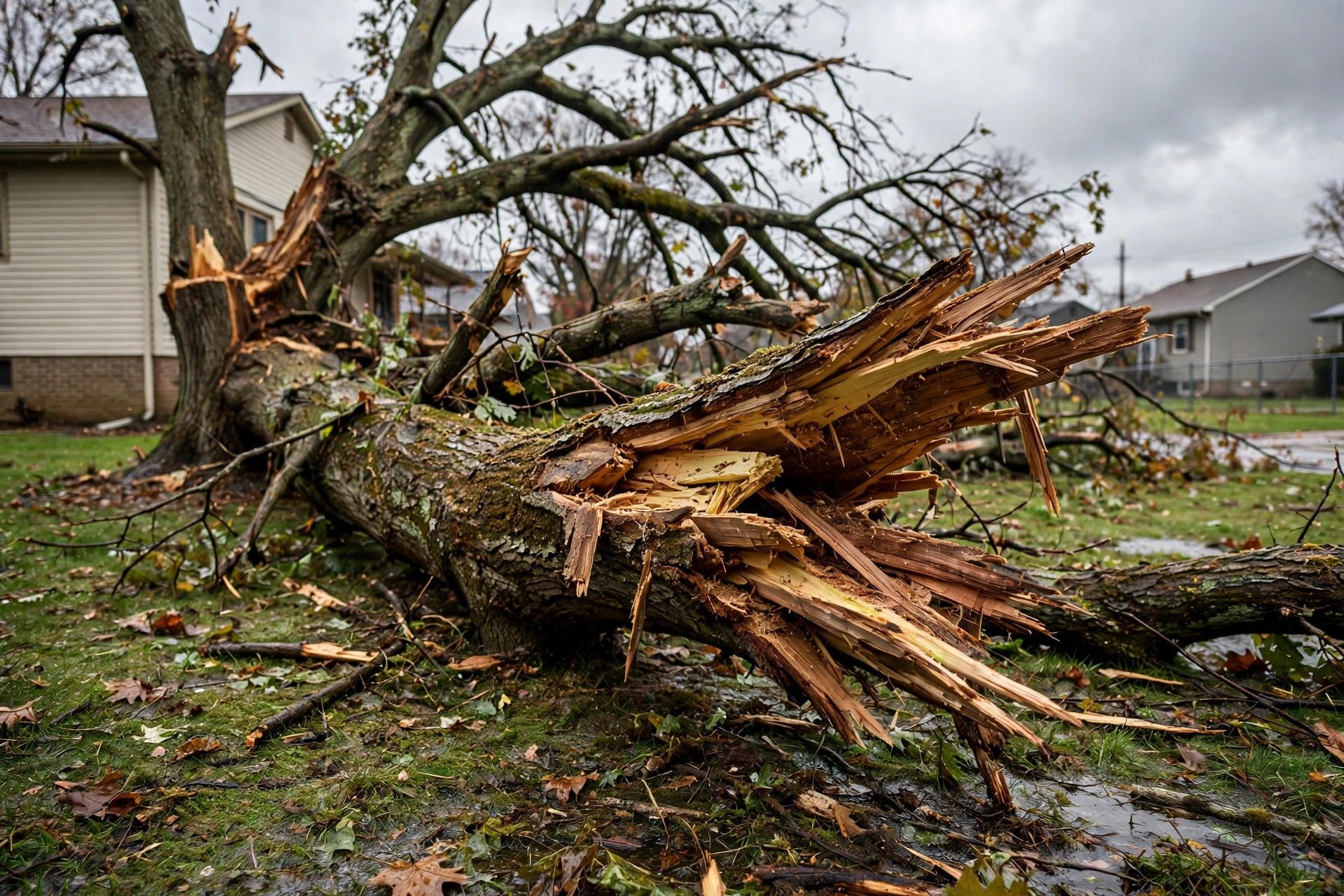
The June 2024 derecho proved it: 70+ mph winds, and the trees that came down were the neglected ones — full sails splitting at weak unions or uprooting where decay had eaten roots. We spent weeks cutting up trees that better structure would have saved.
Bluff neighborhoods take it hardest — the Grandview Drive corridor, Peoria Heights, parts of 61616 catch funneled wind off the Illinois River valley. If your tree’s on the bluff and hasn’t been pruned in years, you’re holding a losing ticket.
After a big storm, check our storm-damaged tree guide before you assume a leaning tree will straighten out. It won’t — and the next storm finishes what the last one started.
Crowded Canopies Are a Buffet for Disease and Bugs
Airflow is a tree’s immune system. A thinned crown dries after rain; a packed, neglected crown stays damp for days — and damp bark grows fungi like a wet basement grows mold.
In central Illinois that means anthracnose on sycamores, oak wilt hunting fresh spring wounds on red oaks, and boring insects homing in on stressed limbs. A crowded tree advertises weakness to every pest in the 61615.
The Morton Arboretum makes the same point in its plant health care guidance: most tree disease problems start with stress, and crowding is stress you can see. Thin the crown and you remove the conditions half these problems need.
- Leaves staying wet long after the rain stops
- Dead patches in the interior where no light reaches
- Heavy aphid or scale activity on inner branches
- Fungal brackets or cankers on the trunk and limbs
You can’t spray your way out of a crowded canopy. Insecticides and fungicides help, but they’re a bandage — the cure is airflow, and airflow comes from a saw.
The Tree Outgrows Its Space — and Your House Pays
Here’s the slow-motion disaster nobody budgets for: the six-foot maple planted eight feet from the foundation in 2005 is forty feet tall now, its roots drinking from the same clay your basement sits in. Peoria’s heavy clay keeps roots shallow and wide, hunting moisture along foundation walls.
It’s not just roots. Limbs scrape shingles every time wind picks up off the river. Gutters clog, siding stays damp and mildews. A tree that fit its spot twenty years ago is now in a fistfight with your house — and the house loses a little more every year.
This is what the benefits of regular pruning come down to in practice: size control. A crown reduction every few years keeps a big tree fitting the space it was planted in, instead of slowly eating the property around it.
Once roots lift a slab or crack a foundation wall, pruning can’t undo it. That’s concrete work and a much bigger bill.
The Neglect Timeline: What Year 1, Year 5, and Year 10 Look Like
Neglect is a slow slide — and knowing where your tree sits on the timeline tells you what it’ll take to fix it.
| Years without pruning | What’s happening up there | What it costs to fix |
|---|---|---|
| 1–2 | Lower limbs die back from shade; small deadwood starts hanging in the crown | $0 — but the clock is ticking |
| 3–5 | Crossing branches rub bark off; dead limbs thicken; the crown gets dense and top-heavy | $300–$500 corrective pruning |
| 6–10 | Decay enters old wounds; weak unions strain; storm breakage starts; limbs reach the roof | $800–$1,500 restoration over 2 seasons |
| 10+ | Major structural defects; hollow sections; the tree becomes a removal candidate | $1,800–$2,500+ full removal |
Fast growers like silver maple run this timeline twice as fast as oaks. And what a neglected tree needs is pruning, not a buzz cut — learn the difference between tree trimming and pruning before you hire.
One more thing the timeline doesn’t show: every stage is cheaper to fix than the next one. Always.
The $300 Pruning Job That Becomes a $2,500 Removal
Let’s talk money. A routine pruning on a medium Peoria shade tree runs $300–$500 every three to five years — the oil change.
Skip three cycles and it’s not a $500 job anymore — it’s a restoration: deadwood removal, structural correction, weight reduction, phased over two seasons. That’s $800–$1,500. Skip that too and the tree becomes a hazard, and hazardous removals near houses run $1,800–$2,500+.
The Real Cost of “I’ll Do It Next Year”
1
Prune on Schedule
$300–$500 every 3–5 years. Cheap insurance.
2
Rescue a Neglected Tree
$800–$1,500 over 2 seasons. Phased and careful.
3
Remove the Tree
$1,800–$2,500+. The price of waiting too long.
Every skipped pruning makes the next one bigger — until there is no next one.
Nobody plans to spend $2,500 — they just keep postponing $400. The arborists at TreesAreGood.org, the ISA’s public site, explain what good pruning should accomplish.
The Rescue Plan: Bringing a Neglected Tree Back Over 2–3 Seasons
Good news: most neglected trees can be saved — just not in one visit. The hard rule is 25%: never remove more of a live crown in one season, or you starve the roots and trigger a panic flush of weak sprouts.
Here’s the phased plan we use on long-neglected Peoria trees:
- Season 1 — deadwood out. Every dead limb goes, plus clearance from the roof, driveway, and service lines. Topped trees start here too — those weak sprouts come off first.
- Season 2 — structure. Crossing and rubbing limbs, competing leaders, included-bark unions. This is the corrective surgery.
- Season 3 — refinement. Thinning for airflow, weight reduction on long limbs. The crown starts looking like a tree again instead of a bush on a stick.
Between visits the tree heals — sealing wounds, rebuilding a balanced crown. Rush it and you get watersprouts: a hundred weak shoots from every cut, a brand-new set of problems.
Some trees are past rescuing — hollow trunks, root decay, running splits. We’ll tell you straight. But most neglected trees just need a plan and patience.
Related Articles
FAQs — Peoria Homeowners Ask About Neglected Trees
How long can a tree go without pruning before it becomes a problem?
Most shade trees develop structural issues after 5–7 years — deadwood, crossing limbs, weak unions. Silver maples get there in half the time. By year 10, it’s a restoration project, not routine maintenance.
Can a tree that’s never been pruned in 20 years still be saved?
Often, yes — if trunk and roots are sound. We work in phases over 2–3 seasons, taking at most 25% of the live crown at once. Hollow trunks or advanced root decay may be past saving.
Is summer a bad time to prune?
Light pruning is fine any time; deadwood can come out in any season. Heavy structural work is best dormant — late fall through early spring in zone 6a. Just don’t prune oaks in spring, when oak wilt spreads.
Will my homeowners insurance pay if a neglected tree damages my house?
Maybe. Insurers can deny claims from long-term neglect versus sudden storm damage. Document your tree care — a paper trail of pruning shortens claim fights.
How much does it cost to fix a neglected tree in Peoria?
Routine pruning: $300–$500. Full restoration: $800–$1,500 over two seasons. Hazard removal: $1,800–$2,500+. Every stage costs more than the last.
Can a neglected tree be fixed in a single pruning?
Usually not. Major corrective work should be phased over 2–3 seasons, capped at 25% of live crown per season — one aggressive session stresses the tree worse than the neglect did.
Get Your Free Estimate
If your trees haven’t seen a saw in years — or ever — anywhere around Peoria — Peoria, East Peoria, Peoria Heights, Bartonville, Washington, Morton, Pekin, Dunlap, Chillicothe — we’ll come look for free and give you an honest rescue plan. Seventeen years, ISA Certified Arborists, licensed and insured.
Call 309-250-8333 for 24/7 emergency service, or grab a free estimate online — we usually respond the same day.
Peoria Tree Removal Co.
https://treeremovalpeoriail.com/
114 W Forrest Hill Ave, Peoria, IL 61604, USA
Tree Service Company
3 Responses