
Signs of a Hazardous Tree in Peoria
A hazardous tree in Peoria may show warning signs such as large dead branches, trunk cracks, cavities, root problems, decay, or a noticeable lean. When these defects occur near a home, driveway, sidewalk, or power line, professional tree removal may be needed.
If you live in Peoria, IL, a large tree can be one of the best features of your property. Mature trees provide shade, privacy, wildlife habitat, and character. But a tree can also become dangerous when its structure starts to fail.
The important part is knowing what to look for before a branch or the entire tree falls.
This matters even more in the Peoria area because trees deal with strong thunderstorms, heavy rain, winter snow and ice, changing temperatures, and wind. The National Weather Service recorded 49 thunderstorm days and 29 heavy-rain days in Peoria during 2025.
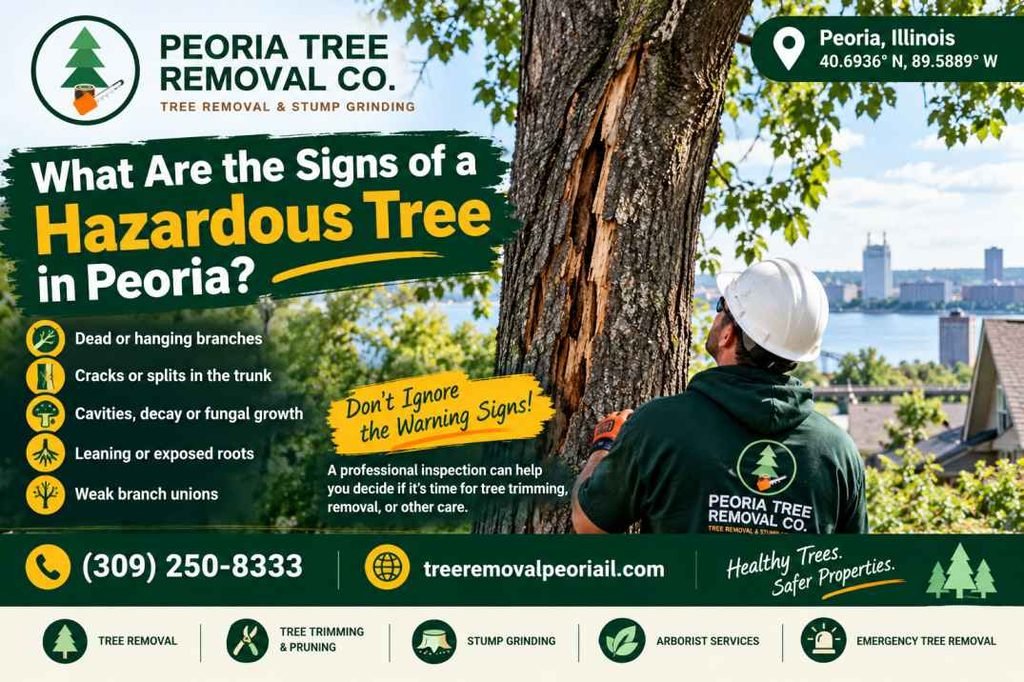
So, what are the warning signs?
The Most Common Signs of a Hazardous Tree in Peoria
The clearest warning signs include large dead branches, cracks or splits in the trunk, cavities, fungal growth, root damage, a leaning trunk, weak branch unions, major decay, and recent storm damage.
However, one sign by itself does not always mean a tree must be removed.
Tree risk depends on the tree’s condition and what could be damaged if it fails. A large tree leaning toward an empty part of the yard presents a different situation from the same tree leaning toward a house, driveway, playground, or busy sidewalk.
The International Society of Arboriculture identifies defects such as dead branches, root failure, codominant stems, cavities, decay, cracks, and wounds as signs that may require closer examination.
1. Large Dead or Hanging Branches Are a Major Warning Sign
Dead branches are one of the easiest hazards for a homeowner to spot.
Look for branches that have:
- No leaves during the growing season
- Broken ends
- Loose or hanging sections
- Missing bark
- Cracks near the branch union
- Dead wood high inside the canopy
Dead wood becomes dry and brittle. During strong wind, ice, or heavy rain, a large dead limb can break and fall.
Illinois Extension specifically recommends watching for dead branches, broken limbs, cracks, splits, and other weak points in the canopy.
If a large branch hangs over your roof, driveway, vehicle, or walkway, don’t climb the tree yourself to investigate it.
That is a job for a qualified tree professional.
2. A Leaning Tree Can Indicate Root or Structural Problems
Not every leaning tree is dangerous.
Some trees naturally grow at an angle. The concern is a new or increasing lean, especially when it appears after a storm or when the soil around the root plate has moved.
Look at the ground around the trunk.
Do you see:
- Cracked or raised soil?
- Exposed roots?
- Soil separation?
- A lifted root plate?
- Mushrooms or fungal growth near the base?
- A trunk that recently changed position?
Root failure can be particularly serious because much of the problem may be underground.
The ISA notes that cracks or separations in the soil can indicate root movement, especially when a tree is leaning. Trees Are Good
If a tree suddenly starts leaning toward your home in 61601, 61614, or 61615, keep people away from the area and have it assessed.
3. Cracks or Splits in the Trunk Need Attention
A vertical crack in a tree trunk should never be ignored.
Cracks can develop from storm damage, frost, previous wounds, weak branch unions, or other structural problems.
Peoria’s changing seasons can also place stress on trees. Illinois Extension explains that frost cracking can create vertical splits in trunks and branches, and repeated cracking can weaken affected areas over time.
Pay special attention to:
Long vertical trunk cracks
These can extend through the bark and into the wood.
Cracks where two major branches meet
This can indicate a weak union.
Multiple cracks in the same area
Several defects together deserve closer examination.
Fresh cracks after a storm
A recently damaged tree may have hidden structural problems that are difficult to see from the ground.
Do not try to “fix” a serious trunk split with bolts, rope, or homemade supports. Get professional advice instead.
4. Cavities, Holes, and Decay Can Mean Internal Problems
A tree can look healthy on the outside while having significant decay inside.
Large cavities, hollow areas, fungal fruiting bodies, soft wood, and extensive wounds can all be reasons for concern.
But there is an important point here:
A cavity does not automatically mean the entire tree must be removed.
The size, location, depth, tree species, remaining sound wood, canopy structure, and nearby targets all matter.
Illinois Extension explains that advanced decay can include soft or crumbly wood, cavities with missing wood, and fungal growth, while also noting that arborists are trained to evaluate trees with decay.
That is why an arborist service can be useful before making an expensive decision.
5. Fungal Growth Around the Trunk or Roots Can Be a Red Flag
Seeing mushrooms or fungal growth around a tree does not automatically mean the tree is going to fall tomorrow.
But fungal growth can sometimes be associated with decay.
Look carefully around the:
- Root collar
- Lower trunk
- Exposed roots
- Old wounds
- Large cavities
University of Illinois Extension recommends examining the root collar and surrounding area for fungal growth because it can indicate decay.
If the tree is large and stands close to a house, garage, driveway, or other target, professional assessment becomes more important.
6. Weak “V” Shaped Branch Unions Can Become Failure Points
Look at the places where large branches join the trunk.
A strong branch union often has a good, natural connection. A narrow V-shaped union, especially where included bark is present, can be weaker.
These trees can develop codominant stems, meaning two or more major stems compete to become the main trunk.
Illinois Extension identifies codominant stems and included bark as structural concerns because they can create weak points where branches or stems may separate.
This does not always mean tree removal is necessary.
Sometimes corrective pruning, cabling, bracing, or ongoing monitoring may be appropriate, depending on the tree.
7. Missing Bark, Cankers, and Large Wounds Should Not Be Ignored
A tree’s bark protects the living tissues underneath.
Large wounds can happen because of:
- Lawn mower damage
- String trimmers
- Vehicle impacts
- Storm damage
- Improper pruning
- Construction
- Animal damage
- Disease
Watch for sunken areas, dead bark, exposed wood, cracks, swelling, or unusual growth.
Illinois Extension recommends examining trunks and branches for wounds, holes, cracks, cankers, weeping, and other abnormalities when evaluating tree health.
A damaged trunk does not always require removal. The severity and location of the wound matter.
8. Sparse Leaves and Branch Dieback Can Show Tree Stress
Sometimes the warning sign is not the trunk.
It is the canopy.
A tree that suddenly develops:
- Smaller leaves
- Early leaf drop
- Sparse foliage
- Dead branch tips
- Large sections of dieback
- Unusual yellowing
- Weak new growth
may be under stress.
Illinois Extension identifies dieback, early leaf drop, stunted leaves, and other foliage changes as possible signs of tree stress and decline.
The cause could be drought, root damage, pests, disease, soil problems, construction damage, or poor pruning.
This is another situation where removing the tree without first understanding the problem may be premature.
Peoria Weather Can Turn a Tree Problem Into an Emergency
A tree that looks questionable on a calm afternoon can become much more dangerous during a severe storm.
Peoria experiences thunderstorms, heavy rain, snow, freezing conditions, and strong wind events. In 2025, the National Weather Service recorded a 58 mph peak wind gust at Peoria and 49 thunderstorm days.
Central Illinois has also experienced major wind events that caused widespread tree and power-line damage.
That is why homeowners should inspect mature trees before storm season instead of waiting until a large limb lands on the roof.
If a tree has already fallen or a major limb is hanging over your home, treat the situation as an emergency.
Trees Near Homes and Roads Deserve Extra Attention
A hazardous tree is not only about the tree itself.
It is also about the target underneath it.
Consider a mature tree near:
- A house
- Garage
- Driveway
- Sidewalk
- Street
- Fence
- Playground
- Patio
- Vehicle
- Utility lines
A large limb falling into an empty section of the yard is very different from the same limb falling through a bedroom roof.
Illinois Extension recommends considering potential targets when assessing tree damage and risk.
This is especially useful for older residential areas of Peoria, including neighborhoods around Grand View Drive, Bradley University, the Peoria Riverfront, and established parts of central Peoria where mature trees and nearby structures can exist close together.
When Tree Trimming May Be Enough
A hazardous-looking tree does not automatically need complete removal.
In some situations, tree trimming and pruning can reduce risk by removing dead, broken, weak, or poorly positioned branches.
Professional pruning can also help reduce weight on a defective branch or improve the structure of a younger tree.
Illinois Extension notes that corrective pruning can address some structural problems, while cabling or bracing may sometimes be used for weak areas on mature trees.
If the tree is still healthy and structurally manageable, pruning may preserve it rather than removing it.
For homeowners who need professional pruning, see Tree Trimming & Pruning in Peoria IL.
When Emergency Tree Removal May Be Necessary
Some situations should not wait.
Call a professional for an urgent assessment if a tree:
- Has fallen against a house
- Has a large split trunk
- Has a major limb hanging over a structure
- Has lifted or failed roots
- Is leaning significantly after a storm
- Is blocking a driveway or access route
- Has broken branches tangled near utility lines
Never approach a tree touching a power line.
The City of Peoria advises residents not to place storm debris in roadways or block sidewalks and states that city workers do not enter private property to remove trees or storm debris. The city directs property owners who cannot safely handle private-property tree debris to contact a private tree removal company.
For storm-related situations, homeowners can also read What Is Emergency Tree Removal?.
Should You Remove a Hazardous Tree or Save It?
The answer depends on the actual condition of the tree.
A professional assessment should consider the tree species, size, age, defects, root condition, canopy, lean, decay, surrounding targets, and location.
An arborist may recommend:
- Monitoring
- Tree trimming
- Structural pruning
- Cabling or bracing
- Plant health care
- Removal of specific limbs
- Complete tree removal
The International Society of Arboriculture maintains resources for finding and verifying credentialed arborists and describes tree risk assessment as one of the services professionals may provide.
If you are unsure about a mature tree on your property, our Arborist Service in Peoria IL page is a useful next step.
What Should Peoria Homeowners Do After a Dangerous Tree Is Removed?
Removing the tree is sometimes only the first part of the job.
After tree removal, you may still have:
- A tree stump
- Surface roots
- Wood chips
- A damaged lawn
- Branch debris
- An area that needs grading
- A space that needs new landscaping
If you plan to reclaim the area, stump grinding can remove the remaining visible stump below ground level.
We also have a related article explaining whether grinding or removing a stump is cheaper in Peoria.
How Much Does Hazardous Tree Removal Cost in Peoria?
There is no honest single price for hazardous tree removal.
The cost can change significantly based on tree height, trunk diameter, species, location, lean, decay, equipment access, nearby structures, utility lines, rigging requirements, cleanup, and whether emergency service is needed.
A small tree in an open backyard is a completely different project from a large mature tree standing over a house.
For that reason, homeowners should get a property-specific assessment rather than relying on a generic online price.
For more information about tree removal pricing factors, see How Much Does Tree Removal Cost in Peoria IL?.
Final Answer: What Are the Signs of a Hazardous Tree in Peoria?
The most important warning signs are dead or hanging branches, trunk cracks, major splits, cavities, decay, fungal growth, root damage, soil movement, sudden leaning, weak branch unions, and serious storm damage.
However, the presence of one defect does not automatically mean the tree needs to be removed.
The bigger question is whether the defect creates an unacceptable risk to people or property.
If a questionable tree is close to your home in Peoria, East Peoria, Peoria Heights, or elsewhere in the Peoria area, don’t wait for the next thunderstorm to find out what happens.
A professional tree inspection can help determine whether the right solution is tree trimming, arborist care, emergency tree service, or complete tree removal.
For local tree-care help, visit Peoria Tree Removal Co..
Peoria Tree Removal Co.
(309) 250-8333
info@treeremovalpeoriail.com
https://treeremovalpeoriail.com/
114 W Forrest Hill Ave, Peoria, IL 61604, USA
Tree Service Company
4 Responses