
Crown cleaning is the simplest pruning job with the clearest payoff: take the dead, dying, and weakly attached branches out of a tree’s crown, and the tree gets safer, healthier, and better looking in a single visit — without changing its size or shape.
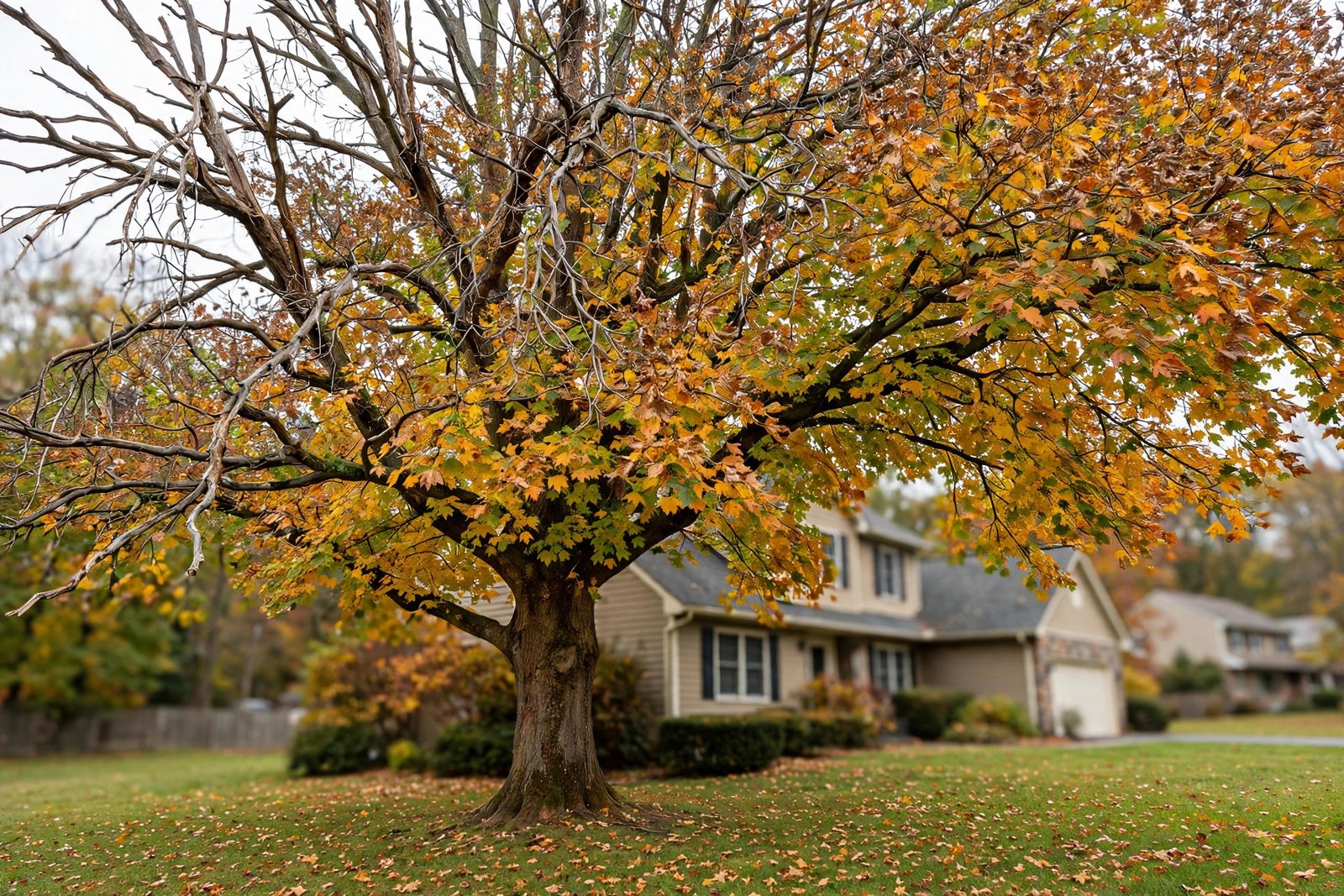
Most homeowners notice deadwood the same way: a gray, barkless branch that never leafed out this spring, a broken limb hanging by a thread of bark after a windy night, or a cluster of thin, leafless twigs deep inside an otherwise healthy-looking maple. It is easy to ignore, because the rest of the tree looks fine. That is exactly why deadwood causes trouble. A dead branch has no living tissue holding it to the tree, and every storm, every heavy snow, and every hot, dry week loosens its grip a little more. Sooner or later it comes down — and the question is only whether it lands on an empty lawn or on a roof, a car, a fence, or someone walking underneath.
Crown cleaning is the named job for fixing that. It is not a haircut, not a size reduction, and not a rescue for a dying tree. It is the deliberate removal of the branches that are already dead, are dying, are diseased, are weakly attached, or have so little vigor left that they are only waiting to fail. Done well, it leaves the tree looking almost unchanged from the street — same height, same spread, same shape — just cleaner, lighter, and safer overhead. This post explains what crown cleaning actually includes, how to tell when your tree needs it, how it differs from the other crown jobs you will hear quoted, and when cleaning is enough versus when it is a sign the tree needs a harder decision.
Quick Facts
- Crown cleaning removes the worst branches, not the most branches: dead, dying, diseased, weakly attached, and low-vigor wood comes out; healthy wood stays.
- Deadwood can usually be removed at any time of year: unlike structural pruning, which is best in the dormant season, taking out dead and diseased branches is not tied to one season — with one exception for disease-susceptible trees during active disease-spread periods.
- Cleaning does not shrink the tree: if a quote promises to “clean” your tree and then takes several feet off the top, that is not cleaning — that is reduction, or worse, topping.
- Winter is the easiest time to see deadwood: bare branches in January and February make dead limbs obvious, which is one reason cleaning pairs naturally with dormant-season work.
- Falling deadwood is a real safety issue, not a cosmetic one: older, larger trees are the most likely to drop branches, and a dead limb over a driveway, sidewalk, or play area is a hazard, not an eyesore.
- Cleaning will not save a tree that is mostly dead: when deadwood is most of the crown, the question stops being “what do we clean” and becomes “is this tree still viable at all.”
What Crown Cleaning Actually Includes
The International Society of Arboriculture defines cleaning plainly: the removal of dead, dying, diseased, weakly attached, and low-vigor branches from the crown of a tree. Every word in that list earns its place, because each describes a different kind of problem branch.
Dead branches are the obvious ones — no leaves, no buds, bark peeling or gone, wood gray and brittle. You can sometimes spot them from the ground in summer because they are the only bare limbs in a leafy crown, and in winter because they stand out against the living branches around them. Dying branches are a step earlier: a few leaves at the tip, or leaves that are smaller and sparser than the rest of the crown, on a limb that is clearly losing ground year by year. Diseased branches carry cankers, fungal fruiting bodies, or bark lesions that mark them as a source of infection for the rest of the tree — cutting them out is as much sanitation as pruning. Weakly attached branches are the ones held by narrow, V-shaped forks with bark trapped inside the joint, the kind of union that splits under ice or wind load. And low-vigor branches are the thin, shaded-out interior twigs that will never amount to anything: they crowd the crown, catch wind, and eventually die and hang anyway.
A good cleaning takes all five kinds, and it takes them for a reason you can see. The crew should be able to point at each branch coming down and say why it is going: dead, diseased, broken, rubbing, or too weak to trust. If a crew cannot explain a cut, the cut probably should not happen. Cleaning is a selective job by definition. A tree that comes back with a third of its live crown missing has not been cleaned. It has been over-pruned, and over-pruning stresses the tree it was supposed to help.
What cleaning does not include matters just as much. It does not lower the height of the tree. It does not thin the whole canopy for light. It does not lift the lower branches for clearance, though a low dead branch may come off in the process. Keeping that boundary clear protects you twice: it keeps the quote honest, and it keeps the tree from losing healthy canopy it needs to feed itself.
Cleaning Is Not Thinning, Raising, or Reduction
Homeowners get these four crown jobs mixed up constantly, and some quotes blur them on purpose, so here is the plain distinction the ISA draws.
Cleaning, as above, removes dead, dying, diseased, weakly attached, and low-vigor branches. The goal is health and safety, and the tree’s size and shape stay essentially the same.
Thinning reduces the density of foliage at the outer edge of the crown, sometimes to let more wind or light through and encourage growth inside. Thinning takes healthy leaves, not just deadwood, and it is a different decision with different risks — thin too much and you strip the tree’s food supply and invite sunscald on branches that grew up in shade.
Raising removes lower branches to give clearance for buildings, vehicles, people, and views. If your complaint is “I cannot walk under the maple without ducking” or “the delivery truck clips the oak,” raising is the job, not cleaning — though a cleaning crew will take a dead lower limb while they are up there.
Reduction reduces the size of the tree, often for utility-line clearance, by cutting leaders and branch ends back to side branches big enough to take over as the new terminal. Reduction keeps the tree’s form and strength when it is done properly. Topping, by contrast, hacks branches back to stubs with no regard for side branches, and it is the one practice this site has already warned against in detail. If anyone quotes you a “cleaning” that leaves stubs all over the crown, you are not getting cleaning or reduction. You are getting topping with a friendlier name.
| Job | What comes off | Tree size after | When you want it |
|---|---|---|---|
| Crown cleaning | Dead, dying, diseased, weakly attached, low-vigor branches | Same | Deadwood, hangers, diseased limbs, safety |
| Crown thinning | Healthy foliage at the crown edge | Same, but lighter | Wind or light through a dense crown |
| Crown raising | Lower branches | Same height, higher clearance underneath | Walkways, driveways, roofs, views |
| Crown reduction | Leaders and branch ends, cut back to strong side branches | Smaller | Line clearance, a tree outgrowing its space |
Ask which job is on the quote, in those words, before anyone climbs. A quote that just says “trim tree” could mean any of the four, and the price and the result will be very different depending on which one the crew actually does.
Signs Your Tree Needs Cleaning
You do not need to climb your tree to judge this. A walk around it, twice a year, tells you most of what you need to know. Look up in late spring, once everything that is going to leaf out has done so, and again in winter, when bare branches show their structure. Here is what to look for.
Dead branches that never leaf out are the first sign, and the easiest. In a leafy summer crown, a bare limb is deadwood until proven otherwise. Snap a small twig if you can reach it safely from the ground: dead twigs snap dry and clean, while living twigs bend a little and show green inside. Never climb to test a branch, and never pull on a dead limb from the ground — that is how hangers become falling limbs.
Hangers and broken branches are the urgent sign. A limb cracked in a storm and caught in the branches below it is called a hanger, and it is the most dangerous thing a cleaning crew removes, because it can drop without warning, sometimes days after the storm that broke it. If you see a hanger over a walkway, driveway, or anywhere people stand, keep people clear and get it dealt with promptly rather than adding it to a someday list.
Crossing and rubbing branches are the quiet sign. Two branches growing through each other rub bark off with every breeze, and each wound is an opening for decay and disease. Cleaning removes the weaker of the pair before the wound becomes a canker. This is especially common in fast-growing yard trees around Peoria — silver maples are notorious for it, with their crowded, weak-forked growth — and catching it early is far cheaper than dealing with the decay later.
Thinning at the top, sparse leaves on one side, or a crown that looks thinner this year than last can mean the tree is shedding branches faster than it replaces them. Some of that is normal aging. A lot of it in a short time is a warning that the tree is under stress — drought, root damage, disease — and cleaning alone will not fix the cause. In that case the cleaning is still worth doing for safety, but the assessment behind it matters more than the cleaning itself: what is stressing the tree, and is it reversible?
Finally, look at what is underneath. Deadwood over a roof, a driveway, a sidewalk, a patio, or a play area is a higher priority than the same deadwood over an open back corner of the lot. Arborists call the thing underneath the “target,” and the target is what turns a falling branch from an annoyance into an accident. Older, larger trees drop branches more often, so the big oak over the driveway deserves a cleaning schedule, not just a cleaning when someone finally notices a limb on the car.
When to Clean, and What a Good Job Looks Like
Here is the good news about timing: you mostly do not have to wait. Both ISA guidance and University of Illinois Extension guidance agree that removing dead and diseased branches can be done at any point in the year, with little effect on the tree. That makes cleaning different from structural pruning, which is best saved for the dormant season when the tree is leafless and wounds close before the growing season. The one caveat worth knowing is for disease-susceptible trees during periods when a disease is actively spreading — oaks during oak wilt transmission season are the classic central Illinois example — when even deadwood work should be timed carefully and tools kept clean between cuts. If your tree has a known disease, say so when you book, so the timing can be set properly.
Winter still has a practical advantage, even though it is not required. Bare branches make deadwood obvious, crews can see the structure they are working in, and frozen ground takes equipment traffic better than soft spring lawns. That is why cleaning often rides along with dormant-season pruning: the crew is already in the tree, the deadwood is easy to see, and the tree wakes up in spring with one less problem. The dormant-season pruning guide explains what a good winter prune targets, and dead and dying branches are at the top of that list.
A good cleaning job has a few marks you can check from the ground. Cuts are made at the branch collar — the slight swelling where the branch meets its parent — not flush against the trunk and not leaving a long stub. No healthy scaffold branch should be missing when the crew leaves. The crown should look like the same tree, just tidier, not like a tree that has been hollowed out from the inside. And the debris should be gone: deadwood left piled under the tree is a tripping hazard and, where disease was involved, a source of infection that should have left the property. Watch, too, for the two shortcuts that betray a bad job: lion-tailing, where the interior is stripped bare and all the foliage is left in tufts at the branch tips, and topping disguised as cleaning, where branch ends are cut back to stubs. Neither is cleaning, and both weaken the tree.
What Cleaning Costs, and What It Cannot Do
No honest post can put a number on your cleaning, because the honest answer depends on the tree, not the job title. A small ornamental with a handful of dead twigs reachable from the ground is a short visit. A mature oak over a house in a Peoria Heights yard, with deadwood through the upper crown, tight access, and a roof underneath, is a climbing job with rigging, and the quote will reflect that. The factors that move the price are the size and height of the tree, how much deadwood there is and where it sits, how the crew can reach it — bucket truck, climbing, or a mix — and what sits underneath it. A written estimate that lists what will be removed and how the crew will reach it is worth more than a low verbal figure that lists nothing.
What cleaning cannot do is just as important to understand before you pay for it. Cleaning will not revive a tree whose crown is mostly dead. If more than roughly half the crown is deadwood, the tree is not a candidate for a tidy-up; it is a candidate for an honest assessment about whether it should stay at all. Cleaning will not fix a structural problem like a split trunk, a girdling root, or advanced trunk decay, and it will not stop a disease that has already reached the trunk. And cleaning will not make a tree safe that is failing at the roots — a tree leaning after a storm, with lifted soil on one side, needs urgent assessment, not a cleaning appointment.
That is the line where cleaning hands over to a bigger decision, and it is worth knowing where it sits before a crew is on site. If the assessment says the tree is mostly healthy with a deadwood problem, clean it and put it on a schedule — every few years for a mature tree, more often after big storms. If the assessment says the tree is in decline, with deadwood as a symptom rather than the problem, cleaning may still be the right safety step while you decide, but it should not be sold to you as the cure. The general trimming versus pruning guide is a useful companion here, because it sorts the different kinds of pruning by what each one is actually for, and the topping post shows what happens when a crown job is done the wrong way.
Cleaning It Yourself: Where the Line Sits
Small dead twigs you can reach from the ground, with a clean, sharp pair of bypass pruners, are fair game for a careful homeowner: cut just outside the branch collar, keep the cut small, and clean the blades between cuts if disease is suspected. That is about where the homeowner’s role ends, and the line is not about skill — it is about height, weight, and what is underneath. Dead branches are unpredictable. They break where you do not expect, they are heavier than they look, and they do not always fall where you aim them. Anything that needs a ladder, a saw above shoulder height, or work near a service line belongs to a crew with climbing gear, rigging, and insurance. And anything near a power line belongs to no homeowner at all: Ameren handles service drops and line clearance, and the number for a scheduled service-drop disconnect is 1-800-755-5000. Do not prune toward a line to save a call.
One more safety note for the do-it-yourself crowd: never pull a hanger down from the ground with a rope or a pole. A hanger that looks stuck can release all at once, and the branch it is caught in can come with it. Keep people and pets clear, and let a crew with rigging take it down in pieces.
Frequently Asked Questions
What is crown cleaning, exactly?
The removal of dead, dying, diseased, weakly attached, and low-vigor branches from a tree’s crown. It improves safety and tree health without changing the tree’s size or shape.
How is crown cleaning different from crown thinning?
Cleaning removes problem branches — dead, dying, diseased, weak. Thinning removes healthy foliage at the crown’s edge to reduce density and let wind or light through. They solve different problems and should be quoted as different jobs.
Can dead branches be removed in any season?
Yes, in most cases. ISA and University of Illinois Extension guidance both say dead and diseased branches can be removed at any time of year. The exception is disease-susceptible trees during active disease-spread periods, when timing and clean tools matter more.
Does crown cleaning make my tree smaller?
No. A proper cleaning leaves the tree the same height and spread, just with the deadwood gone. If a quote takes feet off the top, that is reduction or topping, not cleaning.
How often should a mature tree be crown cleaned?
There is no fixed schedule, but a mature tree benefits from a check every few years, and always after a major storm or ice event. Trees over roofs, driveways, and walkways deserve checks more often than trees over open lawn, because what sits underneath raises the stakes.
When is crown cleaning not enough?
When deadwood is most of the crown, when the trunk or roots are failing, or when disease has reached the trunk. In those cases cleaning may still be a safety step, but the real decision is whether the tree can stay, and that needs an assessment, not just a cleaning crew.
If a tree in your Peoria yard is carrying deadwood over a roof, a driveway, or a walkway, call Peoria Tree Removal Co. at (309) 250-8333 for a free estimate. Ask which crown job is on the quote — cleaning, thinning, raising, or reduction — and what branches will come down and why. The right answer leaves your tree the same size, safer overhead, and with its healthy canopy intact.
Peoria Tree Removal Co. — 114 W Forrest Hill Ave, Peoria, IL 61604 — (309) 250-8333 — https://treeremovalpeoriail.com/
Peoria Tree Removal Co.
114 W Forrest Hill Ave, Peoria, IL 61604
Mon–Sat 8am–6pm · 24/7 emergency tree service