
Diplodia tip blight browns the new shoot tips of your pine — and once those needles are dead, they never green up again.
If the branch tips on your Austrian, Scots, or mugo pine turned brown this spring and the dead needles are still hanging there in November, that is Diplodia tip blight — a fungal disease, not drought or winter burn. It is the most common cause of pine tip and branch death in Illinois, and the cleanup starts now, in the dormant season.
Quick Facts
- The disease: Diplodia tip blight, also called Sphaeropsis blight, caused by the fungus Diplodia pinea (synonym Sphaeropsis sapinea).
- The hosts in Peoria yards: Austrian, Scots (Scotch), mugo, and ponderosa pines are the most susceptible in Illinois. It is rare on white pine.
- The tell-tale sign: New shoot tips (candles) that brown, stunt, and twist, with dead needles only half to three-quarters normal length — and still attached.
- The fingerprint: Tiny black fruiting bodies, pinhead-sized, at the base of dead needles, on two-year-old cones, and on infected bark.
- The November job: Prune out dead tips and cankered wood in dry weather, and pick up every infected cone — cones are the fungus’s winter home.
- What does not work: Spraying a tree that is already blighted. No spray cures infected wood — it has to be cut out.
- When to worry most: A canker on the trunk, a tree losing branch after branch year after year, or a pine that is also drought-stressed — that is when removal enters the conversation.
What Diplodia Tip Blight Actually Is
Diplodia tip blight is a fungal disease, and the fungus behind it, Diplodia pinea, is an opportunist. It attacks the soft new growth of pines — the candles, those pale, upright shoots that lengthen in spring — and it does it without needing a wound. The fungus infects young, healthy, unwounded needles directly, which is what makes it different from the canker diseases that need a crack or a pruning cut to get in. On a stressed tree, it will go after twigs too.
If the name sounds familiar, it is because it has changed twice. The disease was originally called Diplodia blight, then renamed Sphaeropsis blight, and is now Diplodia blight again. Older books and nursery tags may call it either name — same fungus, same disease.
The disease is worst on the pines Peoria planted by the thousand in the 1960s through the 1990s: Austrian pine, the big dark-green windbreak tree along War Memorial Drive and in the older North Valley and Dunlap neighborhoods; Scots pine, the Christmas-tree pine that outgrew its yard; and mugo pine, the low shrubby pine along foundations from Peoria Heights to Morton and Washington. Ponderosa pine is susceptible too. Eastern white pine, by contrast, rarely gets it — a fact worth remembering when you get to the replanting question at the end of this post.
Age matters. The fungus builds up its supply of spores on old dead cones, so trees thirty years and older are the most likely to be attacked — and that describes a lot of Peoria’s Austrian pines, planted as fast-growing screens a generation ago and now mature and cone-bearing. Young trees are not safe either: a young pine that is severely stressed, or growing near an old infected pine, can be attacked too. And research on Austrian and Scots pine in Illinois and Kentucky found the pathogen living on and inside symptomless shoots, on diseased trees and apparently healthy ones alike. A pine can carry the fungus without showing it, until a wet spring gives it its opening.
How to Spot It in Your Yard
Go out this month, once the deciduous trees have dropped their leaves and the pines stand out, and look at the branch tips. Diplodia leaves four signatures, and any one is worth a closer look.
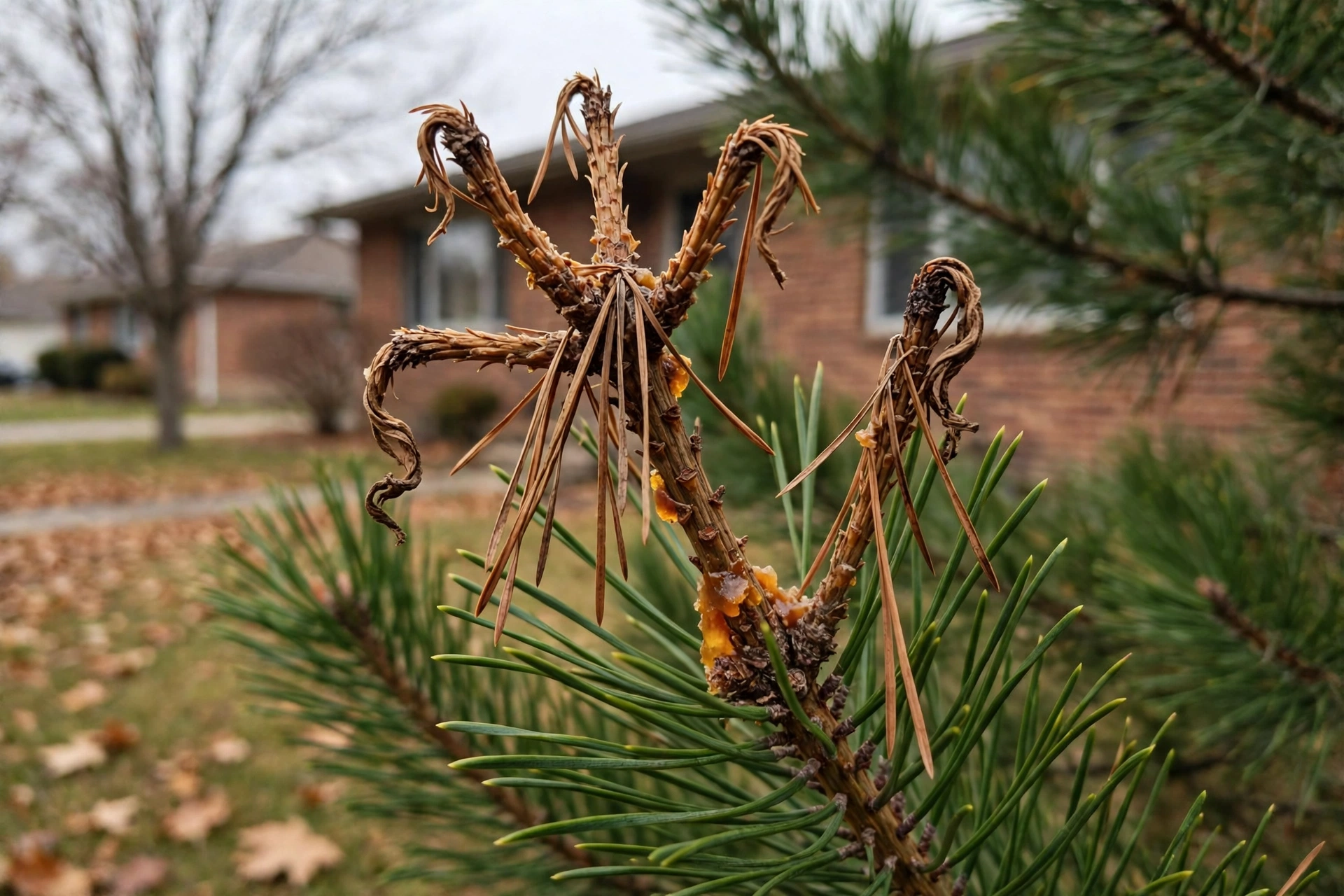
First, the dead candles. The new shoots brown, stunt, and twist — the candle droops instead of standing upright, and the needles on it die when they are only half to three-quarters of their normal length. The brown starts at the base of the needle and grows toward the tip. In a wet spring, every branch on the tree may show brown tips; in a dry one, the damage is usually on the lower branches first, or concentrated on one side of the tree.
Second, the needles that refuse to fall. A blighted branch tip keeps its dead needles attached through the season — brown, dry, and still hanging on in November, when a healthy pine would have shed its oldest interior needles and kept its tips green. If the terminal four inches of a branch are brown and the needles are still there, that is the classic Diplodia picture. Often the tree pushes new growth just below the dead area, and the stem grows in a zigzag — dead tip, live shoot below it, dead tip again. A pine with zigzag branch ends has been fighting this disease for a while.
Third, the cankers. Where the dead shoot meets living wood, look for a resinous canker — a patch of bark that oozes amber sap, sometimes with the bark slightly sunken or cracked. The canker usually sits at the youngest branch whorl or at the base of the blighted needles. Sap on a pine is not always disease — pines bleed resin from any wound — but a resinous patch sitting right below a dead candle is a canker until proven otherwise. If a canker wraps all the way around a branch, everything beyond it dies.
Fourth, the black dots. This is the fingerprint. With the naked eye, look for tiny black fruiting bodies of the fungus at the base of the dead needles, just under the papery fascicle sheath where the needles join the stem, and on the scales of two-year-old seed cones, and on the bark of infected shoots. They are pinhead-sized and black, and they are what separates Diplodia from every look-alike below. If you see brown tips and black pinheads on the cones, you have your diagnosis.
Diplodia or Something Else? The Look-Alikes
Brown pine tips worry homeowners, but Diplodia is not the only thing that browns them. Rule out the look-alikes first — each one calls for a different response.
| What you see | Most likely cause | How to tell it apart |
|---|---|---|
| Shoot tips browned, stunted, twisted; dead needles still attached; black pinhead dots on needles and cones | Diplodia tip blight | Black fruiting bodies at needle bases and on two-year-old cones; cankers below dead wood; worst on Austrian, Scots, mugo |
| Interior needles of a spruce turning purple-brown, black dots in rows on the needles | Rhizosphaera needle cast | Spruce, not pine; needles die from the inside of the tree outward; dots sit in neat rows on the needle surface |
| Needles with red bands and yellow tips, worst on the lower branches, needles dropping | Dothistroma needle blight | Red bands across the needles are the giveaway; needles fall rather than staying attached |
| Whole tree yellowing and wilting fast, needles turning gray-green then brown, sawdust at the base | Pine wilt disease | Whole-tree collapse in weeks, usually on Scots pine; a nematode disease, not a fungus; dead needles fall fast |
| Needles brown at the tips after a dry summer, whole tree looking thirsty, no black dots | Drought stress | Browning starts at needle tips across the whole tree, not just new candles; no cankers, no fruiting bodies; the tree recovers with water |
| Needles browned on the windward side after a cold, windy winter | Winter burn | Damage on the side facing the winter wind; new spring growth is green; no cankers or black dots |
Drought is the one most often confused with Diplodia in Peoria, because the two so often arrive together — and because drought actually makes Diplodia worse. The difference is the pattern: drought browns needle tips across the whole tree, old and new growth alike, and the tree perks up with water. Diplodia kills the new candles specifically, leaves the dead needles attached, and leaves black dots and cankers behind. If you are not sure, look for the black pinheads on a two-year-old cone — that is the fingerprint. And if you are still not sure, the tree disease treatment guide walks through the treat-it, prune-it, or remove-it question for any sick tree, and the University of Illinois Plant Clinic can confirm a diagnosis from a sample.
How It Spreads So Fast
The reason Diplodia can take over a pine in a single wet spring is the way it travels. The fungus spends winter in infected cones, shoots, and needles — including the dead cones still hanging in the crown and the ones that fell to the ground. In spring, during rainy periods, those cones and dead shoots release spores. The spores need high humidity to infect, and they need time: infection can happen in a few hours when temperatures sit between 53 and 96 degrees with at least twelve hours of moisture on the needles.
New shoots are the target, and the window is long. They are susceptible from about two weeks after budbreak until roughly mid-June — the whole period when the candles are elongating and the needles are soft. That is why wet springs are the bad years: rain keeps the needles wet and every candle on the tree is exposed at once. A dry spring can pass almost without a new infection, even on a tree already carrying the fungus.
Stress opens the second door: drought, heat, shade, frost, and insect damage all predispose a pine to infection. A drought-stressed tree is more susceptible to canker infection in particular — and once a canker girdles a branch, everything beyond it dies. That is why the same tree can look fine for years and then collapse branch by branch after two dry summers: the fungus was there all along, waiting for the tree to weaken.
The November Job: What to Cut, and How
November is the right month for the cleanup, because the tree is dormant, the dead wood is easy to see against the bare landscape, and the spores are not flying. The Extension’s guidance is direct: control requires removing all affected twigs and cones.
Start with the cones. Old dead cones are the fungus’s winter storehouse, so pick up every cone you can reach — from the tree and from the ground underneath it. This is the step people skip, and it is the one that matters most for next spring. Bag the cones and the prunings and get them off the site; do not compost them and do not chip them into mulch for the same tree.
Then prune the dead tips and cankered wood. Cut back to healthy wood below the dead area, and do it in dry weather — never prune or shear when the tree is wet, because that is when spores are being released and spread. The Extension’s window is the early spring before buds open, while the foliage is dry, or the dormant season — and autumn, when the tree is dry, is the other window in Report on Plant Disease No. 625. November fits both.
Disinfect your tools between cuts. Dip or swab the blades in 70% denatured or rubbing alcohol, or in fresh household bleach mixed one part bleach to nine parts water. This is not fussy — the fungus travels on a saw blade from a dead branch to a live one, and a pruner that just cut a cankered shoot is carrying spores to the next cut.
Finally, ease the tree’s stress load. Water the tree thoroughly during dry periods — an inch or more of water a week in a drought — and mulch around the base, keeping the mulch off the trunk, to hold moisture and steady the soil temperature. Fertilize only if a soil test says the tree needs it; the Extension’s advice for stunted trees is to fertilize to stimulate vigorous growth, but a soil test is what tells you whether fertilizer will help or just push soft growth the fungus likes. And do not wound the tree: avoid string-trimmer nicks at the base and do not prune in wet weather, because the fungus infects wounded tissue as well as healthy needles.
Our dormant-season pruning guide covers the timing and the cuts for the rest of the yard, and the same dry-weather, clean-tool rules apply to every tree you prune this month.
What Sprays Can and Cannot Do
Sprays have a narrow role, and it is worth being straight about the limits. Fungicide sprays are recommended only in conjunction with the cultural controls above — pruning, cone removal, watering, and mulch — never instead of them. The timing is three sprays: the first when buds begin to elongate and swell, the second just before the new needles begin to emerge from the fascicle sheath, and the third ten to fourteen days later. The Extension recommends a systemic product, applied exactly according to the label, and points homeowners to the Illinois pest management handbooks and their local Extension office for which product to use.
Even then, the protection is partial. How well the sprays work depends greatly on the weather at the time the shoots emerge — a rainy spring can wash the timing out. And recent research has shown that even foliage with no symptoms is often already infected, which raises real questions about chemicals meant to prevent infection in the first place. If anyone offers a spray to cure a blighted pine, that is a promise the chemistry cannot keep. Prune first, water the tree, and then ask your Extension office whether a preventive spray makes sense for the trees that remain. No spray reaches fungus that is already inside the wood — only the saw does.
When Removal Is the Right Call
Most pines with Diplodia can be managed — pruned, watered, and watched — for years. Removal enters the conversation in four situations.
First, a canker on the trunk. A branch canker is a pruning job; a trunk canker is a structural wound on the tree’s main stem. If it wraps much of the trunk, the wood above it starves, and the tree declines no matter how many branches you save.
Second, a tree losing branch after branch, year after year. One bad wet spring is bad luck; three in a row on the same pine means the tree is a reservoir of infection for every other pine in the yard and the neighborhood, and the crown is thinning faster than it can replace itself.
Third, a pine that is also drought-stressed and declining overall — thin crown, short needles, dieback spreading inward from the tips. At that point the tree is fighting on two fronts, and the fungus usually wins the second one.
Fourth, a tree whose blight has reached the root flare or the main stem near the ground. At that point there is no clean cut left to make.
If you are weighing that decision, the signs your tree is dying post covers the broader warning signs, and the cost guide explains what goes into a removal estimate in Peoria, so you can plan rather than guess. Costs vary by tree size, location, and access, and any figure should come from a free on-site estimate, never from a blog post.
One more thing to weigh: what sits near the pine. The Extension is clear — do not plant susceptible trees near mature, infected pines. If your Austrian pine is blighted and you are planning a new pine beside it, you are planting into the spore shadow of the old tree. Either remove the infected tree first, or choose a species that does not host the disease.
What to Plant Instead
If a pine has to come out, or if you are planting a new evergreen, choose one that fights back. Eastern white pine is rarely affected by Diplodia, and it grows well in central Illinois — it is the safest pine choice for a yard that has had tip blight. For a smaller evergreen, consider a spruce or fir, keeping in mind that spruces carry their own disease — Rhizosphaera needle cast — so no evergreen is trouble-free. The honest rule is the one the Extension gives: avoid the most susceptible pines in new landscape plantings, and give the new tree room, sun, and water so it is never stressed enough for an opportunist to take hold.
For the pine that stays, the winter work is simple: water it in dry spells, keep mulch on the root zone and off the trunk, and walk the tree in late winter, before buds open, to catch the dead tips you missed in November. A pine that gets its dead wood removed every dormant season can live with Diplodia for a long time — it just cannot live with it ignored.
Frequently Asked Questions
Will my pine’s brown tips turn green again in spring?
No. Needles killed by Diplodia are dead, and dead needles do not green up. What you will see in spring is new growth pushing out below the dead tips, sometimes in that zigzag pattern where a live shoot grows out from under a dead one. The tree can recover its shape over several seasons if the dead wood is pruned out and the stress is eased.
Is Diplodia tip blight contagious to my other trees?
It spreads to other pines — especially Austrian, Scots, mugo, and ponderosa — carried by rain-splashed spores in spring and by pruning tools used on wet wood. It will not jump to your maple, oak, or spruce. But a blighted pine standing next to a healthy young pine is a real risk, which is why removing infected cones and dead wood matters for the whole yard, not just the one tree.
I pruned the brown tips off in June. Why did it come back?
Usually the timing worked against you. June is the middle of the infection window — spores are flying, needles are soft, and pruning in wet weather spreads them. Or the cut stopped short of the canker, or the tools were not disinfected between cuts. Dormant-season pruning, in dry weather, with clean tools, is the reliable fix.
Should I fertilize my blighted pine to help it recover?
Only if a soil test says the tree needs it. The Extension recommends fertilizing stunted trees to stimulate vigorous growth, but fertilizer is not a cure, and heavy nitrogen pushes a flush of soft growth that the fungus infects most easily. Water and mulch first, test the soil, and fertilize only on the test’s advice.
My neighbor’s Austrian pine is blighted. Is my pine at risk?
Yes, if it is a susceptible species and close by — spores travel on rain and wind in spring, and the infection window runs from a couple of weeks after budbreak to mid-June. Inspect your pine this November, prune out any dead tips and cankers, pick up the cones, and keep the tree watered through dry spells so it is not stressed when spring arrives.
Peoria Tree Removal Co. — 114 W Forrest Hill Ave, Peoria, IL 61604 — (309) 250-8333 — treeremovalpeoriail.com — Mon–Sat 8am–6pm, 24/7 emergency tree service.
Peoria Tree Removal Co.
114 W Forrest Hill Ave, Peoria, IL 61604
Mon–Sat 8am–6pm · 24/7 emergency tree service