
Your trees look worn out right now, and there’s a reason for it. The big maples and oaks across Peoria pushed through a hot, dry summer, and now they’re dropping leaves on tired roots.
Here’s what most folks don’t know: those roots are still wide awake. After the leaves fall, tree roots keep growing for weeks in soil that stays warmer than the fall air.
That makes October a golden window. Feeding roots now helps trees bank energy for spring — and Peoria’s first frost window, October 11–20, is right around the corner.
In this guide, I’ll walk you through how deep-root feeding works, why October beats every other month for it, which trees need it most, and what it usually costs around here.
- Typical cost: roughly $75–$200 per large tree (industry norm)
- Method: pressurized injection, 8–12 inches deep
- Timing: after leaf drop through October, while soil is still workable
- Coverage: a grid of injection points from near the trunk out to the drip line
- Best candidates: stressed or mature trees, newly planted trees, trees in compacted soil
- Soil note: clay-heavy Central Illinois soil keeps surface fertilizer from reaching tree roots
Why October Is the Best Month to Feed Trees in Peoria
Trees do a surprising amount of work after their leaves fall. While the canopy rests, roots stay busy drinking, growing, and storing nutrients for the spring push.
October soil in Central Illinois holds its warmth long after the air turns crisp. In zone 6a, roots stay active for weeks past the first frost window of October 11–20.
Feeding in October matches that rhythm. Nutrients go in while roots can still absorb them, and the tree banks that energy for bud-break next spring.
What Roots Actually Do After Leaf Drop
They don’t sleep yet. Roots keep pushing out fine feeder roots through fall, hunting for water and food before the ground cools off.
The hot, dry stretches of 2026 made that hunt harder. Drought-stressed trees head into fall with thinner reserves — which is one more reason this October matters more than most.
Why Lawn Fertilizer Doesn’t Feed Your Trees
You might figure your tree eats whatever you spread on the grass. It doesn’t — and the reason is pretty simple.
Feeder roots live 8–12 inches down, well below grass roots. Surface fertilizer dissolves in the top inch or two, and the turf grabs it first.
Then there’s our clay. Central Illinois soil is heavy and compacted — especially near driveways and sidewalks along War Memorial Dr and Knoxville Ave. Nutrients spread on top mostly stay on top.
Deep-root feeding skips all of that. It places food right in the feeder-root zone, past the turf and through the hard layer.
How Deep-Root Feeding Actually Works
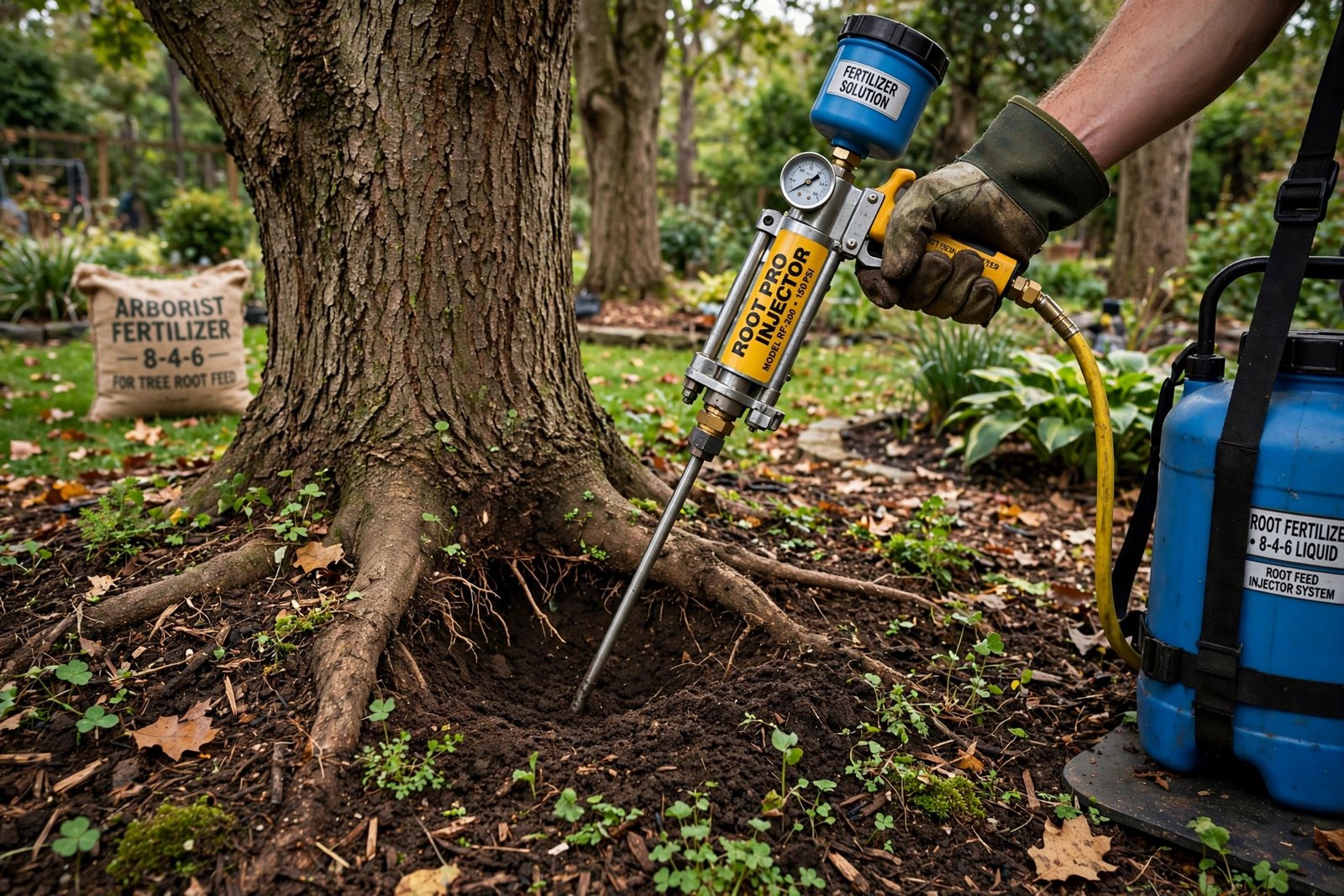
Deep-root feeding is simpler than it sounds. A technician pushes a long probe into the ground and injects a slow-release, balanced fertilizer solution under pressure.
The probe goes 8–12 inches deep — right into the feeder-root zone. Each injection sends nutrients out in every direction, feeding roots directly instead of hoping rain carries food down.
Dozens of injection points go in on a grid, starting a few feet from the trunk and spreading out to the drip line — the circle under the outer edge of the canopy.
There’s a bonus, too. The pressurized probe breaks up compacted soil as it goes, so air and water reach roots better long after the visit.
• • •
Injection points release slow-release nutrients right here
A pressurized probe places fertilizer exactly where feeder roots live — past the turf, through the hard clay.
What’s in the Mix
A good blend feeds the whole tree, not just the leaves. It usually carries the big three — nitrogen, phosphorus, and potassium — plus smaller doses of iron, manganese, and other micronutrients.
Some mixes add soil conditioners that help loosen clay. No brand names to memorize here: the right recipe depends on your soil, and a simple soil test shows exactly what’s missing.
Fall vs. Spring vs. Summer: Which Season Wins
Fall is the sweet spot, but let’s be honest about how the other seasons stack up. Here’s the side-by-side view.
| Season | Root activity | Tree stress | Verdict |
|---|---|---|---|
| Fall (Oct) | High — roots keep growing in warm soil after leaf drop | Low — canopy is resting | Best time to feed |
| Spring (Mar–Apr) | Rising, but energy shifts to new leaves | Medium — tree is busy waking up | Good backup option |
| Summer (Jun–Aug) | Slows down in heat | High — heat and drought stress | Skip if you can |
| Winter (Dec–Feb) | Dormant; soil may be frozen | Low | Too late — wait for spring |
Summer is the season to skip. Heat-stressed roots can’t use nutrients well, and fertilizer on dry ground can scorch turf. Spring works fine — but a tree waking up spends a lot of that energy on leaves instead of root reserves.
The fall-timing advice isn’t just local wisdom, either. A new guide on deep-root fertilization for large shade trees, covered by MarketersMedia in mid-October, puts fall timing front and center — roots stay active in warm soil after leaf drop. And late-September press coverage from Acorn Tree Care pushes pre-winter tree assessments before ice and wind season, a good reminder to check your trees before you feed them.
Which Peoria-Area Trees Benefit Most
Not every tree needs feeding. But these are the ones that usually pay back the investment around here:
- Mature oaks and maples. The big shade trees in Peoria Heights, Morton, and Washington carry huge canopies on aging root systems — and a hot summer wears them down.
- Newly planted trees. Young roots need help settling into our clay during their first 1–3 years. If you planted this season, our guide to tree planting in Peoria walks through setting them up right.
- Trees in compacted soil. Yards near Sheridan Rd, IL-29, and I-74 often sit on construction-packed ground that locks nutrients out.
- Storm survivors. Trees that lost limbs in the June 2024 derecho are still rebuilding, and feeding speeds that recovery.
- Trees along busy corridors. Road-salt spray and exhaust stress the trees along US-150 and the Illinois River riverfront, making fall feeding a smart rebound move.
You can see the same story playing out in public spaces. The big oaks around Bradley Park and Forest Park Nature Center, the street trees along Grandview Drive, and the maples lining the Rock Island Trail all live with the same clay and compaction your yard has.
Whether you’re in 61604, 61615, 61616, 61548, or 61554, the October feeding window looks the same — warm soil, active roots, and time to act before the cold.
Signs Your Tree Is Hungry
Trees can’t talk, but they send clear signals. Watch for these on your next walk around the yard:
- Small, pale, or yellowing leaves in summer
- Early leaf drop or thin spots in the canopy
- Dead twigs at the tips of branches
- Slower growth than similar trees nearby
Some of these overlap with disease or insect damage. If you can’t tell hunger from something worse, a professional tree inspection can sort it out before you spend a dime on fertilizer.
When to Schedule — and When to Wait
Mid-October through leaf drop is the prime window. The soil is still easy to probe, and roots have weeks of growth ahead of them.
Aim to beat the first frost window (October 11–20) — or get in soon after. Once nights start freezing hard, the ground gets tougher to work and roots slow down.
Hold off if the ground is frozen or waterlogged. And be honest about struggling trees: feeding helps stressed trees, but it can’t fix severe decay or major root damage. Those need a diagnosis first.
Most visits take under an hour for a few trees. You won’t see the payoff until spring — fuller leaves, stronger growth — and that’s completely normal.
Your Trees Are Still Working — Feed Them Now
It’s easy to forget trees once the leaves fall. Out of sight, out of mind, right?
But underground, your maples and oaks are doing the heaviest work of fall — growing roots and stocking energy for next spring. A little food now goes a long way.
You can browse our full list of tree services and request a free estimate at https://treeremovalpeoriail.com/ — no pressure, just straight answers for your yard.
Related Articles
- 7 Benefits of Tree Pruning for Peoria Homeowners
- Best Time to Plant a Tree in Illinois | Fall vs Spring
- Winter Tree Care in Peoria, IL: How to Protect Your Trees Before the First Freeze
Frequently Asked Questions
How much does deep-root feeding cost in Peoria?
Most companies charge roughly $75 to $200 per large tree as an industry norm. The price depends on tree size, how many trees you’re feeding, and whether a soil test is included. One visit usually covers a full season of benefit.
Can I just use lawn fertilizer around my tree?
It won’t reach the feeder roots. Grass roots grab surface fertilizer first, and our clay soil keeps the rest near the top. Deep-root injection puts nutrients 8–12 inches down, where the tree can actually use them.
Is October too late to fertilize trees?
No — it’s the best time. Roots keep growing in warm fall soil for weeks after leaf drop. Aim to feed before the ground gets too cold to work, which around Peoria usually means getting it done in October.
How deep do the injections go?
About 8 to 12 inches deep, right into the feeder-root zone. The probes are placed in a grid starting a few feet from the trunk and spreading out to the drip line.
How often should I feed my trees?
Most healthy, mature trees do fine with feeding every 2–3 years. Stressed, young, or storm-damaged trees may benefit from yearly feeding until they bounce back.
Is deep-root feeding safe for my lawn, kids, and pets?
Yes, when a professional does it — the fertilizer goes underground, not on the grass, so there’s no granular residue sitting on the surface. Ask your provider about re-entry times for kids and pets, which are typically short.
Can feeding save a dying tree?
Feeding helps stressed trees, but it can’t fix severe decay, major root damage, or advanced disease. If a tree is dropping big branches or has large dead sections, get a professional inspection first to find the real problem.
Peoria Tree Removal Co. — 114 W Forrest Hill Ave, Peoria, IL 61604 — (309) 250-8333 — treeremovalpeoriail.com — info@treeremovalpeoriail.com
One Response