
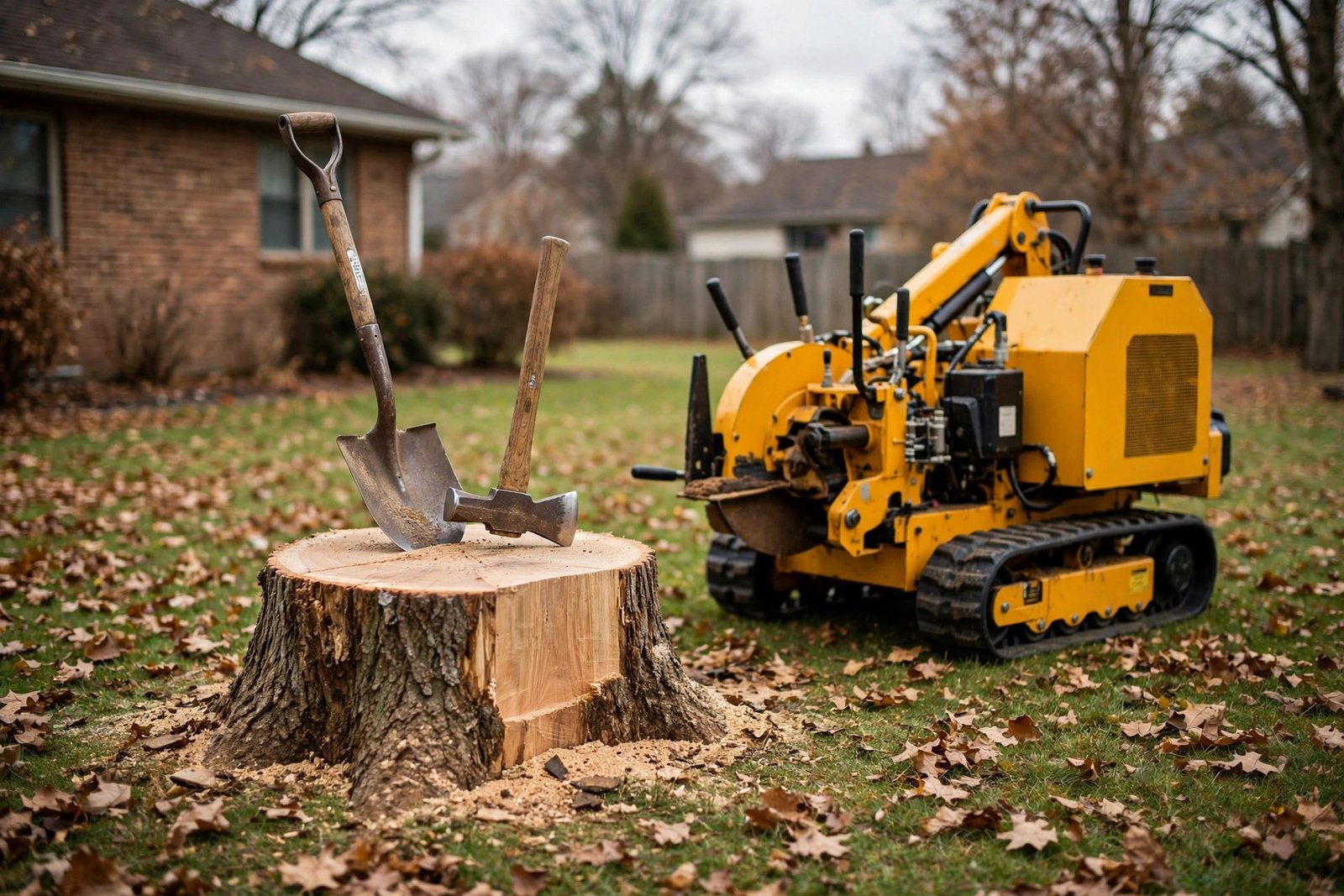
A small stump can come out with a shovel and a free afternoon. A big one usually needs chemistry and months of patience, or a grinder and an hour. Burning is not an option inside the City of Peoria. Pick the method by stump size, not by enthusiasm.
The tree is gone and now there is a stump in the middle of your yard, tripping the mower and sprouting suckers. How hard it is to get rid of depends entirely on the stump: a six-inch ornamental stump and a thirty-inch silver maple stump are different jobs, and the method that works for one will waste your weekend on the other. This post compares the four real ways to remove a stump in Peoria — digging it out, rotting it with chemicals, burning it, and grinding it — and tells you which one fits the stump you have.
Quick Facts
- Digging works for small stumps: under about 12 inches across, a shovel and a saw can do it in an afternoon.
- Chemicals are slow but easy: Epsom salt or potassium nitrate softens a stump over weeks to months, for little money and little effort.
- Burning is banned in the City of Peoria: the Fire Department prohibits open burning of yard waste, and yard waste includes tree stumps.
- Grinding is the fastest finish: a grinder turns a stump into chips in under an hour.
- Call 811 before you dig: Illinois requires a JULIE locate before any digging, even in your own yard.
- Never use gasoline on a stump: it ignites too fast and can flash back.
Before You Touch the Stump: Three Checks
Start with the stump, not the method. Measure across the cut face. A stump under a foot wide is a digging candidate. A stump over eighteen inches wide, or one with thick roots running in every direction, is almost never a one-person digging job — the root ball on a mature tree can weigh hundreds of pounds.
Second, think about what is underneath. Stump roots share ground with gas, electric, water, and sewer lines, and Peoria’s older neighborhoods — the 61604 and 61614 ZIPs, the blocks off Knoxville Avenue and Sheridan Road — have lines in places no one remembers exactly. Illinois requires you to call JULIE at 811 at least two business days before you dig, and the locate is free. Do it before the shovel comes out, not after you nick something.
Third, ask what killed the tree. A healthy tree that came down in the June 2024 derecho is one thing. A tree that died of pine wilt or emerald ash borer is another: diseased wood should not be stacked, stored, or moved around, because the pests travel with it.
Method 1: Dig It Out by Hand
Digging is the oldest method: you against the root system, with leverage on your side. It works best on small stumps — ornamental trees, young maples, crabapples — under about twelve inches across, especially if the tree has been dead a year or two and the wood has dried out.
You need a sharp shovel, a mattock or pickaxe, a bow saw or reciprocating saw with a pruning blade, an axe, and a digging bar, plus gloves and eye protection. Dig a wide circle, at least a foot out from the trunk and down twelve to eighteen inches, until you can see the lateral roots. Cut each root as you expose it, then use the digging bar as a lever to rock the stump and find the taproot underneath. Cut that last, and the stump should lift out.
Expect four to twelve hours of hard work for a small stump, plus a hole to fill afterward. That is the real cost of this method: not money, but a day of your back and a wheelbarrow or two of soil. If the stump turns out bigger than you estimated, stop and switch methods instead of forcing it.
Method 2: Let Chemistry Do the Work
If you are not in a hurry, chemistry is the cheapest way to make a stump disappear. Drill holes, fill them with something that feeds the fungi and bacteria that rot wood, keep it damp, and wait. The stump softens over weeks to months until you can break it apart with an axe.
Drill holes across the top with a one-inch spade bit, eight to twelve inches deep and about three inches apart, plus a few angled into the sides. Fill them with potassium nitrate stump-remover granules or Epsom salt, add warm water so the chemical soaks in, and cover the stump with a tarp or mulch to hold the moisture. Reapply every few weeks. Potassium nitrate works faster because it feeds the decay organisms directly; Epsom salt works by drawing moisture out of the wood and making it brittle. Either way, plan on a full season — longer for a big hardwood stump.
Two safety notes matter. Keep these chemicals away from vegetable gardens, storm drains, and waterways, and keep children and pets away from a treated stump. Potassium nitrate is an oxidizer: store it away from heat and flame and follow the label. And remember this method only rots the stump down to where you drilled — the deep roots stay in the ground, which is fine for a lawn but not if you plan to plant a replacement tree in the same spot right away.
Method 3: Burning — Do Not Try This Inside Peoria
Burning sounds like the easy answer, and in some parts of rural Illinois it is legal with conditions. Inside the City of Peoria, it is not. The Peoria Fire Department’s open burning policy — in effect since May 1, 2004 and revised in September 2019 — states plainly that open burning of yard waste is prohibited, and it defines yard waste to include trees and tree stumps. The Illinois EPA’s open-burning FAQ notes that state-level exceptions for burning landscape waste do not override local prohibitions. So a stump fire in a Peoria backyard is not a gray area; it is a violation, and it is the kind of violation a neighbor can see from the street.
Outside the city limits, the rules change town by town — East Peoria, Morton, Washington, and Bartonville each have their own ordinances — so check your own municipality’s current rules before you light anything. Where burning is allowed, it is slow and smoky: drill holes, let a chemical treatment soften the wood for four to six weeks first, then keep a small, attended fire going for days. And one rule holds everywhere: never use gasoline. It ignites too fast and can flash back at the person pouring it. Kerosene or diesel, used sparingly, is what the guides recommend — and even then, only where burning is legal.
Method 4: Grind It and Be Done
Grinding is what the professionals do, and there is a reason: it is fast, it works on stumps of any size, and it leaves the yard usable the same day. A stump grinder is a machine with a spinning carbide-toothed wheel that chews the stump down below grade, a few inches at a time, and turns it into wood chips. A typical residential stump takes well under an hour; the crew rakes the chips level, leaving a shallow depression to fill with topsoil.
The depth question matters, and it is covered in the guide to stump grinding depth and replanting — grinding usually goes six to twelve inches below the surface, deep enough to mow over and plant grass, and deeper if you plan to replant in the same spot. The chips make useful mulch once aged, or they can be hauled away.
Grinding costs more than a bag of Epsom salt and less than a ruined weekend. The exact figure depends on the stump, which is why the comparison below uses relative markers instead of a price — the stump grinding cost guide has the current ranges for Peoria, and the grind-or-remove comparison explains when grinding beats full removal. The rule of thumb: if you want the stump gone this month, grinding is the method; if you can wait a season, chemicals win. Either way, the work is done by the stump grinding service, not by you and a rental machine you have never operated.
The Four Methods Side by Side
| Method | Best for | Time to gone | Effort | Relative cost |
|---|---|---|---|---|
| Digging by hand | Stumps under ~12 inches, shallow roots | One afternoon (4–12 hours) | Very high | $ |
| Chemical (Epsom salt / potassium nitrate) | Patient homeowners, medium stumps | Weeks to months | Low | $ |
| Burning | Only where legal — not in the City of Peoria | Days of smoldering, after weeks of prep | Medium | $ |
| Grinding | Any size, any timeline | Under an hour | None for you | $$–$$$ |
Cost markers are relative only, not prices. A big hardwood stump changes every column. And one factor does not appear in the table: what sits under the stump. A stump over a sewer lateral or a gas line is a grinding job with a locate first, never a digging job with a mattock — see the guide to tree roots and sewer lines.
After the Stump Is Gone
Whatever method you pick, you are left with a hole. Fill it with topsoil, not chips alone — chips settle and rob nitrogen as they decay, so a hole filled only with chips sinks into a dip by spring. Mound the topsoil slightly above grade, let it settle, then seed or sod. In November, fill and level now and seed in spring rather than throwing seed at frozen ground.
Replanting in the same spot needs more patience: the old roots are still decaying, and some species do not like following themselves. Give it a season and pick a different species for the same hole, as the depth-and-replanting guide linked above explains. A replacement tree elsewhere in the yard can go in right away.
When DIY Stops Making Sense
Hire the work out when the stump is over eighteen inches across, tight against a foundation, driveway, or sidewalk where digging or grinding can crack concrete, or sitting over a septic field or sewer lateral. The same goes for a stump from a diseased tree: the wood needs to go to the right place, not into your firewood pile, because the pests travel with it — see the guide to firewood and tree pests. If the method you picked is not working, or the stump is bigger, closer to something expensive, or sicker than you thought, that is not failure — that is information. A grinder and a crew solve in an hour what a shovel will not solve in a weekend.
Frequently Asked Questions
How long does it take to remove a tree stump?
Digging takes an afternoon for a small stump. Chemicals take weeks to months. Grinding takes under an hour. Burning, where legal at all, takes days of smoldering after weeks of preparation.
Can I remove a tree stump without a grinder?
Yes — digging and chemical treatment both work without a grinder. Digging suits small stumps with shallow roots; chemicals suit anyone who can wait a season. Neither is a good choice for a large hardwood stump.
Does Epsom salt really kill a tree stump?
It helps rot it. Epsom salt draws moisture out of the wood and makes it brittle, which speeds up decay — but it does not dissolve a stump overnight. Drilled holes, regular reapplication, and several months are what make it work.
Can I burn a tree stump in my backyard in Peoria?
No, not inside the City of Peoria. The Fire Department prohibits open burning of yard waste, and yard waste includes tree stumps. Outside the city, check your own town’s ordinance — state exceptions do not override a local ban.
How deep should a stump be ground?
Usually six to twelve inches below grade — deeper if you plan to replant a tree in the same spot. The full detail is in the depth and replanting guide linked above.
Pick the Method That Fits the Stump
A stump is not a single problem, and there is no single right answer. Small and shallow: dig it out on a Saturday. Medium and no rush: drill it, salt it, and let the fungi do the work. Big, awkward, or sitting over something important: grind it and move on. And skip the fire if you live in Peoria — the city has already decided that one for you.
If the stump in your yard is bigger than this post makes it sound, or it sits somewhere that makes you nervous — against the foundation, over the sewer line — call Peoria Tree Removal Co. at (309) 250-8333 for a free estimate. We will tell you plainly which method fits it.
Peoria Tree Removal Co. — 114 W Forrest Hill Ave, Peoria, IL 61604 — (309) 250-8333 — https://treeremovalpeoriail.com/
Peoria Tree Removal Co.
114 W Forrest Hill Ave, Peoria, IL 61604
Mon–Sat 8am–6pm · 24/7 emergency tree service