
A tree shading your solar panels is a timing problem, not just a trimming problem. Most shade can be fixed with a careful trim, but only if you measure the shade across the whole year first.
Trees shading solar panels in Peoria usually call for trimming, not removal — but only after you know how much of the day the shade actually covers, in which season, and which panels it touches. A trim that fixes June can still leave you shaded in December, when the sun sits low. This post walks through the decision the way a homeowner should make it: measure the shade, understand what your inverter does with it, then choose between trimming, removing, or leaving the tree alone.
Quick Facts
- The rough benchmark: Solar panels perform best with direct sunlight, and guidance commonly cited is at least four hours of direct sunlight a day.
- Shade is not all-or-nothing: Panels still produce some power in partial shade and on cloudy days, just less. How much less depends on how much of the panel is shaded, and for how long.
- Your inverter matters: With a conventional string inverter, shade on one panel can drag down the whole string. Microinverters and power optimizers isolate the loss to the shaded panel.
- Winter is the hard test: In central Illinois the winter sun stays low, so shadows stretch long. A tree that clears the roof in June can shade it all afternoon in January.
- The tree decision is separate from the solar decision: This post covers trimming, removal, or leaving the tree. Panel layout, inverter choice, and output estimates are your solar installer’s work.
- Never cut a neighbor’s tree without permission: A tree on someone else’s land is theirs, even if its shade falls on your roof. Talk first, in writing if you can.
The Shadow You Did Not Notice When the Panels Went Up
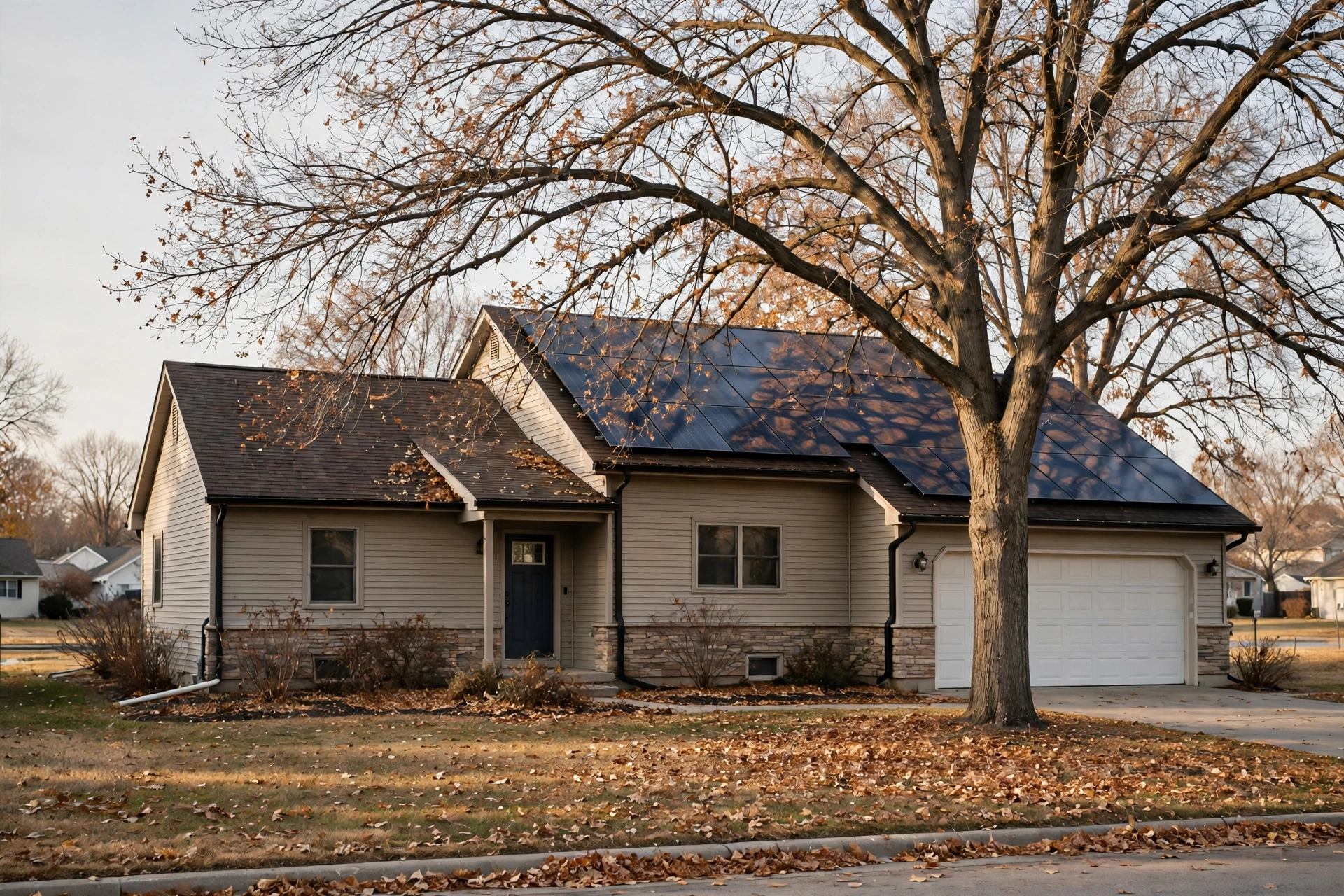
Most Peoria homeowners do not discover a shade problem on installation day. They discover it months later, on a bright afternoon, when they see the oak’s shadow creeping across the south-facing roof. Or they notice it in winter, when a shadow that barely touched the roof in July now covers half the array by two in the afternoon. The panels were placed where the sun was. The tree kept growing, and the sun kept moving.
Shade is not a fixed thing. It moves with the hour, the month, and the tree. A maple that throws a thin shadow across one corner of the roof at noon in June throws a long shadow across the whole slope in December, because the sun in zone 6a sits far lower in winter. Leaves matter too: a silver maple in full leaf casts a dense shadow, while the same tree bare in January casts far less. A homeowner who checks the roof once, on a summer Saturday, has checked the easiest case and learned almost nothing about the hardest one.
Trees also grow toward the light they are shading you from. A young oak planted twenty feet from the house adds height and spread every year, and by the time it is thirty feet tall its crown is over the roofline. Nobody did anything wrong. The tree did what trees do, and the panels did what panels do, and the two of them met in the middle.
Before you decide anything, get a picture of the shade across a year, not a snapshot. Your installer may already have a shade analysis that maps the roof through the seasons. If you have that report, dig it out. If you do not, build a rough version yourself: stand where you can see the roof and note where the tree’s shadow falls at mid-morning, noon, and mid-afternoon. Do it now, in November, when the sun is low and the leaves are mostly down. That reading is the stern one. If the array is clear on a bright November afternoon, it will be clearer still in June. Note which panels are shaded, too — that detail matters, and it is where the inverter comes in.
Why a Little Shade Can Cost More Than It Looks Like
Solar panels do not behave like a garden hose, where blocking part of the flow only costs you that part. In the most common setup they behave more like a chain. In a conventional string-inverter system, a row of panels is wired together, and the whole string tends to perform at the level of its weakest panel. Shade one panel badly, and the string’s output can fall far more than the shaded area alone would suggest. SolarReviews puts it plainly: with a central string inverter, shade on a single panel will reduce power output for the entire solar array, while systems using microinverters or DC power optimizers limit the loss to the shaded panel itself.
That does not mean every shaded system is a disaster. It means the same shadow costs different amounts depending on the equipment behind the panels. A house with microinverters — one small inverter per panel — shrugs off a shadow on a single panel. So the first question about a shaded array is not “how big is the tree?” but “what is behind the panels?” If you do not know, ask the installer or look at the paperwork from the install.
One wrinkle is worth knowing before you treat that as a settled rule. Recent industry research, including a 2024 IEA Photovoltaic Power Systems Programme report, found that modern optimized string inverters can outperform module-level electronics under light to moderate shading in some conditions. Treat the inverter question as a question for your installer, with your actual equipment in front of them. What you can settle here is the tree side: how much shade, where, when, and what a trim would actually change. And remember the honest limit: panels still make power in shade and cloud, just less. The question is “how much sun are you losing, and is the tree work worth getting it back?”
Trim, Remove, or Leave It: The Decision in Plain Terms
Think of the decision as three doors. Trimming is the middle door, and it is the right one most of the time. Removal is the far door, for trees where trimming cannot solve the problem or where the tree is a hazard anyway. Leaving the tree alone is the door people forget, and for some trees it is the honest answer.
Start with trimming. A crown reduction or a targeted raising of the lower limbs can open a sun window over the roof without taking the tree down. The goal is to remove the specific limbs that cast the shadow on the panels during the hours that matter, while keeping the tree’s structure sound. A good crew will want to know which panels are shaded and when, because that tells them which limbs matter. Cutting the wrong side of the crown does nothing for the panels and weakens the tree for no reason.
Trimming works best when the shade comes from one side of one tree, or from a few overhanging limbs, and when the tree is otherwise healthy. It works less well when the tree stands directly south of the array and its whole crown throws the shadow. You can thin a crown, but you cannot thin it into transparency. If the whole tree is in the sun’s path, trimming buys you a season or two and then the tree grows back into the same place.
Removal earns its place in a short list of cases: the tree is dead, dying, or hazardous; it is the wrong species in the wrong spot — a fast-growing silver maple planted ten feet from the house — and will outgrow every trim; the shade covers most of the array most of the day and no reasonable trim opens the roof; or it is already slated to come out and the panels tip a decision you were already leaning toward.
Leaving the tree alone is right when the shade is light, brief, or seasonal, and when the tree gives you something the panels cannot: summer shade on a west-facing wall, a windbreak, a mature oak that anchors the yard. A healthy shade tree lowers summer cooling demand, and that saving is real even if it never shows up on a solar monitoring app.
A Simple Way to Sort Your Situation
Use the table below as a starting point, not a verdict. Your shade analysis, your inverter, and the tree’s health all move the answer.
| What the shade looks like | What it usually means | First move |
|---|---|---|
| A few limbs overhang the roof; shade touches the array for an hour or less | Trimming those limbs will likely clear it | Targeted trim, planned from the shadow |
| One side of one tree shades the array in the afternoon | Crown work on that side can open a sun window | Crown reduction or raising, then re-check |
| The whole crown stands south of the array and shades it most of the day | Trimming will not open the roof for long | Honest conversation about removal, or accept the shade |
| Shade is worst in winter, light in summer | Low winter sun is the driver | Measure in winter before deciding |
| Shade falls on one or two panels; system has microinverters | The loss is contained to those panels | Leave the tree, or trim lightly |
| Shade falls on one panel; system has a string inverter | The loss can spread across the string | Ask the installer about optimizers or a trim |
| The tree is dead, leaning, or dropping large limbs | The shade is the least of it | Removal, on safety grounds |
| The tree belongs to a neighbor | You cannot decide alone | Talk to the neighbor first |
If your row is the winter row, take it seriously. Central Illinois winters are long and low-sun, and the sun that does arrive comes in at a shallow angle over rooftops along War Memorial Drive, Knoxville Avenue, and Sheridan Road alike. A tree south of your roof casts a shadow far longer than its height in December. That is why November is a good month to look: the leaves are down, the sun is low, and what you see is close to the worst case.
What a Good Trim for Solar Actually Looks Like
A solar trim is a targeted opening, planned from the shadow. Before anyone climbs, the crew should know which limbs cast the shadow, at what time of day, and in which season. Have that conversation in the yard, with the roof in view, and agree on what “enough” looks like — because “trim the tree” without a target is how healthy trees get over-pruned.
Never top the tree: cutting the crown back to stubs creates weak shoots that shade the roof worse within a couple of seasons. Keep the work to the limbs that cast the shadow, and time it for the dormant season — late fall and winter — which is the standard window for most shade trees in central Illinois and lets you check the result against the low sun right away.
Cost varies with the tree, the access, and how much has to come off, and no figure in this post is a quote for your tree. Ask what the estimate includes: which limbs, how much crown, cleanup, and whether the crew will re-check the shadow after the work. The Peoria tree trimming cost guide explains the ranges and the factors that move them, and the tree trimming and pruning service page sets out what the service covers.
One more check before the trim: the power lines. If the limbs that shade your panels also reach toward a service drop or an overhead line, say so at the estimate visit. The crew can tell you whether Ameren needs to be involved before any cutting starts. Never let anyone cut near a live line to save a few panels.
When the Tree Is Not Yours
Some of the hardest shade problems are neighbor problems. The tree stands in the yard next door, in Peoria Heights or East Peoria, and its crown throws shade across your roof every afternoon. The general rule is simple: a tree belongs to the owner of the land it grows on, and you do not get to cut your neighbor’s tree down because it shades your panels. Overhanging branches are a narrower question, and the rules about trimming what hangs over your own line vary. This post is not legal advice. But the practical advice works more often than people expect: talk to the neighbor before you talk to anyone else.
Start with the shared interest. A neighbor who hears “your tree is costing me money” hears a complaint. A neighbor who hears “the oak is getting big — would you be open to a trim, and can we share the cost?” hears a neighbor. Bring the facts: which limbs, what hours, what a trim would involve. Put the agreement in writing — which limbs, who pays, who does the work, and when — even if you get along well.
If the tree is dead or dropping limbs onto your property, the urgency changes, but it still starts with a talk. The tree on the property line guide walks through shared trees and boundary lines. If the neighbor will not engage and the tree is a genuine hazard, that is a matter for the city or a lawyer, not for a crew with a saw. The same talk-first rule applies to parkway trees, which belong to the city: you do not get to have a city tree trimmed or removed because it shades your panels. If a city tree is the shade source, the honest answer may be to live with the shade or talk to the installer about panel-level electronics.
The Questions to Ask Before Anyone Cuts
A shade problem is a good test of a tree company, because it rewards the company that measures first and cuts second. Use these questions at the estimate visit, and listen for specific answers.
- Which limbs cast the shadow, and when? If the crew has not looked at the shadow, the trim is a guess.
- How much crown are you taking, and what will grow back? A small, well-shaped trim holds for years. A heavy cut sprouts back fast and shades the roof again.
- What will the roof look like in January after the trim? If the crew only thought about summer, ask them to think about winter.
- Is the tree healthy enough to keep? A trim on a dying tree is money spent twice — once for the trim, once for the removal that follows.
- What does the visit include? Cleanup, chipping, and hauling should be in the estimate, not a surprise at the end of the day.
- Do you need Ameren involved? If any limb is near a service drop or overhead line, the answer should be a clear yes or no, with a reason.
If removal is the answer, the same discipline applies. The tree removal service page explains what removal involves in Peoria, and a free estimate visit is the place to weigh removal against one more trim.
Whether you trim or leave the tree alone, check the roof twice a year: once in November, when the sun is low and the leaves are down, and once in June, when the canopy is full. If the November shadow creeps further across the array each year, plan the next trim before it becomes a removal conversation. If you find yourself trimming the same tree every year for the panels, the trim is not the answer. Measure first, cut second, and never cut a tree you have not really looked at in winter light, from the place where its shadow falls.
Frequently Asked Questions
Should I remove a tree that shades my solar panels?
Usually not first. Measure the shade across the seasons and check which panels it touches. If a targeted trim opens the roof, trimming is the answer. Removal earns its place when the tree is hazardous, when trimming cannot open the roof, or when the tree will outgrow every trim you give it.
How much sunlight do solar panels need?
Panels work best in direct sunlight, and guidance commonly cited is at least four hours of direct sunlight a day. They still produce power in partial shade and cloud, just less. How much less depends on the shade, the hours, and the inverter.
Does shade on one panel affect the whole system?
It can, with a conventional string inverter, where a shaded panel can drag down the whole string. With microinverters or power optimizers, the loss is largely limited to the shaded panel. Ask your installer which setup you have.
Can trimming fix winter shade?
Sometimes. Winter shade comes from the low sun, so shadows are long even from trees that clear the roof in summer. A trim planned from the winter shadow — measured in November or December — can help, but a tree standing directly south of the array may shade the roof all winter no matter how it is trimmed.
Can I cut my neighbor’s tree if it shades my panels?
No, not without their permission. A tree belongs to the owner of the land it grows on. Talk to the neighbor, share the facts about which limbs and which hours, and offer to share the cost of a trim. Put any agreement in writing.
Do I need to tell my solar installer before trimming?
Yes, it is worth a call. The installer can confirm your inverter type, share any shade analysis from the original install, and tell you whether panel-level electronics would help. The tree crew handles the tree; the installer handles the system.
If a tree is shading your panels and you want an honest read on whether trimming will fix it, call Peoria Tree Removal Co. at (309) 250-8333 for a free estimate. Walk the shadow with the crew, ask the winter question, and decide on facts — not on a guess from the driveway. Start with the Peoria Tree Removal Co. homepage if you want the full picture of the services behind the advice in this post.
Peoria Tree Removal Co. — 114 W Forrest Hill Ave, Peoria, IL 61604 — (309) 250-8333 — https://treeremovalpeoriail.com/
Peoria Tree Removal Co.
114 W Forrest Hill Ave, Peoria, IL 61604
Mon–Sat 8am–6pm · 24/7 emergency tree service