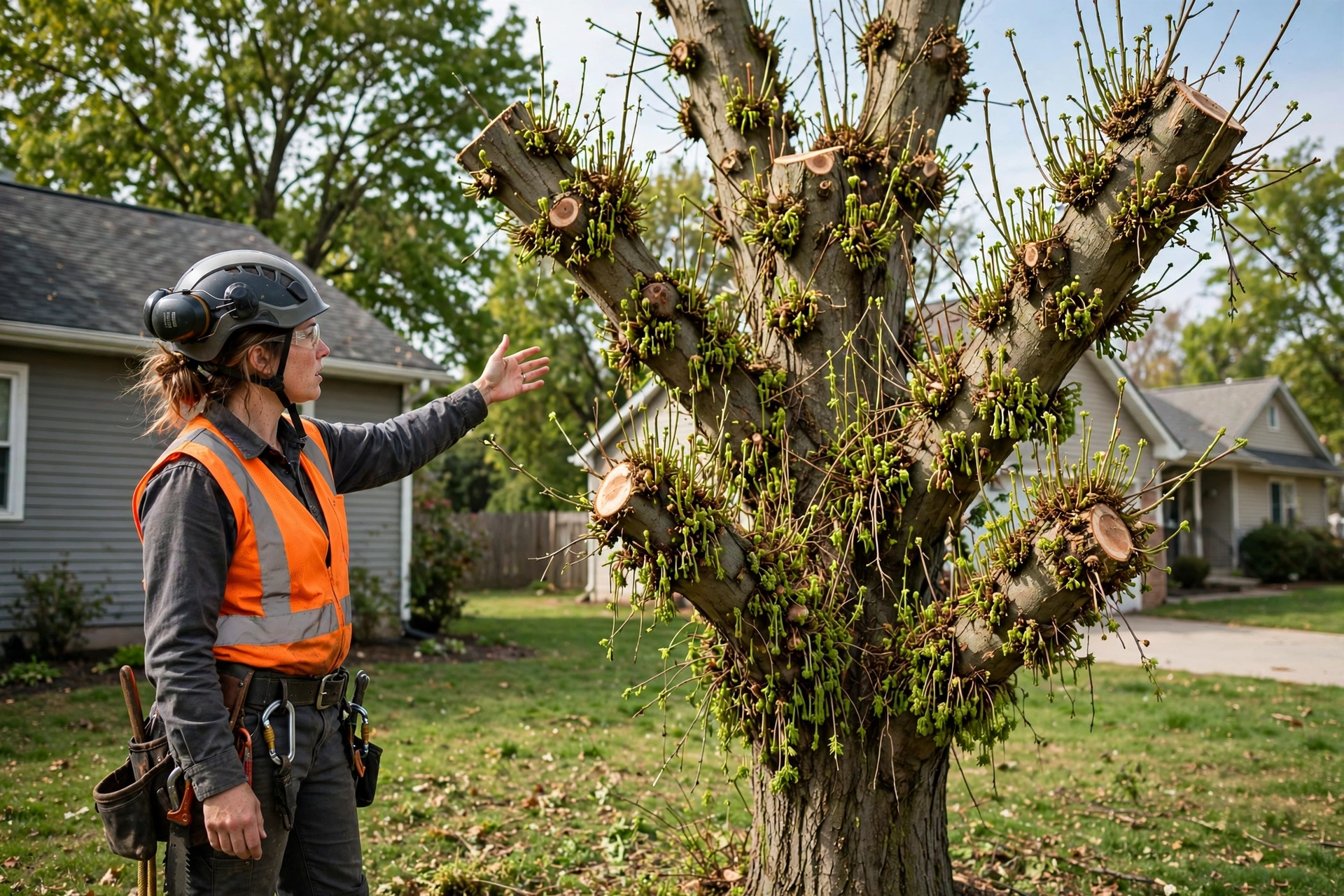
Tree topping in Peoria, IL means cutting a tree’s main branches back to stubs. It does not make trees safer — it triggers weak, fast-growing shoots that snap easily in Central Illinois storms. Proper crown reduction is the safe alternative.
Every spring we drive past topped trees all over Peoria — along War Memorial Drive, near Bradley University, out in Bartonville and Morton. Same look every time: a trunk with a fuzzy ball of skinny shoots, like a bad haircut growing out. The homeowner paid good money thinking it would keep the tree small and safe.
It does neither. Topping does not control size, does not improve safety, and shortens the tree’s life. Here is what topping is, why arborists condemn it, how much you can prune safely, and what to do if your tree was already topped.
What Is Tree Topping in Peoria, IL?
Tree topping — also called hat-racking, heading, or rounding over — is the practice of cutting a tree’s crown back to stubs or lateral branches too small to take over as leaders. Instead of selective cuts at natural branch points, the crew simply lops everything off at the same height.
People top trees for three reasons: the tree got too big near the house or power lines, they want a better river view from their Grandview Drive lot, or storm damage took the top. Every one of these has a proper solution — topping is never it.
Topping is not pruning. Real pruning follows the tree’s natural structure and ANSI A300 standards. Topping ignores all of that. It is fast, it looks dramatic, and it sets the tree up for a slow, expensive decline.
Why Tree Topping Ruins Trees
Tree topping ruins trees four ways: it starves the tree by removing its leaves, scorches suddenly exposed bark (sunscald), lets decay fungi rot down through the cut stubs, and triggers weak watersprout regrowth that snaps in storms. Most topped trees in Central Illinois decline badly within 5 to 10 years.
Starvation
Leaves are how a tree eats. Topping can remove 50 to 100 percent of the leaf-bearing crown in one visit. The tree burns through stored energy growing emergency shoots, and a stressed, starving tree invites insects and disease.
Sunscald
Bark that spent decades in shade suddenly bakes in full sun. On thin-barked maples — common in the 61604 and 61614 — the bark cracks and peels, opening the door for decay to travel into the trunk.
Decay at Every Cut
A proper cut is made at the branch collar — the swollen ring of tissue where a limb meets the trunk — where the tree can seal the wound. A topping stub has no such defense. Decay fungi enter the big flat cuts and rot downward; within years the stubs are hollow shells.
Weak, Dangerous Regrowth
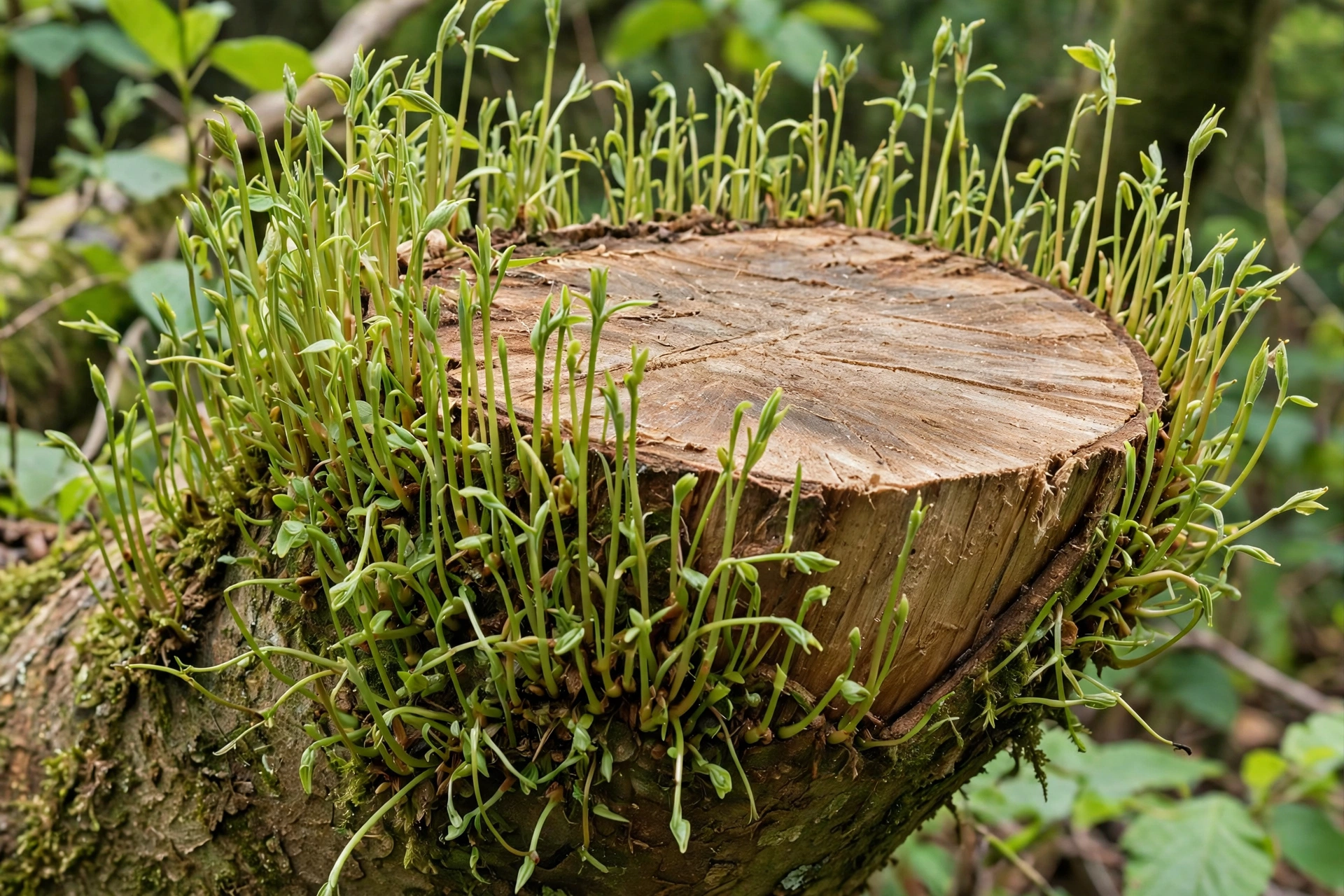
The tree erupts in watersprouts — dozens of shoots per stub, growing six feet a season. It looks like recovery, but watersprouts attach weakly to surface wood. They snap first in every windstorm, tearing off chunks of decayed stub with them.
The 25% Rule: How Much Can You Safely Prune?
So if topping is out, how much can you prune without hurting the tree? The industry rule is simple: never remove more than 25 percent of a tree’s live crown in a single growing season — a standard from ANSI A300, the national pruning guidelines that certified arborists follow.
Go past that line and you trigger the same stress response as topping — emergency sprouting, sunscald, decline. When a reputable crew says “we’ll do part this year and the rest next year,” that is arboriculture, not upselling.
Mature trees need less, not more. A big oak in Tower Park might only need deadwood removal and light thinning every three to five years. Young trees benefit from structural pruning — training a strong central leader while cuts are small and heal fast. See our guide to tree trimming vs pruning in Peoria.
Tree Topping vs. Proper Crown Reduction
Crown reduction is the proper alternative to topping: instead of cutting limbs to stubs, the arborist shortens each limb back to a strong lateral branch at least one-third its diameter. The tree keeps its natural shape, keeps enough leaves to stay healthy, and every cut is placed where the tree can seal it.
Crown reduction costs more than topping because it takes real skill — typically $250 to $700 for a medium tree around Peoria. Topping is cheaper that day and far more expensive over the tree’s life. Our tree trimming service in Peoria follows ANSI A300 pruning standards on every job, and our crews work to ANSI Z133 safety standards.
Why Topped Trees Fail First in Peoria Storms
Topped trees fail first in Peoria storms because their regrowth — fast-growing watersprouts — attaches weakly to decayed stub wood and snaps under ice and wind loads. The June 2024 derecho proved it: topped trees across Peoria County shed limbs everywhere, while properly pruned trees mostly stood their ground.
When watersprouts break they tear long strips of bark down the trunk, opening the tree to more decay — each storm makes the next one more dangerous. A topped tree over your driveway, roof, or sidewalk is not a cosmetic problem. It is a hazard with a countdown, and our 24-hour emergency tree removal crew answers around the clock when it fails.
What Happens If You Never Trim or Prune a Tree?
A tree that never gets pruned develops deadwood that falls, crossing limbs that wound each other, and weak co-dominant stems — two competing trunks joined by a seam of included bark — that split apart under ice or wind. Most mature shade trees in Central Illinois need professional pruning every 3 to 5 years.
We see the rest constantly: dead branches piling up in the crown, limbs rubbing bark-to-bark until wounds never heal, low limbs scraping trucks on tight Bartonville streets. Dense, unthinned crowns catch more wind — and shade out the grass below into the muddy bare spots Peoria lawns are known for.
The fix is not dramatic: deadwood out, crossing limbs resolved, clearance raised, weight balanced. A few hundred dollars every few years adds decades to a tree’s life. Neglect costs nothing today and thousands later.
Can a Previously Topped Tree Be Fixed?
A previously topped tree can sometimes be restored through multi-year restoration pruning — selecting the strongest watersprouts to become permanent limbs and removing the rest over two or three visits. But if decay has hollowed the main limbs or the tree is a hazard, removal is the honest answer.
Sometimes the honest answer is removal. If the trunk is compromised or the tree leans toward the house with a crown of weakly attached shoots, no pruning makes it safe — and taking it down before the next derecho is far cheaper than a 2 a.m. emergency removal after it lands on the garage. An ISA Certified Arborist assessment tells you which situation you’re in, with a written plan and real numbers.
Related Articles
- What Happens If You Never Prune or Trim Your Tree in Peoria?
- How to Choose a Tree Service in Peoria: 7 Questions to Ask
Tree Topping FAQs — Peoria Homeowners Ask
What is tree topping?
Cutting a tree’s crown back to stubs or undersized laterals to reduce its height — also called hat-racking or heading. It violates ANSI A300 pruning standards.
Why should topping be avoided?
It starves the tree, causes sunscald and decay, and triggers weakly attached watersprouts that break in storms. Topped trees decline faster and cost more over their lifetime.
How much of a tree can I prune safely?
About 25 percent of the live crown per season, maximum. Mature trees usually need less — deadwood removal and light thinning every three to five years.
Can a topped tree be saved?
Sometimes, through multi-year restoration pruning if the trunk and main limbs are sound. If decay is advanced or the tree is hazardous, removal is the safer call.
Is tree topping illegal in Peoria?
No city-wide ban exists for private trees, but topping can void tree warranties and violates the standards most reputable companies follow. Always ask what pruning standard a crew uses before hiring.
Get Honest Pruning Advice in Peoria, IL
Whether your tree was topped years ago or a big maple is eating the house, start with an honest assessment from a TCIA-accredited crew — not someone with a “we’ll just take the top off” pitch. We’ll tell you what the tree needs, what it costs, and what can wait.
Call 309-250-8333 for a free estimate anywhere in Peoria, Bartonville, Chillicothe, Peoria Heights, Washington, East Peoria, Morton, or Pekin. Or explore our full tree service in Peoria, IL — and visit TreesAreGood.org to see why arborists say never top a tree. More about us on our homepage.
Listen to This Article
Prefer listening? Hear the full article narrated:
Peoria Tree Removal Co.
(309) 250-8333
info@treeremovalpeoriail.com
https://treeremovalpeoriail.com/
114 W Forrest Hill Ave, Peoria, IL 61604, USA
Tree Service Company
3 Responses