
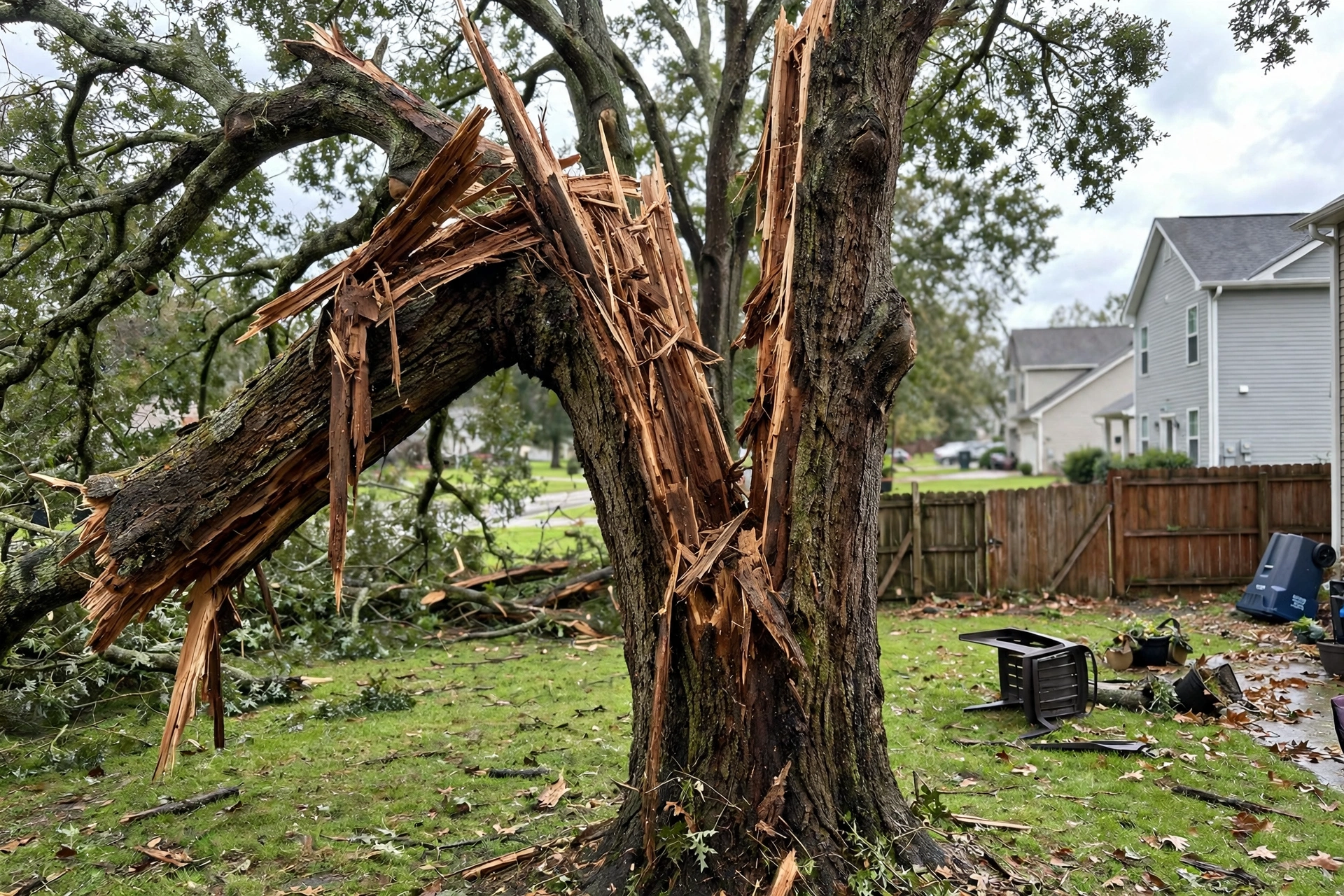
A storm-damaged tree in Peoria, IL can often be saved when the damage is limited to small limbs and bark wounds. But a split trunk, more than half the canopy gone, or a lifted root plate means the tree is dangerous and should be removed by a professional.
The morning after a big storm, the phone starts ringing before sunrise, and every caller asks the same question: “Is my tree going to be okay?” After 17 years of storm work across Peoria County — ice storms, derechos, the brutal June 2024 wind event — we can usually tell a lot from a few good photos.
This guide covers what’s salvageable, how to spot danger signs, what to do about a hanging branch, and how to storm-proof your trees. If a tree is on your house right now, skip ahead and call 309-250-8333 — we answer around the clock.
Can a Storm-Damaged Tree Be Saved?
Many storm-damaged trees recover fine with proper cleanup pruning — the deciding factor is how much structure and canopy survived. Losing under 25 percent of the canopy with the trunk intact is recoverable; a split trunk, more than half the canopy gone, or a lifted root plate means removal.
Usually Salvageable
Broken small limbs, torn bark patches that don’t circle the trunk, and minor crown thinning are all recoverable. Cleanup pruning — cutting broken limbs back to proper branch collars so they seal — lets the tree compartmentalize damage and move on.
Usually Not Salvageable
A trunk split down the middle, more than half the canopy ripped away, the root plate lifted, or a major new lean — these are removals. “Saving” such a tree usually means paying for pruning now and removal later, after the next storm finishes the job.
The gray zone needs an arborist’s eye. A big oak that lost one major limb but kept a balanced crown might suit corrective pruning and cabling — a judgment call for someone who understands tree biology and structural risk. Our 24-hour emergency tree removal page explains how our storm response works, day or night.
How to Tell If a Storm-Damaged Tree Is Dangerous
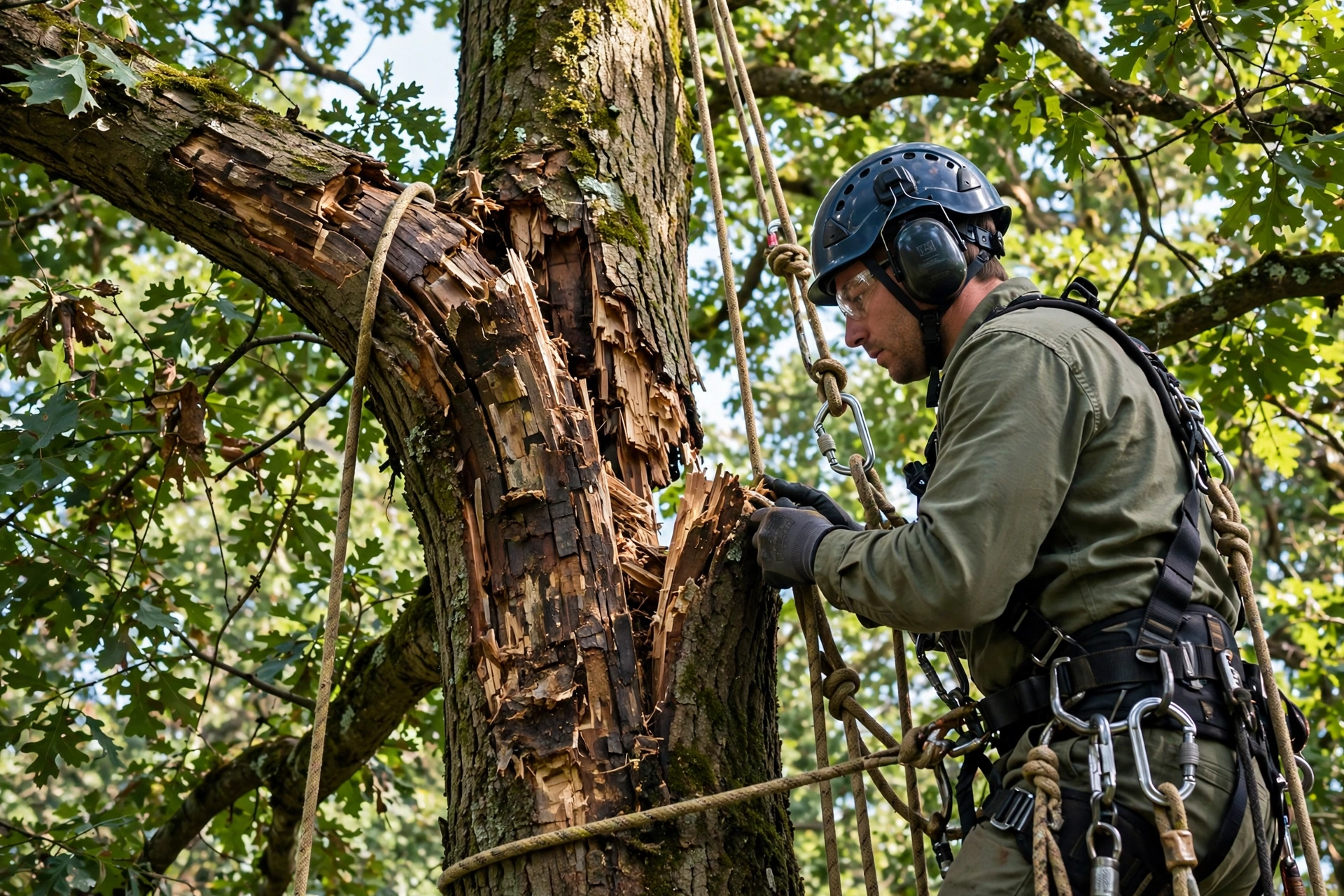
A storm-damaged tree is dangerous if it has hanging broken limbs (widow-makers), cracks or splits in the trunk, a new lean that was not there before the storm, or soil heaving around the base. Keep people and pets away from any tree showing these signs until a professional assesses it.
Hangers (widow-makers). Broken limbs caught in the canopy that never fell all the way down. They can drop without warning — days after the storm, or on the next gust. Never stand under one, and never try pulling it down yourself.
Cracks and splits. A crack down the trunk or through a major limb union means wood fibers have separated. Wind, frost, or the tree’s own weight can finish the split anytime.
A new lean. Straight before the storm, leaning after? The root plate — the disc of roots and soil anchoring the tree — has shifted. Heaved or cracked soil in a circle around the base means torn roots underground.
Bark stripped in sheets. Lightning and violent wind can peel bark in long strips. If stripping wraps more than halfway around the trunk, the tree can’t move enough water and nutrients to survive.
What to Do If a Large Branch Is Hanging After a Storm
If a large branch is hanging after a storm, stay clear and call a professional — never try to cut it down yourself. Hangers sit under hidden tension and can kick, swing, or drop without warning. A pro with ropes and rigging can remove most hangers in under an hour.
- Stay clear and secure the area. Keep kids, pets, and parked cars out from under the hanger. Rope it off if you can do so safely from a distance — hangers can fall on their own, sometimes days later.
- Do not DIY it. Homeowners get seriously hurt every year cutting hangers from ladders or yanking them with trucks. This is the single most dangerous post-storm job there is.
- Call a professional crew. We handle hangers with ropes, rigging, and sometimes a bucket truck or crane — controlling every piece from cut to ground. Most take under an hour and cost far less than an ER visit.
If the branch is on your house or blocking your driveway, that’s an emergency: 309-250-8333, any hour. See what emergency tree removal actually includes for the full rundown.
Peoria Storms Are Getting Rougher — June 2024 Proved It
Central Illinois sits in one of the most storm-active corridors in the country: ice storms that load branches with roughly 500 pounds of ice per tree, and derechos — fast-moving walls of destructive wind — like the June 2024 event that hit Peoria County with 70+ mph winds.
The Illinois River valley funnels wind into the bluff neighborhoods — Peoria Heights, Grandview Drive, the 61616 — so those trees take a beating even in storms that spare the flatlands.
That June storm confirmed what we see every time: the trees that failed worst had pre-existing problems. Topped crowns full of weak watersprouts. Co-dominant stems with included bark. Dead tops nobody pruned out in years. The storm didn’t create the weakness; it exposed it.
If a tree came down on your house, our tree-on-house guide walks you through the exact steps, including insurance.
How Property Owners Prevent Storm Damage
Property owners prevent storm damage with professional pruning every 3 to 5 years (late winter is ideal in Central Illinois), planting storm-tough species like oaks at least 20 to 30 feet from the house, mulching and watering through droughts, and getting periodic risk assessments on large trees near structures.
You cannot stop a derecho, but you can decide how your trees meet it. Storm-proofing is mostly good tree care on schedule:
Prune on a cycle. Every three to five years, a pro removes deadwood, thins crowded crowns so wind passes through, and fixes co-dominant stems while cuts are small. Late winter — February into March — is ideal here.
Choose the right species. Skip silver maples, Bradford pears, and Siberian elms near the house. Oaks, hickories, and Kentucky coffeetree stand up far better. Plant 20 feet out — 30 for oaks.
Water in drought, mulch always. A 3-inch mulch ring (never against the trunk) conserves moisture and protects roots. Healthy roots anchor better in wind.
Assess your big trees. A periodic arborist risk assessment every couple of years catches the defects storms exploit. Cheapest insurance a big tree can have.
What Does Storm-Damaged Tree Cleanup Cost in Peoria, IL?
Simple storm cleanup — removing broken limbs and debris from an otherwise healthy tree — runs a few hundred dollars in the Peoria area. Full emergency removals with crane work run $500 to $3,000+, with after-hours calls carrying a premium for immediate response.
Most homeowner policies cover tree removal when the tree damaged a covered structure — your house, garage, or fence. They generally do not pay to remove a tree that fell in the yard without hitting anything, though many cover debris removal up to a limit. Document everything with photos before cleanup starts, and keep every receipt. We provide detailed line-item invoices formatted for insurance claims on every emergency job.
Related Articles
- Peoria Storm-Season Tree Prep Checklist
- After This Week’s October Storms: What to Check on Your Trees in Peoria IL
Storm-Damaged Tree FAQs — Peoria Homeowners Ask
Can a storm-damaged tree be saved?
Often, if damage is limited to smaller limbs and bark wounds — cleanup pruning lets the tree recover. A split trunk, more than half the canopy lost, or a lifted root plate usually means removal.
How do I know if a storm-damaged tree is dangerous?
Look for hanging limbs, trunk cracks or splits, a new lean, and heaving soil at the base. Any of these near a house, driveway, or sidewalk means keep clear and call a professional.
What should I do if a large branch is hanging after a storm?
Stay out from under it, keep kids and pets away, and never cut it yourself — hangers kill people every year. Call a pro with rigging: 309-250-8333.
How can property owners prevent tree damage during Central Illinois storms?
Prune every 3–5 years (late winter is best), plant storm-tough species away from structures, mulch and water in droughts, and get risk assessments on big trees near the house.
Will insurance cover storm-damaged tree removal?
Usually when the tree damaged your house, garage, or fence. Trees that fell without hitting a structure typically aren’t covered for removal, though debris cleanup often is.
Storm Damage in Peoria? Call Now — We Answer 24/7
Do not wait out a dangerous tree, and do not hand a chainsaw job to whoever knocks on your door first. Storm-chasing crews flood into Peoria after every big wind event — a local company with 17 years here will still be around next week if anything needs a second look.
309-250-8333 — day, night, weekends, holidays. For non-emergency work, explore our full tree service in Peoria, IL, learn more about Peoria Tree Removal Co., or check TreesAreGood.org for trustworthy storm-damage guidance.
Listen to This Article
Prefer listening? Hear the full article narrated:
Peoria Tree Removal Co.
(309) 250-8333
info@treeremovalpeoriail.com
https://treeremovalpeoriail.com/
114 W Forrest Hill Ave, Peoria, IL 61604, USA
Tree Service Company
3 Responses