
After This Week’s October Storms: What to Check on Your Trees in Peoria
- Cost: Storm cleanup $300–$1,500; emergency removal $500–$3,500+ depending on size and hazard
- Method: Ground-first inspection, photos for insurance, professional assessment for hanging or leaning trees
- Timeline: Inspect within 48 hours of the storm; hanging limbs can fall days later
- Permit: None needed for storm cleanup on private property in Peoria
- Safety: Stay at least 50 feet from downed lines; never cut storm-damaged trees under tension yourself
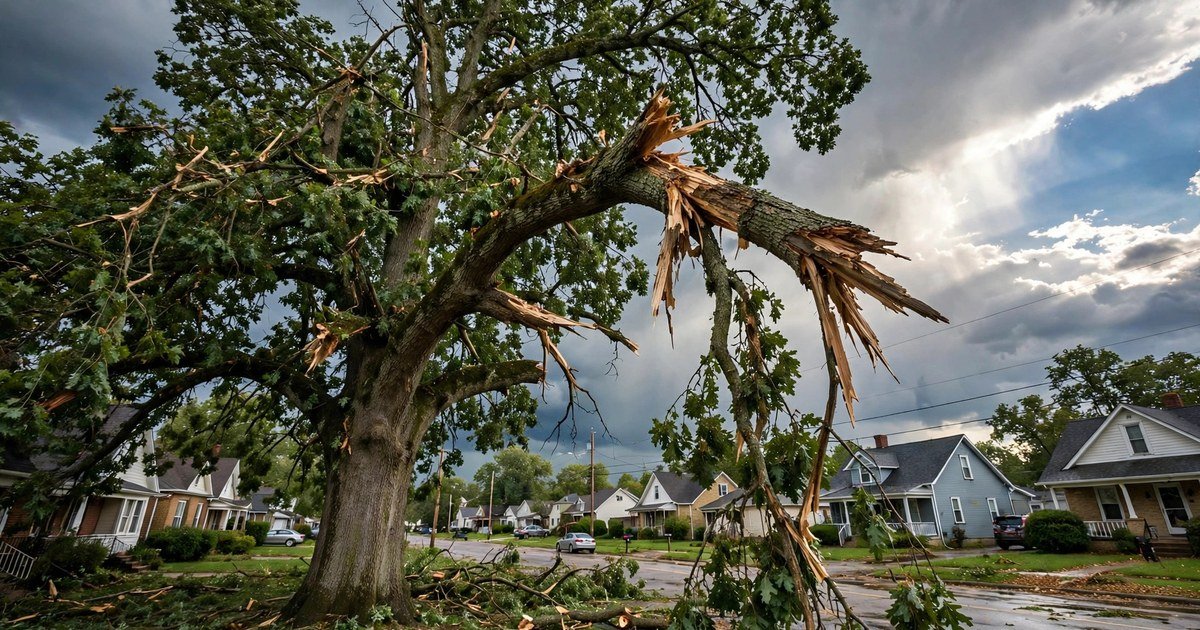
What This Week’s Storms Actually Did
Let’s put the week in context, because it was genuinely unusual. The National Weather Service in Lincoln reported Peoria hitting 88°F on October 12, breaking the old record of 87 set in 2024 — and it was the latest 90-degree-ish day this region has seen that late in the year.
Then came the whiplash. Severe storms fired up Tuesday through Thursday nights with wind gusts up to 60 mph and hail — enough to snap healthy limbs, and more than enough to finish off trees already weakened by emerald ash borer, hidden decay, or old storm wounds.
It wasn’t just us. The same system dropped 75 mph winds on Kansas City, knocking down trees and power lines and leaving 44,000+ customers without power, while severe thunderstorm warnings in southeastern Illinois cited “damage to roofs, siding, and trees.”
Now the second punch: frost is forecast for Friday and Saturday nights. Trees stressed by wind damage go into the cold in worse shape — and a cracked limb that freezes gets more brittle, and more likely to come down in the next wind.
The Post-Storm Tree Walk: Do This Today
Grab your phone and walk your whole property — every tree, not just the ones that look bad. Work ground-first, then look up.
Start at the Base: Roots and Soil
After heavy rain and 60 mph gusts, soil around roots loosens, and trees can start to lean or tip.
- Check for lean. Sight up the trunk. A new lean since the storm is urgent — a tree that moved can keep moving.
- Look for lifted soil. Cracked or heaved ground on one side of the trunk means the root plate lifted and roots tore. This tree needs a professional look, fast.
- Check the root flare. Brush back mulch or soil piled against the trunk and look for cracks where trunk meets roots.
The bluff neighborhoods along Grandview Drive catch the worst wind off the Illinois River, and the soil up there is thin — trees can’t anchor deep. If you live on the bluffs, check your trees first.
Look Up: The Canopy Is Where the Danger Hides
Step well back and scan the whole crown. Binoculars help.
- Hanging limbs (“widowmakers”). A branch that broke but didn’t fall is the most dangerous thing in your yard — it can weigh hundreds of pounds and drop in the next breeze. Keep everyone out from under it.
- Split crotches. Where two big limbs meet the trunk in a V, storms pry them apart. Look for fresh cracks or a gap that wasn’t there before. A split limb over a roof or driveway is an emergency.
- Missing bark or fresh wounds. Hail strips bark. Small wounds heal; big patches of missing bark on the trunk are a structural concern.
- Lopsided canopy. A tree that lost a big limb on one side is unbalanced, and the remaining limbs carry more wind load. A corrective prune restores balance.
Scan the Trunk and Big Limbs
Walk around each tree and look the trunk over from all sides.
- Vertical cracks mean the wood failed under load. Short, shallow ones may be old. Long, fresh cracks — especially weeping sap — need attention.
- Fungus or mushrooms at the base or on the trunk mean decay was already inside before the storm. A tree with conks (shelf fungi) has internal rot.
- Reopened old wounds. Storms rip old injuries open — pruning cuts, lightning scars, mower damage. Fresh splitting around an old wound weakens the tree.
Act Now, Schedule Soon, or Just Watch?
Not everything needs a crew tomorrow. Use this triage to sort what you find:
| What you see | Urgency | What to do |
|---|---|---|
| Tree on house, car, or lines | Emergency — now | Call 911 if lines are involved, then call for emergency tree service |
| Hanging broken limb | Emergency — now | Keep everyone clear; call a pro to remove it safely |
| New lean or lifted root plate | Urgent — 24–48 hrs | Professional assessment; may need cabling or removal |
| Split limb over roof/driveway | Soon — this week | Schedule a crew; don’t park or walk under it meanwhile |
| Large limb down, no hazard | Soon — this week | Photograph, then schedule cleanup and hauling |
| Small branches scattered | Routine | Rake and bundle yourself, or add to a cleanup visit |
| Minor bark wounds | Watch | Monitor; call if cracks spread or sap flows heavily |
Storm Damage Triage at a Glance
Tree on a structure or lines, hanging limbs, new lean, lifted roots. Our emergency line runs 24/7.
Split limbs over targets, downed large limbs, reopened wounds. Schedule a crew before the next wind.
Small debris, minor bark loss, healthy-looking trees. Recheck after the next storm.
Photograph Everything Before You Touch It
This part matters more than most homeowners realize. If you end up filing an insurance claim — for roof damage, a crushed fence, a tree on the garage — your photos are the evidence.
- Shoot wide, then close. Get the whole scene first, then close-ups: the break point, the split, the lifted roots.
- Include a reference. A person, a ladder, or a tape measure in the frame shows scale. “Big branch” means nothing; “a 14-inch limb” does.
- Don’t move anything yet. Clear a path if you must, but leave debris in place until you’ve documented it. Once it’s hauled away, you can’t photograph it.
We’ve watched homeowners lose legitimate claims because they cleaned up first and had nothing to show the adjuster. Ten minutes with your phone is the cheapest insurance you own.
The Mistakes We See After Every Storm
We run storm cleanup all over Peoria — after the June 2024 derecho we worked nonstop for weeks, from the bluffs to Morton to Washington. And every storm brings the same handful of preventable mistakes.
Cutting a tension-loaded limb yourself. This is the big one. A storm-bent limb stores enormous energy — cut it wrong and it whips back or drops on you. Storm-damaged trees injure more homeowners than any other kind of tree work. If the wood is bent, twisted, or pinned under something, that is not a DIY job.
“It looks fine” — until it isn’t. Last fall a homeowner in 61615 called us about a small branch on the lawn. While we were there, we spotted a cracked hanger twenty feet up over the driveway that they’d walked under twice a day for a week. The scariest damage is the kind you don’t notice.
Waiting until the next storm. A split limb doesn’t heal — every wind event works the crack wider. The calls we get after the second storm are always bigger jobs than the ones we could have done after the first.
Hiring the first truck that knocks. Storms bring out the door-knockers — out-of-town crews with a chainsaw and no insurance, cash up front. Ask for proof of insurance, a local address, and a written quote. A legitimate crew gives you all three without blinking.
If you’re unsure what you’re looking at, that’s exactly what a professional assessment is for. Our crew does free storm-damage assessments across Peoria, East Peoria, Peoria Heights, Bartonville, Morton, and Washington — we’ll tell you straight what’s urgent and what can wait.
When the Lines Are Involved: Stop and Call the Utility
If a tree or limb is touching, resting on, or lying across power lines:
1. Stay at least 50 feet away. Electricity can travel through the tree and the wet ground around it.
2. Call 911, then your utility company. Only the power company can de-energize lines. No tree crew touches a tree in contact with live lines until the utility clears it.
3. Don’t touch anything the tree touches. Fences, gutters, ladders, puddles near the tree — all of it can be energized.
Once the utility gives the all-clear, then call us. We coordinate with utility crews regularly after storms.
What About the Rest of October?
The storms are past, but the season isn’t done. Frost arrives Friday and Saturday nights, and trees already stressed by wind damage handle cold worse. A cracked limb that freezes gets more brittle. Soil heaved around roots that then freezes can shift further.
After your storm walk, a short pre-frost list is worth doing this weekend: deep-water stressed trees before the ground firms up, mulch the root zones of young trees, and get hanging or split limbs down before ice adds weight.
For anything that can’t wait, our 24/7 emergency tree service covers Peoria and the surrounding towns around the clock — and our full tree service lineup handles assessment, trimming, removal, and stump grinding in one visit.
The National Weather Service in Lincoln keeps the latest forecasts and storm reports for Central Illinois — worth a bookmark through storm season. And the Illinois Department of Natural Resources publishes guidance on managing storm-damaged woodlands if you own acreage outside town.
Related Articles
- Storm-Damaged Tree in Peoria, IL: Can It Be Saved or Must It Go?
- Peoria Storm-Season Tree Prep Checklist
- Frost Hits Peoria Tonight: 5 Last-Minute Tree Tasks Before the Cold Sets In
Frequently Asked Questions
My tree is leaning after the storm. Will it straighten back up?
No. A new lean means damaged roots, and it won’t correct itself. A mature tree with a new lean needs a professional assessment — it may be stabilizable with cabling, or it may need removal before it fails.
A big limb is hanging in the tree but hasn’t fallen. Is that dangerous?
Yes — hanging limbs (“widowmakers”) can weigh hundreds of pounds and fall without warning, sometimes days after the storm. Keep people, pets, and cars out from under it and call a professional. Never try to pull or cut one down yourself.
Should I call my insurance company before or after cleanup?
Document first, then call. Photograph everything — wide shots, close-ups, something for scale — before anything is moved. Then open the claim and ask what documentation they want. Emergency work to prevent further damage should happen immediately; just photograph it first.
Can I cut up the fallen tree myself?
If it’s small, lying flat on open ground with no tension and nothing pinned underneath — probably. But storm-felled trees are often twisted or spring-loaded, which makes every cut unpredictable. If the trunk is under tension or near structures or wires, call a professional.
How fast can you get here for a storm emergency?
Our emergency line is staffed 24/7, and typical response in the Peoria area is under two hours — faster for trees on houses. On big storm nights we triage by severity, but everyone gets a callback and a plan the same night.
What if the tree fell from my neighbor’s yard onto mine?
In Illinois, you’re generally responsible for the portion on your property — but if the tree was visibly dead or hazardous and your neighbor knew, they may share liability. Photograph everything, notify your neighbor in writing, and check with your insurer.
Storm Damage? Don’t Wait for the Next Wind.
We’ll walk your property, identify every hazard this week’s storms left behind, and give you a straight answer on what needs immediate attention. Free storm-damage assessments across Peoria, East Peoria, Peoria Heights, Bartonville, Morton, and Washington.
Mon–Sat 8am–6pm, 24/7 emergency tree service.
Peoria Tree Removal Co. — 114 W Forrest Hill Ave, Peoria, IL 61604 — (309) 250-8333 — treeremovalpeoriail.com — info@treeremovalpeoriail.com
Peoria Tree Removal Co.
114 W Forrest Hill Ave, Peoria, IL 61604
Mon–Sat 8am–6pm · 24/7 emergency tree service
4 Responses