
Frost Hits Peoria Tonight: 5 Last-Minute Tree Tasks Before the Cold Sets In
- Cost: DIY frost prep under $50 in supplies; professional winterizing $150–$400
- Method: Deep watering, mulch rings, trunk wrap, burlap wind screens
- Timeline: Do it this weekend — before Friday night’s frost and before the ground freezes in late November
- Permit: None needed
- Safety: No special risks; the most dangerous thing is a ladder against a wet tree — keep it simple
Why This Frost Is Trickier Than Usual
A normal October frost is no big deal for established trees — they’ve been hardening off for weeks. But this year the record heat kept trees growing late. Some pushed tender new growth that never hardened before the cold arrived, and that soft growth is the first thing frost damages.
The trees most at risk this weekend:
- Trees planted this year. Their root systems are still small and shallow. A hard freeze on dry soil can kill roots that haven’t established yet.
- Young trees with thin bark. Maples, honey locusts, and fruit trees under about 4 inches in diameter can suffer frost cracks — the bark splits when sunny winter days warm the trunk and freezing nights shrink it.
- Evergreens in windy spots. They keep their needles all winter, which means they keep losing moisture all winter. Wind makes it worse.
- Anything drought-stressed. Dry soil going into the freeze leaves roots with no moisture reserve. Dry cold is harder on trees than wet cold.
The 5 Tasks: Your 72-Hour Checklist
Do these in order — each one builds on the last, and all five fit in a weekend.
1. Deep-Water Everything, Especially New Trees
This is the single most important task, and the one most people skip. Dry soil plus freezing temperatures equals root damage.
- How much: A long, slow soak — enough to wet the soil 12 to 18 inches deep. For a young tree, roughly 10–15 gallons. For a mature shade tree, run a soaker hose for several hours.
- Where: Water the whole root zone, not just the trunk — roots spread as wide as the branches.
- When: Now, while the ground is unfrozen. Peoria’s ground typically freezes in late November, but don’t gamble — this weekend is your window.
Newly planted trees are the priority. A tree planted this spring or fall has a tiny root ball; if it goes into the freeze dry, it may not leaf out next spring.
2. Refresh Mulch Rings to 3–4 Inches
Mulch is a winter blanket for roots — it insulates the soil, holds moisture, and prevents the freeze-thaw cycles that heave young roots out of the ground.
- Depth: 3 to 4 inches of shredded bark or wood chips. Less than 2 doesn’t insulate; more than 4 can smother roots.
- Width: Out to the drip line if you can, or at least 3 feet from the trunk for young trees.
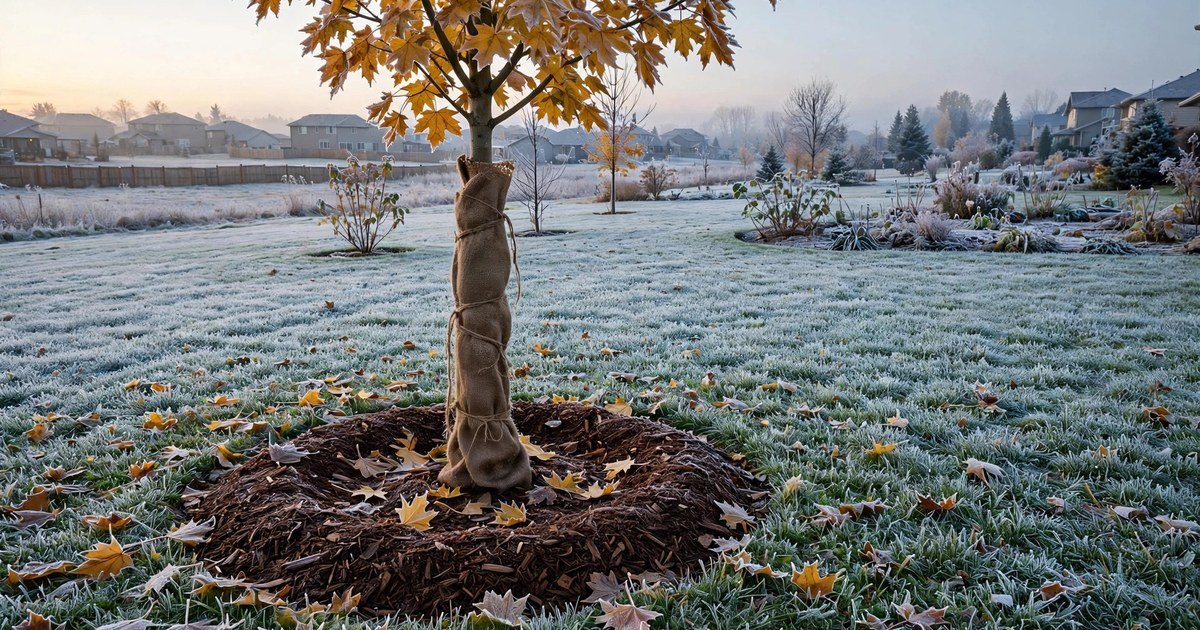
- The donut, not the volcano. Pull mulch back 3–4 inches from the trunk. Mulch piled against bark traps moisture and invites rot — the classic “mulch volcano” kills more young trees than frost does.
3. Wrap the Trunks of Young and Thin-Barked Trees
Frost cracks hit young trees hardest: a sunny winter afternoon warms the southwest side of the trunk, then the temperature plummets at sunset. The bark expands and contracts faster than the wood underneath — and splits.
- What to wrap: Any tree under about 4 inches trunk diameter, plus thin-barked species (maples, honey locust, linden, fruit trees).
- What to use: Commercial tree wrap or burlap strips, spiraled from the base up to the first branches, overlapping each layer by about a third.
- When to remove it: Early spring, around late March or April. Leaving it on through summer traps moisture and invites insects.
Ten minutes per tree and a few dollars — the cheapest insurance in tree care.
4. Shield Evergreens From Winter Wind and Salt
Evergreens don’t drop their needles, so they lose water all winter — and wind accelerates the loss. The result is winter burn: brown, dead patches on the windward side.
- Wind screens: For exposed evergreens — especially along the windy bluffs near Grandview Drive or open lots in 61615 — drive three stakes on the windward side and wrap burlap around them. Leave air space; don’t wrap the tree tight.
- Anti-desiccant sprays: These waxy coatings reduce moisture loss from needles. Apply now, before the hard freeze.
- Salt protection: If evergreens sit near a driveway or sidewalk that gets salted, a burlap screen on the road side blocks salt spray.
Mature, sheltered evergreens usually need nothing. It’s the young, exposed ones — the arborvitae row planted last spring — that need help.
5. Disconnect Hoses, Drain Barrels, Shut Off Outdoor Water
This one’s about your pipes as much as your trees — a burst outdoor spigot in January means no water for a dry February.
- Disconnect and drain all hoses. A connected hose traps water in the spigot, which freezes, expands, and bursts the pipe inside your wall.
- Drain rain barrels completely and store them upside down. A full barrel that freezes can split.
- Shut off outdoor water lines from the inside valve if you have one, then open the outside spigot to drain.
| Tree type | Biggest frost risk | Do this weekend |
|---|---|---|
| Planted this year | Root kill in dry, shallow soil | Deep soak + 3–4″ mulch ring + trunk wrap |
| Young deciduous (thin bark) | Frost cracks, sunscald | Trunk wrap to first branches; remove in spring |
| Evergreens (young/exposed) | Winter burn, salt spray | Burlap wind screen; anti-desiccant spray |
| Mature shade trees | Low risk unless storm-damaged | Deep water if dry; inspect for storm damage |
| Fruit trees | Bud damage, bark splitting | Trunk wrap + mulch; no pruning until late winter |
Your 72-Hour Frost Prep Timeline
Deep-soak every tree, starting with this year’s plantings. Wet the full root zone, not just the trunk.
Refresh mulch rings to 3–4 inches (donut, not volcano). Wrap young trunks up to the first branches.
Burlap screens for exposed evergreens. Disconnect hoses, drain barrels, shut off outdoor water.
What NOT to Do Before the Frost
- Don’t fertilize now. Fertilizer pushes tender new growth — exactly what you don’t want days before a frost. Wait until spring.
- Don’t do heavy pruning. Fresh cuts stimulate growth and won’t harden before the cold. Save major pruning for late winter (February–March). The exception: remove anything that’s an immediate hazard.
- Don’t wrap canopies in plastic. Plastic traps moisture against leaves and bark, cooking the tree on sunny days and freezing it at night. Burlap breathes; plastic doesn’t.
- Don’t pile leaves against trunks. A deep drift of wet leaves holds moisture against bark and invites rot. Rake leaves into beds or compost them instead.
After the Frost: What to Watch For
Saturday morning, take a walk and look at what the cold did:
- Blackened or wilted new growth on shrubs and young trees — usually cosmetic. The plant pushes new growth in spring.
- Split bark on young trunks — check the southwest side of thin-barked trees you didn’t wrap. Small splits often callus over.
- Evergreen browning — early winter burn. Get a wind screen up before the next cold snap.
This week’s storms plus the freeze also make it a good time to scan for hanging limbs and split crotches — frost makes cracked wood more brittle, and the next wind event is always coming.
For bigger pre-winter work — corrective pruning after storm damage, hazard removals before ice season — our tree trimming and pruning crew works across Peoria, East Peoria, Morton, and Washington, and our full tree service lineup covers everything from emergency response to stump grinding in one visit.
The National Weather Service in Lincoln has the latest frost advisories for Central Illinois, and University of Illinois Extension publishes solid fall tree-care guidance for our zone 6a conditions.
Related Articles
- Winter Tree Care in Peoria, IL: How to Protect Your Trees Before the First Freeze
- After This Week’s October Storms: What to Check on Your Trees in Peoria IL
- When Should You Avoid Trimming Tree Branches in Central Illinois?
Frequently Asked Questions
Will tonight’s frost kill my trees?
For established, healthy trees — no. The risk is to newly planted trees, trees with late-season tender growth from the record heat, and young thin-barked trees. That’s who the five tasks above protect.
Should I cover my trees with a sheet tonight?
For trees, covering the canopy isn’t practical or necessary — focus on the roots (water + mulch) and young trunks (wrap). Never use plastic sheeting on foliage; it traps moisture and causes more damage than the frost.
Is it too late to plant a tree this fall?
Not at all — fall is the best planting season in zone 6a. Soil is still warm enough for root growth while cool air reduces stress. You can plant until the ground freezes, usually late November. Water deeply and mulch well.
Do I really need to water if it’s about to freeze?
Yes. Moist soil holds heat better than dry soil, insulating roots through temperature swings, and roots keep absorbing water until the ground freezes. A deep soak now is the single best pre-winter task.
What about the tree I planted this spring? Any extra steps?
Give it the full treatment: deep soak, 3–4 inch mulch donut, and a trunk wrap. First-year trees have the smallest root systems and thinnest bark — the most vulnerable plants in your yard.
When do I remove the trunk wrap — and what if I forget?
Remove it in early spring, around late March or April. Leaving it through summer traps moisture and harbors insects — set a phone reminder now. One season of protection is all a young tree needs.
Running Out of Weekend? We’ll Handle the Big Stuff.
Hazard pruning, storm-damaged limbs, and pre-winter assessments across Peoria, East Peoria, Peoria Heights, Bartonville, Morton, and Washington. One call covers the work, the cleanup, and honest advice on what your trees actually need.
Mon–Sat 8am–6pm, 24/7 emergency tree service.
Peoria Tree Removal Co. — 114 W Forrest Hill Ave, Peoria, IL 61604 — (309) 250-8333 — treeremovalpeoriail.com — info@treeremovalpeoriail.com
Peoria Tree Removal Co.
114 W Forrest Hill Ave, Peoria, IL 61604
Mon–Sat 8am–6pm · 24/7 emergency tree service
One Response