
Central Illinois sits in one of the iciest regions of the state, and a little fall prep work can save your trees, your roof, and your power line when the next glaze hits.
Start prepping your trees in fall, before December arrives: prune out dead, weak, and damaged limbs, have an arborist cable trees with narrow forks or co-dominant stems, mulch the root zone, and deep-water before the ground freezes. After an ice storm, never shake ice off branches — prune broken limbs cleanly, and stay clear of anything touching a downed power line.
Quick Facts
- Ice load: Just 1/4 inch of ice can add around 500 pounds of extra weight to a single tree, and ice can multiply a branch’s weight up to 30 times.
- Damage threshold: Breakage starts at about 1/4–1/2 inch of accumulation; 1/2 inch to a full inch of ice causes major limb failure.
- Best prep window: Late fall, after leaves drop and before December’s ice season — in Peoria’s zone 6a, aim for November.
- Typical cost: Most Peoria-area homeowners pay roughly $250–$600 per tree for storm-prep pruning, depending on size and access.
- Permits: Trees between the sidewalk and curb belong to the city — check Peoria’s rules before pruning parkway trees.
- Safety: Ice-loaded branches can snap without warning. Never touch a limb that’s resting on a power line.
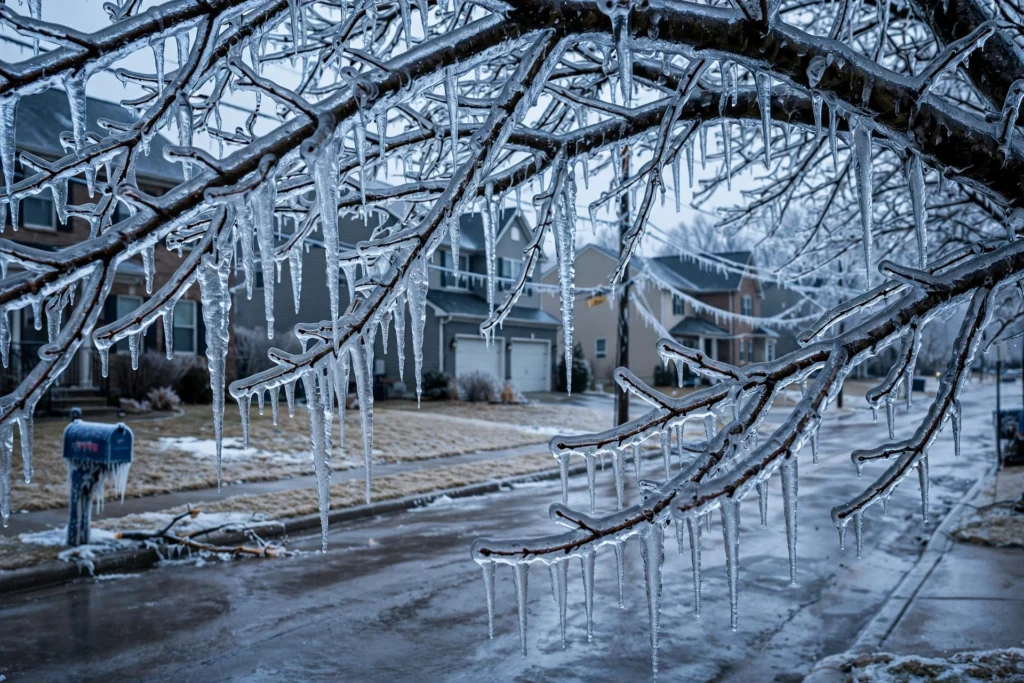
How Ice Actually Breaks a Tree
Wind hits hard and fast, then it’s gone. Ice is a slow, steady load that builds for hours until something gives — every branch, twig, and bud collects a glaze, and the weight keeps stacking up.
The numbers are startling. A quarter inch of ice can add roughly 500 pounds to a single tree, and ice can multiply a branch’s weight up to 30 times. Damage happens in stages: at a quarter inch, small limbs bend and weak branches snap; at half an inch, big branches break; at three-quarters of an inch, trees can lose major limbs or topple — which is why outages drag on for days.
Why a Little Ice Does So Much Damage
Trees are built for wind, not for carrying hundreds of extra pounds. Failures happen at spots that were already weak: co-dominant stems with trapped bark, limbs with hidden decay, or V-shaped forks that were never strong joints.
Ice loads every tree in the neighborhood at the same time, so nearly every yard on the block has damage by morning — and good crews book out fast.
Central Illinois Knows Ice Storms Too Well
If you’ve lived in the Peoria area for a while, you remember: December 2007 hit central Illinois twice. The December 1–2 storm spread freezing rain across most of the state, snapping trees and power lines from DeKalb to Peoria. Then the December 8–14 storm brought up to half an inch of freezing rain to western Illinois, with inch-and-a-half ice in the worst-hit spots.
By December 2, about 2.4 million utility customers were without power across an eight-state area, and 49 Illinois counties were declared disaster areas. Repair costs topped $177 million, and some 65,000 customers were still dark six days later.
That same year, a January storm had already coated central Illinois with more than an inch of ice. An ISA study of parkway trees in Urbana found that central Illinois sees ice storms more often than any other part of the state, most striking between December and March.
What Recent Winters Have Taught Us
Since 2007, Peoria-area homeowners have weathered glaze events, heavy wet snows, and the June 2024 derecho. The pattern holds: it’s rarely the snow that wrecks trees here — it’s freezing rain coating everything in a half-ton shell. From Grandview Drive to the Illinois River riverfront, mature trees in the 61604, 61614, and 61615 ZIP codes are exactly what ice loves to punish.
Which Trees Get Hit Hardest in Peoria
Not all trees handle ice equally. An ISA survey of parkway trees in Urbana, Illinois ranked species by damage — and the results match what local crews see every winter.
| Species | Ice-Storm Risk | Why It Fails |
|---|---|---|
| Bradford pear | Severe (8.8% badly damaged in Urbana study) | Narrow V-shaped forks with included bark split under load |
| Silver maple | High (weak wood, weak crotches) | Fast-growing soft wood and brittle branch unions |
| Siberian elm | Severe (41.7% — worst in the study) | Brittle wood and a fine branching pattern that catches lots of ice |
| Willows & poplars | High | Fast growth, soft wood, and shallow roots |
| Evergreens | Moderate to high | Needles and leaves collect ice all winter long |
| Red & white oaks | Low (under 1% badly damaged) | Strong, slow-grown wood with sturdy branch attachments |
The Usual Suspects in Peoria Yards
Older neighborhoods near Bradley University and along Sheridan Road are full of silver maples — the go-to shade tree for decades, and exactly what ice exploits. Newer subdivisions off War Memorial Drive and toward Dunlap are packed with Bradford pears, which split apart so reliably that many arborists now tell people to stop planting them.
Walk your yard in November and look for these warning signs:
- Dead, hanging, or cracked limbs — these are the first to go
- V-shaped forks with bark pinched between the stems (included bark)
- Two trunks of similar size rising from one spot (co-dominant stems)
- Old storm damage, cavities, or mushrooms growing on the trunk (decay)
- Limbs already leaning over your roof, driveway, or the neighbor’s fence
If you spot any of these, that tree deserves attention before December, not after the ice finds it for you.
What to Do BEFORE the Ice Arrives
The good news: fall is the perfect time for all of this. Leaves are down, so branch structure is easy to see, and there’s still time to act before the December–March ice window.
1. Prune Out the Weak, Dead, and Damaged Limbs
This is the single most effective thing you can do — less deadwood means less weight for ice to grab and fewer branches for it to throw at your house. Urbana’s regularly pruned silver maples suffered far less ice damage in the ISA study. For high, heavy limbs, a professional tree trimming and pruning service in Peoria can handle what you shouldn’t tackle from a ladder.
Never “Top” a Tree to Shrink It
Topping — lopping the top off a tree to make it shorter — is one of the worst things you can do before ice season. The regrowth is weakly attached and breaks even more easily under ice. If a tree is too big for its spot, thin the crown or remove it — don’t top it.
2. Cable and Brace the Risky Trees
Some trees are worth saving despite shaky structure — a big shade tree over the patio, say. An arborist can install steel cables between major limbs to brace weak unions, spreading ice loads across the canopy instead of letting one fork take the full hit. Davey Tree lists cabling among its top five winter-prep steps.
3. Mulch and Water Before the Ground Freezes
Freeze-thaw cycles and saturated winter soil can destabilize roots, especially on young or shallow-rooted trees. A 2–4 inch mulch layer around the base (kept off the trunk) insulates roots, and a deep late-fall watering gives the tree moisture reserves before the ground freezes.
Your Fall Ice-Prep Timeline
During the Storm: Stay Safe and Stay Inside
When freezing rain falls, stay away from the trees — ice-loaded branches can fail without warning. Keep kids and pets inside, and don’t park under big trees.
Don’t knock ice off sagging branches — frozen wood is brittle, and the shock of a broom handle snaps limbs that might have survived. The one exception is light, fluffy snow, which you can brush off gently. Ice stays put until it melts.
If a limb lands on a power line, don’t touch it or anything touching it — call your utility company right away. For limbs blocking your driveway or leaning on the house, emergency tree removal in Peoria crews handle the dangerous work so you don’t have to.
After the Ice Passes: Clean Up the Right Way
Once the ice melts, walk the yard and take stock. Pick up fallen sticks, pile the brush, and prune small broken branches yourself with clean, sharp hand tools.
Prune broken limbs back to the branch collar — the slightly swollen ring where the branch meets the trunk. Don’t leave stubs, and don’t cut flush: both invite decay. Trim torn bark back only to where it’s firmly attached. A split fork can sometimes be saved with cabling, so get a pro’s opinion before assuming the worst.
If damage is high in the canopy, a limb is hung up in another tree, or a chainsaw is involved and you’ve never run one — that’s a job for a professional. Storm-damaged limbs under tension can kick back. See our main Peoria tree service page for cleanup and recovery options after major storms.
Frequently Asked Questions
How much ice does it take to damage a tree?
Less than you’d think. Small-branch breakage starts at just a quarter to half an inch of ice, and half an inch to a full inch causes major limb failure. A quarter inch of ice adds around 500 pounds to a single tree — that’s why even “minor” glaze events snap branches everywhere.
Should I shake ice off my tree branches?
No. Hitting or shaking ice-coated branches usually breaks them — frozen wood is brittle. Let the ice melt naturally, and only brush off light, fluffy snow. Prune broken branches cleanly back to the branch collar afterward.
Which trees are most likely to break in an ice storm?
Bradford pears, silver maples, Siberian elms, willows, and poplars fail most — weak wood and brittle forks. Evergreens suffer too, since needles hold ice all winter. Oaks and other slow-growing hardwoods hold up best.
When should I prune trees to prepare for ice season?
Late fall, after leaf drop — weak structure is easy to see, and there’s still time before December’s ice season. In Peoria’s zone 6a, finish pruning, cabling, and mulching by late November.
Will my homeowners insurance cover ice storm tree damage?
It depends on what the tree hit. Most policies cover removing a tree that damages your home or other insured structures, plus some debris removal. A tree that simply falls in the yard is often not covered. Check your policy and call your agent.
What should I do about a tree leaning on a power line after a storm?
Stay far away and call your utility company first — only they can safely deal with lines. Don’t touch the tree, the line, or anything touching either one. Once the utility clears the line, a tree service can remove or repair the tree itself.
Related Articles
- Storm Season Tree Prep Checklist for Peoria, IL
- Winter Tree Care in Peoria, IL: Protecting Trees from Cold Damage
- What Is Emergency Tree Removal? When to Call Right Away
Get Your Trees Ready Before the Next Ice Storm
Don’t wait until the forecast turns icy. Call Peoria Tree Removal Co. for storm-prep pruning, cabling, and hazard assessments across the Peoria area.
Call (309) 250-8333 for a Free Estimate114 W Forrest Hill Ave, Peoria, IL 61604
(309) 250-8333
info@treeremovalpeoriail.com
Peoria Tree Removal Co.
114 W Forrest Hill Ave, Peoria, IL 61604
Mon–Sat 8am–6pm · 24/7 emergency tree service