
Should You Water Trees in Fall and Winter? An Illinois Homeowner’s Guide
Yes — water your trees in fall until the ground freezes, and keep watering evergreens and new plantings during winter thaws when the ground is not frozen. Fall drought stress quietly kills more new Illinois trees than winter cold does. A deep soak every week or two beats a daily sprinkle every time.
It feels wrong. The leaves are falling, the hose is put away, and winter is coming — why would a tree need water now? Because the part of the tree you cannot see is still working.
Tree roots grow well into fall, long after the leaves drop. And evergreens never really stop losing water — their needles breathe all winter. If the soil goes into winter dry, the tree starts the coldest months already stressed. Here is how to get fall and winter watering right in Central Illinois.
Quick Facts
- Fall rule: Keep watering until the ground freezes — usually late November to early December in the Peoria area.
- Winter rule: Water evergreens and trees planted within 2 years during thaws, when air is above 40°F and the ground is not frozen.
- How much: Roughly 10 gallons per inch of trunk diameter per watering, applied slowly over the root zone.
- How often: Every 1–2 weeks in fall if rain is scarce; once or twice per winter thaw for evergreens and new trees.
- Established trees: Mature, deep-rooted trees usually need no supplemental water once dormant.
- Peoria clay catch: Water slowly — clay soil absorbs slowly and runoff wastes most of a fast soak.
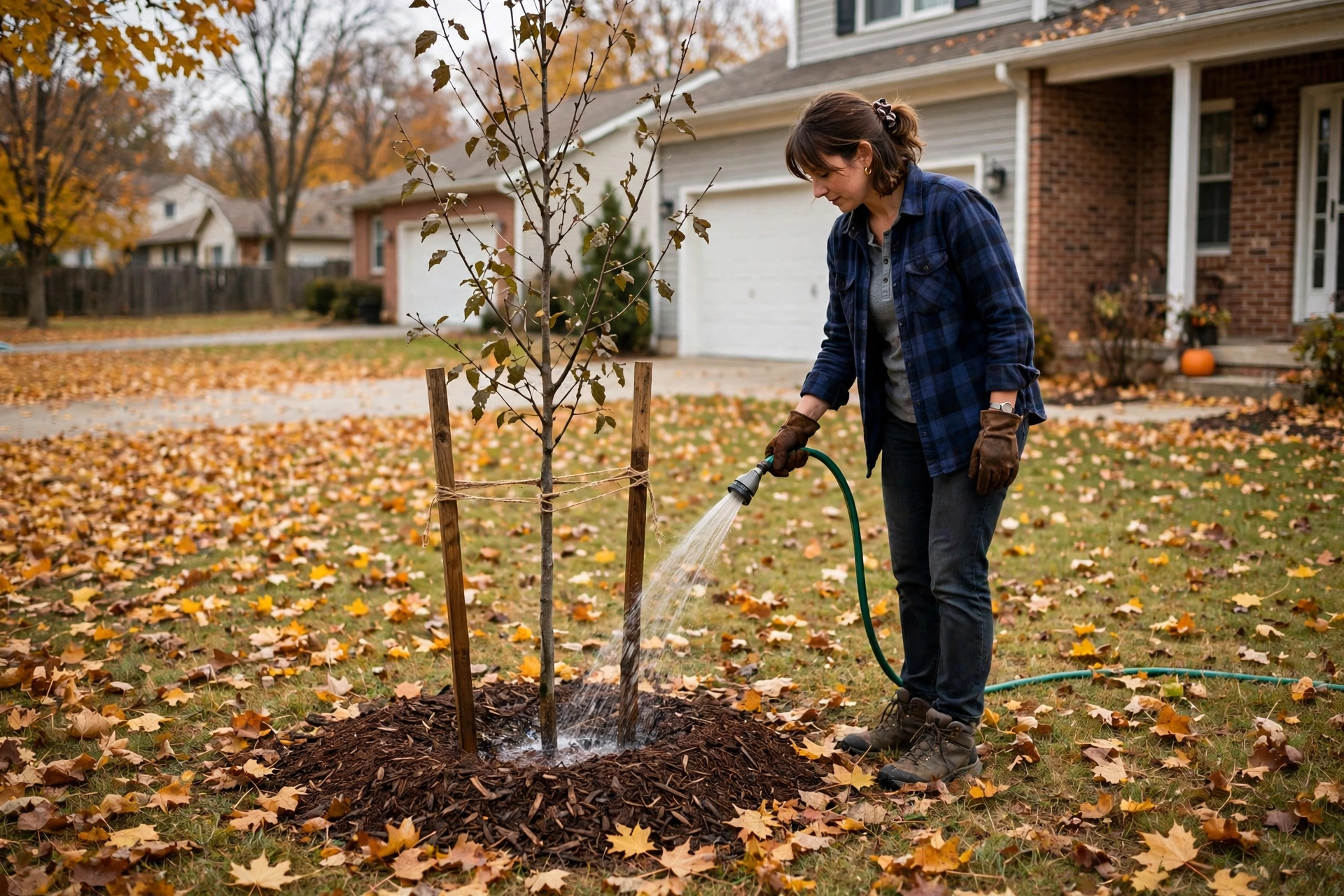
Roots Do Not Read the Calendar
Here is the thing most homeowners miss: when the leaves drop, the roots keep going.
In fall, a tree shifts its energy underground. Root growth actually peaks in early to mid-fall in Illinois — the soil is still warm from summer while the air cools, which is perfect growing conditions for roots. A tree planted this spring or last fall is still building the root system it needs to survive, and that construction project runs on water.
A dry fall means the roots go into winter underdeveloped. Then winter brings its own stresses — drying winds, freeze-thaw cycles, and for evergreens, months of water loss through needles. A tree that entered winter with a half-built root system and dry soil is the tree that leafs out weakly in spring, or does not leaf out at all.
This is why fall watering matters more than most people think. You are not watering the leaves. You are watering next year’s tree.
New Plantings: The Thirstiest Trees You Own
A newly planted tree is living on a fraction of its natural root system. The nursery dug it up, cut most of its roots, and packed what was left into a root ball. Until new roots grow out into your soil — a process that takes one to two full growing seasons — that tree cannot reach far for water.
In practice, this means a tree planted this year or last year depends on you through its first winter. Fall watering is not optional for these trees; it is the difference between establishment and replacement.
Water deeply and slowly. A soaker hose circling the root zone, or a hose trickling for an hour or two, beats a sprinkler every time. You want the water to soak 8 to 12 inches down, where the roots are. A quick spray that wets the top inch does almost nothing.
Keep it up until the ground freezes. In the Peoria area, that is usually late November into early December, but watch the weather, not the calendar — a warm November means keep watering.
The First-Winter Checklist for New Trees
- Water deeply every 1–2 weeks through fall until the ground freezes.
- Mulch 2–3 inches deep in a wide ring — but never piled against the trunk.
- Skip the fertilizer. Fall feeding pushes tender growth that winter kills.
- During winter thaws (air above 40°F, ground thawed), give new trees a drink once or twice.
- Check the mulch in spring and pull it back from the trunk if it has drifted.
Evergreens: Losing Water All Winter
Deciduous trees shut down for winter. Evergreens do not.
Pines, spruces, firs, arborvitae, and yews keep their needles all winter, and those needles keep losing moisture to dry winter wind. On a sunny, windy January day, an evergreen can lose a surprising amount of water — while its roots sit in frozen soil, unable to replace a drop.
This is what causes winter burn: needles turn brown from the tips inward, usually worst on the south and west sides where sun and wind hit hardest. It is dehydration, not cold damage, and it is one of the most common evergreen problems in Illinois.
Fall watering is the main defense. An evergreen that goes into winter with fully hydrated soil has a reservoir to draw on. Water evergreens deeply through fall, right up until freeze-up, and give them a drink during any winter thaw when the ground is workable.
New evergreen screens — those rows of arborvitae everyone plants for privacy — are the most vulnerable. They are young, their roots are shallow, and they are fully exposed to wind. If you planted a screen in the last two years, winter watering is mandatory, not optional.
Established Trees: Mostly on Their Own
Here is the good news: a mature, established tree with a deep root system generally needs no fall or winter watering at all. Its roots reach far and deep, tapping moisture you cannot.
The exceptions: established trees under unusual stress. A mature tree in a restricted planting pit downtown, one surrounded by new construction that cut its roots, or any tree coming off a brutal drought summer deserves fall water. And if fall has been genuinely dry — weeks without meaningful rain — even big trees appreciate a deep soak or two before freeze-up.
When in doubt, check the soil. Dig down a few inches with a trowel a foot or two from the trunk. If it is powdery dry, water. If it is moist, leave it alone.
The Peoria Clay Problem
Central Illinois soil is heavy clay, and clay changes the watering game.
Clay absorbs water slowly. Hit it with a fast-running hose and most of the water runs off across the surface — or pools, then evaporates — instead of soaking in. You think you watered deeply. The roots got almost nothing.
The fix is patience. Water slowly: a trickle, a soaker hose, or repeated short cycles with soak-in breaks between. An hour of slow soaking does more than ten minutes of blasting.
Clay also holds water a long time once it is wet. That is the other edge of the sword — overwatering in clay suffocates roots. If the soil is still moist from last week’s watering, skip this week. The trowel test never lies.
The Fall Watering Rhythm
Peak root growth. Deep soak every 1–2 weeks if rain is scarce. Mulch now.
Keep going until freeze-up. Evergreens especially — hydrate before winter.
Only during thaws: air above 40°F and ground not frozen. New trees + evergreens.
Resume as the ground thaws. Spring growth is thirsty work.
How to Water: The Slow Soak Method
Forget the sprinkler. Here is the method that actually works:
Soaker hose. Lay it in a spiral or circle around the tree, starting a foot from the trunk and extending to the drip line — the circle under the outermost branches. Run it low and slow for an hour or two. This is the gold standard for new trees.
Trickle hose. No soaker hose? Lay a regular hose on a slow trickle and move it around the root zone every 30 minutes or so. Same effect, slightly more effort.
Watering bag. Those green bags that wrap the trunk and drip slowly are excellent for new plantings. Fill once or twice a week in fall. Remove them before hard winter — or keep filling during thaws.
Five-gallon bucket with a hole. Drill a small hole near the bottom, set it by the tree, fill it, walk away. Primitive, free, and effective.
Whatever the method, the goal is the same: water penetrating 8 to 12 inches deep, across the whole root zone — not just at the trunk. Most of a tree’s absorbing roots are in the top foot of soil, spread wide.
Winter Thaw Watering: The Overlooked Step
Central Illinois winters are not one long deep freeze. They are freeze, thaw, freeze, thaw. Those thaw stretches — a few days in the 40s with the ground softened — are watering opportunities most homeowners miss.
During a genuine thaw, when the soil is workable and not frozen, give your evergreens and new plantings a drink. The roots can actually absorb it, and it replaces what winter wind has been stealing.
Do not water onto frozen ground. It just runs off or freezes into a sheet of ice around the trunk — which helps nobody. The test is simple: push a screwdriver into the soil. If it goes in easily, you can water. If it bounces off frozen dirt, wait for the next thaw.
One or two good thaw waterings per winter is plenty for most trees. You are topping up the reservoir, not running a irrigation program.
Signs Your Tree Went Into Winter Thirsty
Come spring, drought stress shows up in specific ways:
- Late or sparse leaf-out. The tree leafs out weeks behind its neighbors, or the canopy looks thin.
- Leaf scorch by midsummer. Brown, crispy leaf edges in July on a tree that looked fine in May often trace back to fall drought.
- Winter burn on evergreens. Brown needle tips, worst on the sunny and windy sides.
- Dieback at the branch tips. The outermost twigs die while the interior survives — the tree sacrificed its edges.
If you see these signs, the fix is the same: deep, consistent watering through the next growing season, and a proper fall watering routine going forward. A stressed tree can recover, but it needs a full season of good care.
A professional tree care service can assess whether a struggling young tree is drought-stressed, planted too deep, or dealing with something else entirely — the symptoms overlap, and the fixes differ.
Mulch: Watering’s Best Friend
Mulch and water work as a team. A 2-to-3-inch layer of shredded bark or wood chips over the root zone — spread wide, kept off the trunk — does three things: it holds soil moisture, it moderates soil temperature, and it keeps the mower away from the bark.
Apply or refresh mulch in fall, right as you are doing your fall watering. The combination carries the tree into winter in the best possible shape.
What not to do: the mulch volcano. Piling mulch against the trunk in a cone holds moisture against the bark, invites rot and rodents, and can kill a young tree faster than drought. Flat ring, trunk clear. Every time.
| Tree Type | Fall Watering | Winter Thaw Watering |
|---|---|---|
| Newly planted (year 1–2) | Every 1–2 weeks until freeze-up | Yes — once or twice per thaw |
| Young evergreens & screens | Deep soak until freeze-up | Yes — winter burn prevention |
| Established deciduous | Only if fall is very dry | Not needed |
| Established evergreens | Deep soak before freeze-up | Optional in long dry spells |
Frequently Asked Questions About Watering Trees in Fall and Winter
Can you overwater trees in the fall?
Yes, especially in clay soil. If the ground is already moist, skip the watering. Soggy roots suffocate. Check with a trowel before you soak.
Should I water my lawn trees or just new plantings?
New plantings first, always. Established lawn trees only need fall water after a genuinely dry autumn.
Is it too late to start watering in November?
Not until the ground freezes. If the soil is still workable, a deep soak in November counts — roots are still active.
Do I need to water street trees in the parkway?
Those are usually the city’s trees, but a bucket or two in a dry fall never hurts. They are some of the most stressed trees in town.
What about trees I planted this spring — are they still “new”?
Yes. A tree is “new” for its first two growing seasons. Spring-planted trees absolutely need fall watering and first-winter thaw drinks.
Set Your Trees Up Before the Freeze
Fall watering is the cheapest tree care there is — just water, applied slowly, at the right time. Do it now, and your trees go into winter hydrated, rooted, and ready.
For pruning, health assessments, and year-round care from a local crew, visit Peoria Tree Removal Co. — serving Peoria and the surrounding Illinois towns.
**Peoria Tree Removal Co.** 114 W Forrest Hill Ave, Peoria, IL 61604 (309) 250-8333
Home
Peoria Tree Removal Co.
114 W Forrest Hill Ave, Peoria, IL 61604
Mon–Sat 8am–6pm · 24/7 emergency tree service
One Response