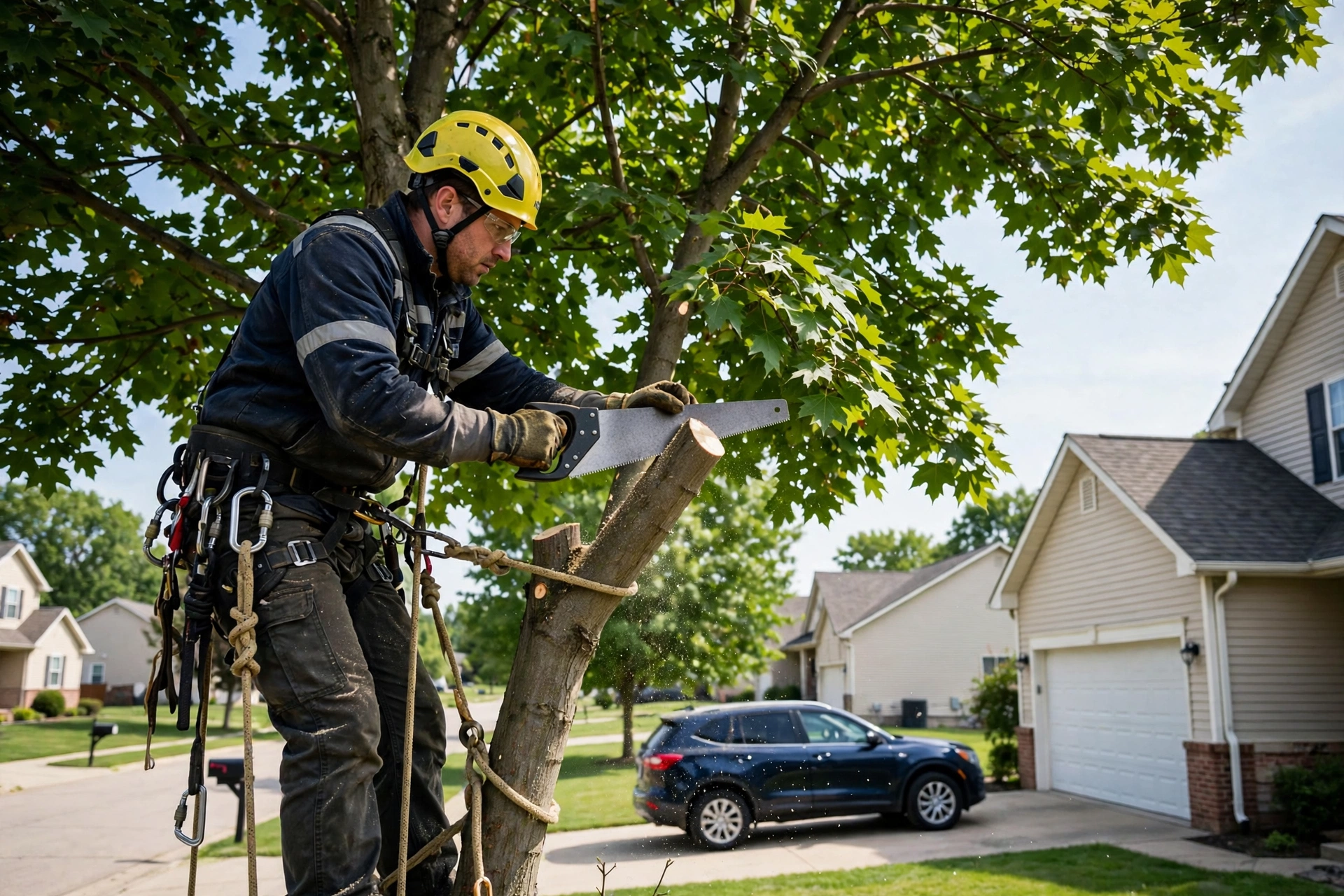
Never take more than about a quarter of a tree’s live branches in one growing season — that’s the 25% rule most ISA Certified Arborists follow. Cut more and you starve the tree, because fewer leaves means less food to heal wounds and fight disease.
That’s the short version. The real answer depends on the tree — its age, health, and species.
Quick Facts: How Much Can You Prune a Tree at Once? (Peoria, IL)
- The 25% rule: never remove more than ~25% of live crown in one growing season
- Leaves are the food factory: heavy pruning starves the tree of energy it needs to heal
- Dead wood doesn’t count: dead, damaged, and diseased branches can always come off
- Young trees bounce back faster than mature ones, which need a lighter touch
- Recovery time: 1–3 growing seasons to rebuild a properly thinned crown
- Typical pro pruning cost in Peoria: $300–$500 for routine work on a medium tree
- Topping is never acceptable: cutting everything back to stubs isn’t pruning — it’s damage
- Best pruning window in Peoria (zone 6a): late winter to early spring, while trees are dormant
Last spring we got called to a red oak in the 61604, near Bradley Park, where someone had taken half the crown off in one afternoon. The tree didn’t die that week. It just never came back.
Here’s what nobody tells homeowners: pruning is wounding, and every cut is paid for with stored energy. Take too much and the tree starts the season running on empty.
Why Peoria Homeowners Ask This More Than Most
Peoria is rough on trees. The June 2024 derecho tore through the county with 70+ mph winds, and our ice storms load mature limbs with hundreds of pounds of ice. After every big weather event we see the same thing: a homeowner looks at a battered silver maple and “cleans it up” by taking half the crown. Good intention, bad result — a storm-stressed tree is the worst candidate for heavy pruning, because it’s already spent its reserves surviving the storm.
Then there’s what we plant. Half the residential trees around here are silver maples, Bradford pears, or Siberian elms — fast growers put in cheap across subdivisions toward Dunlap and along the War Memorial Dr corridor. They grow fast, break often, and practically beg to be cut back hard. But fast-growing wood is weak wood: these species answer heavy cutting with a broom of weak shoots that break even easier in the next storm. In the older neighborhoods — Glen Oak, Moss-Bradley, the Grandview Drive corridor — the issue is the opposite: gorgeous 60-year-old oaks that don’t regrow a crown in a summer. What comes off is gone for years.
The 25% Rule: How Much You Can Prune a Tree at Once
Ask ten arborists how much can you prune a tree at once and nine will give you the same number: about a quarter of the live crown per growing season. It’s the ANSI A300 pruning standard, built on decades of watching what trees survive. Stay under it and a healthy tree handles the work fine. Blow past it and you’re gambling.
The part most people miss: the 25% applies to live wood. Dead, storm-snapped, or diseased sections don’t count — they weren’t feeding the tree anyway.
Your Tree’s Canopy Budget
Think of the live crown as a budget. You only get one per season.
Dead, damaged, and diseased wood doesn’t count — it was never paying in.
Why per growing season? The tree needs a full season of photosynthesis to pay back what you took. Prune 20% in March and another 20% in September and you’ve taken 40% — the tree doesn’t care that you split it into two visits. Big jobs get spread across dormant seasons — the rule never bends toward “take half, it’ll be fine.” Unsure what your tree can afford to lose? That’s what a professional trimming and pruning assessment is for.
Why Cutting Too Much Starves the Tree
Leaves are the tree’s kitchen. All summer they catch sunlight and turn it into sugar — the tree’s food. Some powers today’s growth; the rest gets packed into roots and trunk as starch, like money in a savings account. That account is what the tree lives on all winter and spends each spring to push new leaves.
Cut off half the leaves and the kitchen’s half its size — but the bills didn’t change. The tree still has to seal every wound, grow roots, and get through winter, so it raids savings. If the account was full, it survives, barely. If it was already low — drought, storm damage, Peoria’s clay — the tree goes into winter broke. And here’s the kicker: trees don’t heal wounds, they seal them. Walling off decay costs energy, so every oversized cut is a double hit — less income, more spending. A starved tree doesn’t just look thin; borers hit stressed trees first and decay spreads faster through undefended wood. Over-pruning rarely kills outright — it just makes the tree lose every fight it’s already in. The ISA’s TreesAreGood.org has a good plain-language rundown of the science.
Thinning vs. Reduction vs. Topping: Three Very Different Cuts
Thinning removes whole branches back to their origin to open the crown. Light gets in, air moves through, the tree keeps its natural shape. Done right you can barely tell it was pruned.
Reduction shortens limbs back to a lateral branch at least a third the diameter of the cut stem. It’s the right tool when a limb reaches toward the house or the service drop. It takes judgment: cut back to too small a lateral and the remaining branch can’t take over.
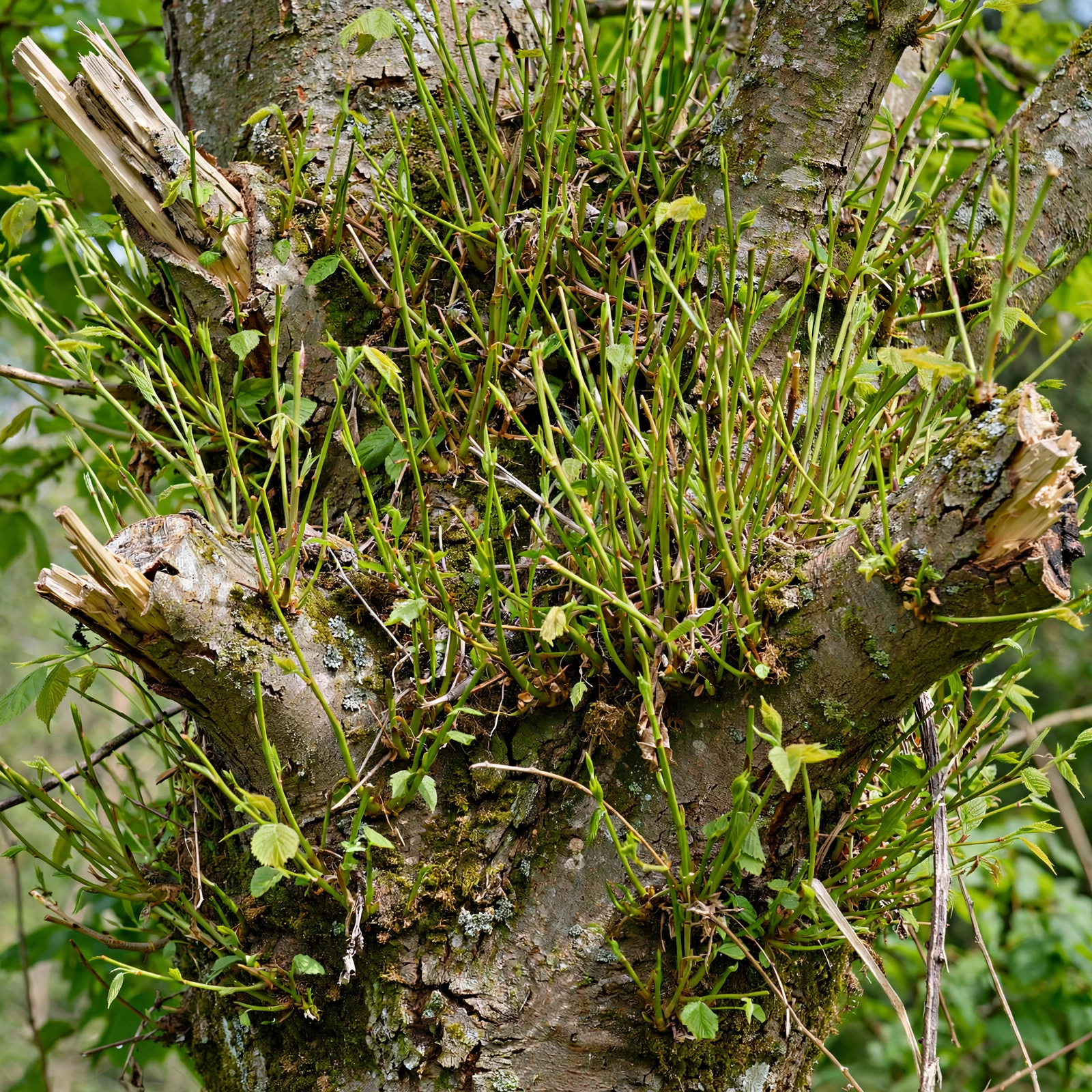
Topping — cutting everything back to stubs — is never acceptable. It removes the whole food factory at once, leaves wounds the tree can’t seal, and triggers panic regrowth: watersprouts that shoot up three feet in a summer and snap in the next storm. A topped tree ends up uglier, weaker, and more dangerous than what you started with. Our tree topping guide shows what topping does to Peoria trees and what to do instead. When someone quotes you a pruning job, ask which one they’re selling — “thinning and selective reduction” is arboriculture; “we’ll just cut it all back” is a crew with a chainsaw and no plan.
How to Tell You’ve Gone Too Far
An over-pruned tree tells on itself within a season or two. Here’s what to look for:
- Watersprouts — a flush of weak, fast-growing vertical shoots erupting all over the trunk and limbs. The tree’s screaming for leaves, so it throws up emergency growth that attaches weakly and grows weakly.
- Sunscald — bark that spent twenty years in shade suddenly gets full afternoon sun and burns: cracked, peeling bark on the south and west sides of limbs that used to be interior wood. In Peoria summers, with heat radiating off 61615 driveways, sunscald can kill limbs outright the first August after a heavy cut.
- Dieback — branch tips dying from the ends inward, the tree abandoning its extremities to save the core.
We saw all three on a Bradford pear off Knoxville Ave last year, after a homeowner took nearly 60% of the crown “to let light in.” It’ll survive, probably — but it’ll never be the tree it was. If you’re seeing these symptoms and wondering what’s reversible, our dying and diseased tree signs guide walks through it.
Young Trees vs. Mature Trees: Age Changes the Math
The 25% rule is the ceiling, not the target — and where you land under it depends on age. Young trees are the best pruning investment you’ll ever make. A tree in its first decade seals small wounds fast and replaces lost foliage in a season, so corrective pruning now — removing a competing leader, taking out crossing branches — prevents a $2,000 job twenty years later. Mature trees want a lighter touch. A 50-year-old oak seals wounds slowly, so 10–15% is the sweet spot for mature trees, split across dormant seasons.
| Tree age & condition | Safe amount per season | Notes |
|---|---|---|
| Newly planted (1–3 years) | Light shaping only | Prune for structure, not size; let roots establish |
| Young tree (3–10 years) | Up to ~25% | Best window for corrective pruning; heals fast |
| Mature, healthy tree | 10–15% ideal; 25% max | Split big jobs across 2–3 dormant seasons |
| Mature, stressed tree | 10% max — or wait a year | Drought, storm damage, or disease means no spare energy |
| Any age, storm-damaged | Remove what’s broken, then stop | Dead and damaged wood doesn’t count toward the 25% |
The pattern: the younger and healthier the tree, the more it can afford. Show a customer this math and most choose the multi-year plan.
How the Pros Decide What Comes Off: The 3 D’s
We use the same triage on every job: the 3 D’s — dead, damaged, diseased. Those come off first, every time, no debate. Dead wood is just weight and hazard. Damaged means storm-cracked limbs or branches rubbing the house — a cracked limb is a future failure. Diseased wood is a reservoir that infects the rest of the tree, so cut it back into healthy wood and disinfect tools between cuts. And remember: none of it counts toward your 25%.
After the 3 D’s comes structure: crossing branches rubbing each other raw, co-dominant leaders with a tight V of included bark (a split waiting for the next ice storm), weak attachment angles, watersprouts from old bad pruning. Each gets judged on its own: does removing it make the tree safer, and can the crown afford it this season? Then we step back and look at the whole shape — fixating on one limb is the easiest pruning mistake there is. We stop when the budget’s gone; there’s always next dormant season.
Anyone can cut branches; knowing which ones the tree can afford to lose is the actual skill. The International Society of Arboriculture sets the standards our ISA Certified Arborists train to, and our tree pruning benefits guide covers what proper pruning buys you.
Related Articles
FAQs — How Much Can You Prune a Tree at Once in Peoria?
Does the 25% rule include dead branches?
No — the 25% applies to live wood only. Dead, damaged, and diseased branches weren’t feeding the tree, so removing them costs nothing.
Can I prune 25% in spring and another 25% in fall?
That’s 50% in one growing season, and the tree counts it that way too. The rule runs per season, not per visit. Spread major work across two or three dormant seasons instead.
My neighbor topped their tree and it looks fine. Is topping really that bad?
Give it three to five years. Topped trees explode with weakly attached watersprouts, the big wounds rot from the inside, and the regrowth ends up denser and more dangerous than the original crown.
What is the 1-2-3 rule for pruning trees?
It’s the three-cut method for larger limbs: 1) an undercut 12 to 18 inches out, 2) a top cut just beyond it to drop the weight, 3) the final cut just outside the branch collar. It stops bark from tearing down the trunk.
I think I over-pruned my tree last year. Will it die?
Probably not — one bad haircut rarely kills a healthy tree. Watch this season’s growth: vigorous shoots mean recovery, spreading dieback means trouble. Water deeply, don’t prune again this year, and call an ISA Certified Arborist if dieback spreads.
What part of a tree should never be cut?
The branch collar — the swollen ring where a limb meets the trunk — and the central leader. Cutting flush through the collar destroys the tree’s natural seal; removing the leader ruins its structure. Both wounds never truly close.
Get Your Free Estimate
Not sure how much your tree can afford to lose? Overgrown maple in the 61604, storm-beaten oak in Peoria Heights, Bradford pear anywhere in the Peoria area — Peoria, East Peoria, Bartonville, Washington, Morton, Pekin, Dunlap, Chillicothe — we’ll come look at it free and tell you straight: a light thinning, a multi-year plan, or nothing at all. Seventeen years, ISA Certified Arborists, licensed and insured, Mon–Sat 8am–6pm with 24/7 emergency service.
Call 309-250-8333 for a free estimate, or grab one online — we usually respond the same day.
Peoria Tree Removal Co.
https://treeremovalpeoriail.com/
114 W Forrest Hill Ave, Peoria, IL 61604, USA
Tree Service Company