
Mushrooms at a tree’s base are the visible tip of a fungus already inside the roots — some kinds mean the tree is losing the wood that holds it up.
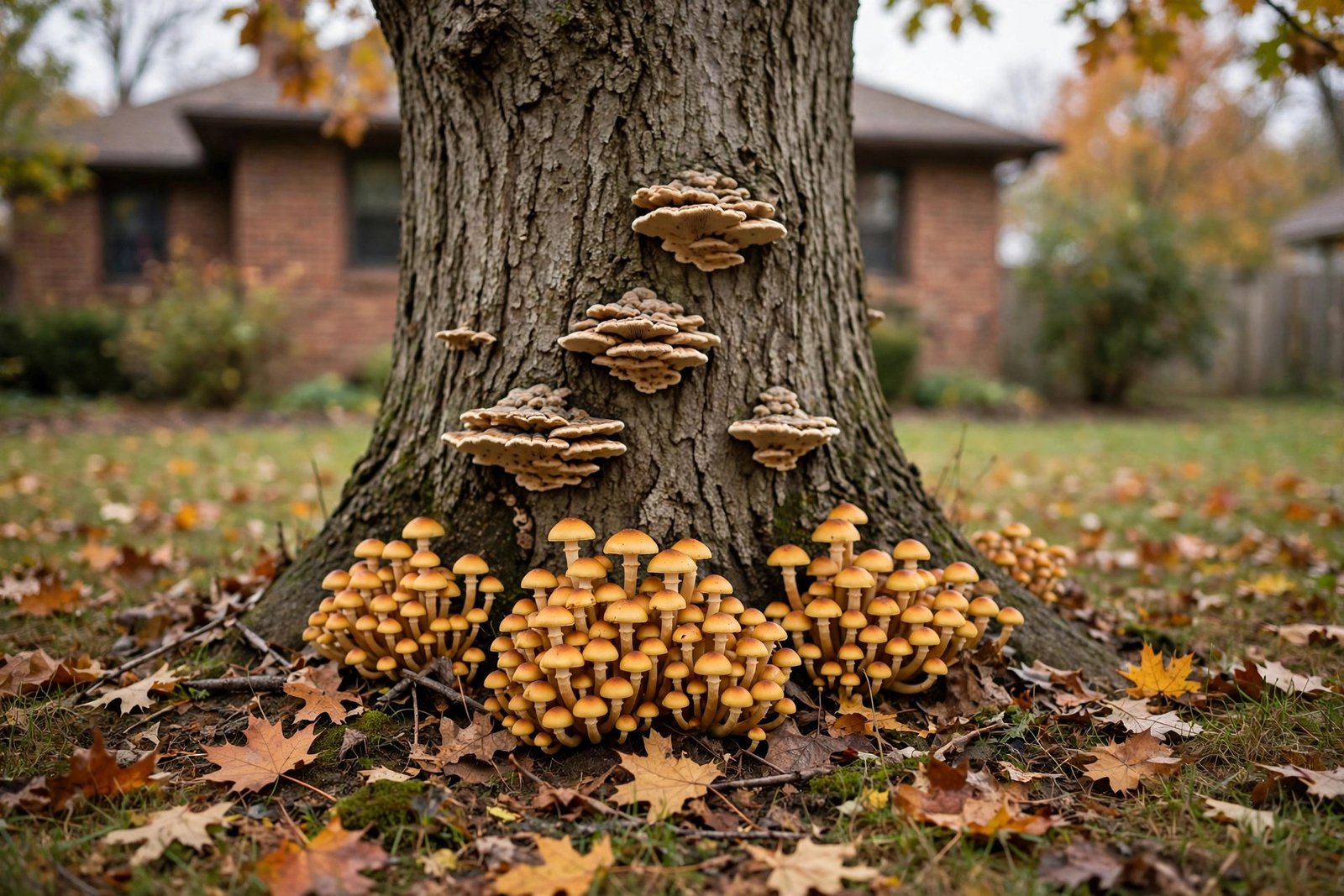
Mushrooms growing at the base of a living tree in Peoria usually mean root rot or butt rot: a decay fungus has been breaking down the wood inside the roots or lower trunk for months or years, and the mushroom is simply the first part you can see. The canopy can still look full and green while the base quietly weakens.
Quick Facts
- The mushroom is the announcement, not the disease: the fungus has lived inside the wood for months or years before it fruits.
- Location decides urgency: growth on the trunk base, root flare, or exposed roots is serious; mushrooms out in the lawn usually are not.
- Honey-colored clusters in fall are the classic warning: they point to Armillaria root rot, which has no cure once established.
- Hard shelf fungi (conks) mean long-standing decay: they take a mature fungal colony to form and can persist for years.
- Fungicide sprayed on bark will not help: it cannot reach the decay inside the heartwood.
- Never eat wild mushrooms from a tree base: identification from a photo is not safe, and some are toxic.
What the Mushrooms at the Base Actually Are
A mushroom is a fruiting body — the reproductive part of a fungus whose main body lives out of sight, as a network of threads through the wood. When that fungus is a wood-decay species, its job is to break down cellulose and lignin, the fibers that give a trunk its strength. By the time a cluster appears at the base, the decay underneath has usually been progressing for a while. That is why arborists treat base fungi as a structural question, not a cosmetic one. The key question is where it is feeding: on the trunk, root flare, or an exposed root, it is almost always feeding on the living tree; a few feet away in the lawn or mulch, it is usually feeding on buried wood or the mulch itself.
Fungi do not force their way through healthy, intact bark. They need an entry point: a pruning wound, bark scraped by a mower or string trimmer, a crack from storm stress, roots cut during a driveway project, or soil compaction that stressed the roots for years. In Peoria, the June 2024 derecho tore bark across the city, and the freeze-thaw cycle opens cracks every winter. A wound made five years ago can be the door a fungus walked through last year.
Which Growths Matter — and Which Do Not
Not every fungus at the base means the same thing. Read the shape, the color, and exactly where it is attached before you decide how urgent the situation is.
| What you see | Where it is | What it usually means | What to do |
|---|---|---|---|
| Soft honey-colored mushroom clusters | Base of trunk, root flare, or soil right at the base | Armillaria (honey fungus) root rot | Get an arborist assessment promptly, especially near a house |
| Hard, woody shelf brackets (conks), often stacked | Lower trunk or root flare | Long-established internal decay (butt rot or heart rot) | Get an assessment; the decay column is usually years old |
| Bright yellow-orange shelf clusters | Trunk or exposed roots | Often Laetiporus (chicken of the woods), a brown rot | Get an assessment; brown rot weakens wood fast |
| Soft mushrooms scattered in lawn or mulch | Away from the trunk, not touching roots | Saprophytic fungus feeding on buried wood or mulch | Rake them up; usually harmless |
| Mushrooms on a dead branch only | High in the canopy on dead wood | Decay confined to already-dead wood | Least worrying; prune the dead branch in season |
| White fan-shaped sheets under loose bark | Under bark at the base | Armillaria mycelial fans — active infection | Do not peel more bark; get an assessment |
The table’s first three rows are the ones that change decisions. Honey-colored clusters in late summer or fall are the signature of Armillaria, also called honey fungus or shoestring root rot. Under the bark it forms white, fan-shaped sheets of mycelium; in the soil it spreads as dark, shoestring-like rhizomorphs that travel from tree to tree through root contact. The University of Illinois Extension notes that Armillaria attacks about 700 species of woody plants, and that among shade trees, oaks and maples are the ones most commonly infected — the two trees that dominate Peoria yards. No fungicide controls it once it is in the roots.
Shelf fungi, or conks, tell a different part of the story: time. A conk is a hard, woody bracket that grows flat against the bark, often in stacked layers, adding a new layer each year. A conk takes a mature colony to form, so one on the lower trunk usually means a decay column has been inside the tree for years. Growth at the root flare typically points to butt rot, with decay in the trunk base and the big structural roots — the exact wood that keeps the tree standing in a windstorm. The bright yellow-orange shelves are usually Laetiporus, commonly called chicken of the woods, a brown rot that leaves wood crumbly and weak.
The harmless end of the scale is in the table too: mulch mushrooms mean a thinner mulch layer, not a removal, and a mushroom on a dead branch high in the canopy is decay doing its job on wood that is already dead — prune the branch, and the problem goes with it.
Why Peoria Trees Are Prone to It
Three local conditions stack the odds. First, age: Peoria’s older neighborhoods — the 61604 and 61614 ZIPs, the streets off Grandview Drive, the blocks around Bradley Park — are full of mature oaks and maples planted fifty or more years ago, and old trees carry old wounds. Second, water: the heavy clay soils of the river bluffs drain slowly, and mulch piled against the trunk — the “mulch volcano” seen all over town — keeps the bark wet and gives fungi a damp bridge into the tree. Third, stress: drought summers, the derecho, construction, and grade changes all weaken a tree’s defenses. Penn State Extension puts it plainly — the plants most susceptible to Armillaria are those under stress from prolonged drought, repeated insect defoliation, root injury, or recent transplanting.
How to Check the Tree Yourself (Safely)
You can learn a lot from the ground, without touching the tree. Start with the canopy: is it thinning, are the leaves smaller than usual, is there dieback at the branch tips, did the leaves turn color early this fall? Armillaria’s early symptoms are slowing growth, yellowing foliage, and dying twigs — gradual decline, not sudden collapse. Then look at the base: is the trunk leaning more than it used to, is the soil cracked or lifted on one side? Those are stability warnings, and they outrank the mushrooms. Never push on, prune, or stand under a leaning tree with cracked soil or lifted roots — it can drop with almost no warning, and getting close to inspect it is how people get hurt. Call from a distance.
Then check the flare. Brush the leaves away and look at where the trunk widens into the ground. Bark should be firm and intact. Soft, spongy, or missing bark at the base, a hollow sound when you tap the lower trunk, or a dark, wet patch that never dries are all worth noting for the assessment. Do not peel bark off to look underneath — you would be making a fresh wound for the next fungus. And check the trees nearby too: Armillaria spreads through the soil, so honey mushrooms at the base of two or three trees in the same part of the yard point to a colony in the ground, which matters for what you plant there next.
If what you find is only lawn mushrooms with a healthy-looking tree, note the date and check again in a few weeks. If anything on the serious list shows up — clusters at the flare, conks, a leaning trunk, lifted soil — do not wait for spring. Winter storms load a weakened base exactly when the ground is softest.
What Happens Next: Watch, Assess, or Remove
There are really three outcomes, and the assessment exists to tell them apart. Some trees get watched: a small conk high on a dead limb, lawn mushrooms with a sound trunk, a healthy tree with a single season of mulch fungi. Watching means a dated photo and a re-check after the next storm season — not forgetting about it.
Most base-fungus trees get assessed. A professional inspection looks at the whole tree — canopy, trunk, flare, roots, lean, and what sits underneath — and weighs how much sound wood is left against what the tree could hit if it failed. That is the judgment that matters: a rotting tree in an open back corner is a different decision from the same tree leaning over a bedroom. The inspection is also where you learn whether pruning or reducing the canopy load can buy the tree time, or whether the decay has gone too far. For the full picture of what an inspection covers, see the guide to professional tree inspection.
Removal is the third outcome, and it is the right one when the base is hollow, the root plate is lifting, or the decay has taken the structural wood on the side facing the house. That is a safety call, not a failure. The decision framework is covered in the guide to when a tree should be removed, and the signs that push a tree into the hazardous category are listed in the hazardous tree guide.
Do not try to treat the fungus yourself. Fungicide sprayed on the bark cannot reach decay inside the heartwood, and no fungicide controls Armillaria in the roots. Pulling the mushrooms off changes nothing — they grow back from the fungus inside. And do not eat wild mushrooms from a tree base: honey mushrooms have toxic look-alikes, and a photo identification is not a safe basis for eating anything.
Keeping the Next Tree Healthy
If the assessment ends in removal, the ground still holds the fungus. Armillaria can live for years in old stumps and dead roots, and it spreads through root contact — so planting the same species in the same hole is asking for a repeat. Stump grinding removes the biggest food source, and the University of Illinois Extension’s resistance table is the right place to check which species tolerate Armillaria better before you replant. Give the spot a season and plant a different species a few feet off the old hole.
For the trees that stay, prevention is mostly about not opening doors. Keep mulch two to four inches deep and pulled back from the trunk so the flare stays visible and dry. Keep mowers and string trimmers off the bark — a nicked trunk is an open door. Water deeply during drought rather than sprinkling the lawn, and avoid piling soil against the trunk during landscaping projects. A tree with an intact flare, dry bark, and unstressed roots is a hard target for decay fungi. The broader routine is covered in the tree disease treatment guide, and the early warning signs are in the guide to signs a tree is dying or diseased.
Frequently Asked Questions
Do mushrooms at the base of a tree mean it is dying?
Usually they mean the base or roots are decaying, which is different from dying and in some ways worse. A tree with root rot can carry a full green canopy for years, because the outer ring of wood that moves water is the last part to go. What it loses is the wood that holds it up, and the failure comes at the base in a storm.
Are mushrooms on a tree dangerous to touch?
Touching them is not the risk; eating them is. Never eat wild mushrooms growing on or around a tree — several have toxic look-alikes, and identification from a photo is not reliable. If children or pets are in the yard, pick the mushrooms off and throw them away, but remember that removing them does not remove the fungus inside the tree.
Can a tree with mushrooms at the base be saved?
Sometimes, if the decay is limited and the tree is otherwise vigorous — pruning dead wood and reducing canopy load can buy time. But root rot from Armillaria has no cure, and once the structural roots are heavily decayed the honest answer is usually removal. An assessment tells you which side of that line your tree is on.
How fast does root rot kill a tree?
Slowly, usually over years — Armillaria can colonize a root system over months to decades. The danger is not speed but silence: the canopy can look fine while the base weakens, so the first visible sign of trouble may be the failure itself.
Look at the Base, Not Just the Canopy
A tree tells you the truth at its base before it tells you anywhere else. Mushrooms on the trunk or root flare are the tree showing you its structural problem in the open, months or years before a storm tests it. Most of the time the news is manageable — a mulch fungus, a dead branch, a tree worth watching. Sometimes it is not, and the sooner you know, the more options you have.
Peoria Tree Removal Co. — 114 W Forrest Hill Ave, Peoria, IL 61604 — (309) 250-8333 — https://treeremovalpeoriail.com/
Peoria Tree Removal Co.
114 W Forrest Hill Ave, Peoria, IL 61604
Mon–Sat 8am–6pm · 24/7 emergency tree service