
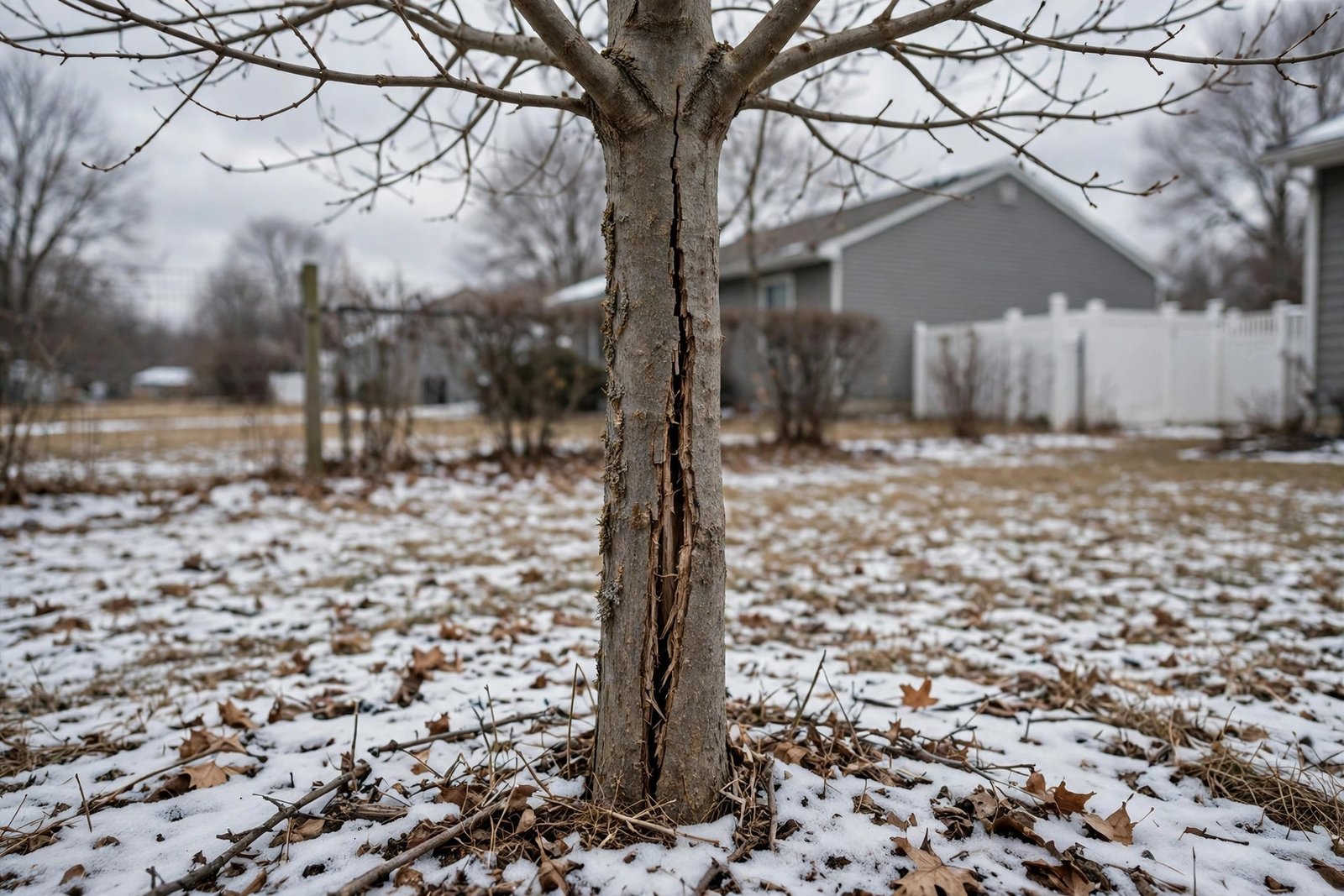
A long vertical crack on the sunny side of your tree is usually a frost crack or sunscald — winter temperature swings, not cold alone. Most trees recover; the fix is prevention, patience, and knowing when the damage is serious.
You walk past the maple in the front yard in February and notice something new: a long, straight crack running up the trunk, right where the afternoon sun hits it. Or in April, as the tree leafs out, you see a sunken, discolored patch of bark on the south side that was not there last fall. It looks serious, and it can be — but in central Illinois it is also one of the most common forms of winter tree damage, and it has a name, a cause, and a set of things you can do about it. This post explains what frost cracks and sunscald are, why they happen on the sunny side of the tree, which trees are most at risk, and what to do when you find one.
Quick Facts
- Frost cracks and sunscald are caused by temperature swings, not by cold alone: a sunny winter day followed by a freezing night does the damage.
- They appear mostly on the south and southwest sides: that is where the sun warms the bark the most.
- Young, thin-barked trees are most at risk: maples, crabapples, lindens, fruit trees, birch, and willow top the list.
- Most trees recover: healthy trees seal the wound with callus tissue, called wound wood, at roughly half an inch a year.
- Prevention works best on young trees: white tree guards, put on in mid-to-late fall and removed in spring, plus summer watering and good mulching.
- Do not paint or seal the crack: wound dressings do not help trees heal, and they can trap moisture against the wound.
What You Are Looking At: Frost Cracks vs Sunscald
Homeowners use one word — a crack — for two different injuries that often appear together. Telling them apart matters, because they mean different things about the tree.
A frost crack is a long, vertical split in the trunk, sometimes shallow, sometimes deep enough to reach into the wood. The Morton Arboretum describes them as cracks that often, but not always, occur on the south or southwest sides of the tree, because that side experiences the greatest temperature swings between day and night. On a bitterly cold day with full sun, the trunk warms and the wood expands. Then the sun sets, or a cloud moves in, and the temperature drops fast. The outer layer of wood contracts more quickly than the inner layer, and the trunk splits at a weak point — a long vertical crack, sometimes with a sharp pop you can hear on a still winter night. Frost cracks can also appear on any side of the trunk during extreme cold snaps, and they can open and close with the seasons, gaping in winter and nearly closing in summer.
Sunscald — also called southwest damage or a frost canker — is a different injury with the same cause. Instead of a clean split, sunscald appears as an elongated, sunken, discolored area on the trunk, usually on the south or southwest side. The Morton Arboretum notes that sun-side trunk temperatures in winter can run as much as 20 degrees Fahrenheit above the air temperature, enough to wake the bark tissue out of dormancy. When night falls and the tissue refreezes, the cells rupture and die. Over weeks the bark darkens, turns reddish-brown, and becomes rough; eventually the dead bark cracks and falls away, leaving a sunken patch. Affected trees often show sparse foliage, stem dieback, and stunted growth above the injury, because the damaged bark can no longer move water and nutrients past that point.
The University of Minnesota Extension makes the distinction this way: a frost canker is the sunken dead area on the south or southwest side, while a true frost crack is the deeper split that can appear on any side during extreme temperature swings. In practice, a Peoria homeowner may find both on the same tree — a crack that opened in January, and a sunken patch around it by April. Either way, the cause is the same, and so is the response.
Why It Happens on the South and Southwest Sides
The key fact about winter tree injury, and the one that surprises most homeowners, is that it is not caused by an unusually cold winter. The Morton Arboretum puts it plainly: low-temperature injury is more often associated with extreme temperature fluctuation than with prolonged cold. A tree that spends January at a steady twenty degrees is usually fine. A tree that spends a sunny afternoon at forty-five degrees on its south side and then drops below freezing at sunset is the one that cracks.
Here is what happens on that sunny side. Winter sun is low in the sky, so it strikes the trunk almost horizontally, and snow on the ground reflects extra light and heat back onto the bark. On the south and southwest faces, bark temperatures can climb well above the air temperature — an Illinois arborist writing about the Chicago suburbs reports bark reaching 45 degrees or more on a day when the air stays below freezing. The living tissue just under the bark, the cambium, warms up and begins to come out of dormancy. Then the sun sets, or a cloud bank rolls in, and the temperature falls thirty degrees or more in a few hours. The warmed tissue refreezes fast. Cells rupture. The bark splits, or the tissue dies and becomes a sunken canker over the following weeks.
That is also why the damage often shows up late — in February and March, when the days are getting longer and the sun is getting stronger, but the nights are still bitterly cold. Trees in exposed locations — a young maple standing alone in a front yard on Sheridan Road, a newly planted linden with no afternoon shade — take the worst of it, because nothing breaks the sun or the wind for them.
Which Trees in Central Illinois Are Most at Risk
Not every tree is equally vulnerable, and knowing the risk list helps you decide where to spend your prevention effort.
Young trees, first. Young trees with thin, smooth bark have not yet developed the thick, insulating outer bark that protects a mature tree. The Morton Arboretum lists the most susceptible species as London plane, maple species, crabapples, fruit trees, lindens, poplars, birches, and willows. Purdue Extension’s list matches closely: maples, birches, crabapples, London plane, cherries and other stone fruit, and elms. If you planted a maple or a crabapple in the last two or three years, it is the tree to check first — and the tree to protect first.
Newly planted and transplanted trees. A tree that has just been moved has lost a large part of its root system, and the University of Minnesota Extension notes that transplant stress — and, more importantly, water stress from root loss — may be the leading predisposing factor for frost cankers, regardless of species. A tree that went into winter short of water is a tree whose bark is already stressed when the temperature swings start. This is one more reason the fall watering routine matters.
Stressed trees of any age. Drought in the previous summer, compacted soil, a grade change, or an old injury all make a tree more vulnerable. Purdue Extension notes that trees stressed by hotter, drier summers are more likely to be damaged in the following winter. A mature tree with a healthy root system and a full canopy will usually ride out the swings. A mature tree that has been struggling for two years may not.
Trees on the sunny, exposed side. A tree on the south or southwest side of a lot, with no building or larger tree to shade its trunk in the afternoon, takes the full cycle every sunny winter day. The same species planted on the north side of the house, or shaded by a fence or a larger tree, may never show a crack at all. When you plant, that afternoon shade is worth thinking about — it is free protection for the life of the tree.
Will a Frost Crack Kill My Tree?
Usually, no — but the honest answer is that it depends on how bad the damage is and how healthy the tree is otherwise. Most frost cracks and sunscald patches are injuries the tree can live with, and many close up on their own over a few years. Purdue Extension’s advice is reassuring and practical: if cracking has already occurred, do not panic. Depending on the extent of the damage, the tree may be able to seal off the injury with callus tissue, called wound wood. Healthier trees do this more quickly.
The pace of that healing is slow, and it helps to know the number. University of Illinois Extension reports that callus tissue grows at about half an inch a year, so a crack that is an inch wide will take roughly two years to close, and a wider injury will take longer. That is normal. The tree is not failing because the crack is still visible next spring; it is healing at the only speed it can.
There are cases where the damage is serious enough to change the decision. Call a professional for an assessment if the crack is deep and runs a long way up the trunk, if the bark is peeling away in large sheets, if the tree above the injury is thinning, dying back, or failing to leaf out in spring, or if the same trunk cracks again in the same place year after year. A crack that keeps reopening is a structural weak point, and on a large tree over a house or driveway, that weak point is a risk worth having assessed. Our guide to the signs a tree is dying or diseased covers the warning signs that mean a tree needs a professional look, and if you are unsure whether a tree is dead or just dormant in late winter, our guide to telling a dead tree from a dormant one will help you read the signs before you decide anything.
How to Prevent Frost Cracks and Sunscald
Prevention is mostly about the first few winters of a young tree’s life, and about keeping the tree healthy enough to handle the swings. Here is what the extension services recommend, and what works in Peoria’s climate.
White tree guards on young trees. The most direct protection is a white guard around the trunk of a young tree — Purdue Extension recommends installing them in mid-to-late fall on trees less than four inches in diameter, and notes that white corrugated drainpipe from a home and garden store works well. The white surface reflects the sun instead of absorbing it, so the bark stays closer to the air temperature. Put the guard on after the leaves fall and take it off in spring, as the weather warms: left on through summer, a guard traps moisture against the trunk and can cause rot. University of Illinois Extension makes the same point about timing — wrap the trunk the first winter, and by the second winter the tree will have reoriented itself and built up thicker bark on its sunny side, so the guard becomes less necessary. One honest caveat, from the University of Minnesota: research has not yet conclusively proven that trunk wraps prevent damage. They are the best tool available, they are cheap, and they are worth using on young thin-barked trees — but they are not a guarantee.
Water through the dry spells, including in fall. A tree that goes into winter with moisture in its root zone handles temperature swings better than a dry one. Keep watering — deeply, at the dripline — during dry periods until the ground freezes, and water evergreens especially, since they keep losing moisture through their needles all winter. Our guide to fall and winter tree watering covers the routine in detail.
Mulch, properly. Two to four inches of mulch, pulled back from the trunk, conserves soil moisture and insulates the roots from cold. The “pulled back” part matters: mulch piled against the trunk — the mulch volcano — holds moisture against the bark and invites decay and rodents.
Do not fertilize or prune late in the summer. The Morton Arboretum warns against late-summer fertilization or pruning, which can stimulate new growth that does not have time to harden off before winter. Tender, unhardened growth is the first tissue to be damaged when the temperature swings start. Prune in the dormant season instead, and feed only when a soil test shows a real need.
Plant with the sun in mind. When you put in a new tree, think about where the afternoon sun will hit its trunk in January. A spot with afternoon shade — from the house, a fence, or a larger tree — is free protection for the life of the tree. Our guide to the best time to plant a tree in Illinois covers planting timing and placement.
| Damage | What it looks like | When it appears | What to do |
|---|---|---|---|
| Frost crack | Long vertical split, sometimes deep into the wood; may open in winter and close in summer | Mid-to-late winter, after sunny days and freezing nights | Monitor; trim dead bark to living tissue; call an arborist if deep or recurring |
| Sunscald / frost canker | Sunken, darkened, reddish-brown patch, usually south or southwest side; bark later cracks and falls away | Late winter into spring, as damage from winter becomes visible | Same as above; protect with a white guard next fall |
| Normal bark shedding | Thin plates peeling on mature trees (oaks, sycamore); no sunken tissue underneath | Any season | Nothing — this is normal for many species |
What to Do If You Find a Crack
First, do not paint it, seal it, or fill it. Wound dressings and sealants do not help a tree heal — the tree seals the wound itself, from the edges inward, with callus tissue — and a sealant can trap moisture and decay organisms against the very tissue that needs to stay dry. This is the same reason we do not recommend sealing pruning wounds: the tree’s own compartmentalization does the work, and the best thing a homeowner can do is stay out of its way.
Second, look at the loose bark. University of Illinois Extension advises that splitting bark is dead bark, and it should be cut away to living tissue to help the healing process. Use a sharp knife or pruning tool, cut cleanly back to where the bark is firmly attached and green underneath, and leave a smooth edge that the callus can grow over. Do not cut into living tissue beyond the dead area, and do not peel bark away from the trunk in strips.
Third, protect the wound next winter. You can wrap the damaged area late in the fall each year, until the wound calluses over or thicker bark develops — the same white guard, put on after leaf fall and taken off in spring. Keep watering the tree in dry spells, keep the mulch ring in place, and watch the crown in spring: full, even leaf-out above the crack is the sign the tree is recovering. Sparse foliage or dieback above the injury is the sign to get a professional assessment.
Finally, keep the tree’s overall health up. A tree that is watered, mulched, and pruned at the right time will heal a frost crack faster than a tree that is fighting drought and compacted soil at the same time. If the tree is one you want to keep for decades — the maple that shades the front of the house, the crabapple by the driveway — a plant health care plan is the scheduled version of that care, with inspections that catch the next problem before it becomes a crack. And if the tree is large, leaning, or over the house, do not wait for spring to decide: get a professional look now, while the damage is fresh and the options are still open.
Frequently Asked Questions
Will a frost crack heal on its own?
In most cases, yes. A healthy tree seals the crack with callus tissue at roughly half an inch a year. A narrow crack may close in a season or two; a wide one takes longer. What matters is whether the crown above the crack stays full and healthy.
Should I wrap my tree trunk every winter?
Wrap young, thin-barked trees — maples, crabapples, lindens, fruit trees, birch — for their first few winters, from mid-to-late fall until spring. Mature trees with thick bark usually do not need it. Remove the guard in spring so it does not trap moisture and cause rot.
Is sunscald the same as a frost crack?
They are related but not identical. Sunscald is the sunken, discolored patch where bark tissue died from warming and refreezing; a frost crack is the deeper vertical split caused by the same temperature swings. A tree can have one, the other, or both.
When should I call an arborist about a crack?
When the crack is deep or runs a long way up the trunk, when bark is peeling off in sheets, when the crown above it is thinning or dying back, or when the same trunk cracks in the same place year after year. If the tree is over a house, driveway, or sidewalk, do not wait — get it assessed.
Look at the Sunny Side This Winter
Frost cracks and sunscald are the price of a climate that gives trees sunny winter days and freezing winter nights in the same week. They are common, they are usually survivable, and they are largely preventable on the young trees that need protection most. Walk your yard on the next mild day and look at the south and southwest sides of your young maples, crabapples, and lindens. If you find a crack, you now know what it is, what it means, and what to do. If you find nothing, put the guards on anyway — November is the month to do it, before the swings start.
If a crack has you worried about a tree you care about, call Peoria Tree Removal Co. at (309) 250-8333 for a free estimate, and ask for a tree health assessment. We will look at the tree, tell you plainly whether it is healing or in trouble, and what — if anything — needs to happen next.
Peoria Tree Removal Co. — 114 W Forrest Hill Ave, Peoria, IL 61604 — (309) 250-8333 — https://treeremovalpeoriail.com/
Peoria Tree Removal Co.
114 W Forrest Hill Ave, Peoria, IL 61604
Mon–Sat 8am–6pm · 24/7 emergency tree service