
Cedar-apple rust needs two trees to survive — your cedar and your crabapple — and November is the month to catch it, because the galls are full size now.
If your crabapple’s leaves turned yellow-orange and spotty this year, and the cedar nearby is wearing round brown balls on its twigs, you are looking at one disease, not two — a fungus that spends half its life on junipers and half on apples and crabapples. The brown balls on your cedar are the part you can do something about this fall.
Quick Facts
- The disease: Cedar-apple rust, caused by the fungus Gymnosporangium juniperi-virginianae.
- The two hosts: Eastern red cedar and other junipers on one side; crabapples and apples (Malus) on the other. It needs both to complete its life.
- The cycle: 24 months, host to host and back again.
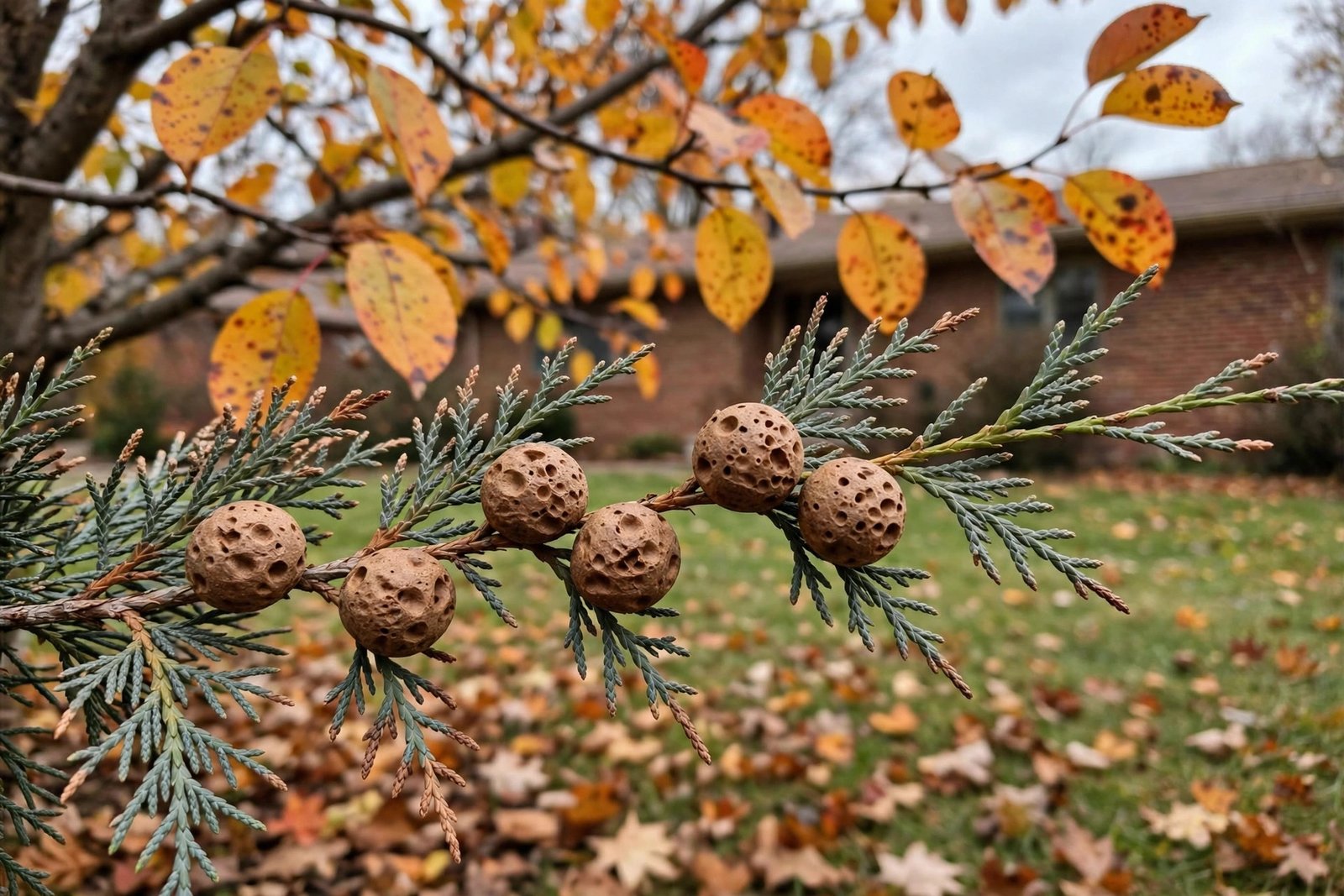
- The November clue: Galls on the juniper reach full size by fall — greenish-brown to tan, round to kidney-shaped, 3/8 to 1 and 3/16 inches across, with golf-ball-like dimples.
- The spring show: Those galls sprout bright orange, jelly-like horns in spring rain, releasing the spores that spot your crabapple’s leaves.
- The fix: Remove the galls before the horns form, plant resistant crabapple varieties, and ask your local Extension office about fungicide timing.
- The stakes: Mostly cosmetic on crabapples, and it rarely kills either tree — but a heavily galled juniper can lose twig tips, and a susceptible crabapple can look rough every year.
What Cedar-Apple Rust Actually Is
Cedar-apple rust is a fungal disease that cannot finish its life on one tree. The fungus Gymnosporangium juniperi-virginianae must move between two hosts: a juniper (usually eastern red cedar, Juniperus virginiana, in central Illinois) and a crabapple or apple. Take away either host and the cycle breaks; leave both in place, a few hundred feet apart, and the disease runs year after year.
That two-host habit is why the disease is so common in Peoria yards. Eastern red cedar is native here — windbreaks, fence screens, foundation evergreens off War Memorial Drive and Knoxville Avenue, volunteers along the Rock Island Trail and the river bluffs — and flowering crabapples fill front yards from the North Valley to Dunlap, Peoria Heights, Morton, and Washington. Put the two in the same yard, or in neighboring yards, and the fungus has everything it needs.
It helps to know what the disease is not. It is not a sign of bad soil, it is not contagious to people or pets, and it will not jump to your maple, oak, or spruce — the fungus only uses junipers and apples. A crabapple can live with it for decades. What it does, year after year, is make the crabapple look spotty and tired by midsummer, and litter the juniper with galls that slowly kill twig tips. For most Peoria homeowners, the decision is about appearance, not about saving a tree from death — useful to know before you spend money or cut anything down.
The Galls on Your Cedar: What You’re Looking At This November
Walk out to your cedar this month and look at the small twigs. The galls are hard to miss once you know them: round to kidney-shaped growths, 3/8 to 1 and 3/16 inches across — roughly marble size — greenish-brown to tan in the fall, with golf-ball-like depressions across the surface. They sit on the needles and small twigs, sometimes one or two, sometimes a whole cluster along a branch.
Those dimples are the giveaway, and they are also the point: each one is where a telial horn will push out next spring. The horns are brownish when dry, but with spring rain they rapidly elongate and turn bright orange and jelly-like. They can shrink and swell several times as rain comes and goes, and every time they swell they release basidiospores — the spores that infect your crabapple.
After the horns have done their work, they collapse, dry up, and fall off, and the gall dies — which may kill the twig from the gall out to the tip. A cedar with a few galls will barely notice. A cedar loaded with them can end up with many dead twig tips and a thin, ragged look, especially on the side facing the crabapple.
November matters because the galls are finished growing by fall. In spring they are small and green and easy to overlook; by November they are full size, tan, and obvious against the blue-green foliage. This is the window to find them all and take them off before the horns ever form. If you wait until you see the orange horns in April, the spores are already on their way.
One more check: make sure the brown things are galls, not bagworm bags, which hang from silk threads and look like little pine-cone pouches — our bagworm guide shows the difference. If it sways on a thread, it is a bagworm, not a rust gall, and it needs a different fix.
The Spots on Your Crabapple: The Other Half of the Story
If you only ever looked at your crabapple, you would never guess a cedar was involved. The first sign shows up in spring, a few weeks after infection: tiny yellow spots on the leaves. As they mature, the spots turn yellow-orange, swell slightly, and develop a red border with tiny black dots in the center — the spermagonia, the fungus’s first fruiting stage on the apple side of its life.
By mid-summer, the undersides of the spots grow small cup-like structures with tubes, called aecia. Most people only notice this stage after the aecia have split open and look ragged and frayed. On very susceptible varieties, the fungus can also infect the fruit and even the soft, succulent twigs.
The damage to the crabapple is usually cosmetic. The Morton Arboretum calls cedar-apple rust a less serious leaf-spotting disease: a badly spotted tree looks rough by August, and in a wet year a susceptible variety can drop many leaves early — but it leafs out again the next spring, and the disease very rarely threatens the life of an established crabapple. Ugly, recurring, worth managing — not an emergency.
Infection needs surprisingly little weather. According to the University of Illinois Extension, a wet spring period of just 4 to 6 hours at 50 to 75 degrees Fahrenheit is enough for severe infection — one damp April evening, not a week of rain. Spores can be carried several miles on the wind, but most infections happen within several hundred feet of the source juniper, so the cedar in your yard, or your neighbor’s, is usually the one doing it.
The Two-Year Cycle, Step by Step
The whole story takes 24 months and two hosts. Once you see the sequence, the November gall-removal advice makes obvious sense.
| Step | When | Where | What happens |
|---|---|---|---|
| 1. Horns sprout | Spring, rainy weather | On the juniper galls | Horns elongate, turn bright orange and jelly-like; each swelling releases basidiospores |
| 2. Crabapple infected | Spring, within days of the horns | Crabapple and apple leaves | Basidiospores land on leaves; 4–6 wet hours at 50–75°F is enough for severe infection |
| 3. Spots mature | Late spring to mid-summer | Crabapple leaves, sometimes fruit and twigs | Spots turn orange and swollen with a red border and black dots; cup-like aecia form underneath |
| 4. Spores return | Midsummer into early fall | From crabapple aecia to juniper | Aeciospores go airborne and infect juniper twigs |
| 5. Galls grow | The following spring through summer | On the juniper | New galls develop and grow |
| 6. Galls mature | Fall | On the juniper | Galls reach full size, tan with golf-ball dimples — the stage you see in November |
| 7. Horns again | The next spring | On the mature galls | The cycle repeats |
The timing is the point. The galls you can see right now are the ones that will sprout horns next spring, so removing them now breaks the cycle before a single spring spore is released. Spraying the crabapple has to be timed to the short, weather-dependent spring infection window. Both approaches work; gall removal is the one a homeowner can do with hand pruners on a dry November afternoon.
How to Tell Cedar-Apple Rust From the Look-Alikes
Spotted leaves and odd growths on evergreens have several causes in Peoria, and the fix is different for each.
| Problem | What you see | When it shows | Key difference from cedar-apple rust |
|---|---|---|---|
| Cedar-apple rust | Round tan galls with dimples on juniper; yellow-orange leaf spots with a red border on crabapple | Galls full size in fall; spots in spring and summer | Needs both hosts; orange jelly horns in spring rain |
| Apple scab | Olive-green to black velvety spots on crabapple leaves; leaves yellow and drop early | Spring, in cool wet weather | Spots dark and velvety, no red border or black dots; no galls on any juniper |
| Fire blight | Shoots wilt and blacken as if scorched, often curving into a shepherd’s crook; branch tips die back | Late spring to summer, after bloom | Bacterial disease of the shoots — no leaf spots with red borders, no galls, and it can kill branches fast |
| Bagworms | Small pine-cone-shaped silk bags hanging from twigs on evergreens | Bags visible all year; caterpillars feed in summer | Bags hang by silk threads and sway; galls grow out of the twig |
| Rhizosphaera needle cast | Lower spruce branches thinning from the bottom up, purplish-brown needles dropping | Most evident in fall and the following spring | A spruce disease; no galls, no leaf spots |
If you are still unsure, the University of Illinois Plant Clinic can identify a sample for certain — the right call before you remove a tree or start a spray program on a guess. A correct identification is cheaper than a wrong treatment, and it is the same advice our tree disease treatment guide gives for any tree problem you cannot name.
What to Do This November
November gives you the cheapest intervention in the whole two-year cycle: take the galls off the juniper.
Prune the galls out. Clip each gall off with hand pruners, cutting just below it on the twig, and bag the galls for the trash rather than composting them or tossing them under the crabapple. Do this before the telial horns form in spring; once the orange horns appear, the spores are already moving. A light gall load is a fifteen-minute job; a heavy one may mean pruning out whole twig tips. If the cedar is large, loaded with galls, or close to power lines, that is a job for a crew, not a ladder — and our dormant-season pruning guide explains why late fall and winter are the right season for this kind of work.
Count before you commit. Walk both trees and be honest about the numbers. A crabapple with a few spotted leaves and a cedar with a handful of galls is a pruning job. A crabapple that defoliates every August and a cedar whose every twig carries galls is a bigger decision — see the removal section below.
Check the distance. Most infections happen within several hundred feet of the source juniper, so the cedar in your own yard is the usual suspect — but so is the neighbor’s cedar screen, or the volunteer eastern red cedar along the back fence. If your crabapple is spotted every year and your own juniper is clean, look over the fence. You cannot prune a neighbor’s tree, but knowing the source changes the plan: fungicide on your crabapple in spring, or a resistant replacement rather than the same fight every year.
Plan the spring spray, if you spray at all. Fungicides for cedar-apple rust are preventive — they protect new leaves during the short spring infection window, and they do nothing for spots already there. The right product and schedule depend on your tree and your yard, so the Extension guidance is to check with your local Extension office or garden center for recommended fungicides and follow the product label exactly. We name no specific product here: the label — not a blog post — is the authority on what is legal and safe to use on your tree.
Think about the next tree you plant. If the crabapple comes out, or you are adding a second one, disease resistance is the first thing to check — before flower color, size, or fall color. The Morton Arboretum’s crabapple guidance is blunt: disease resistance should be your first consideration, because the four common crabapple diseases can make a susceptible tree look ragged year after year.
Resistant Crabapples Worth Planting in Peoria
If you are replacing a crabapple or planting one near junipers, start from the Arboretum’s resistance ratings. “Resistant” means lower risk, not immunity — a resistant tree can still show a few spots in a bad year.
| Cultivar | Size | Rust resistance | Notes for Peoria yards |
|---|---|---|---|
| ‘Adirondack’ | 12–18 ft high, 6–10 ft wide | Excellent | Narrow, upright; white flowers, orange-red fruit; good in tight spaces |
| ‘Beverly’ | About 20 ft high and wide | Excellent | Red-white flowers, red fruit; also excellent against mildew |
| ‘Cardinal’ | About 20 ft high and wide | Excellent | Good fire blight resistance too; strong all-around pick |
| ‘Centurion’ | About 20 ft high, 15 ft wide | Excellent | Narrow, upright; cherry-red fruit; excellent fire blight resistance |
| ‘Sargent’ (Sargent crab) | About 8–10 ft high, 12–15 ft wide | Excellent | Low, spreading; good small-yard or under-wire choice |
| ‘Adams’ | About 20 ft high and wide | Fair | Rose flowers, persistent dark-red fruit, but only fair rust resistance — a poor pick next to junipers |
Ask a local nursery for the disease ratings that apply in central Illinois before you buy, and check the full botanical name on the tag. Ratings can shift with region and weather. The full Arboretum list is on the Morton Arboretum crabapple cultivars page.
Spacing matters as much as variety: a crabapple in full sun with open air dries faster after rain than one crowded against a fence, and dry leaves are harder to infect. Our planting-distance guide covers the spacing rules that keep young trees healthy, and the same logic applies here: if you can put several hundred feet between a crabapple and a juniper screen, do it, and if you cannot, choose the resistant variety.
When Removal Is the Right Call
Most of the time, cedar-apple rust is not a removal problem — it is a pruning problem, a variety problem, or a live-with-it problem. But three situations put removal on the table.
The juniper is the problem, and it is not worth keeping. A volunteer eastern red cedar that seeded itself along the fence, is loaded with galls, and drops dead twig tips every year is doing your crabapple no favors and giving you nothing back. Removing it breaks the cycle for every crabapple within several hundred feet. That is a different conversation from a specimen juniper you planted and love — in that case, prune the galls and keep the tree.
The crabapple is the problem, and it loses every year. Some older crabapple varieties are so susceptible that they defoliate by August in any wet year, no matter what you do. If the spring bloom is the only thing the tree has going for it and it spends the rest of the year looking sick, replacing it with a resistant cultivar beats a yearly spray schedule you will resent. Our pest-and-disease decision framework walks through the same treat-or-remove logic for any sick tree: how bad is it, how fast is it getting worse, and what does the tree give you when it is healthy?
The tree is structurally compromised anyway. Galls kill twig tips, and a juniper galled for years can end up thin and lopsided. If that juniper is also leaning, split, or hanging over a roof or driveway, the rust is not the reason to remove it — the structure is — but it is a reason not to spend money saving it. Tree removal cost varies with the size of the tree, its condition, and how hard it is to reach, so any removal decision should start with a free estimate, not a guess. A large tree close to the house or over a roof is a job for a professional crew — see our tree removal service in Peoria for how that work is done safely.
What removal will not do is sterilize the neighborhood. Spores can travel several miles, and a volunteer cedar two streets over can still spot your crabapple in a wet spring. Removing your own juniper cuts the heaviest local source, but it is not a guarantee of a spot-free tree — and saying so plainly beats selling a promise the wind will not keep.
It will not kill your crabapple, either. A healthy, established crabapple can live with cedar-apple rust for decades, leafing out fresh every spring. It will not spread to your maple, oak, or spruce, and it will not make your fruit unsafe to eat. Ignored completely, it gets worse on the juniper side: galls accumulate, twig tips die back, and a cedar that started out full ends up thin and scruffy. That slow decline is the best argument for the November gall check — fifteen minutes with hand pruners is the cheapest tree care you will do all year.
Frequently Asked Questions
Can I just cut down the cedar and be done with cedar-apple rust?
Cutting down your own juniper removes the heaviest local spore source, and your crabapple will usually look much better the following spring. But spores can travel several miles, so a neighbor’s cedar or a volunteer juniper nearby can still cause some spotting in a wet year. Removal helps a lot; it does not guarantee a spot-free tree.
Will spraying my crabapple fix the spots that are already there?
No. Fungicides are preventive: they protect new leaves during the short spring infection window, and spots already on the leaves will not clear up. If you spray, the timing has to be right — the Extension guidance points you to your local Extension office or garden center for the recommended schedule, and to the product label for how to use it.
Should I remove the galls or leave them alone?
Remove them before the horns form in spring. November is ideal because the galls are full size and easy to find: clip each one off just below it on the twig and dispose of the galls away from the trees. Leaving them means orange horns in the next spring rain, releasing spores onto your crabapple.
My crabapple is spotted every year but my juniper looks clean. How is that possible?
Spores can travel several miles, and most infections happen within several hundred feet — so the source may be a neighbor’s tree or a volunteer eastern red cedar along a fence line or the river bluffs. Check the trees around your yard, not just the ones in it.
Is cedar-apple rust the same thing as apple scab?
No, though both spot crabapple leaves and both like wet springs. Apple scab makes olive-green to black velvety spots, causes leaves to yellow and drop early, and has nothing to do with junipers. Cedar-apple rust makes yellow-orange spots with a red border and tiny black dots in the center, and it always involves a juniper somewhere nearby. The treatments and timing differ, so get the identification right before you spray or prune.
Peoria Tree Removal Co. serves Peoria, East Peoria, Peoria Heights, Morton, Washington, Bartonville, Pekin, and Dunlap. If a galled juniper or a struggling crabapple needs a professional look, call (309) 250-8333 for a free estimate.
Peoria Tree Removal Co.
114 W Forrest Hill Ave, Peoria, IL 61604
Mon–Sat 8am–6pm · 24/7 emergency tree service