
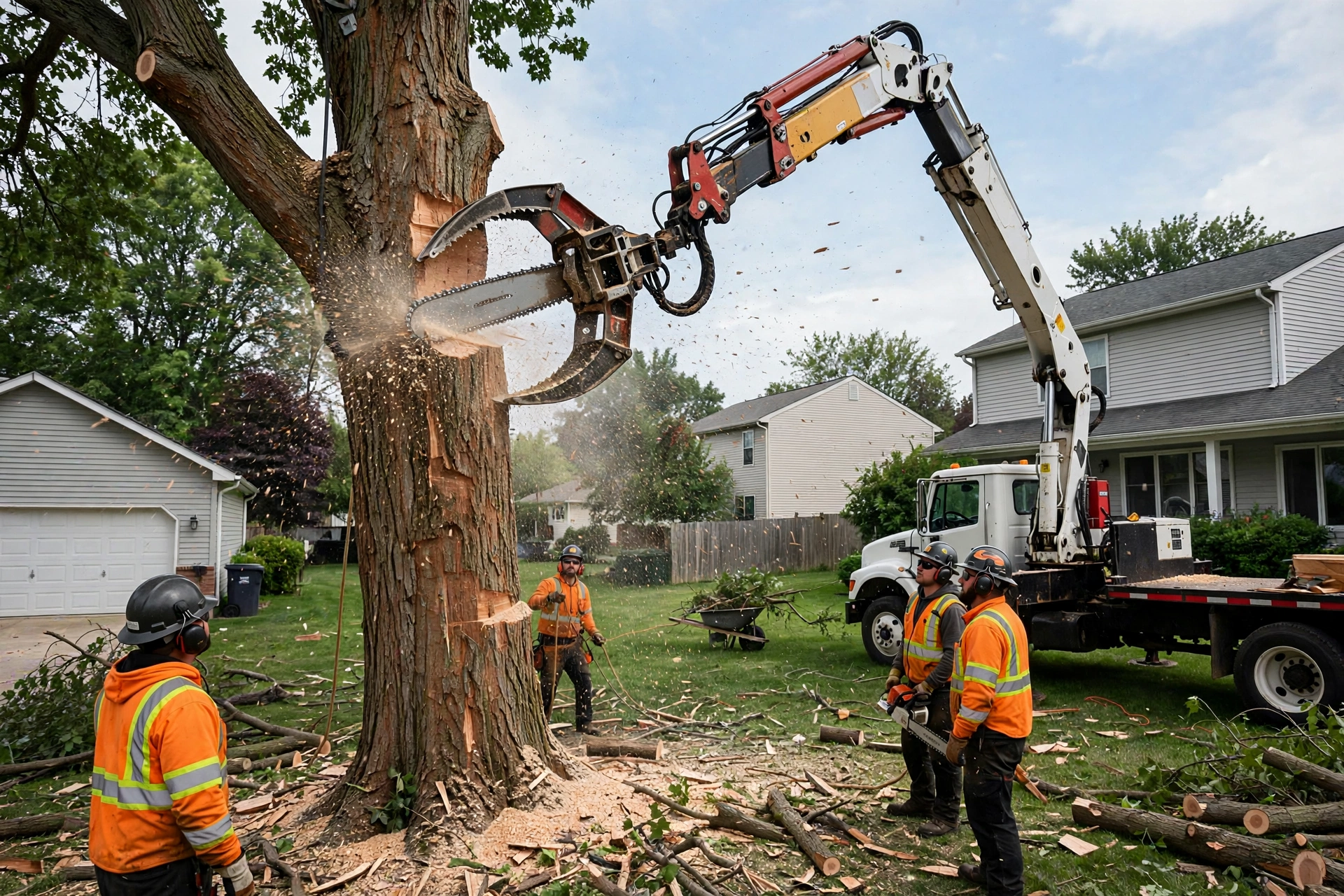
Crane-assisted tree removal is needed when a tree stands over a house, garage, or fence with no safe drop zone. A climber cuts the tree into sections while a crane lifts each piece straight up and swings it to the chipper, so nothing free-falls onto your roof, driveway, or landscaping.
Quick Facts: Crane-Assisted Tree Removal (Peoria, IL)
- What it is: a crane lifts each cut tree section vertically, so nothing drops onto structures below.
- Best for: trees hanging over houses, garages, pools, fences, or backyards with no equipment access.
- Typical Peoria cost: $1,800–$4,500 for a crane-assisted removal; grapple-saw jobs run $3,000–$6,000+.
- Timeline: most single-tree crane jobs are finished in half a day.
- Crew on site: an NCCER-certified crane operator, a climber, ground crew, and a chipper operator.
- Safety standard: the work follows ANSI Z133 arboricultural safety guidelines.
Last spring we quoted a silver maple on a narrow lot off Sheridan Road in Peoria Heights. It leaned hard over a detached garage, the side yards were barely six feet wide, and the neighbor had just paved a new driveway two feet from the fence line. No drop zone — not even close. We parked the crane on the street out front, set the outriggers on hardwood mats, and the climber worked from the driveway side, cutting sections while the crane picked each one straight up and swung it to the chipper. By lunch the tree was gone, the garage roof didn’t have a scratch, and the neighbor’s new driveway didn’t get a single mark.
That’s the whole point of the crane: control. Peoria’s older neighborhoods are full of mature silver maples and oaks that now tower over houses, garages, and fences. Between the June 2024 derecho, our ice storms, and zone 6a freeze-thaw cycles, plenty of these trees end up leaning where you don’t want them — with nowhere safe to fall.
When Only a Crane Will Do: 5 Signs Your Tree Needs the Big Lift
Not every removal needs a crane — most don’t. But certain situations leave no safe alternative.
- The tree hangs directly over your house or garage. If the canopy sits over the roofline with no open ground to lower pieces into, a crane lifts every section up and away instead of letting gravity decide.
- The backyard has no equipment access. Grandview Drive bluff homes with no rear access, tight lots in Peoria Heights and West Peoria — when a bucket truck can’t get back there, the crane parks on the street and reaches over the house.
- Storm damage left a leaner or a split trunk. The June 2024 derecho and our ice storms left plenty of trees half-uprooted or split at the crotch. That’s exactly the kind of call our emergency tree removal crew handles — trees too unstable to climb or rig the normal way.
- The tree is dead or hollow and unsafe to climb. A dead ash or hollow silver maple won’t hold a climber’s rope. The crane takes the full weight of every cut, so nobody has to trust rotten wood.
- Something expensive sits underneath. In-ground pools, new fences, septic fields, stamped-concrete driveways — across 61604, 61614, and 61615, we’ve lifted trees off lots where what sat below the tree was worth more than the job itself.
How a Crane Pick Actually Works
People picture the crane grabbing the whole tree and yanking it out. That’s not what happens. A crane removal is a quiet, deliberate sequence — the crane does the heavy holding, the climber does the cutting, and nothing ever falls freely.
How a Crane Pick Works: 4 Steps
1
Rig
The climber ties in and straps the next section to the crane’s line before a single cut is made.
2
Cut
The climber saws the section free while the crane takes its full weight — the piece never drops.
3
Lift
The operator raises the section straight up, clear of the roof, fence, or wires.
4
Swing
The crane rotates and sets the piece down by the chipper, where the ground crew processes it.
The crane gets positioned — usually on the street — the outriggers go down on hardwood mats, and the operator and climber walk the plan together: which sections come off in what order, how heavy each pick will be, where every piece lands. Then the rhythm starts. The climber rigs and cuts, the operator lifts the piece straight up and swings it to the drop zone, and the ground crew feeds the chipper and keeps the yard clear.
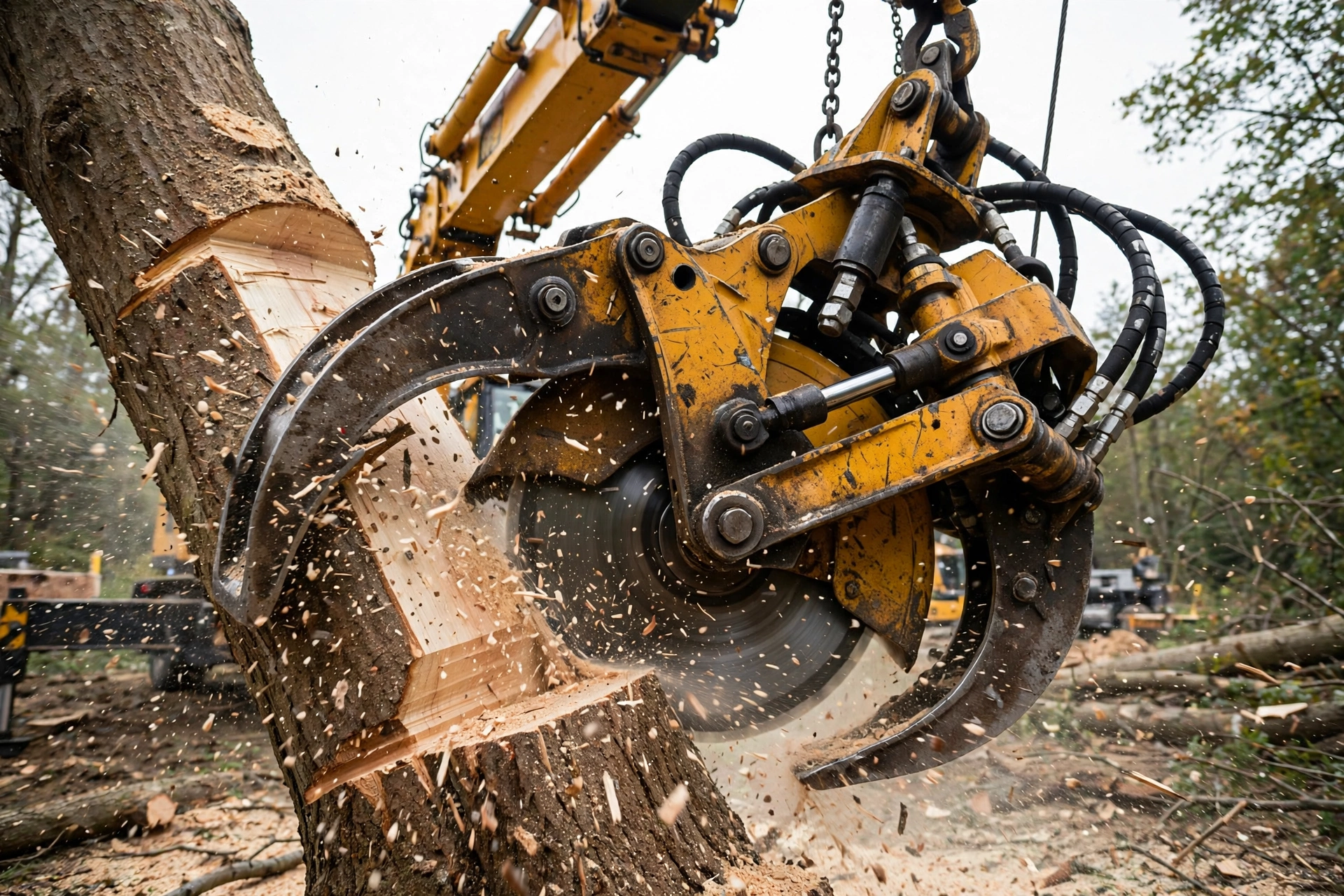
For the biggest or most hazardous picks, there’s the grapple saw: a robotic saw head on the crane boom that grabs the trunk and cuts through it in one motion — no climber in the tree at all. It costs more, but for a massive dead tree over a roof where nobody should be climbing, it’s the safest tool in the business.
What a Crane Day Looks Like for You (the Homeowner)
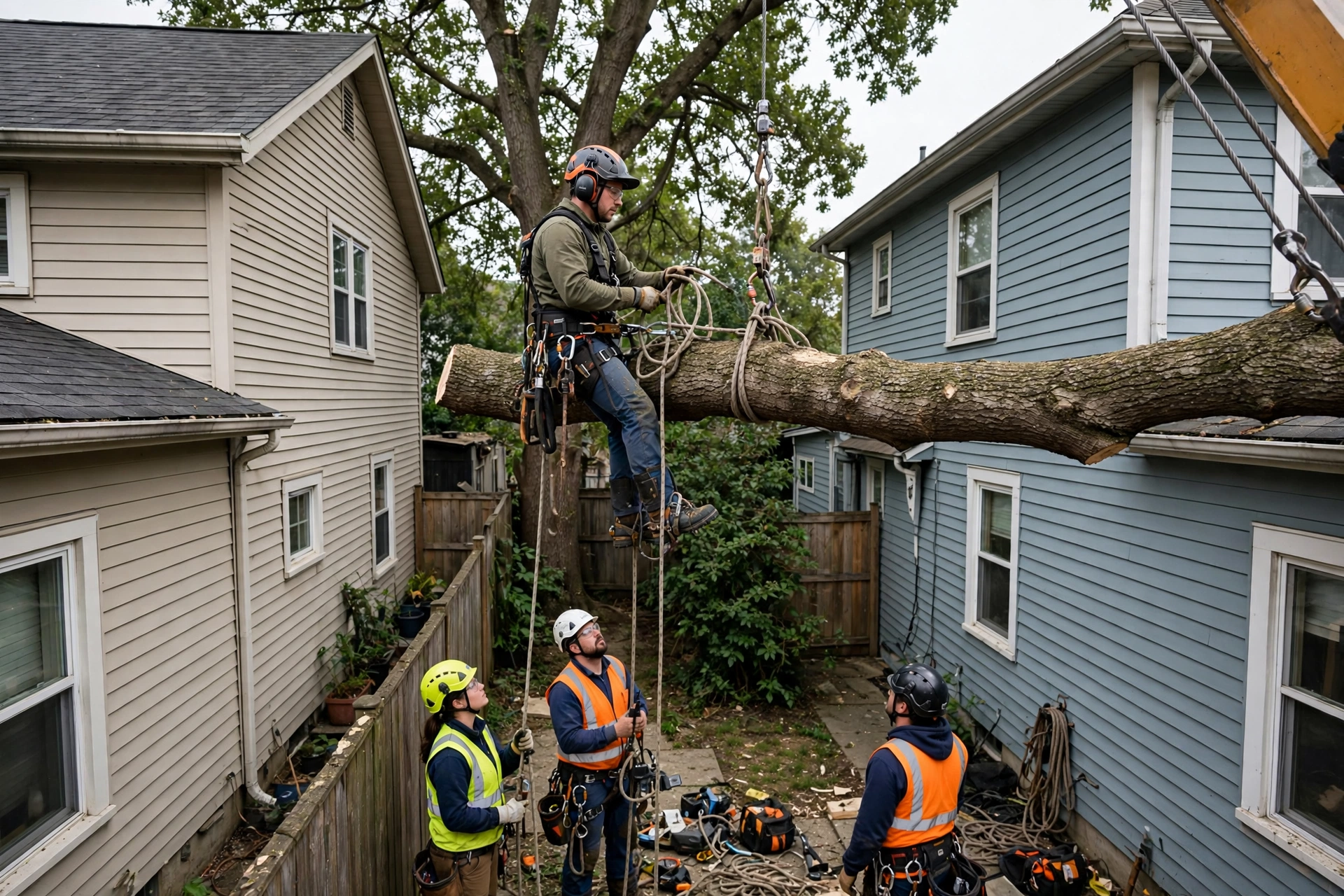
A crane job sounds dramatic, but from your side of the window it’s surprisingly calm. Here’s how the day usually goes.
- Morning walk-through. The crew lead walks the property with you and confirms where the crane will sit before the outriggers go down.
- Street parking for the rig. The crane and chipper need room. We may ask you — and sometimes the neighbors — to move cars off the street in front of the house, and we’ll set cones around the work zone. On a busy road like War Memorial Drive, we plan the setup so traffic keeps moving.
- Outriggers on mats, not on your lawn. The crane stays on the street or driveway; it doesn’t drive across your grass. Hardwood mats spread the weight so pavement and turf stay intact.
- Clear crew roles. The NCCER-certified operator runs the crane, the climber cuts, two ground crew members manage the rigging and the chipper, and the crew lead runs the show.
- A half-day timeline. Most single-tree crane removals wrap up in three to five hours, debris hauled or chipped the same day, the yard raked before the crew leaves.
It’s the same crew you’d meet on any tree service visit, just with a bigger truck parked out front and a lot less drama overhead.
What Does Crane-Assisted Removal Cost in Peoria?
Yes, the crane adds cost — the rig, the certified operator, and the extra crew time all show up on the invoice. But compare it against a new roof and it’s the cheapest insurance on the lot. Here’s how the options stack up around Peoria:
| Job type | Peoria price range | When it fits |
|---|---|---|
| Standard removal (climb & rig) | $800–$2,000 | Open drop zone, tree clear of structures, climber can rig pieces down safely. |
| Crane-assisted removal | $1,800–$4,500 | Tree over a house, garage, or fence; tight backyard with no equipment access; storm-damaged leaners. |
| Crane + grapple saw | $3,000–$6,000+ | Very large or hazardous trees, dead trees too dangerous to climb, zero-drop-zone jobs where speed and no climber exposure matter. |
What moves a quote up or down inside those ranges?
- Tree size and species. A 60-foot silver maple with a wide crown takes more picks than a straight 40-foot oak.
- Access. A crane that parks curbside and reaches over the house is one thing; a tight lot where the rig has to set up two houses down is another.
- Number of picks. Every section is a cycle of rig, cut, lift, and swing — and oversized sections get cut smaller to stay within the crane’s weight limits, which adds cycles.
- Cleanup and hauling. Chipping on-site and hauling logs away takes crew time. Most Peoria quotes include it; always ask.
For a full breakdown of what goes into pricing, see our tree removal cost guide for Peoria.
When a Crane Is NOT Needed (Save Your Money)
A crane is a tool, not a sales pitch. Plenty of trees come down safely without one. You can likely skip the crane when:
- There’s a clear drop zone. If the yard has open ground bigger than the tree is tall, sections can be lowered or dropped safely with standard rigging.
- A bucket truck can reach it. Plenty of trees off Knoxville Avenue come down fine from a bucket — no crane required.
- The tree leans safely away from everything. A straight trunk with a natural lean toward open lawn is a straightforward fell or rig-down job.
- It’s a smaller tree. A 25-foot ornamental doesn’t need a 30-ton crane. A climber and a ground crew handle it in an hour or two.
Here’s the rule of thumb we give our own neighbors: if a company tells you every tree on the property needs a crane, get a second quote. Cranes cost real money, and a crew worth hiring only calls for one when the job actually demands it.
Who’s Running the Crane? Certification and Safety
A crane over your house is only reassuring if the person running it knows what they’re doing. Here’s what to look for.
- NCCER-certified operators. The National Center for Construction Education and Research certifies crane operators through standardized training and testing — it’s the credential that says the operator has proven they can run the machine safely. Read more at NCCER, and ask any tree company who their operator is and what certification they hold.
- ANSI Z133 safety standards. This is the arboriculture industry’s safety standard, and it covers crane-assisted work specifically: pre-lift planning, communication protocols between climber and operator, and exclusion zones under every suspended load. Nobody stands under a piece that’s hanging from the crane.
- A real lift plan, not a guess. Before the first pick, the operator and climber agree on the weight of each section. Crane charts say exactly what the boom can hold at a given radius and angle, and the crew stays well inside those numbers. If a section looks too heavy, it gets cut smaller.
- Daily inspections and constant communication. The crane gets walked around and checked every morning — rigging, slings, hydraulics, outriggers. And the climber and operator stay in radio or visual contact through every pick, so nobody’s guessing when a thousand-pound section of oak is hanging over your shingles.
After the June 2024 derecho, plenty of new faces showed up in Peoria offering tree work with rented equipment. A crane in untrained hands over your roof is a gamble you don’t need to take.
Related Articles
- Tree Too Close to House? Safe Removal in Peoria
- Hazardous Tree Peoria IL – Signs You May Need Tree Removal
- The Cost to Remove a Tree by Size (10 ft, 30 ft, large) Peoria, IL
Crane Removal FAQs
Will the crane damage my driveway or lawn?
Almost never. The crane sets up on the street or a paved surface, and the outriggers sit on hardwood mats that spread the load. The crew photographs everything beforehand so any pre-existing cracks are documented.
How much does crane-assisted tree removal cost in Peoria, IL?
Most jobs land between $1,800 and $4,500, depending on tree size, access, and the number of picks. Grapple-saw jobs on very large or hazardous trees run $3,000 to $6,000 or more. A free on-site estimate is the only way to get an exact number.
Can you remove a tree with a crane without anyone climbing it?
Yes — that’s what the grapple saw is for. The saw head on the crane boom grabs the trunk and cuts through it, then the crane lifts the piece away. It’s the go-to method for dead trees nobody should be climbing.
How long does a crane removal take?
Most single-tree jobs finish in three to five hours, including cleanup. Very large trees or difficult access can take a full day.
Do you grind the stump after the crane work is done?
We can — it’s usually quoted as a separate line item, so ask about it during the estimate. Here’s what stump grinding after a removal typically involves.
The Bottom Line
A crane turns the scariest tree on your property — the one leaning over the garage, the storm-split maple over your fence — into a routine half-day job. No free-falling limbs, no crushed shingles, no torn-up fence.
If you’ve got a tree hanging over your roof anywhere in Peoria — Peoria Heights, West Peoria, the bluff neighborhoods, anywhere — don’t wait for the next ice storm to make the decision for you. Get eyes on it now and get it handled while you still get to choose the timing. Call 309-250-8333 for a free estimate.
Peoria Tree Removal Co.
https://treeremovalpeoriail.com/
114 W Forrest Hill Ave, Peoria, IL 61604, USA
Tree Service Company
2 Responses