
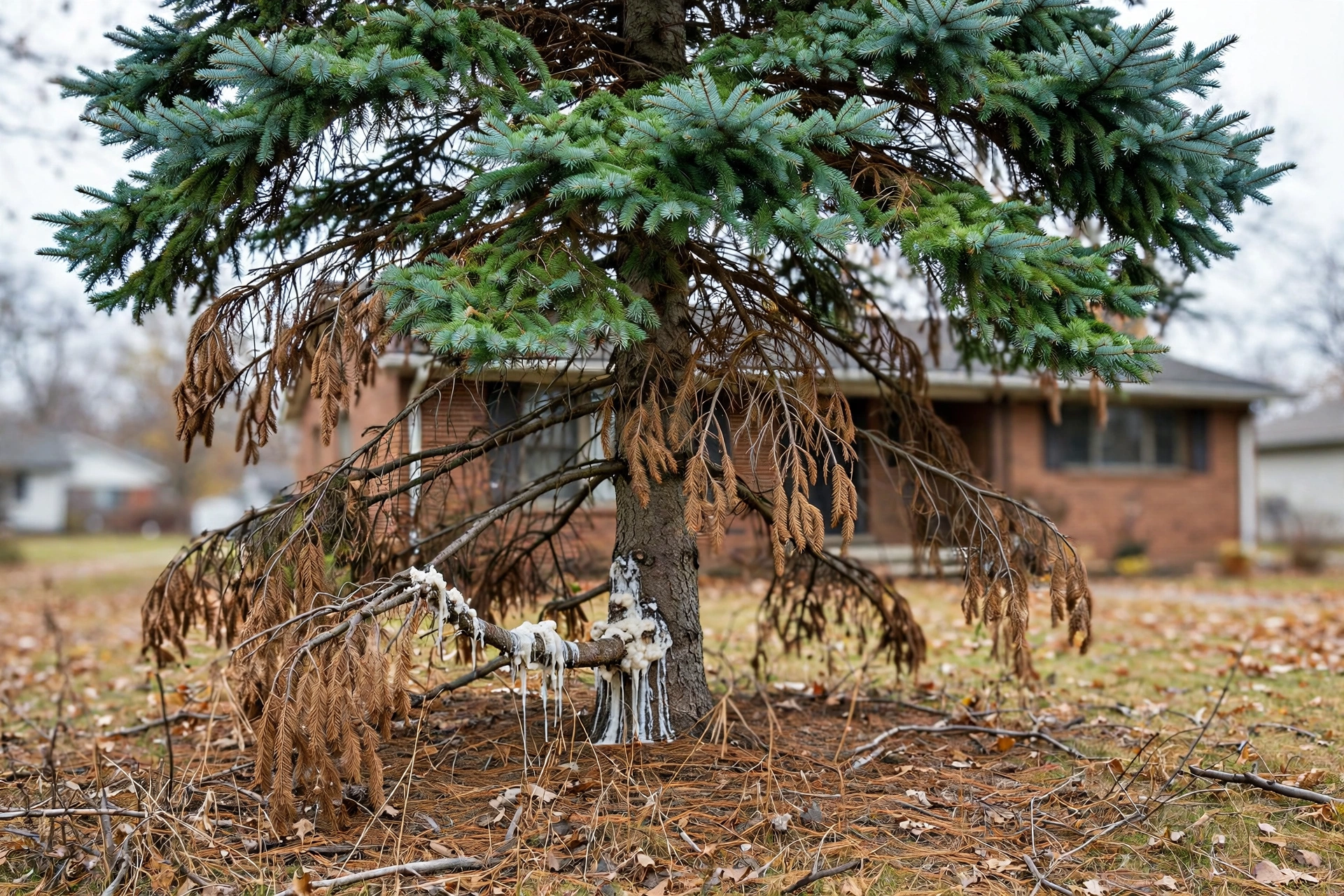
Your blue spruce is dying from the bottom up, one limb a year — and the white resin on the bark tells you why: cytospora canker. No spray fixes it.
If the lowest branches on your blue spruce have turned brown while the top stays green, cytospora canker is the most likely cause. It is a slow fungal disease that girdles branches at their base, and the fix is careful pruning in dry weather — not a spray.
Quick Facts
- The disease: Cytospora canker, also called Leucostoma canker — the same disease. The fungus is Leucostoma kunzei.
- The trees it hits: Colorado blue spruce (Picea pungens) and Norway spruce (Picea abies). The number one killer of Colorado blue spruces 15 years or older.
- The pattern: Branches die from the bottom upward, usually about one limb a year.
- The tell: White resin patches on the bark at the base of a dead branch, plus tiny black dots in the inner bark.
- The treatment: None in a bottle. No chemical control prevents or eradicates it, and no fungicide effectively controls it. Prune dead branches in dry weather.
- What not to do: Do not prune when the branches are wet, and do not burn the cut branches.
What Cytospora Canker Is
Cytospora canker and Leucostoma canker are the same disease. The name changed when plant scientists reclassified the fungus, but the disease never changed — it is the fungus Leucostoma kunzei, and it has been killing spruces in Illinois for as long as anyone has been planting them.
The University of Illinois Extension calls it probably the most common and damaging infectious disease of spruce in Illinois. That matches what you see driving through Peoria: big blue spruces thinning from the bottom along Grandview Drive and Knoxville Ave.
Here is how it works. The fungus gets into a branch, usually through a wound or a stressed spot, and grows in the bark at its base. It forms a canker — a dead patch of bark that wraps around the branch and cuts off water and food. Once the branch is girdled, everything beyond it dies: the needles brown, the twigs go dry and brittle, and the whole limb is gone.
The whole tree is rarely killed — the fungus takes branches slowly, about one limb a year. The exception is when it reaches the trunk and girdles it. Stressed spruces are more susceptible.
Why the Lower Branches Die First
The bottom-up pattern is the signature of this disease. The lowest branches die first, then the next ones up, over years. The top of the tree can stay green and healthy-looking long after the bottom third is bare.
Age matters too. The disease hits hardest in trees 10 to 20 years old, and it is the number one killer of Colorado blue spruces 15 years or older. That is the age of most of the big blue spruces in Peoria’s older neighborhoods, the ones you see along War Memorial Dr. When the pattern is bottom-up, year after year, one limb at a time, cytospora canker belongs at the top of the list.
The Tell: White Resin and Black Dots
Dead lower branches alone do not prove cytospora canker. Drought, winter injury, shade, and other diseases all leave brown limbs behind. The diagnosis rests on two signs, and you need to look for both.
The first sign is white resin. On a cankered branch, conspicuous patches of white resin appear on the bark at the base of the dead branch, where the canker is. Look at the bark where the dead limb meets the trunk.
The second sign is smaller. Peel back the thin outer bark in the cankered area and look at the inner bark. You should find tiny black dots, about the size of a pinhead, embedded in the inner bark and often in the resin itself. Those are the fruiting bodies of the fungus — the pycnidia — which release the spores. White resin plus black pinhead dots means cytospora canker. If you are not sure, the University of Illinois Extension can confirm a sample through its diagnostic service.
Cytospora Canker or Something Else?
A spruce losing branches can have more than one problem, and the fix for one is useless for another.
| Problem | What it looks like | How it differs |
|---|---|---|
| Cytospora canker | Whole branches die bottom-up, about one limb a year; white resin at branch bases; black dots in inner bark | A canker disease — the branch is girdled at its base |
| Rhizosphaera needle cast | Needles brown and drop, starting low; branches stay alive | A needle disease — the branch survives |
| Diplodia tip blight | New shoot tips on pines brown and die back | A pine disease; it kills shoot tips, not whole branches |
| Drought stress | Needles brown from the tips inward, all over at once, after a hot dry spell | No resin, no black dots; damage appears in one season |
The distinction that matters most in Peoria is the second row. Rhizosphaera needle cast also starts low, but it is a needle disease: the needles drop and the branch lives. Cytospora is a canker disease: the whole branch dies. If the branches are alive but the needles keep dropping, our live tree disease treatment post walks through how that assessment usually goes.
The November spruce check — five minutes, four steps
1. Stand back. Are the dead branches only at the bottom, climbing slowly year by year? That pattern points to cytospora.
2. Walk in close. Look at the bark where each dead limb meets the trunk. White resin patches are the first clue.
3. Scratch and peel. Brown tissue under the bark means the branch is dead. Peel the thin outer bark in the resin area and look for tiny black dots.
4. Mark and plan. Mark every dead branch and plan to prune them out on a dry day in late winter. Do not prune in wet weather, and bag the cut branches.
What to Do in November
Four jobs, in order, and none of them involves a spray bottle.
First, diagnose before you cut. Count the dead branches, note how high the dieback has climbed, and check whether the trunk itself shows resin or cankers.
Second, plan the pruning for late winter, on a dry day. Remove dead branches as they occur, cutting back to the nearest living lateral branch or to the trunk. The dead wood is where the fungus lives and where the spores come from. Never prune when the branches are wet — spores exude from the cankers, and wet tools and wet bark spread them. Our live tree pruning benefits post explains why dormant-season work is easier on the tree.
Third, help the tree fight back. A vigorous spruce loses limbs more slowly than a stressed one. Water during drought — a deep soak at the base — and apply organic mulch under the full spread of the branches, keeping it off the trunk. In a zone 6a yard, a mulch ring put down after the first frost (usually October 11–20) also holds soil moisture through winter.
Fourth, dispose of the cut branches properly. Bag them for yard-waste pickup. Do not burn them — open burning of yard waste is prohibited inside the City of Peoria under the Fire Department’s open-burning policy. Do not chip them and spread the chips under the tree either: the spores live in that wood.
What Not to Do
Do not buy a fungicide. There is no chemical control that prevents or eradicates cytospora canker, and no fungicide effectively controls it. Anyone who offers to spray your spruce for this disease is selling you something that does not work.
Do not prune on a wet day. Spores exude from the cankers and travel on wet tools and wet bark. A rainy-day pruning session can move the fungus from one dead branch to a healthy one. Wait for a dry day in late winter.
Do not top the tree or strip the lower branches in one go. Removing too much live growth at once stresses the tree, and a stressed spruce is more susceptible to the very fungus you are fighting. Take the dead wood out.
When a Spruce Has to Come Down
Cytospora canker rarely kills a whole tree, but “rarely” is not “never.” There are three situations where removal is the honest answer.
The first is a girdled trunk. If the fungus has reached the trunk and wrapped a canker around it, the tree above that point is cut off from water and food, and it will die.
The second is a tree that has lost so much of its canopy that it is no longer the tree you planted. A spruce that has lost its lower two-thirds over several years is not going to fill back in. Spruces do not regrow lower branches.
The third is a tree that has become a hazard. A spruce with a dead top over a roof, a driveway, or a play area is a different problem from a spruce losing limbs in a back corner. Dead wood is brittle wood, and a dead top in a winter storm is a risk worth pricing out before the storm. Our live signs of a dying or diseased tree post lists the symptoms that actually decide whether a tree stays or goes.
Frequently Asked Questions
Why are my spruce tree’s lower branches dying?
The most common reason in Illinois is cytospora canker, a fungal disease that girdles branches at their base and kills them from the bottom of the tree upward, about one limb a year. Look for white resin patches at the base of dead branches.
Can cytospora canker be treated with a spray?
No. There is no chemical control that prevents or eradicates it, and no fungicide effectively controls it. The management is pruning out dead branches in dry weather, in late winter if possible, and keeping the tree vigorous with water and mulch.
When should I prune a spruce with cytospora canker?
Late winter, on a dry day. Cut dead branches back to the nearest living lateral or to the trunk, and never prune when the branches are wet — the spores spread on wet tools and wet bark.
Walk Your Spruce This Week
November is the month this disease is easiest to see: the rest of the yard is bare, and the brown lower branches and white resin patches stand out against the green spruce.
Mark the dead branches now, plan the pruning for a dry day in late winter, and give the tree water and mulch in the meantime. That is the whole program — no spray, no shortcut — and no reason to wait until the dieback has climbed another tier.
If your spruce is losing lower branches and you are not sure what you are looking at, call Peoria Tree Removal Co. at (309) 250-8333 and tell them what you are seeing. If it is only cankered lower limbs, they will tell you that.
Peoria Tree Removal Co. — 114 W Forrest Hill Ave, Peoria, IL 61604 — (309) 250-8333 — treeremovalpeoriail.com — Mon–Sat 8am–6pm, 24/7 emergency tree service.
Peoria Tree Removal Co.
114 W Forrest Hill Ave, Peoria, IL 61604
Mon–Sat 8am–6pm · 24/7 emergency tree service