
How to Protect Young Trees from Deer Damage This Winter in Illinois
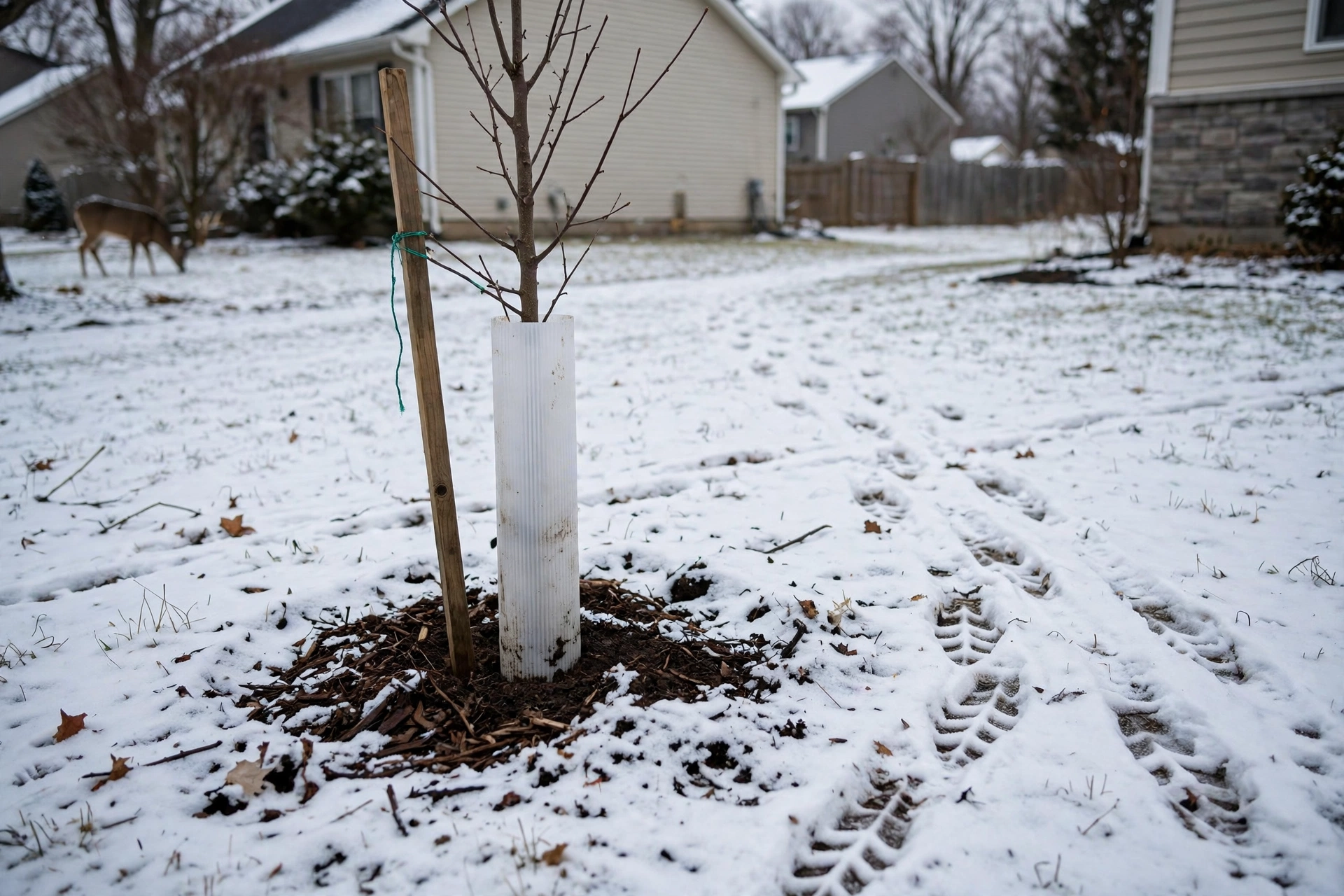
Yes — protect young trees before winter sets in. Hungry deer browse buds and twigs all winter, and bucks rub their antlers on trunks each fall, which can strip the bark clean around the trunk and kill the tree. A four-to-five-foot tree tube or wire cage installed before the first hard freeze stops nearly all of it.
You planted the tree in spring. You watered it all summer. Then winter comes, the food gets scarce, and a deer turns your young maple into a chew toy. It happens every year across Illinois, and most of it is preventable with an afternoon of work in the fall.
Deer pressure around Peoria is real. The river bluffs, the wooded ravines along the Rock Island Trail, and the farm-field edges around every suburb hold plenty of deer, and winter pushes them into yards looking for food. If your trees are under ten years old, they are on the menu.
Quick Facts
- Two kinds of damage: Browsing (eating buds and twigs) happens all winter; rubbing (bucks scraping antlers on trunks) happens in fall.
- Most vulnerable: Trees under 3 inches of trunk diameter and under 8 feet tall.
- Guard height: At least 4 to 5 feet tall — deer browse up to about 6 feet standing on their hind legs.
- When to install: Before the first hard freeze, typically late October through November in Central Illinois.
- Local pressure: Highest near wooded corridors — river bluffs, creek bottoms, forest preserves, and farm-field edges around Peoria.
- Cost: Tree tubes and guards run roughly $5–$25 each; a wire cage costs a few dollars in materials per tree.
Why Winter Is Deer Season for Your Trees
In summer, deer have options. Clover, soybeans, garden vegetables, forest understory — food is everywhere, and your young trees are just one choice among many.
In winter, the buffet closes. Farm fields are bare stubble. Gardens are done. The forest understory is dormant. What is left? The buds, twigs, and bark of young trees — including the ones in your yard.
A deer’s winter diet shifts to woody browse out of necessity. The tender buds at the tips of your young tree’s branches are nutritious, easy to reach, and right at mouth height. A single deer can strip the lower branches of a young tree in one night, and a small herd can reshape a new planting in a week.
This is not a rural-only problem. Suburban Peoria neighborhoods that back up to ravines, the Forest Park Nature Center, or the Illinois River bluffs see heavy deer traffic all winter. If you have seen deer tracks in your yard, your young trees are already on their radar.
Rubbing vs. Browsing: Know What You Are Looking At
Deer damage two different ways, and telling them apart matters because the fixes differ.
Browsing: The Winter Nibble
Browsing is eating. Deer clip off buds, twig tips, and leaves, leaving a ragged, torn edge — deer have no upper incisors, so they tear rather than snip cleanly. A rabbit’s cut looks like a clean diagonal slice; a deer’s looks ripped.
You will see browsing damage from late fall through early spring, worst in January and February when natural food is scarcest. Deer browse up to about six feet high when they stand on their hind legs, so a young tree’s entire lower canopy is in range.
Light browsing is ugly but survivable. Heavy browsing — every bud on the lower half gone, year after year — stunts the tree permanently and can kill it.
Rubbing: The Fall Shredder
Rubbing is different and often worse. In fall, bucks rub their antlers against small trunks to shed velvet and mark territory. They shred the bark off in vertical strips, sometimes all the way around the trunk.
A buck picks trees with trunks roughly one to four inches thick — exactly the size of a tree you planted a few years ago. Favorite targets include young maples, fruit trees, and anything with smooth bark.
If the rubbing goes all the way around the trunk, the tree is girdled. The bark is the tree’s plumbing — water up, sugar down — and a fully girdled tree usually dies above the wound. Partial rubbing can heal, but it leaves the tree stressed and open to disease.
Rubbing happens in fall, mostly September through November, before the rut. By the time you notice it, the damage is done. That is why protection goes on before fall, not after.
Deer Damage ID: What Happened to Your Tree?
Signs: Ragged, torn twig tips; missing buds; damage up to 6 ft high.
When: Late fall through early spring.
Fix: Tube or cage tall enough to cover the browse line.
Signs: Bark shredded in vertical strips on the trunk; wood exposed; usually 1–3 ft off the ground.
When: Fall (Sept–Nov).
Fix: Rigid trunk guard before fall; repair partial wounds with clean cuts.
Signs: Clean 45° snipped twigs; bark gnawed near ground level only.
When: Winter.
Fix: Short 18-inch guard around the base.
Tree Tubes and Guards: The First Line of Defense
For most homeowners with a few young trees, a physical guard is the answer. It is cheap, it works, and it goes on in minutes.
Corrugated Tree Tubes
Plastic tree tubes — the ribbed cylinders you see in new plantings — are the simplest option. They slip over the tree and stake into the ground. Get them at least four feet tall; five is better.
Tubes do double duty. They stop browsing on the trunk and lower branches, and they stop rubbing completely — a buck cannot shred bark through rigid plastic. They also create a mini-greenhouse that speeds early growth.
The catch: check them every spring. Tubes can harbor moisture and insects against the bark if left on too long, and a tube that is too tight will constrict a fast-growing trunk. Most trees outgrow their tubes in two to three years. When the trunk fills the tube, take it off or move up a size.
Spiral and Mesh Wraps
Spiral plastic wraps coil around the trunk and expand as the tree grows. They are excellent against rubbing and sunscald, and they are cheap enough to put on every young tree you own.
Their weakness is height — most are only a few feet long, so they protect the trunk but not the branches above. Pair them with a taller cage if browsing is your main problem.
Wire mesh guards — a cylinder of hardware cloth or welded wire staked around the tree — are the heavy-duty option. A four-foot cylinder of two-inch mesh stops both rubbing and browsing on the trunk and lower limbs, lasts for years, and does not trap moisture. Leave a few inches of clearance between the mesh and the bark so the trunk has room to grow.
What Height Actually Works
This is where people go wrong. A two-foot guard stops rabbits. It does nothing against deer.
Deer browse standing on all fours up to about four feet, and up to six feet rearing on their hind legs. Your guard needs to be at least four feet tall, and five feet is the safe standard. For the trunk itself, rubbing happens in the one-to-three-foot zone, so any guard covering that range handles it.
If deer are reaching over your four-foot tubes to nip the leader — the central top shoot — extend the protection or switch to a full cage. Losing the leader ruins the tree’s shape permanently.
Fencing: When You Have a Lot to Protect
If you planted a row of new trees, a small orchard, or a privacy screen of young evergreens, guarding each one individually gets tedious. Fencing the area starts making sense.
Individual Cages
A circle of welded-wire fencing, four to five feet tall and staked in two or three places, is the gold standard for a valuable young tree. It keeps deer off the trunk and the lower canopy, it lasts a decade, and it costs a few dollars in materials.
Make the circle wide — at least a foot of clearance all around the branches. A tight cage just teaches the deer to browse through the mesh.
Perimeter Fencing
To keep deer out of an area entirely, the fence needs to be eight feet tall. Deer can clear six feet when motivated, and a hungry deer in February is motivated. Eight feet is the standard that actually works.
That is a real project — posts, wire, gates — and it is overkill for most yards. But for a new orchard, a nursery bed, or a large new planting on acreage, it is the only thing that reliably works. Anything shorter is a suggestion, not a barrier.
Electric Fencing
A single electrified wire at nose height, baited with a little peanut butter on foil, trains deer fast. It is cheap and effective for seasonal protection. But it needs a charger, maintenance, and it is not great near kids or pets. Most suburban homeowners skip it.
Repellents: Helpful, Not Reliable
Deer repellents — the sprays that taste or smell bad — work until they do not. They need reapplying after every rain, and a starving deer in February will eat right through the bad taste. Use repellents as a supplement over your physical guards, never as the plan itself.
Common Mistakes That Waste Your Effort
Guards too short. The number one mistake. A two-foot tube protects against rabbits and nothing else. Go four to five feet or do not bother.
Volcano mulch against the guard. Piling mulch against the trunk holds moisture against the bark and invites rot and rodents. Keep mulch in a flat ring, a few inches deep, pulled back from the trunk.
Leaving guards on forever. Check every spring. A guard left on a growing trunk girdles it slowly — the very damage you were preventing.
Protecting only some trees. Deer notice. The unguarded tree becomes the designated restaurant.
Waiting until damage appears. Rubbing happens in fall and browsing peaks in midwinter. Guards go on in late October or November, before the damage season, not after.
| Protection Method | Stops Rubbing? | Stops Browsing? | Best For |
|---|---|---|---|
| 4–5 ft tree tube | Yes | Yes, on trunk and lower branches | New plantings, fastest install |
| Wire mesh cage | Yes | Yes, full lower canopy | Valuable specimen trees, long-term |
| Spiral trunk wrap | Yes | No (too short) | Rub-prone trunks, sunscald prevention |
| 8 ft perimeter fence | Yes | Yes, whole area | Orchards, large new plantings |
| Repellent spray | No | Partial, temporary | Supplement only, not a plan |
What to Do About Damage That Already Happened
If the deer got there first, assess honestly.
Light browsing — a few nipped twig tips — needs nothing. The tree will push new growth in spring. Do not “even it out” with shears; ragged natural breaks heal fine.
Partial rubbing — bark stripped on one side — can recover if less than half the trunk’s circumference is damaged. Trim any loose bark back to solid wood with a clean cut so the wound can seal, then guard the tree so it does not happen again.
Full girdling — bark gone all the way around — is usually fatal above the wound. The top will leaf out in spring on stored energy, then collapse by midsummer. Do not wait through a slow decline; plan the removal and replant with protection from day one.
A professional tree trimming service can clean up ragged wounds properly and tell you honestly whether a rubbed tree is worth saving.
Frequently Asked Questions About Deer and Trees in Illinois
When should I put guards on my trees?
Late October through November, before the first hard freeze. Rubbing season starts in fall and browsing peaks in midwinter — guards need to beat both.
When can I take the guards off?
When the trunk is too thick to interest a buck — roughly 4 inches in diameter — and the lowest branches are above the browse line. For most trees, that is year three or four. Check every spring regardless.
Will deer damage kill a mature tree?
Rarely. Mature trees are above the browse line and too thick to rub. Deer damage is a young-tree problem, which is exactly why new plantings need guards.
Do deer eat evergreens in winter?
Yes — arborvitae is a favorite, and they will browse yews, junipers, and even spruce in a hard winter. Evergreen screens need the same protection as deciduous trees.
I see deer every day. Is there any point?
Yes. Daily deer traffic just means guards are non-negotiable, not useless. A physical barrier works whether one deer or twenty walk past it.
Protect Them Now, Thank Yourself in Spring
An afternoon in November with a bundle of tree tubes beats a spring full of dead saplings. The deer are coming — they come every winter. The only question is whether your trees are ready.
Peoria Tree Removal Co. helps Peoria-area homeowners protect, prune, and care for young trees — and remove the ones that did not make it. See what a local crew can do at Peoria Tree Removal Co..
**Peoria Tree Removal Co.** 114 W Forrest Hill Ave, Peoria, IL 61604 (309) 250-8333
Home
Peoria Tree Removal Co.
114 W Forrest Hill Ave, Peoria, IL 61604
Mon–Sat 8am–6pm · 24/7 emergency tree service