
Dutch elm disease still kills American elms across Illinois — and the one branch that flags in June is the warning to act on before the beetles return.
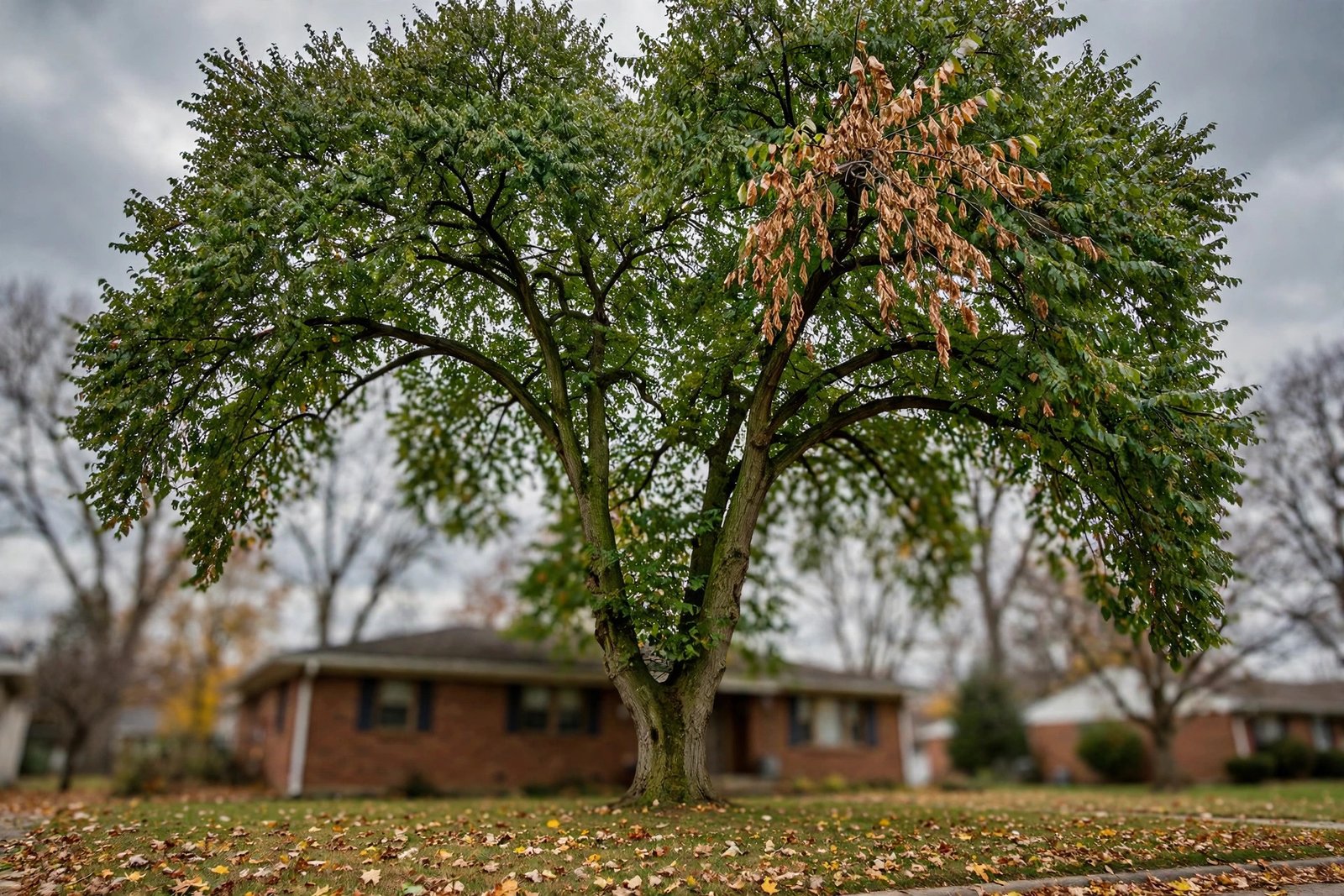
Dutch elm disease is a fungal wilt that plugs an elm’s water vessels, spread by bark beetles and through grafted roots. An infected American elm can die in a single season, but an early catch — one flagged branch, less than five percent of the crown — can still be pruned out.
Quick Facts
- The disease: Dutch elm disease (DED), caused by the fungi Ophiostoma ulmi and Ophiostoma novo-ulmi.
- Who it hits: only elms (Ulmus species) and closely related Planera; the American elm is very susceptible.
- Where it occurs: still common in Illinois, according to the University of Illinois Extension — the Plant Clinic confirms numerous cases every year.
- First sign: “flagging” — one upper branch turns yellow, wilts, and browns in late spring to midsummer while the rest of the tree stays green.
- How it spreads: two bark beetles carry spores to fresh wounds, and the fungus travels underground through root grafts between neighboring elms.
- Speed: a spring infection can kill a tree in the same growing season; small trees can go in weeks.
- Can it be saved: only if caught very early — pruning works when less than 5% of the crown is affected. Fungicide injections prevent infection in healthy, valuable trees; they do not cure advanced disease.
- November matters: the beetles are inactive in the cold, so the dormant season is the safe window to remove dead or infected elm wood.
What Dutch Elm Disease Actually Is
The name is a little misleading. The disease is not Dutch in origin — it is probably Asiatic — but it got its name because Dutch pathologists did the early work on it in the 1920s. It reached the United States in the early 1930s and has been killing American elms ever since. The American elm was once the classic American street tree, and plenty of them still stand in Peoria yards and along the older streets off War Memorial Drive and Knoxville Avenue.
The fungi invade the water-conducting vessels in the sapwood and plug them, so the tree cannot move water to its leaves even when the soil is wet. The first signs look like drought — leaves yellow, wilt, and brown while the rest of the canopy looks fine. Once the fungus is established in the main stem, no spray a homeowner can buy will chase it out; the University of Illinois Extension is blunt that no chemicals are available to homeowners for control. Only elms get it, which narrows the diagnosis: a wilting elm in June is a different problem from a wilting oak. The University of Illinois Extension has the full disease profile, and it is the source for the facts in this post.
How It Travels: Beetles and Root Grafts
The disease moves in two directions, and both matter in a Peoria yard. The overland route is the beetle. Two species do the carrying: the native elm bark beetle and the smaller European elm bark beetle. They breed in dead and dying elm wood — a dead elm left standing, a pile of elm logs with the bark still on. When they feed on a healthy elm, they carry the spores in, usually through a small wound or a twig crotch. A single beetle visit is enough.
The underground route is silent. Elms growing close together often fuse their roots where they cross, forming grafts, and the fungus travels through them into the next tree without any insect at all. That is why the University of Illinois Extension says that without community-wide sanitation, Dutch elm disease is almost impossible to control. One neighbor’s dead elm is every elm on the block’s problem. Firewood is the third way it moves: elm logs with the bark attached are beetle breeding sites, so do not store them with the bark on and do not move elm firewood to another property — the same rule in the guide to how firewood spreads tree pests.
The Signs to Watch For
Most new infections in Illinois are first noticed in June. The University of Illinois Plant Clinic confirms numerous cases every year, and June is when they start showing up. The Morton Arboretum advises checking valuable trees weekly from early May through July, then monthly through September.
The first symptom is flagging. One branch, usually in the upper crown, turns yellow, then wilts, then browns — while the rest of the tree is still green. It looks like a flag of a different color stuck into the canopy, and that is where the name comes from. A spring infection can kill the tree in the same growing season. A fall infection may let the tree survive the winter and die the following spring. Small trees can go in a few weeks; a large elm may take a season or two, declining branch by branch.
There is a second field check. Peel back the bark on a recently wilted branch and look at the wood underneath: Dutch elm disease leaves brown streaks in the outer sapwood, running with the grain. That streaking is strong evidence, but it is not a diagnosis on its own — only a laboratory test can confirm it. Do not peel bark off the trunk to look for streaks yourself; that creates the kind of wound the disease uses. If the signs above sound familiar, compare them with the broader warning signs in the guide to signs a tree is dying or diseased — but do not stop there. The treatment for a drought-stressed elm and the treatment for a diseased elm are opposites: one needs water and patience, the other needs to come out before it infects its neighbors.
Dutch Elm Disease or Something Else?
Dutch elm disease is not the only thing that makes an elm look sick, and the differences decide the response. Elm yellows is the closest look-alike: it is a wilt disease too, but it is caused by a phytoplasma, not a fungus, and a laboratory test sorts the two out. Drought stress browns leaf edges too, but it affects the whole crown evenly, improves after rain, and does not produce brown streaking in the sapwood. Anthracnose spots and curls young leaves in a wet spring, and the tree usually leafs out again.
| Problem | What you see | What it means for the tree |
|---|---|---|
| Dutch elm disease | One upper branch flags in late spring to midsummer; leaves yellow, wilt, brown; brown streaks in sapwood; spreads fast | Fungal wilt; lab test to confirm; early pruning or removal, injections only as prevention |
| Elm yellows | Similar wilting and yellowing, leaves often dropping while still green | Phytoplasma, not a fungus; also fatal; lab test tells them apart |
| Drought stress | Whole crown browns evenly, leaf edges scorch first; improves after rain; no sapwood streaking | Water and mulch; the tree usually recovers |
| Anthracnose | Brown blotches and curling on young leaves in a wet spring; tree leafs out again | Mostly cosmetic; rarely fatal |
| Oak wilt | Same wilt pattern — but on oaks, not elms; top-down death in red oaks | Different fungus, different host; see the oak wilt timing rules |
The honest test is the pattern, not a single leaf. One flagged branch in June, brown streaks in the sapwood, and nearby elms declining in the same pattern — that combination points at Dutch elm disease, and it points at a laboratory test. A whole crown browning evenly in August after a dry July points at drought.
Can an Elm Be Saved?
Sometimes — but only if the catch is early, and only in a narrow window. The Morton Arboretum puts the line plainly: pruning out the disease works best when no more than 5% of the tree is symptomatic, and when the infection is a new one in the upper crown. That means one flagged branch, caught in the first days, on a tree that is otherwise healthy. The cut has to go well below the visible damage — the final cut lands seven to ten feet below the lowest evidence of discolored wood — and the saw blade has to be sterilized with a 10% bleach solution or denatured alcohol before that final cut is made. The infected wood then has to be destroyed, not stacked by the fence. If the main stem is already infected, or the disease came in through the roots, pruning will not save the tree.
Fungicide injections are the other tool, and they are mostly a preventive one. Systemic fungicides such as propiconazole and thiabendazole, injected into the trunk or root flare, can protect a healthy elm and can stop the fungus colonizing the uninfected parts of an early-stage tree. When properly applied, an American elm may be protected for about three years, and the treatment has to be repeated on schedule. But the injections are expensive, they are temporary, and they have to be applied by a licensed, certified arborist — there is no homeowner version. They also do not prevent infection through root grafts. Think of injections as insurance for a tree worth keeping, not as a cure for a tree already going. The broader treatment picture is in the tree disease treatment guide.
Why November Is the Month to Act
November is the best month of the year to deal with elms in Peoria. The elm bark beetles are inactive in the cold, so cutting elm wood now does not invite the carriers, and the fungus is not producing spores. Peoria’s first frost usually lands between October 11 and 20, in USDA zone 6a, and by November the window is open.
November is also the month when the evidence is easiest to read. With the leaves down, you can see the crown structure — the dead branches, the bare top on an elm that flagged in summer. Walk your elms now, before winter, and look at three things: dead branches in the upper crown, bark cracking or peeling in odd patches, and whether the elms next door are declining in the same pattern. If two or three elms on the same block all went downhill this year, that cluster pattern is itself a clue. This is also the window for the work itself: a dead or infected elm should come out over the winter, before the beetles return in spring and start breeding in it. The timing is covered in the guide to dormant-season pruning.
What to Do If You Suspect Dutch Elm Disease
Do not start by cutting. The first step is confirmation, because the symptoms overlap with drought stress, elm yellows, and other elm problems — and the response to Dutch elm disease is the most disruptive one. A laboratory test is the only sure diagnosis. The University of Illinois Plant Clinic tests samples from suspect trees, for a nominal charge, and an arborist can collect the sample or tell you how to submit one.
Once a case is confirmed, the sequence is containment first, tree second. Map every elm within about fifty feet — those are the trees at risk through root grafts. Break the root grafts by trenching three to four feet deep, usually halfway between the infected tree and the healthy ones, or in a line around the dripline. Call JULIE at 800-892-0123 before any digging, so underground lines are marked first. Trenching has to happen before the infected tree comes out. Remove the infected elm before spring, before the beetles emerge and breed in it. The decision framework is covered in the guide to when a tree should be removed.
Handle the wood correctly. In Peoria, open burning of yard waste is not allowed, so burning is not the disposal route. Chip the wood, or strip the bark off the logs and let them dry out — chips have to reach at least 120 degrees to compost safely. Do not move elm logs to another property, and do not stack them for firewood with the bark on. A professional inspection is the practical way to run this sequence. For what an inspection covers, see the guide to professional tree inspection. If the elm is a parkway tree — the strip between the sidewalk and the street — it is the city’s tree, not yours. Call the City of Peoria Public Works Forestry Division at (309) 494-8850, which handles dead and dying public trees.
What Not to Do
Do not prune an elm in the growing season if you can avoid it — fresh cuts in May, June, or July are exactly what the beetles are looking for. If a branch is a genuine safety hazard in that window, sterilize tools between every cut and get the cut wood chipped or debarked the same day, but the safe choice is to wait for the dormant season. Do not store elm firewood with the bark on: a log pile is a beetle breeding site. Do not water a wilting elm and assume it is drought: Dutch elm disease blocks water movement inside the tree, so extra water does not reach the leaves — and while you wait a season, the fungus travels through the root grafts to the next elm. Do not ignore a cluster: three flagging elms on the same block is an outbreak, and it needs the trenching and removal sequence now, not a wait-and-see spring.
Replanting After an Elm
Losing a mature elm leaves a hole in a yard that nothing fills quickly. The long-term answer for elms is resistant selections: decades of breeding have produced American elm selections with real resistance to Dutch elm disease, and the Morton Arboretum keeps a list of elm cultivars with their descriptions for anyone choosing a replacement. Resistant does not mean immune — no elm is completely immune — but a resistant selection is a very different bet from a seedling American elm. The other option is to plant something else entirely, which is often the better call where several elms on a block have already gone. The guide to how far to plant a tree from the house covers spacing by mature size.
Frequently Asked Questions
Can Dutch elm disease be cured?
No complete cure exists. Management is containment: confirm the diagnosis with a lab test, prune out a very early upper-crown infection, remove infected trees before the beetles breed in them, break the root grafts to protect neighbors, and use fungicide injections to protect healthy, high-value elms nearby.
How fast does Dutch elm disease kill a tree?
Fast. An elm infected in spring can wilt from the top down over a few weeks and be dead within a single growing season. Small trees can go in weeks. A large elm may decline over two or more years, losing branches one at a time, which is why a slow decline is sometimes mistaken for drought or old age.
Is it safe to prune my elm tree in November?
Yes — the dormant season is the safest window. The elm bark beetles that carry the fungus are inactive in the cold, so a fresh cut in November is not an invitation the way a cut in June is. Peoria’s first frost usually falls between October 11 and 20, so by November the window is open.
Should I remove a tree if only one branch looks infected?
Not on one branch alone — but act on it the same week. If less than 5% of the crown is affected and the infection is in the upper crown, pruning out the diseased limb promptly can eradicate the fungus from the tree. Get a laboratory confirmation first, and make the cut well below the discolored wood, with a sterilized blade. If the flagging is already on several branches, or the main stem shows streaking, the tree is past pruning and removal is the safe call.
Can I keep elm wood for firewood?
Not with the bark on, and not by moving it. Elm logs with bark attached are beetle breeding sites, and moving them moves the disease. Chip the wood, or strip the bark and let the logs dry out. In Peoria, open burning of yard waste is not allowed, so chipping or debarking is the disposal route — not a burn pile.
Check Your Elms This Month
Dutch elm disease rewards the homeowner who looks at the right time. November gives you bare branches to read, a safe window to cut, and months before the beetles return to plan any removal or trenching. Walk your elms this week: look at the crown from the top down, check the bark for cracks, and look at the elms on either side of your property line — this disease does not respect fences. If an elm flagged this summer, or a neighbor’s elm has been losing branches for two years running, do not wait for spring. A confirmed diagnosis in November leaves you the whole winter to act. The same diagnosis in June leaves you watching beetles do the work.
Peoria Tree Removal Co. — 114 W Forrest Hill Ave, Peoria, IL 61604 — (309) 250-8333 — https://treeremovalpeoriail.com/
Peoria Tree Removal Co.
114 W Forrest Hill Ave, Peoria, IL 61604
Mon–Sat 8am–6pm · 24/7 emergency tree service