
That white dust on your oak or lilac leaves is powdery mildew — mostly cosmetic, and the fix is a rake and a pair of pruners, not a sprayer.
If the leaves on your oak, lilac, or crabapple look as if someone dusted them with flour, you are almost certainly looking at powdery mildew, one of the most common leaf diseases in Illinois. It looks worse than it is, and the two jobs that actually help — fall cleanup and pruning for airflow — are November and winter jobs, which is why this post exists now.
Quick Facts
- The disease: Powdery mildew, a group of related fungi that grow as a white, powdery coating on the surface of leaves, shoots, buds, and stems.
- The hosts in Peoria yards: Oak (red and white oak especially), lilac, crabapple, dogwood, maple, and honeylocust — lilac is the most common Illinois host.
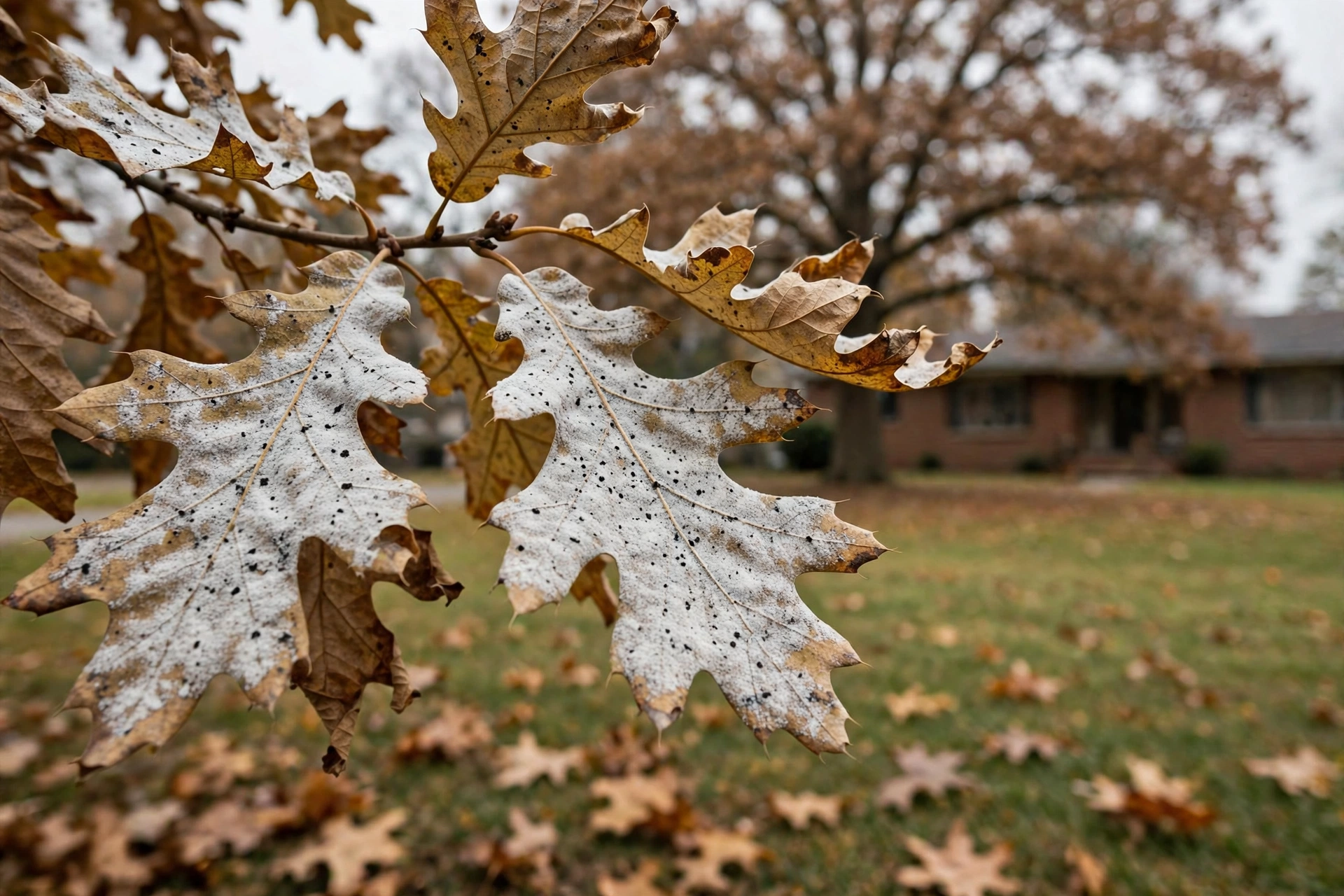
- The look: White or dusty-gray patches that spread until the leaf looks dusted with flour. Late in the season, tiny black dots appear mixed into the white felt.
- The harm: Mostly cosmetic on a mature tree. Repeated heavy infections can weaken young or highly susceptible trees, but it rarely kills an established one.
- The November job: Rake up and bag the infected fallen leaves, and plan dormant-season pruning to open the canopy to air and sun.
- What does not work: Spraying the tree now. Fungicide is not recommended for late-season infections, and no spray cures leaves that are already coated.
- What not to do: Do not compost the infected leaves, and do not burn them. Open burning of yard waste is prohibited inside the City of Peoria.
What Powdery Mildew Is
Powdery mildew is not one fungus. It is a whole family of related fungi — six closely related genera do the work across the Midwest — and each one sticks to a small set of hosts. The mildew on your oak is not the same species as the mildew on your lilac, and neither one will jump to your roses. That is why the disease shows up on one plant and leaves the shrub next to it untouched.
The fungus lives on the surface of the leaf, sending tiny feeding threads into the leaf cells and laying down a mat of threadlike growth and spores. That mat is the white powder you see. It starts as small, round, white patches on a leaf, shoot, bud, or flower. The patches enlarge and run together, and in a bad year cover the whole leaf, turning mealy or felt-like and fading from white to gray or tan. Leaves can stunt, curl, turn yellow, and drop early; flower buds can come out deformed.
Here is the part that surprises most homeowners: powdery mildew does not need rain. Most leaf fungi need a wet leaf to get started. This one is the opposite — its spores germinate when the relative humidity is anywhere from 23 to 99 percent, but not in free moisture, and rain washes them off. What it wants is the pattern Peoria gets for weeks every fall: warm, dry days around 80 degrees followed by cool, damp nights around 60 degrees with humidity near 90 percent. That is why the disease often looks worst in the fall, and why a dry summer with dewy nights can produce a heavier outbreak than a wet one.
The University of Illinois Extension rates powdery mildew on shrubs and trees at a frequency of 4 out of 5 and a severity of 2 out of 5 — common, and mostly harmless.
Which Peoria Trees and Shrubs Get It
In Illinois, the most common hosts are lilac, zinnia, phlox, and rose — the plants every Peoria gardener grows. But the disease is just as much a tree problem, and the trees it hits are the ones that fill Peoria yards.
Oak is the big one. Red oak and white oak both get it, and the University of Illinois Extension has photographed it on red oak leaves, where the white coating often shows most clearly on the underside.
Lilac is the classic. A lilac planted in a shady corner, hemmed in by a fence and the house, will mildew almost every year. The shrub sits in still, damp air, and the fungus has everything it needs. The same lilac planted ten feet out in full sun with air moving around it may never show a spot.
Crabapple gets it too, and on apple and crabapple the coating sometimes takes on a purple cast instead of white, which throws people off. Dogwood is the odd one out: most powdery mildews in the landscape show symptoms from mid-July on, but the dogwood mildew is active all summer, so a flowering dogwood can look dusty as early as June. Maple, honeylocust, and rhododendron round out the usual list.
Two things decide whether a tree in your yard gets it: the species — a resistant variety barely notices the fungus, while a susceptible one mildews every year — and the spot. Crowded plants in the shade with poor air circulation are where the disease is worst, every time. A tree standing alone in sun and wind is a hard target; a tree jammed against a garage, under a bigger tree, or behind a solid fence is an easy one.
The Timeline: When Powdery Mildew Shows Up
| When | What happens |
|---|---|
| Winter | The fungus overwinters as a mat of growth on plant tissue and inside dormant buds, and as tiny black resting structures in the old mildew. It waits. |
| Spring, as buds open | Spores are released in damp spring weather and carried by wind and water to new, soft leaves. The new growth is the most sensitive tissue on the tree. |
| Late spring into summer | First patches appear on the newest leaves — small, round, white, easy to miss unless you look at the undersides. |
| Mid-summer | On dogwood, symptoms are already well along; on most other trees the patches are spreading and joining up. |
| Late summer into fall | Peak season. Warm dry days and cool damp nights repeat for weeks, and the coating can cover whole leaves. Tiny black dots — the overwintering structures, called cleistothecia — appear mixed into the white felt, like poppy seeds. |
| Fall, after leaf drop | Infected leaves fall with the rest. The fungus rides them into winter. This is the moment the next year is decided. |
Those black dots are worth a closer look, because they are the one feature that proves what you are seeing. Late in the season, the fungus makes small, spherical, dark brown-to-black resting structures inside the mildew — the Extension describes them as similar in appearance to tiny poppy seeds — and they are the reason the disease comes back in the same spot year after year. They sit in the fallen leaves and on the buds all winter, and they are the first spores of spring.
That last row of the table is the whole point of this post. The mildew you see in September is decided by the leaves you leave on the ground in November. Take them away and you take away a large part of next spring’s infection.
Will Powdery Mildew Kill My Tree?
No, almost certainly not — and that answer comes straight from the Extension, which calls the damage “more unsightly than harmful on most shrubs and trees.” A mature oak or maple with a white coating in September is not in danger. The tree will drop its leaves and leaf out normally in spring.
There are two situations where the honest answer gets longer.
The first is a young tree. A newly planted oak or crabapple has less stored energy than a mature one, and anything that cuts a season of photosynthesis short drags on establishment. A young tree that mildews heavily in its first two summers is not dying, but it is a tree worth helping: rake its leaves, water it through dry spells, and give it room to breathe.
The second is a highly susceptible variety that gets hit hard year after year. The Extension is clear that management becomes necessary when a plant has suffered repeated infections for several years. The damage adds up slowly — stunted leaves, early leaf drop, thinner growth — and the tree spends each spring rebuilding what the fungus took the previous fall. A lilac that mildews every year and blooms less each spring is telling you the spot is wrong, not that the shrub is doomed.
Mildew on a tree that is also dropping branches, thinning at the top, or showing bark damage is a second problem on top of a first one, and the first one is the one that matters. Our live signs of a dying or diseased tree post lists the symptoms that actually decide whether a tree stays or goes, and mildew alone is not on that list. That is also why removal is almost never the answer to powdery mildew: the disease does not make a tree hazardous, it does not spread to the house, and it does not condemn the tree. If someone tells you a mildewed tree has to come down, get a second opinion first.
Powdery Mildew or Something Else?
A white coating on a leaf is not always powdery mildew, and the fix for one white coating can be useless for another. Here is how the common look-alikes differ.
| Problem | What it looks like | How it differs from powdery mildew |
|---|---|---|
| Powdery mildew | White or dusty-gray powder on the upper leaf surface, sometimes the underside too; tiny black dots late in the season | Does not wipe off — the mat is attached to the leaf |
| Sooty mold | Black, powdery coating, often on the underside and on stems | Wipes off with a finger; grows on the sticky honeydew left by aphids or scale insects |
| Downy mildew | Yellow patches on top, gray-white fuzz on the underside | Needs a wet leaf to infect; the fuzz is underneath, not on top |
| Woolly aphids | White, cottony clumps, usually along veins or at branch joints | The clumps are insects — poke one and it moves, or crushes into a waxy smear |
| Tar spot | Raised black spots, like splattered tar, on maple leaves | Black and raised, not white and powdery; a different fungus on a different host |
| Dust, road salt, or spray residue | A pale film over the whole leaf, often on the road side of the tree | Washes off with water; no patches, no curling, no black dots |
If you are unsure, the finger test settles it. Rub the white area gently. Powdery mildew stays put — it is a mat of fungus grown into the leaf surface. Sooty mold smears off on your finger. Dust and salt residue rinse off with a splash of water. And if the white stuff is in cottony clumps that look like tiny bits of cotton wool, you are looking at woolly aphids, which are insects, not a fungus, and the treatment is entirely different.
What to Do Now in November
This is the part of the post that earns its keep, because the work is now, not in spring. Four steps, in order.
First, rake the infected leaves and get them off the property. Bag them for yard-waste pickup or take them to a municipal drop-off. The fungus overwinters in fallen leaves and on dormant buds, and the Extension’s advice is the same in every one of its powdery mildew notes: remove and destroy dead foliage around the plants in the fall to decrease the level of infection next spring. Every mildewed leaf left on the lawn is next spring’s infection. This is the single most effective thing a homeowner can do, and it costs nothing but an afternoon.
Second, do not compost the infected leaves. A home compost pile does not get hot enough to destroy the fungi, and the resting structures survive the winter in the pile just as happily as they would on the lawn. Bag the material and take it to an appropriate dump site or landfill — the same goes for infected stems and buds you prune off.
Third, do not burn them. Open burning of yard waste is prohibited inside the City of Peoria under the Fire Department’s open-burning policy, and a pile of damp oak leaves makes a smoky fire that will bring a neighbor to your door long before it burns clean. Bag them.
Fourth, plan the pruning. Powdery mildew is a disease of still, damp air, and the long-term fix is airflow. Dense, crowded growth needs to be thinned so air moves through the canopy and sun reaches the inner leaves. That is a dormant-season job — late winter, before the buds break — and the live dormant-season pruning post explains why the tree is best worked on when it is asleep. A lilac hemmed in by a fence and a garage will mildew every year no matter how much you rake, and the honest fix may be to move it, thin the plants around it, or replace it with a resistant variety when the time comes.
Two habits to change for next year. Water at the base of the tree, not over the leaves, and water early in the day so any foliage that does get wet dries fast. And go easy on the fertilizer — heavy feeding pushes out soft, succulent new growth, and that new growth is the most susceptible tissue on the tree.
What About Fungicide Sprays?
Most homeowners should skip them, and the Extension agrees. There are two reasons, and both are about timing.
First, fungicides against powdery mildew are protectants, not cures. They shield new leaves from infection; they do not clean up leaves that are already white. To help, they have to go on at the first sign of the disease in spring, and then be reapplied every seven to fourteen days to protect the new growth as it comes out. On a mature oak, that means covering both sides of every leaf in the canopy, repeatedly, all season.
Second, the window is closed for this year. The Extension is explicit: if infections occur early in the growing season, fungicides can reduce infection, but treatment must start as soon as the first symptoms are seen, and once the disease becomes widespread it cannot be controlled in that year. Chemical control is not recommended for infections that take place late in the growing season. By November, the leaves are falling anyway. A spray now buys nothing.
There is also the cost question. Treating a mature tree for a mostly cosmetic problem, season after season, is hard to justify against a rake and a pruning saw. If a tree is a specimen you care about deeply, talk to the Extension office or a plant clinic before buying anything — they can tell you whether a spray makes sense for that tree, and whether a resistant variety would be the smarter long-term answer. Do not take a spray recommendation from a bottle label alone, and do not let anyone sell you a spray in November.
If you are planning a spring spray for a tree with a history of heavy infection, the decision belongs in spring, at the first sign of mildew — and the live tree disease treatment post explains how that assessment usually goes.
When Mildew Means a Closer Look
Powdery mildew alone is not a reason to remove a tree. Mildew plus other symptoms can be. Call for an assessment if you see any of these alongside the white coating: branches dying back from the tips, a canopy that has thinned over two or three years, bark falling off the trunk in sheets, mushrooms or shelf fungi at the base, or a lean that has grown worse. Any one of those is a structural or health problem, and the mildew is just the thing you noticed first.
The same applies if the tree is over a roof, a driveway, or a play area. A healthy oak with mildew is safe. A declining oak with mildew over your bedroom is a different conversation, and it is one worth having before the next storm season, not during it. And if the same tree mildews heavily every year despite the fall cleanup and the pruning, say so when you call — it may be in the wrong spot, or stressed by something underground that no amount of raking will fix.
Frequently Asked Questions
What is the white powdery stuff on my tree leaves?
Usually powdery mildew, a fungal disease that grows as a white, flour-like coating on the surface of leaves, shoots, and buds. It is one of the most common leaf diseases in Illinois, shows up nearly every year, and is mostly cosmetic on mature trees. It does not wipe off like dust or sooty mold.
Will powdery mildew kill my oak tree?
No. On a mature oak it is a cosmetic problem — it may cause some early leaf drop and a thinner look late in the season, but the tree leafs out normally the next spring. It is a bigger concern for young, newly planted trees and for highly susceptible varieties that get hit hard year after year.
How do I get rid of powdery mildew on trees?
Rake up and bag the infected fallen leaves in the fall, and prune for airflow in the dormant season so sun and air reach the inner canopy. Water at the base in the morning, avoid heavy fertilizer, and plant resistant varieties in sunny, open spots. Fungicide only helps if it starts at the first sign of disease in spring — a spray in fall does nothing.
Should I rake up leaves with powdery mildew, or can I mulch-mow them?
Rake and bag them. Mulch-mowing chops the infected leaves into small pieces and spreads the fungus back under the tree, and a home compost pile does not get hot enough to kill it. Bag the mildewed leaves for yard-waste pickup or a municipal drop-off. Clean leaves can be mulch-mowed; mildewed leaves should leave the property.
Can powdery mildew spread from my lilac to my oak?
No. Each powdery mildew fungus sticks to a small set of hosts — the mildew on a lilac is a different species from the mildew on an oak, and it will not jump between them. What spreads is the weather pattern: a shady, crowded, damp corner of the yard will mildew whatever susceptible plant grows there.
If your oak or lilac is white with mildew and you are unsure whether that is all it is, the November walk is the time to find out — the leaves are down, the structure is visible, and a free assessment costs nothing. Call Peoria Tree Removal Co. at (309) 250-8333 and tell them what you are seeing. If it is only mildew, they will tell you that, and the rake will do the rest.
Peoria Tree Removal Co. — 114 W Forrest Hill Ave, Peoria, IL 61604 — (309) 250-8333 — treeremovalpeoriail.com — Mon–Sat 8am–6pm, 24/7 emergency tree service.
Peoria Tree Removal Co.
114 W Forrest Hill Ave, Peoria, IL 61604
Mon–Sat 8am–6pm · 24/7 emergency tree service