
A pool, addition, or driveway does not mean clearing the yard. Decide from the final footprint, remove only the trees in the way, and protect the rest.
Remove a tree for a pool, addition, or driveway only when its roots, canopy, or debris fall inside the project footprint — many trees can be kept with root barriers and protected root zones. Decide after the footprint is final: remove trees whose roots reach the excavation, grind stumps before the builder starts, and let the ground settle before pouring concrete.
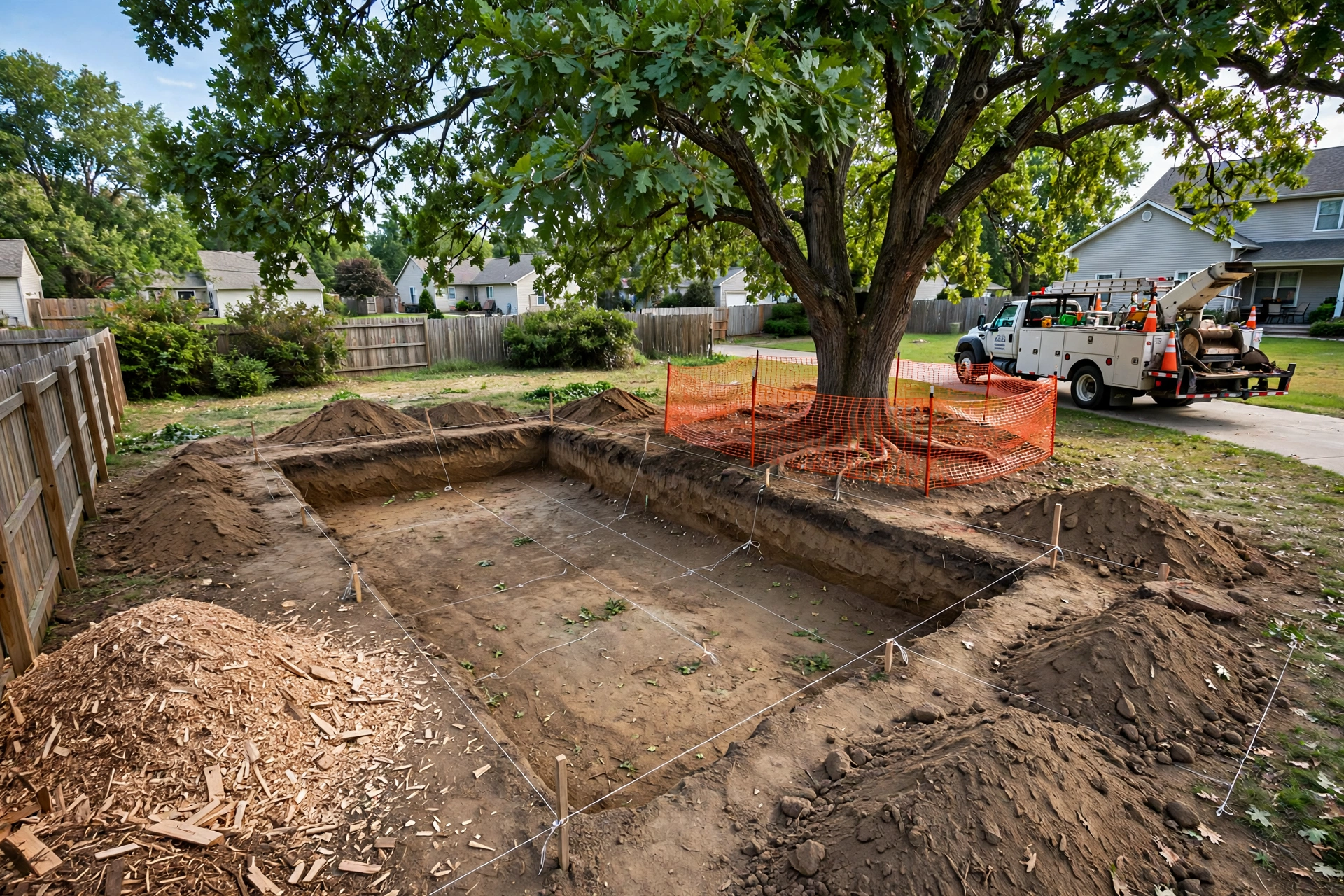
Quick Facts
- Decide after the footprint is final. The excavation and work area are bigger than the finished pool or driveway.
- Root clearance guide: about 15–20 feet from large trees, 25 feet for aggressive species such as silver maple, willow, and sweetgum.
- Vinyl-liner pools are the most vulnerable to root damage; concrete and fiberglass pools resist roots better.
- Grind stumps before the builder starts, and backfill and compact thoroughly.
- Protect the trees you keep: keep equipment and stockpiles outside the dripline — compaction kills trees 2–3 years after the project.
- Check the permit position before cutting.
Removing Trees for a Pool, Addition, or Driveway: Start With the Footprint
The most expensive mistake is cutting first and measuring second. A pool is not just the water — it is the excavation, the deck, the equipment pad, the plumbing trench, and room for the crew and machines. An addition is not just the new rooms — it is the foundation excavation and the concrete truck’s access route.
So the first step is a plan decision. Get the footprint final on paper with the builder, then walk the yard with that plan and mark every tree against it — a tree ten feet from the finished pool edge may stand two feet from the excavation. One walk-through with the plan, the builder, and the tree crew prevents both expensive mistakes: a tree cut that could have been saved, and a tree saved that sits over the excavation.
Roots and Pools: The Clearance Question
Roots are the real issue with pools, more than branches or shade. Tree roots grow toward water, and a pool is a very large, very reliable source of it. A root that finds damp soil around a pool shell will keep growing toward it, and over the years it can press against the shell, lift the deck, or push through a vinyl liner.
As a planning guide, keep large trees about 15–20 feet from the pool shell, and give aggressive species — silver maple, willow, and sweetgum — about 25 feet. These are planning distances, not a guarantee and not a city rule — small trees such as dogwood and redbud can sit much closer.
| Tree | Root behaviour near water | Clearance guide |
|---|---|---|
| Silver maple | Very aggressive — seeks water fast | About 25 feet |
| Willow | Very aggressive — one of the thirstiest trees | About 25 feet |
| Oak | Strong roots, slower toward water | About 15–20 feet |
The type of pool matters too. A vinyl-liner pool is the most vulnerable to root damage; concrete and fiberglass pools resist roots better.
Root barriers are the alternative to removal: a panel of thick HDPE plastic buried vertically between the tree and the pool, deep enough to deflect roots downward. A properly installed barrier, combined with enough distance, keeps most trees and most pools living together — our guide to root pruning and root barriers covers installation and timing, and a barrier goes in before the pool does, while the ground is open.
Don’t forget the plumbing: the pool’s pipes run from the shell to the equipment pad in a shallow trench, and roots love the damp soil around a pipe joint. A tree over the plumbing run is a removal or a reroute decision.
Debris, Shade, and Chemistry: The Daily Reality
Roots are the long-term risk. Debris is the weekly one: a tree over a pool drops leaves, twigs, flowers, seeds, and sap into the water, and every bit of it has to be skimmed, vacuumed, or filtered out.
- Heavy shedders: oaks drop acorns and leaves; pines drop needles all year; sweetgums drop spiky seed balls that clog skimmers; silver maples drop seeds in spring and leaves early in fall.
- Mess that stains: oak tannins and pine sap can stain pool finishes, and leaves left on a vinyl liner can leave brown marks.
Shade is the trade-off that cuts the other way. A tree on the west side shades the water in the late afternoon, keeping it cooler on the hottest Peoria days. Ask two questions about each tree: how much work does it make, and how much comfort does it give? A silver maple ten feet from the pool that drops seeds into the skimmer all spring is a removal; a mature oak twenty feet west that shades the deck every afternoon is a keeper.
Additions and Driveways: The Same Logic, Different Footprint
An addition changes the same calculation in a different shape. The foundation excavation is the critical zone — a footing trench cuts through roots cleanly, and a tree that loses a third of its roots on one side can lean or fail in the next big storm. If the excavation comes within the dripline of a large tree, removing it before construction is usually cheaper than dealing with a dying tree over a new addition two years later.
Driveways have their own version of the problem. A driveway is a slab on a prepared base, and roots under a slab lift it and seek the moisture at its edges. A large tree within ten or fifteen feet will eventually push roots under it, and the result is a cracked, lifted slab that no patching fixes. The choice is to remove the tree, move the driveway, or install a root barrier.
Stumps and Ground: The Handoff Your Builder Actually Needs
Removing the tree is only half the job. What happens to the stump and the ground underneath it is what your builder cares about.
Grind the stump before the builder starts. A stump left under a pool deck, a patio, or a driveway will rot, settle, and leave a hollow — and the concrete above it will crack and sink. Grinding takes the stump well below grade.
Backfill and compact thoroughly. The hole left by a stump and its roots has to be filled and compacted in layers, not just topped up with loose soil. Uncompacted ground settles over months, and anything built on it settles with it.
Wood chips are not a construction base. Chips are fine as mulch in a garden bed, but they are not fill under concrete — they decompose and hold moisture. Haul them away and backfill with proper compactable material.
Protecting the Trees You Decide to Keep
The trees you keep are the ones most at risk during construction, and the damage usually does not show up until two or three years later. The killer is compaction: heavy equipment, trucks, and stockpiles squeeze the air out of the soil inside the root zone, and roots die slowly.
- Fence the root zone at the dripline of every tree you are keeping, and keep everything inside it off limits: no equipment, no trucks, no stockpiles.
- Route equipment outside the dripline. One pass by a loaded truck compacts soil more than a summer of foot traffic. Agree on the access route with the builder before work starts.
- Keep stockpiles out of the root zone. A pile of soil or gravel sitting on roots for a month suffocates them just as surely as a truck does.
- Do not change the grade around a kept tree. Adding fill buries the roots and starves them of air; cutting the grade down severs them.
Our guide to tree preservation during construction covers the protection plan in full.
Timing: Remove Before Construction, Not After
Tree removal belongs before construction, not after, and not during. Removing a tree after the pool is in means maneuvering a crew and a crane around a finished shell, a deck, and a fence, with every branch lowered by hand. The right sequence is: final footprint, tree decisions, removals and stump grinding, backfill and settling, then construction. Late fall, after the leaves are off and before the ground freezes, is the simplest window. Whatever the season, the sequence stays the same: trees first, building second.
Permits and Neighbors: Check Before You Cut
Before any tree comes down for a project, check the permit position. The rules depend on the tree, the location, and the project, and they can change — so this post does not state the permit rules as fact. Our guide on whether you need a permit to remove a tree in Peoria walks through how to check. Do that check early, while the footprint is still being finalized.
Neighbors deserve a mention too. A tree on or near a property line, or whose roots cross into the neighbor’s yard, is a shared question, not a solo one. Talk to the neighbor before the crew arrives.
Building on a fresh lot instead? Our guide to clearing trees for a new build covers that side of the job, and our tree removal service page covers removals, including the free estimate.
Frequently Asked Questions
Do I have to remove all trees near a new pool?
No. Remove only the trees whose roots, canopy, or debris fall inside the project footprint or too close to the shell and plumbing. Many can be kept with root barriers and protected root zones.
How far should a pool be from a tree?
About 15–20 feet from large trees, and 25 feet for aggressive species such as silver maple, willow, and sweetgum. Vinyl-liner pools are the most vulnerable to root damage, and a root barrier can let a tree stay closer.
Should the stump be ground before pool construction?
Yes, always. A stump left under a pool deck, patio, or driveway rots and settles, and the concrete above it cracks and sinks. Grind it before the builder starts, backfill with compactable material, and let the ground settle first.
Can tree roots damage a pool after it is built?
Yes. Roots grow toward water, and over the years they can press against the shell, lift the deck, or push through a vinyl liner. Manage it with clearance and root barriers.
Do I need a permit to remove a tree for a project in Peoria?
It depends on the tree, the location, and the project, and the position can change — so check the city’s current position before cutting, while the footprint is still being finalized.
The Bottom Line
A pool, an addition, or a new driveway is a chance to get the yard right for the next twenty years, and the tree decisions are part of that — not an afterthought for the week before the builder arrives. Finalize the footprint, walk it with the builder and the tree crew, remove the trees that are genuinely in the way, and fence off the root zones of the trees you keep.
If you are planning a pool, an addition, or a driveway in Peoria and you are not sure which trees stay and which go, call Peoria Tree Removal Co. at (309) 250-8333 for a free estimate. Most Peoria homeowners pay roughly a few hundred dollars for a small tree and several thousand for a large one close to a structure. We will walk the footprint with you and give you a straight answer. The University of Illinois Extension is a useful reference for Illinois homeowners.
Peoria Tree Removal Co.
114 W Forrest Hill Ave, Peoria, IL 61604
Mon–Sat 8am–6pm · 24/7 emergency tree service