
Those black spots on your maple leaves are tar spot, a cosmetic fungus — and the fix is a rake, not a sprayer.
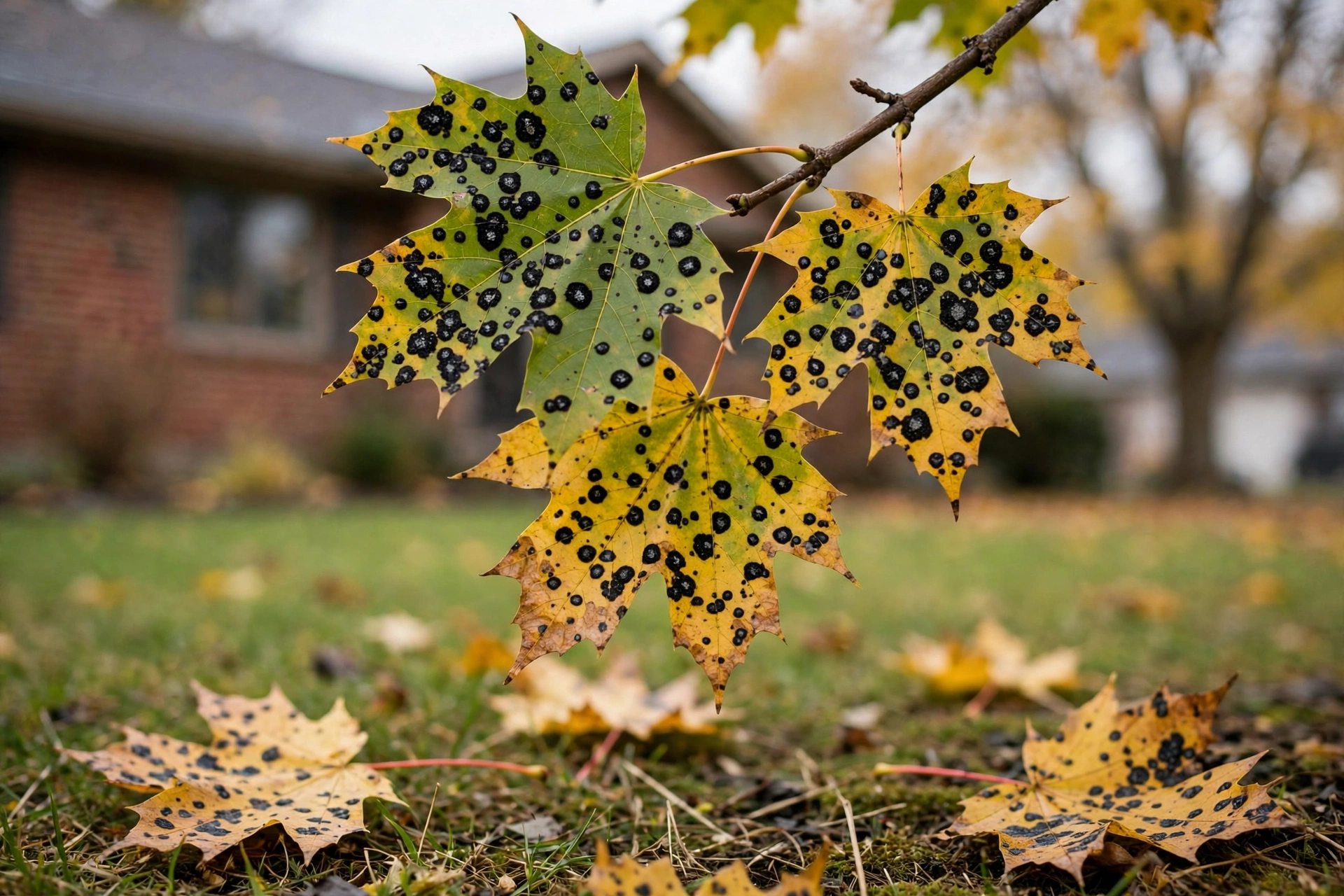
If your maple’s leaves are covered in raised black spots that look like drops of tar, you are almost certainly looking at tar spot, a fungal disease that looks alarming and mostly is not. It rarely harms the tree, and the one job that matters — raking up the fallen leaves — is a November job, which is why this post exists now.
Quick Facts
- The disease: Tar spot, caused by fungi in the genus Rhytisma (R. acerinum, R. punctatum, R. americanum).
- The hosts in Peoria yards: Silver maple, Norway maple, Freeman maple, and other maples — silver maple is the one Peoria homeowners see most.
- The look: Raised black spots on the upper leaf surface, like splattered tar. Some spots are large; some are tiny speckles.
- The harm: Mostly cosmetic. Severe cases can cause some early leaf drop, but the disease rarely affects the tree’s overall health.
- The November job: Rake up and dispose of infected fallen leaves. The fungus spends the winter in them.
- What does not work: Spraying the tree now. Fungicide is rarely warranted, and no spray cures leaves that are already spotted.
- What not to do: Do not burn the leaves. Open burning of yard waste is prohibited inside the City of Peoria.
What Tar Spot Is
Tar spot is a leaf disease, and the name is the description. Fungi in the genus Rhytisma infect maple leaves in spring, and by late summer the infection shows as raised, black, tar-like spots on the upper surface of the leaf. The spots are thick and slightly waxy to the touch, and they look as if someone flicked tar or black paint across the leaf. A heavily spotted leaf can carry a dozen of them; a lightly spotted one may have two or three.
Three species of the fungus do this work, and each makes a slightly different spot. Rhytisma acerinum makes the big ones, half a centimeter to two centimeters across — the classic tar drop. Rhytisma punctatum makes many tiny spots, about a millimeter each, sometimes called speckled tar spot. Rhytisma americanum sits in between. The species matters less than the pattern: black, raised, on the upper surface, on a maple, appearing over the summer. If the spots are flat, powdery, or on the underside of the leaf, it is something else.
Silver maple is the maple Peoria grows most, and it is a willing host — the University of Illinois photographed its tar spot examples on a silver maple at its horticulture farm. Norway maple and Freeman maple get it too, and in recent years the Extension has noted outbreaks becoming more frequent, likely because of moist spring weather with above-average rainfall. Peoria’s springs have supplied plenty of that. Trees in moist, sheltered spots — a low corner of the yard, a maple hemmed in by a fence and a garage — tend to be hit year after year, because the leaves stay damp longer and the fungus likes damp.
The Timeline: What Tar Spot Looks Like Month by Month
Tar spot does not appear overnight. It follows a slow, predictable calendar, and knowing the calendar is how you tell it from the leaf problems that show up suddenly.
| When | What you see |
|---|---|
| Spring, as leaves open | Infection happens. Spores from last year’s fallen leaves land on the new, soft leaves. Nothing is visible yet. |
| Mid-June | First symptoms: small, pale yellow spots on the upper leaf surface. Easy to miss. |
| Mid-July | The yellow spots expand, and a thick, raised, black stroma starts to form inside each one. The tar look begins. |
| Late summer into fall | Full tar spot: raised black spots with a wavy or rippled surface, unmistakable on the leaf. Leaves may yellow around the spots. |
| Fall, if severe | Some early leaf drop. The tree drops spotted leaves ahead of the rest of the canopy. |
| Winter | The fungus overwinters in the fallen leaves on the ground, waiting for spring. |
That last row is the whole point of this post. The disease you see in August is decided by the leaves you leave on the ground in November. The fungus cannot survive winter anywhere else in your yard — it needs those fallen leaves. Take them away and you take away next spring’s spores.
Will Tar Spot Kill My Maple?
No, almost certainly not. This is the question every homeowner asks first, and the Extension’s answer has been consistent across fifteen years of its newsletters: the disease is primarily aesthetic and rarely affects the host tree’s overall health. Even in a severe year, the worst it usually does is cause some premature defoliation — the tree drops spotted leaves early, looks thin for a few weeks, and leafs out normally the next spring.
That does not mean you should ignore it entirely. A tree that is spotted every year and also shows other problems — dead branches in the crown, bark peeling off the trunk, mushrooms at the base, or a canopy that thins year after year — has more going on than tar spot. Tar spot alone does not do those things. If you see them together, the tar spot is the least of it, and the tree deserves a closer look. Our live signs of a dying or diseased tree post lists the symptoms that actually matter, and the tree-health-care guide covers the same ground in more detail.
There is one more honest limit. A young, newly planted maple that is heavily spotted in its first summer is not in danger from the spots, but it is a tree worth watching: young trees have less stored energy, and anything that cuts a season of photosynthesis short drags on establishment. Rake its leaves and water it through dry spells.
Tar Spot or Something Else?
Black spots on a maple leaf are not always tar spot, and the treatment for one leaf problem can be useless — or harmful — for another. Here is how the common look-alikes differ.
| Problem | What it looks like | How it differs from tar spot |
|---|---|---|
| Tar spot | Raised black spots, upper leaf surface, like splattered tar | The spots are thick, raised, and waxy; leaves otherwise normal |
| Anthracnose | Brown or black blotches, often along veins, with leaf curling | Blotches are flat and irregular, often with dead patches and distorted leaves; worse in wet springs |
| Leaf scorch | Brown, dry edges and tips, papery texture | Starts at the leaf edge and moves inward; a water or heat problem, not a fungus |
| Maple bladder gall | Small red or green bumps on the upper leaf surface | Bumps are round and blister-like, caused by mites, and usually red or pink first |
| Sooty mold | Black, powdery coating, often on the underside too | Wipes off with a finger; grows on the honeydew left by aphids or scale |
If you are unsure, the test is simple: run a finger over the spot. A tar spot is raised and stuck fast, like a drop of dried tar. Sooty mold smears. A gall is a bump in the leaf itself. And if the leaf is brown and dead at the edges with no black spots at all, you are looking at scorch, which is a watering problem, not a disease.
The anthracnose post covers that disease in full, and the two are easy to confuse in a wet year, because both follow wet springs. The difference that matters is the fix: anthracnose needs cleanup too, but it also needs you to watch the tree’s overall vigor, while tar spot needs almost nothing beyond the rake.
What to Do Now in November
This is the part of the post that earns its keep, because the work is now, not in spring. Four steps, in order.
First, rake the infected leaves and get them off the property. Bag them for yard-waste pickup or take them to a municipal drop-off. The fungus overwinters in fallen leaves, and every spotted leaf left on the lawn is next spring’s infection. This is the single most effective thing a homeowner can do, and the Extension has said so in every one of its tar spot notes: rake and destroy the leaves in the fall.
Second, do not mulch-mow the infected leaves back into the lawn. Mulch-mowing is fine for clean leaves, but chopping spotted leaves into small pieces and spreading them under the tree just puts the fungus back where it started. Bag the spotted leaves; mulch-mow the clean ones. Our fallen-leaves guide makes the same distinction, and it is worth following here.
Third, do not burn them. Open burning of yard waste is prohibited inside the City of Peoria under the Fire Department’s open-burning policy, and a pile of damp maple leaves makes a smoky fire that will bring a neighbor to your door long before it burns clean. Bag them.
Fourth, look at the tree while the leaves are down. Tar spot is a leaf problem, but November is when the rest of the tree is visible: dead branches, bark damage, a leaning trunk, a root flare buried under mulch. A healthy maple with spotted leaves needs nothing more than the rake. A maple with spotted leaves and a thinning crown or dead wood needs an assessment, and the live tree disease treatment post explains how that assessment usually goes.
One thing not to do: do not strip the leaves off the tree to “stop the spread.” The tree needs its leaves until they fall on their own, and pulling them off wounds the twigs and stresses the tree for no benefit. The spores are already in the leaves; they cannot infect anything until spring. Wait for the drop, then rake.
What About Fungicide Sprays?
Most homeowners should skip them, and the Extension agrees: fungicides are rarely warranted for tar spot. The reason is timing. The fungicides that work against tar spot are protectants — they shield new leaves from infection, they do not cure leaves that are already spotted. To help, they have to go on when the leaf buds are opening in spring, and then twice more at ten-day intervals, covering both sides of every leaf in the canopy. On a mature silver maple, that is a tall order for a homeowner with a pump sprayer, and the research suggests the benefit is marginal even when it is done well.
There is also the cost question. Treating a mature tree for a cosmetic problem is, in the Extension’s words from its own case study, rarely environmentally sound, effective, or economical. The spray bill buys you cleaner leaves on a tree that was never in danger. The rake costs nothing and does more.
If a tree is a specimen you care about deeply — a big Freeman maple that anchors the front yard — talk to the Extension office or a plant clinic before buying anything. They can tell you whether a spray makes sense for that tree in that spot, and which product the label actually covers. Do not take a spray recommendation from a door-to-door salesman or a bottle label alone.
When Tar Spot Means a Closer Look
Tar spot alone is not a reason to remove a tree. Tar spot plus other symptoms can be. Call for an assessment if you see any of these alongside the spots: branches dying back from the tips, a canopy that has thinned over two or three years, bark falling off the trunk in sheets, mushrooms or shelf fungi at the base, or a lean that has grown worse. Any one of those is a structural or health problem, and the spots are just the thing you noticed first.
The same applies if the tree is over a roof, a driveway, or a play area. A healthy maple with tar spot is safe. A declining maple with tar spot over your bedroom is a different conversation, and it is one worth having before the next storm season, not during it. The silver-maple guide covers why that species earns extra attention in Peoria — weak branch unions, fast growth, and a habit of dropping limbs — and it is a useful companion to this one.
Frequently Asked Questions
What are the black spots on my maple leaves?
Usually tar spot, a fungal disease caused by fungi in the genus Rhytisma. The spots are raised, black, and tar-like on the upper surface of the leaf. They start as pale yellow spots in mid-June and turn black by late summer. The disease is cosmetic and rarely harms the tree.
Will tar spot kill my maple tree?
No. Tar spot may cause some early leaf drop in a severe year, but it rarely affects the tree’s overall health or growth. A tree that is dying has other symptoms — dead branches, bark loss, mushrooms at the base — and those are the ones to act on.
How do I get rid of tar spot on maple trees?
Rake up and dispose of the infected fallen leaves in the fall. The fungus overwinters in them, so removing them cuts next spring’s infection. Do not burn the leaves — open burning of yard waste is prohibited in Peoria — and do not mulch-mow spotted leaves back under the tree. Fungicide is rarely warranted.
Should I rake up maple leaves with tar spot, or can I mulch-mow them?
Rake and bag them. Mulch-mowing chops the infected leaves into small pieces and spreads them under the tree, which puts the fungus right back where it started. Clean leaves can be mulch-mowed; spotted leaves should leave the property.
My maple gets tar spot every year. Is something wrong with my yard?
Probably not — the tree is likely in a moist, sheltered spot where leaves stay damp, which is exactly what the fungus needs. Trees damaged year after year tend to sit in low, sheltered corners. Raking every fall is the fix; if the same tree is spotted heavily for years and also thinning, have it assessed.
If your maple is spotted and you are unsure whether that is all it is, the November walk is the time to find out — the leaves are down, the structure is visible, and a free assessment costs nothing. Call Peoria Tree Removal Co. at (309) 250-8333 and tell them what you are seeing. If it is only tar spot, they will tell you that, and the rake will do the rest.
Peoria Tree Removal Co. — 114 W Forrest Hill Ave, Peoria, IL 61604 — (309) 250-8333 — treeremovalpeoriail.com — Mon–Sat 8am–6pm, 24/7 emergency tree service.
Peoria Tree Removal Co.
114 W Forrest Hill Ave, Peoria, IL 61604
Mon–Sat 8am–6pm · 24/7 emergency tree service